Introduction
Welcome to Old Lucknow, the beating heart of Awadhi heritage, where history breathes through majestic arches and the air smells faintly of slow-cooked kebabs and fresh jasmine. If you are standing in front of the colossal Bara Imambara, you are at the absolute epicenter of Lucknow’s cultural universe.
But a trip to Lucknow is about much more than just ticking off one grand monument. The historic lanes stretching outwards from this iconic structure are packed with centuries-old gateways, hidden culinary alleys, sprawling royal ruins, and bustling bazaars.
Whether you are a solo backpacker looking for a cultural deep-dive, a family traveling with curious kids, a couple searching for old-world romance, or a weekend traveler short on time, this complete Lucknow travel guide will help you map out the absolute best things to do near Bara Imambara.
Why Lucknow is a Must-Visit City
For many travelers, India’s urban getaways are synonymous with either fast-paced modern megacities or coastal beach retreats. However, Lucknow offers something entirely distinct—a beautifully preserved soul rooted in unparalleled refinement, artistic heritage, and exquisite architecture.
Known affectionately as the “City of Nawabs,” Lucknow is a playground for heritage lovers, architecture enthusiasts, and hardcore foodies. It is a city where conversations are treated like an art form, where spectacular monuments hold secrets that baffle modern engineers, and where the street food rivals fine dining. From the intricate artistry of Chikankari embroidery to the legendary melt-in-your-mouth Galouti kebabs, Lucknow delivers a rich, sensory travel experience that is practical to navigate and impossible to forget.
Best Places or Experiences Near Bara Imambara
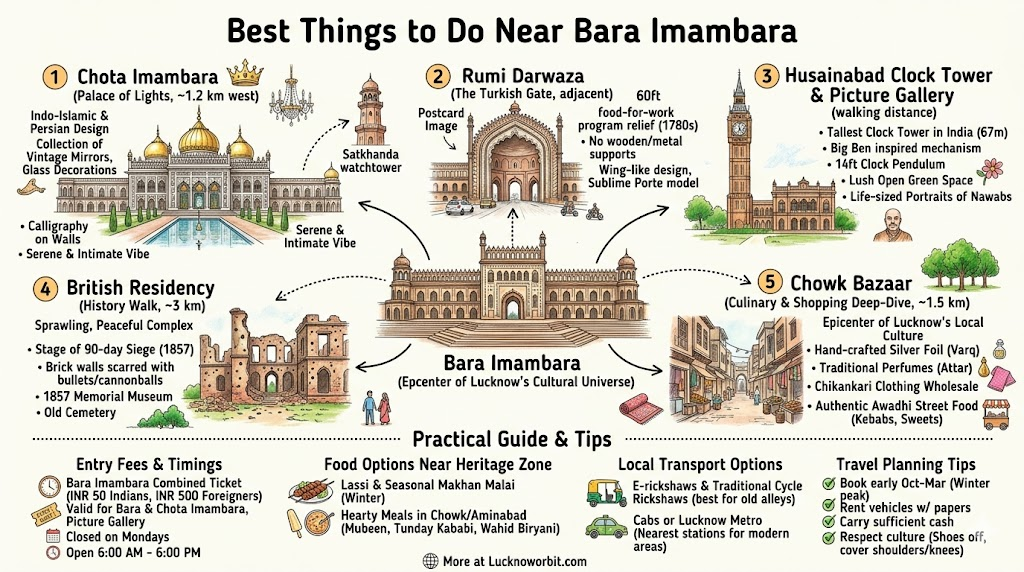
1. The Architectural Marvel: Chota Imambara
Built in 1832 by Muhammad Ali Shah (the third Nawab of Awadh), the Chota Imambara, or the “Imambara of Hussainabad,” stands just a short distance west of its bigger sibling. Famously dubbed the “Palace of Lights” by European travelers, this stunning monument is renowned for its beautiful Indo-Islamic and Persian design, gold-plated domes, and magnificent Belgian glass chandeliers that are lit up brilliantly during festive occasions.
- Location: Hussainabad, Old Lucknow (approx. 1.2 km west of Bara Imambara).
- Why it is worth visiting: The interiors house an astonishing collection of vintage mirrors, glass decorations, and historic chandeliers. It also features beautiful calligraphy on its walls and a more intimate, serene vibe than the busier Bara Imambara.
- Best things to do: Admire the grand reflection pool in front of the main structure, explore the royal crowns and historic artifacts inside the hall, and check out the neighboring Satkhanda—an iconic, incomplete red-brick watchtower.
- Best time to visit: Late afternoon (3:30 PM to 5:00 PM) when the lowering sun illuminates the white facade beautifully.
- Ideal for whom: Architecture enthusiasts, couples, families, and photographers.
- Travel tip: You do not need to buy a separate entry ticket if you have already bought the combined ticket at the Bara Imambara counter. Keep that ticket safe!
2. Stand Beneath the Iconic Rumi Darwaza
The signature postcard image of Lucknow, the Rumi Darwaza is a massive, 60-foot-tall gateway constructed in the 1780s by Nawab Asaf-ud-Daula. Built as part of a “food-for-work” relief program during a devastating famine, this imposing archway features no external wooden or metal supports. Its distinct, wing-like design is modeled after the historical Sublime Porte (Bab-i-Humayun) in Istanbul, earning it the nickname “The Turkish Gate.”
- Location: Right next to the main Bara Imambara complex.
- Why it is worth visiting: It is one of the grandest examples of Awadhi architectural style in existence. Seeing vehicles pass right beneath its massive arch feels like stepping straight back into the 18th century.
- Best things to do: Take iconic photographs from the designated viewing pathways, observe the intricate stone carvings along its apex, and view it fully illuminated under spotlights at night.
- Best time to visit: Early morning for crowd-free photography, or late evening to see it lit up.
- Ideal for whom: Solo travelers, backpackers, photographers, and quick weekend travelers.
- Travel tip: Since it stands directly on a busy public road, there is absolutely no entry fee or timing restriction to view it from the outside. However, be extremely mindful of local traffic while framing your photos.
3. Climb the Husainabad Clock Tower & Picture Gallery
Standing proud at 67 meters (221 feet), the Husainabad Clock Tower holds the distinction of being the tallest clock tower in India. Built in 1881 to mark the arrival of Sir George Couper, its massive four-faced clock mechanism was inspired directly by London’s Big Ben. Right next to it sits the Husainabad Picture Gallery, a grand royal summer house overlooking a beautiful stepwell-style tank.
- Location: Hussainabad area, walking distance from Rumi Darwaza.
- Why it is worth visiting: The park surrounding the clock tower offers a rare patch of open green space in Old Lucknow. The adjacent Picture Gallery exhibits massive, fascinating life-sized portraits of the Nawabs of Awadh painted by European artists.
- Best things to do: Stroll through the lawns, marvel at the 14-foot-long flower-shaped clock pendulum, and view the trick portraits in the picture gallery that seem to change perspective as you walk past them.
- Best time to visit: 4:00 PM to 6:00 PM for a relaxed evening breeze.
- Ideal for whom: Families with kids, backpackers, and history buffs.
- Travel tip: The open lawns around the clock tower are completely free to enter, making it a great budget-friendly spot to relax after a long day of walking.
4. Walk Through History at the British Residency
The British Residency is a sprawling, peaceful complex of ruined buildings that served as the stage for the dramatic 90-day Siege of Lucknow during the First War of Independence in 1857. Left exactly as it was after the uprising, the brick walls are still scarred with countless bullet holes and cannonball hits, heavily preserved under the watchful eye of the Archaeological Survey of India (ASI).
- Location: Mahatma Gandhi Marg, Deep Manak Nagar (approx. 3 km from Bara Imambara).
- Why it is worth visiting: It provides a stark, evocative contrast to the Islamic style of the nearby Imambaras. The lush, quiet lawns offer a profound sense of peace right in the middle of a bustling city.
- Best things to do: Tour the 1857 Memorial Museum housed inside the main building ruins, read the historical plaques explaining the battles, and explore the old cemetery grounds.
- Best time to visit: October to March (cooler months), ideally in the morning hours before it gets too warm.
- Ideal for whom: Solo travelers, heritage lovers, and couples seeking a quiet walking trail.
- Travel tip: Give yourself at least 2 hours here. The property is quite large and requires significant walking over grassy lawns and pathways.
5. Culinary & Shopping Deep-Dive in the Chowk Bazaar
If you want to experience the true living heritage of Lucknow, head directly into the labyrinth of lanes known as the Chowk. This is one of the oldest marketplaces in northern India, famous across the globe for two legendary things: authentic Awadhi street food and traditional hand-woven Chikankari clothing.
- Location: Chowk area, Old Lucknow (approx. 1.5 km from Bara Imambara).
- Why it is worth visiting: This is the absolute epicenter of Lucknow’s local culture. It’s home to generations-old shops where masters still hand-craft silver foil (varq), mix traditional perfumes (attar), and embroidery clothes.
- Best things to do: Go on a self-guided food walk to try melt-in-your-mouth Mubeen’s Pasanday, Raheem’s Kulcha Nihari, or iconic Malai Gilori sweets at Ram Asrey. Shop for beautiful, authentic hand-embroidered kurtas right from wholesale vendors.
- Best time to visit: 12:00 PM to 8:00 PM (Note: Many shops stay closed or open late on Thursdays).
- Ideal for whom: Foodies, shoppers, backpackers, and culture seekers.
- Travel tip: The lanes of Chowk are incredibly narrow and packed. Leave your autos or e-rickshaws at the main road entry and explore exclusively on foot to avoid getting stuck in tight crowds.
Practical Guide for Exploring Near Bara Imambara
To make your exploration completely seamless, here is a practical breakdown of what to expect on the ground:
Best Places to Visit & Things to Do
Your ideal route should begin directly at the Bara Imambara to tackle the grand labyrinth (Bhul Bhulaiya). From there, walk or take a quick cycle rickshaw through the Rumi Darwaza, stop by the Husainabad Clock Tower, and end your heritage loop at the stunning Chota Imambara. Cap off your afternoon with an authentic food tour or shopping spree in the nearby Chowk Market.
Entry Fees & Operational Details
- Bara Imambara Combined Ticket: Around ₹50 for Indian adults, ₹25 for children, and ₹500 for foreign tourists. This single combined ticket conveniently grants you entry to the Bara Imambara, Chota Imambara, and the Husainabad Picture Gallery.
- Timings: Most historical monuments near Bara Imambara open early around 6:00 AM and close by 5:00 PM or 6:00 PM. Note that while the public structures remain visible, inner complexes are closed to the public on Mondays.
Food Options Near the Heritage Zone
Old Lucknow is a street-food paradise. Right outside the main monuments, you will find street vendors selling refreshing Lassi and seasonal Makhan Malai (a fluffy, saffron-flavored milk dessert available in winters). For a hearty meal, head into Chowk or Aminabad to sample world-famous Tunday Kababi (legendary soft buffalo/mutton kebabs) or Wahid Biryani.
Local Transport Options
The areas surrounding Bara Imambara are old and compact. The most efficient way to hop between nearby sights is by hiring local E-rickshaws or traditional cycle rickshaws. They are cheap, eco-friendly, and effortlessly navigate the tightest alleys. If you are traveling from modern areas like Gomti Nagar or Hazratganj, taking a cab or utilizing the clean Lucknow Metro to the nearest station (like Lucknow University or KD Singh Babu Stadium) is highly recommended.
Budget Planning & Safety Tips
Old Lucknow is incredibly kind to budget travelers. Transport, entry tickets, and world-class street meals can easily be covered for under ₹500 to ₹800 a day per person.
From a safety perspective, the area is highly welcoming and tourist-friendly. However, because the markets get intensely crowded, keep your personal belongings, wallets, and phones secure. If you are traveling as a couple or solo traveler, dressing modestly is recommended as these historical monuments are active religious and cultural spaces.
Travel Planning Tips for Lucknow
To ensure your Lucknow trip planning goes off without a hitch, keep these practical, tried-and-tested tips in mind:
- Book your stays early during peak season: The best time to visit Lucknow is during the cooler winter months (October to March). Hotels in central hubs like Hazratganj or Gomti Nagar fill up fast, so secure your rooms well in advance.
- Rent vehicles only with proper documentation: If you choose to rent a scooter or car to explore the city at your own pace, ensure you carry a valid driver’s license and verify the vehicle’s registration and insurance documents carefully before driving off.
- Carry sufficient cash for local markets: While digital UPI payments are widely accepted across India, smaller street vendors, rickshaw wallahs, and old wholesale shops in Chowk or Aminabad still prefer hard cash. Keep plenty of small-denomination notes on hand.
- Respect local culture and environment: Remember that the Imambaras are deeply sacred religious monuments. Always remove your shoes before entering the main halls, avoid loud shouting inside the acoustic corridors, and dress respectfully (cover your shoulders and knees).
- Keep the heritage premises clean: Avoid littering disposable water bottles or snack wrappers around these centuries-old heritage structures. Always look for designated trash bins to help preserve the city’s incredible history.
Common Mistakes to Avoid
- Poor itinerary planning: Trying to squeeze the historical Old Lucknow sites and the modern South Lucknow attractions into a single morning will leave you exhausted and stuck in afternoon traffic jams.
- Overpaying for local transport or guides: Always negotiate and clarify rickshaw fares before climbing in. At the Bara Imambara, hire only official, government-authorized guides holding valid ID cards to avoid inflated prices.
- Skipping local food options: Relying solely on your hotel’s continental room service menu is a travel crime in Lucknow! Even if you prefer milder flavors, don’t miss out on trying the local sweets, baked Kulchas, and street chaat.
- Ignoring the transition from North to South: Travelers often make the mistake of staying completely isolated in one zone. Balance your time beautifully between the historic architecture of the North Lucknow heritage zone and the modern parks, wide boulevards, and cafes of South and East Lucknow (Gomti Nagar area).
Suggested Lucknow Itinerary Angle
To help you figure out how to structure your days, here is how you can easily fit these experiences into your personal Lucknow itinerary:
1-Day Express Plan
Focus exclusively on the crown jewels of the historical zone. Spend your morning exploring the Bara Imambara and its Bhul Bhulaiya maze. Walk through the Rumi Darwaza for photos, visit the Chota Imambara before lunch, and spend your entire evening shopping and eating your way through Chowk Bazaar.
2-Day Comprehensive Plan
- Day 1: Follow the 1-Day Express Plan above to cover the main old-world heritage circuit.
- Day 2: Move towards central and modern Lucknow. Spend your morning exploring the bullet-scarred ruins of the British Residency. In the afternoon, enjoy high-street shopping and “Ganjing” at Hazratganj Market. End your evening watching the sunset at the magnificent, red-sandstone Ambedkar Memorial Park in Gomti Nagar.
Weekend Travel Plan
If you have a full weekend, dedicate Saturday entirely to the classic Nawabi history near Bara Imambara and Aminabad markets. On Sunday, shift gears completely to experience the city’s green spaces and modern culture—visit the sprawling Janeshwar Mishra Park, check out the Gomti Riverfront, and enjoy dinner at one of the stylish cafes hidden in the bustling lanes of Gomti Nagar.
FAQs
Q1: What is the best time to visit Bara Imambara and its nearby attractions?
A: The ideal months are from October to March when the weather is pleasant and cool enough to enjoy walking outdoors.
Q2: Is the entry ticket for Bara Imambara valid for other monuments?
A: Yes! The standard ticket bought at the main counter is a combined ticket that includes entry to Bara Imambara, Chota Imambara, and the Husainabad Picture Gallery.
Q3: Can we explore the Bhul Bhulaiya maze without a guide?
A: While you can physically enter, it is highly recommended to hire an authorized local guide. The maze has over a thousand pathways but only one correct way out, and the guides share fascinating historical stories and acoustic demonstrations you would otherwise miss.
Q4: Are the attractions near Bara Imambara open every day?
A: The main inner complexes of the Imambaras are closed to the public on Mondays. Public structures like the Rumi Darwaza and Clock Tower can still be viewed from the road.
Q5: Is Old Lucknow family-friendly?
A: Absolutely. Children thoroughly enjoy the mystery of the Bhul Bhulaiya maze and the large green lawns surrounding the Husainabad Clock Tower.
Q6: What should I wear when visiting these historical places?
A: Because these are active religious and cultural spaces, visitors should dress modestly. Keep your shoulders and knees covered, and be prepared to remove your footwear before stepping into the inner shrines.
Q7: Can I find vegetarian food options near Bara Imambara?
A: Yes! While Old Lucknow is famous for non-vegetarian Mughlai food, iconic spots like Ram Asrey offer incredible vegetarian sweets, and the local street-style Basket Chaat at Hazratganj or Aminabad is legendary.
Q8: How far is Bara Imambara from the Lucknow railway station (Charbagh)?
A: It is roughly 5 to 6 km away. You can easily take an auto-rickshaw, a direct cab, or use the Lucknow Metro to a nearby station to bridge the distance.
Q9: Can we take large backpacks inside the Bara Imambara?
A: No, large bags and heavy luggage are restricted inside the monument complex for security and preservation reasons. Carry only a small personal handbag for valuables.
Q10: Is photography allowed inside these heritage structures?
A: Photography is permitted in most open courtyard areas, but pay close attention to local signage, as cameras are strictly prohibited inside specific inner prayer halls and tombs.
Conclusion
Stepping into the historic lanes near Bara Imambara is like opening a beautifully illustrated chapter of India’s royal past. By looking beyond the main gates and exploring the neighboring towers, hidden galleries, quiet colonial ruins, and aromatic food stalls, you get to experience the authentic soul of the city.
As you plan your next perfect trip, let Lucknoworbit.com be your trusted local travel guide. We are here to help you unlock the hidden places in Lucknow, navigate local transport like a pro, and make smarter travel decisions that turn a simple holiday into an unforgettable journey. Pack your bags, keep your curiosity handy, and get ready to discover the magic of Awadh!
