Introduction
While mainstream travelers continuously squeeze into the overcrowded, neon-lit commercial zones of generic resort cities or over-hyped beaches, true culinary explorers seek something more grounded. They look for destinations where history isn’t just trapped in a museum display case, but sizzling on a cast-iron griddle right before your eyes.
Lucknow, the historic capital of Uttar Pradesh, offers exactly this rare brand of deep, visceral cultural connection. Walking into the atmospheric narrow lanes of the old city means escaping the superficial tourist traps of modern times. Here, the heavy air carries the rich aroma of slow-cooked fat, burning charcoal, and a secret blend of dozens of spices refined over centuries.
Authentic Galouti Kebabs.
Why Lucknow is a must visit city
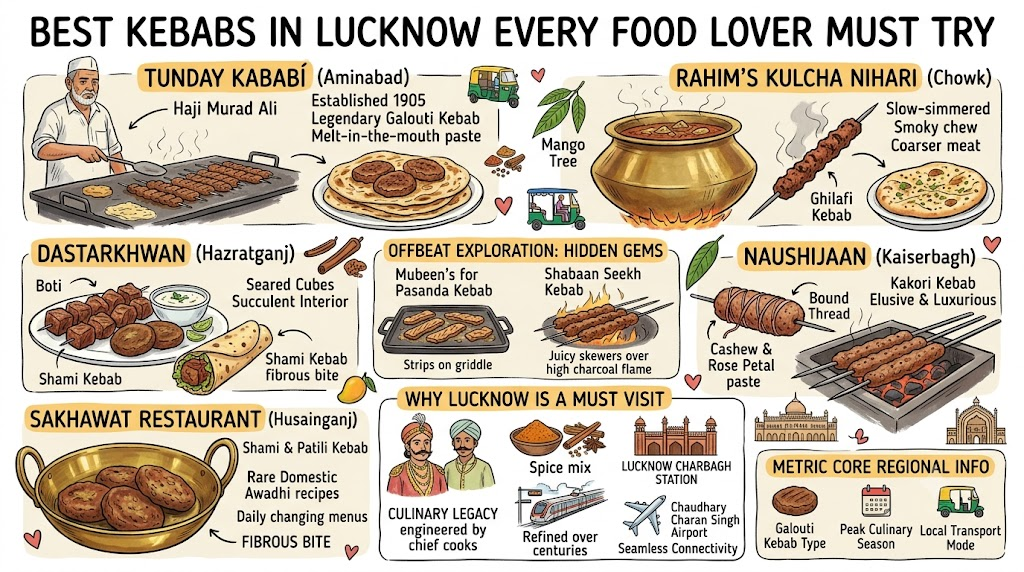
Lucknow carries massive historical and cultural weight as the heart of the Awadhi empire. Its culinary legacy was carefully engineered by royal khansamas (chief cooks) who turned simple open-flame cooking into a complex art form. This geographical culinary hub acts as a living chapter in global food history, balancing rich Mughal influences with delicate Persian techniques.
For modern travelers, accessing this culinary capital is entirely seamless. The city is exceptionally well-connected by the modern Lucknow-Agra Expressway and Purvanchal Expressway, making it a perfect road trip destination. It boasts two major railway hubs (Lucknow Charbagh and Junction) and the Chaudhary Charan Singh International Airport, rendering it reachable for backpackers, luxury travelers, and culinary researchers alike.
The primary travel circuit smoothly bridges the atmospheric, labyrinthine lanes of Old Lucknow (Chowk and Aminabad) with the structured, vibrant layout of British-era Hazratganj and the sleek, modern cafe-lined avenues of Gomti Nagar.
| Metric | Core Regional Information |
|---|---|
| Primary Airport | Chaudhary Charan Singh International Airport (LKO) |
| Major Rail Terminus | Lucknow Charbagh Station (LKO) |
| Signature Kebab Type | Galouti Kebab (melt-in-the-mouth minced patty) |
| Peak Culinary Season | October to March (crisp winters elevate hot street food) |
| Local Transport Mode | Auto-rickshaws, E-rickshaws, and Metro lines |
Best Places or Experiences
1. Tunday Kababi (Aminabad)
Tunday Kababi is not merely an eatery; it is a legendary monument to global gastronomy that has preserved its exact flavor profile for well over a century. Established in 1905, this historic food joint owes its unique name to its founder, Haji Murad Ali, who famously prepared these delicacies with just one arm after a fall.
The Times of India
The signature dish here is the legendary Galouti Kebab, a delicate creation specifically engineered for an aging, toothless Nawab who still demanded the rich taste of meat. The finely ground meat undergoes an intensive preparation process where it is tenderized using raw papaya and smoked deeply with cloves and pure ghee over live coals.
- Location: Naaz Cinema Road, Aminabad, Old Lucknow (approx. 4 kilometers from Charbagh Railway Station).
- Why it is worth visiting: It is the undisputed birthplace of the single most famous melt-in-the-mouth kebab recipe on Earth.
- Best things to do: Pair your Galouti Kebabs with flaky, sweet Mughlai Paranthas, watch the master chefs flip rows of kebabs on giant shallow griddles, and pick up a box of fresh Mughlai sweets next door.
- Best time to visit: Late afternoon between 3:30 PM and 6:00 PM to beat the massive dinner rush.
- Ideal for whom: Culinary historians, hardcore meat-lovers, and experimental backpackers.
- Travel tip: The Aminabad branch serves both mutton and buffalo varieties, but the original, raw street-style Chowk branch serves exclusively buffalo meat on charcoal grills.
2. Rahim’s Kulcha Nihari (Chowk)
Tucked away deep within the historic Akbari Gate inside Old Lucknow, Rahim’s has stood as a bastion of authentic morning and evening comfort food for generations. While highly celebrated for its slow-simmered stews, Rahim’s also serves up some of the most uniquely textured Ghilafi and Seekh Kebabs in the region.
The culinary magic here lies in the mastery of textures and heat control. Their kebabs are carefully crafted with coarser meat cuts compared to the paste-like Galouti, giving the diner a smoky chew that bursts with juices infused from regional spices.
- Location: Akbari Gate, Chowk, Old Lucknow (approx. 6 kilometers from the city center).
- Why it is worth visiting: It represents the peak of traditional, non-commercialized communal Awadhi dining culture.
- Best things to do: Order the iconic combination of Ghilafi Kebabs and freshly baked, layered Kulchas, look for the massive brass handis bubbling at the entrance, and explore the nearby embroidery markets.
- Best time to visit: Early morning at 8:00 AM for an authentic local breakfast or after 7:00 PM for the dinner atmosphere.
- Ideal for whom: Architectural explorers, bold foodies, and early-morning urban walkers.
- Travel tip: The seating area inside is highly functional, rustic, and tight; opt for a quick takeaway if you are uncomfortable with intense, bustling crowds.
3. Dastarkhwan (Hazratganj)
Operating near the historic Gymkhana Club and Tulsi Theatre, Dastarkhwan provides a slightly more structured but deeply authentic bridge between old-world recipes and accessible dining comfort. It is highly regarded by local office-goers, families, and visiting professionals who want authentic tastes without navigating the intense alleyways of the far-west old quarters.
Dastarkhwan is universally celebrated for its masterfully balanced Boti Kebabs and rich Shami Kebabs. Unlike the minced varieties, the Boti Kebab consists of small, boneless cubes of tender meat that have been marinated overnight in yoghurt and raw spices before being quick-seared to maintain a succulent interior.
- Location: Near Tulsi Theatre, Hazratganj, Central Lucknow. Reddit
- Why it is worth visiting: Excellent hygiene combined with absolute adherence to traditional Awadhi gravy and marinade secrets.
- Best things to do: Try their fiery Boti Kebab rolls, sample the rich chicken Mughlai curry, and take a long post-dinner walk down the wide pavements of Hazratganj.
- Best time to visit: 1:00 PM to 3:30 PM for a relaxed lunch or late night after 9:30 PM.
- Ideal for whom: Multi-generational families, corporate travelers, and couples looking for a seated meal.
- Travel tip: Parking in this central zone can be incredibly chaotic; it is highly recommended to take a metro to the Hazratganj station and walk down.
4. Naushijaan (Kaiserbagh)
Naushijaan is a prized destination among culinary purists because it serves as the ultimate local temple for the highly elusive Kakori Kebab. Originating from a nearby historical township, the Kakori Kebab is considered the richer, more exclusive cousin of the Galouti.
At Naushijaan, the meat is ground an astonishing eight to ten times to achieve an ultra-smooth consistency. It is then enriched with luxurious binding elements like cashew paste, roasted gram flour, dried rose petals, and khus khus (poppy seeds), making it so delicate that it must be bound to the skewer with fine thread before hitting the open coal tandoor.
- Location: DM Compound Colony, Kaiserbagh Officer’s Colony, Lucknow. so.city
- Why it is worth visiting: It offers the most technically perfect, fragrant, and luxurious Kakori Kebab in the entire urban area.
- Best things to do: Order their unique Majlisi Kebab (a loose, paste-like spicy meat delicacy), watch the precise skewer work of the grill masters, and pair your meal with thin roomali rotis. ChompSlurrpBurp
- Best time to visit: 7:30 PM onwards when the outdoor live grills are completely heated up.
- Ideal for whom: Gourmands looking for highly refined spice profiles and luxury food travelers.
- Travel tip: Always ask the server for fresh lime and raw onions to cut through the intense, buttery richness of the Kakori paste.
5. Sakhawat Restaurant (Husainganj)
Hidden quietly away from the glaring neon billboards of the commercial markets, Sakhawat has operated out of a modest structure for decades, relying purely on word-of-mouth recommendations from ancestral Lucknow families. It is an institution dedicated to the preservation of rare, domestic Awadhi recipes that are rarely commercialized.
Sakhawat is the ultimate destination to experience a perfect Shami Kebab. Unlike the melt-in-your-mouth Galouti, a true Shami features a distinct fibrous bite, created by boiling whole meat pieces with chana dal (split chickpeas) and whole spices before grinding them smoothly into flat patties and shallow frying them.
- Location: Behind the Press Club, near Gymkhana Club, Husainganj, Lucknow. Reddit
- Why it is worth visiting: It is one of the few surviving establishments that still serves daily changing menus based on seasonal ingredients and ancestral household recipes.
- Best things to do: Try their unique Patili Kebab (cooked slowly inside a deep brass pan), converse with the elderly owners about old Lucknow, and taste their authentic mutton korma.
- Best time to visit: 7:00 PM to 9:00 PM (arrive early as their limited daily batches sell out rapidly).
- Ideal for whom: Off-the-beaten-path explorers, backpackers, and solo travelers tracking heritage foods.
- Travel tip: The ambiance is absolutely basic and no-frills, so focus your attention entirely on the unparalleled culinary craftsmanship.
Offbeat Exploration: Hidden Gems Tourists Miss
Mubeen’s (Akbari Gate)
While the masses flock exclusively to Tunday, local residents slip down the lane to Mubeen’s. This historic spot specializes in a stunningly robust Pasanda Kebab—thin, flattened strips of choice meat marinated in an array of pungent spices and slow-cooked to a dark, caramel perfection. It is coarser, spicier, and carries a rustic punch that contrasts beautifully with the velvet texture of other royal kebabs.
Shabaan Seekh Kebab (Akbari Gate)
Operating from a tiny, intensely smoky storefront that can easily be missed, Shabaan is a local legend that deals exclusively in beef and mutton Seekh Kebabs. The meat here is hand-minced coarsely, heavily seasoned with fresh green chillies and coriander seeds, and blasted over high-heat charcoal. The result is a intensely juicy, charred skewer that costs a fraction of standard restaurant prices.
Detailed Practical Guidance for Travelers
| Destination | Standard Entry Fee | General Timings | Best Local Food Options Nearby | Recommended Nearby Attractions |
|---|---|---|---|---|
| Tunday Kababi | Free Admission | 11:30 AM – 11:00 PM | Mutton Galouti Kebab, Mughlai Parantha | Aminabad Market, Prakash Kulfi |
| Rahim’s | Free Admission | 7:00 AM – 11:00 PM | Kulcha Nihari, Ghilafi Kebab | Bara Imambara, Rumi Darwaza, Chowk |
| Dastarkhwan | Free Admission | 12:30 PM – 10:30 PM | Boti Kebab Roll, Chicken Masala | Hazratganj Shopping Lane, British Residency |
| Naushijaan | Free Admission | 12:00 PM – Midnight | Kakori Kebab, Majlisi Kebab | Kaiserbagh Palace Complex, Safadat Ali Tombs |
| Sakhawat | Free Admission | 6:30 PM – 10:30 PM | Shami Kebab, Patili Kebab | Vidhan Sabha Building, Husainganj Lane |
Logistics & On-Ground Navigation
Local Transport Options
- Lucknow Metro: An incredibly clean, efficient, and air-conditioned north-south corridor that connects major hubs like the Airport, Charbagh Station, Hazratganj, and Husainganj. It is the best option to avoid surface traffic jams.
- E-Rickshaws: These small electric vehicles dominate the tight lanes of Chowk and Aminabad. They are highly affordable and run on shared routes, making them perfect for short micro-hops between food stalls.
- Auto-Rickshaws: Readily available for longer point-to-point transit across the city. Always negotiate and fix the final fare before entering the vehicle, as meters are rarely utilized.
- Car Rentals / App Cabs: Services like Ola and Uber operate smoothly throughout Lucknow, providing a highly reliable, air-conditioned option for traveling to modern zones like Gomti Nagar.
Budget Planning
- Backpacker / Budget Tier: ₹800 to ₹1,200 per day. This easily covers shared hostel or budget guesthouse stays, entirely street-level culinary hopping, and public transit via the Metro and shared E-rickshaws.
- Mid-Range / Comfort Tier: ₹3,000 to ₹5,500 per day. This covers comfortable 3-star heritage or business hotel accommodations, private app-cab transits, and comfortable seated meals at established kebab houses and fine-dining restaurants.
Safety and Inclusivity Tips
- Families: Stick to daytime or early evening excursions in Old Lucknow. Choose seated restaurants like Dastarkhwan or modern branches of Tunday for a stress-free environment for kids and elders.
- Couples: The modern parks of Gomti Nagar and the upscale cafes of Hazratganj offer highly relaxed, globally standard environments for couples traveling together.
- General Safety: Old Lucknow is highly packed but generally incredibly hospitable and safe. Keep your personal bags and smartphones secure against pickpockets in dense market choke points, and always carry bottled drinking water.
Strategic Travel Planning Guardrails
Travel Planning Tips for Lucknow
- Prioritize the Winter: Plan your trip strictly between November and February to enjoy exploring the historic lanes without intense heat.
- Carry Physical Cash: While digital UPI payments are accepted almost everywhere, tiny street vendors in the deepest parts of Chowk often experience network dead zones and prefer small paper notes.
- Dress Moderately: When entering the traditional neighborhoods of Old Lucknow or active monuments, ensure your shoulders and knees are fully covered out of local cultural respect.
- Prep Your Digestion: Traditional Awadhi food is rich in heavy fats and complex spices. Carry mild over-the-counter antacids to help your system adjust to multiple rich street meals.
- Book Your Stays Centrally: Look for hotels near Hazratganj or Sapru Marg to ensure you are balanced equidistant between the historic old sectors and the modern city expansions.
Common Mistakes to Avoid
- Over-packing Itineraries: Trying to hit both the major monument complexes and three different old-city street food stalls in a single afternoon will leave you exhausted and stuck in heavy traffic.
- Assuming All Eateries are Open All Day: Several legendary kebab joints close their kitchens between 4:00 PM and 6:30 PM to prepare fresh evening batches. Always verify operating hours.
- Skipping the Local Vegetarian Fare: Do not become so hyper-focused on kebabs that you miss out on Lucknow’s incredible vegetarian gems, like the legendary Basket Chaat at Royal Cafe or the morning Kachori-Jalebi spreads.
- Overpaying for Unmarked Transits: Never board an unmetered auto-rickshaw outside the railway station without explicitly finalizing the total price first.
- Sticking Exclusively to Fine Dining: Avoiding the raw street-side stalls out of minor hesitation means missing out on the actual high-heat charcoal smoke that defines the authentic flavor profile of Awadhi cuisine.
Suggested Itinerary Blueprints
1. Day Quick Dash (The Heritage & Spice Route)
Designed for business travelers or rapid transit passengers. Spend your afternoon exploring the grand architecture of the Bara Imambara and Rumi Darwaza. As the sun dips, head directly into Akbari Gate for Kulcha Nihari at Rahim’s, followed by a swift auto-rickshaw ride to Aminabad to experience the classic Mutton Galouti at Tunday Kababi before heading to the station.
2. Day Deep-Dive (Old World vs Modern Awadh)
- Day 1: Dedicate this full day to old heritage. Explore the embroidery lanes of Chowk, lunch on kebabs at Mubeen’s, visit the beautiful Husainabad Clock Tower, and spend your evening digesting with fresh saffron kulfi at Prakash Kulfi in Aminabad.
- Day 2: Focus on the sophisticated, modern evolution of the city. Walk through the sprawling British Residency ruins in the morning, enjoy a seated lunch of exquisite Kakori Kebabs at Naushijaan, shop along the lanes of Hazratganj, and finish your night exploring the chic lounges of Gomti Nagar.
3. Complete Weekend Travel Plan (The Ultimate Gastronomic Loop)
- Friday: Arrive and check into a central hotel. Spend the evening adjusted to the local rhythm by strolling through Hazratganj and enjoying dinner at Dastarkhwan.
- Saturday: Start early at 8:00 AM with a robust breakfast at Rahim’s. Spend your afternoon visiting the massive architectural marvels of the Imambaras. By nightfall, dive deep into the street grills of Aminabad, testing Tunday and Shabaan back-to-back.
- Sunday: Dedicate your morning to capturing photos of the stunning La Martiniere College architecture. Have a quiet, nostalgic lunch of Shami Kebabs at Sakhawat, purchase authentic Chikan embroidery garments as souvenirs from reliable state emporiums, and catch your evening departure. ChompSlurrpBurp
Common Tourist Mistakes to Avoid
- Geographic Blunders: Attempting to combine a late-afternoon food tour of Old Lucknow’s Chowk area with a formal dinner reservation in the far-eastern sector of Gomti Nagar on the exact same day. The cross-city evening traffic will eat up hours of your time.
- Commercial Traps: Wasting your precious evening hours inside the generic, air-conditioned shopping malls of Vibhuti Khand rather than soaking in the atmospheric, historic evening energy of the old-city bazaars.
- Neglecting Modern/Alternative Zones: Forgetting to explore the incredibly peaceful, artistic, and cafe-centric expansions of modern Lucknow, which offer beautiful green parks and a look into the lives of the city’s younger generation.
- Transport Overpayment: Boarding the first available vehicle outside major tourist monuments without checking standard app-cab rates on your smartphone to cross-reference and avoid standard tourist price gouging.
- Luxury Dining Bias: Believing that five-star hotel buffets can replicate the exact flavor profile of old-city street stalls. The true soul of an Awadhi kebab depends on seasoned iron griddles and open charcoal smoke that luxury indoor kitchens simply cannot replicate.
Frequently Asked Questions
1. What is the difference between a Galouti Kebab and a Kakori Kebab?
The Galouti Kebab features a highly delicate, completely velvet patty texture originally made using raw papaya tenderizers and an array of about 150 secret spices, primarily shallow-fried on flat griddles. The Kakori Kebab is the richer, skewer-grilled cousin made using fine mutton thigh meat, kidney fat, cashew paste, and rose water, cooked over open coals.
ChompSlurrpBurp
2. Are there any vegetarian kebab options available in Lucknow?
Yes, Lucknow serves exceptional vegetarian alternatives. Most traditional restaurants and modern outlets offer masterfully spiced Veg Galouti Kebabs made from lentils, yams (Jimikand), or paneer, which replicate the signature melt-in-your-mouth texture beautifully.
Tripoto
3. Is the food in Old Lucknow safe for foreign travelers with sensitive stomachs?
It is entirely safe if you follow standard baseline precautions. Stick to highly famous, high-turnover institutions like Tunday or Rahim’s where food is continuously cooked fresh in front of crowds, and always drink sealed, branded mineral water.
4. Which Tunday Kababi outlet is the absolute original one?
The absolute original branch is located in the narrow lanes of Chowk near Akbari Gate, which dates back to 1905 and serves exclusively buffalo meat kebabs. The highly popular Aminabad branch was opened in 1996 to serve both mutton and chicken variants in a more accessible environment.
5. What is the ideal time of year to plan a food tour in Lucknow?
The absolute best months are from October to March. The winter weather in Uttar Pradesh is crisp, cool, and perfect for walking around outdoor street grills without dealing with the oppressive heat of summer or monsoon rains.
6. Can I find chicken kebabs at these historic outlets, or is it mostly mutton?
While traditional Awadhi heritage is built almost entirely on mutton and buffalo meat, almost all major seated outlets, including Dastarkhwan and the Aminabad Tunday branch, now serve chicken variants of their famous kebabs to cater to modern preferences.
7. How much does a typical meal for two cost at a historic kebab joint?
Street-level heritage dining in Lucknow is incredibly affordable. A satisfying meal for two people consisting of multiple kebab plates, paranthas, and cold drinks at a spot like Tunday or Dastarkhwan generally ranges from just ₹400 to ₹700.
8. What traditional bread pairs best with authentic Lucknowi kebabs?
You should pair Galouti and Kakori kebabs with flaky, slightly sweet Mughlai Paranthas or paper-thin Roomali Rotis. For rich stews like Nihari, the thick, leavened, and baked Khamiri Roti or Kulcha is the absolute golden standard.
Tripoto
9. Are these legendary food joints open for lunch, or do they only serve dinner?
Most established places open by 12:30 PM for lunch, but the outdoor live grills, smoky atmosphere, and special variants like the Kakori and Seekh kebabs operate at peak capacity from 7:00 PM onwards.
10. Where can I buy authentic souvenirs after my food tour?
Head to the historic markets of Aminabad or Chowk to purchase genuine, hand-crafted Chikan embroidery garments. For perfumes, look for traditional, oil-based natural Attars in the old markets of Chowk.
11. Is it easy to find parking near the old food stalls of Chowk?
No, parking a private car near Akbari Gate or Chowk is virtually impossible due to extremely narrow lanes and heavy pedestrian flow. Leave your vehicle at a designated metro station parking lot and use an E-rickshaw to enter.
12. Do I need to make advanced table reservations at these old city eateries?
No, these are traditional, fast-moving street-level operations that run entirely on a first-come, first-served basis. Be prepared to stand in short lines during peak weekend dinner hours, which is part of the authentic local experience.
Conclusion
Choosing a journey to Lucknow over a cookie-cutter commercial vacation yields a profound intellectual and sensory reward that stays with you long after the trip ends. It forces you to slow down, to engage your senses, and to respect a lineage of culinary craftsmen who have protected their ancestral art through centuries of urban change. When you watch a kebab dissolve effortlessly on your palate amidst the chaotic, historic symphony of Old Lucknow, you aren’t just eating dinner—you are actively consuming a living piece of royal history.
