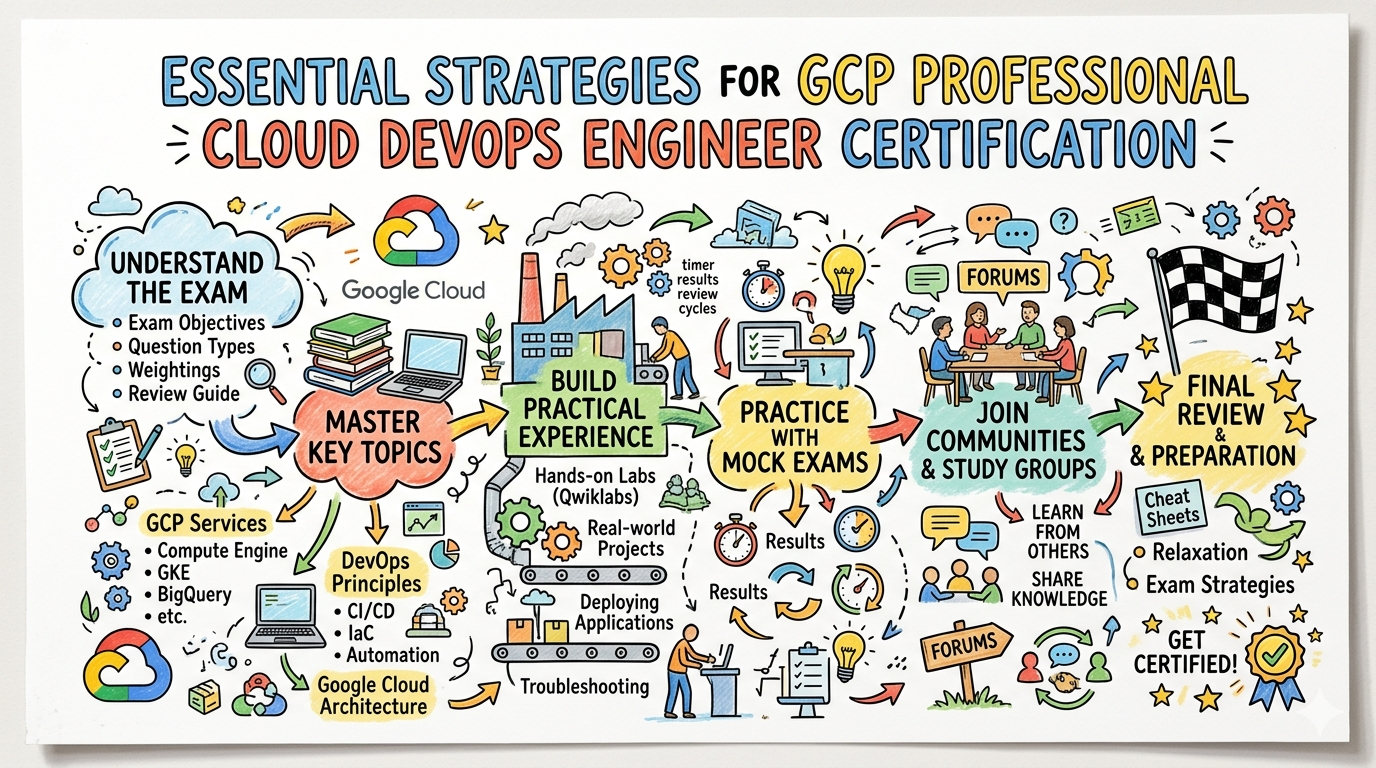
Introduction
Modern software delivery demands a seamless integration of development and operations, making the role of a platform professional more critical than ever before. The GCP Professional Cloud DevOps Engineer certification serves as a benchmark for validating an engineer’s capability to balance service reliability and delivery speed. This guide is written for working software engineers, site reliability specialists, and engineering managers who need an objective, fluff-free analysis of this engineering path. Navigating the vast ecosystem of Google Cloud requires a clear roadmap, and this comprehensive breakdown helps technical leaders make informed decisions about skills development and career progression. Understanding these cloud-native methodologies is also highly relevant for adjacent practices supported by platforms like aiopsschool, where automated operations and intelligent infrastructure management intersect. By evaluating the structural depth of this certification, professionals can map out a definitive learning trajectory that aligns perfectly with modern enterprise architectures and infrastructure engineering demands.
What is the GCP Professional Cloud DevOps Engineer?
The GCP Professional Cloud DevOps Engineer designation represents a candidate’s advanced ability to design, implement, and manage continuous delivery pipelines on Google Cloud Platform. It signifies that an engineer can successfully balance the velocity of feature deployment with the absolute stability and reliability of production systems. This validation exists to certify that a professional understands how to translate theoretical Site Reliability Engineering principles into practical, repeatable cloud architectures.
Unlike foundational certificates that focus on cloud vocabulary, this engineering credential emphasizes production-focused implementation, declarative infrastructure management, and systemic observability. It aligns directly with enterprise engineering workflows by testing a candidate’s capability to handle complex deployment strategies, automated rollbacks, and distributed logging systems. Holding this certification demonstrates a deep competence in using Google Cloud tools to optimize software development lifecycles, enforce security guardrails, and minimize mean time to resolution during production incidents.
Who Should Pursue GCP Professional Cloud DevOps Engineer?
This technical progression is designed primarily for experienced systems engineers, cloud architects, and software developers who are actively building or migrating applications to Google Cloud. Site Reliability Engineers and platform professionals will find the curriculum directly applicable to their daily tasks of scaling infrastructure and managing service level objectives. Security analysts and data engineering professionals can also leverage this path to understand how continuous integration pipelines enforce compliance and data pipeline deployments.
While enterprise engineering managers and technical leads may not write deployment manifests daily, pursuing this knowledge helps them design better team topologies and architectural strategies. Globally, as organizations migrate toward managed Kubernetes and serverless architectures, this credential holds massive weight across North America, Europe, and Asia-Pacific enterprises. Within the Indian enterprise ecosystem, where massive scale and rapid cloud migration dominate the technology sector, possessing this validated expertise sets senior engineers apart in highly competitive technical landscapes.
Why GCP Professional Cloud DevOps Engineer
The value of this technical track lies in its deep focus on architectural principles rather than fleeting software tools. While specific command-line flags might change over time, the core tenants of continuous delivery, immutable infrastructure, and robust observability frameworks remain constant across the industry. Enterprises are rapidly adopting Google Cloud for its superior data analytics, managed Kubernetes engine, and advanced networking capabilities, creating a sustained demand for engineering talent that can operate these environments.
Investing time into this curriculum offers a massive return on effort because it forces an engineer to master the underlying philosophies of site reliability and automated system defense. It protects technical professionals against automation obsolescence by shifting their focus from basic script writing to designing resilient, self-healing platforms. Ultimately, it establishes a high level of professional credibility, ensuring that an engineer remains a critical asset to any enterprise looking to modernize its delivery pipelines and infrastructure management frameworks.
GCP Professional Cloud DevOps Engineer Certification Overview
The formal preparation program for this track is delivered via the official training initiatives hosted on devopsschool. The evaluation process is built around a rigorous, scenario-based examination that simulates real-world enterprise infrastructure failures, deployment bottlenecks, and architectural dilemmas. It avoids rote memorization, focusing instead on a candidate’s ability to analyze multi-tiered applications and select the optimal automation or monitoring strategy.
The ownership of the learning journey rests on mastering core Google Cloud services, structural debugging, and architectural optimization across complex distributed networks. Architecturally, the program covers continuous integration and delivery frameworks, service monitoring, incident management, and overall platform security compliance. It acts as a comprehensive validation system, ensuring that anyone who passes possesses the technical maturity required to manage multi-million dollar cloud infrastructures without causing catastrophic business downtime.
GCP Professional Cloud DevOps Engineer Certification Tracks & Levels
The engineering path is structured to transition technical professionals from baseline cloud mechanics to advanced architectural engineering. The foundational level establishes an understanding of core cloud components, identity management, and basic compute environments. Moving into the professional track, the focus shifts entirely to implementation engineering, continuous deployment mechanics, and programmatic infrastructure management.
Advanced specializations allow engineers to dive deeper into specialized domains such as Site Reliability Engineering, financial cloud optimization, or highly secure development pipelines. These defined levels map directly to enterprise career progression, helping a system administrator move into a platform engineer role, and eventually progress into a principal enterprise architect. By following this sequential structural growth, professionals ensure they build a rock-solid technical foundation before tackling advanced multi-region orchestration challenges.
Complete GCP Professional Cloud DevOps Engineer Certification Table
| Track | Level | Who it’s for | Prerequisites | Skills Covered | Recommended Order |
|---|---|---|---|---|---|
| Cloud Infrastructure | Foundational | Associate Cloud Engineers, Systems Admins | 6+ months cloud experience | GCP Basics, IAM, Compute, Basic Networking | Step 1 |
| Engineering Automation | Professional | DevOps Specialists, Platform Engineers | 3+ years IT, 1+ year GCP | CI/CD, Artifact Registry, Cloud Build, IaC | Step 2 |
| Reliability Engineering | Professional | Site Reliability Engineers, Ops Architects | 3+ years infrastructure experience | Cloud Monitoring, Cloud Logging, SRE Principles | Step 3 |
| Enterprise Security | Advanced | DevSecOps Engineers, Security Architects | Professional level certification | Binary Authorization, KMS, IAM Guardrails | Step 4 |
| Cloud Economics | Advanced | FinOps Practitioners, Cloud Managers | Professional cloud knowledge | Billing Exports, BigQuery Architecture, Cost Control | Step 5 |
Export to Sheets
Detailed Guide for Each GCP Professional Cloud DevOps Engineer Certification
GCP Professional Cloud DevOps Engineer – Associate Cloud Engineer Track
What it is
This baseline certification validates an engineer’s capability to maintain, monitor, and configure core Google Cloud Platform resources effectively on a daily basis.
Who should take it
Systems administrators, junior cloud operators, and support engineers looking to establish a verified baseline of operational competence on Google Cloud infrastructure.
Skills you’ll gain
- Configuring identity and access management access control lists.
- Deploying virtual machine instances and managing cloud storage buckets.
- Setting up basic networking, subnets, and cloud firewalls.
- Managing managed instance groups and basic load balancing.
Real-world projects you should be able to do
- Deploy a multi-tier web application using Compute Engine and Cloud SQL.
- Set up a secure project structure with granular IAM permissions for multiple teams.
Preparation plan
- 7 Days: Focus on memorizing core GCP services, their use cases, and practicing standard Google Cloud CLI commands for resource manipulation.
- 30 Days: Complete hands-on lab environments covering virtual private clouds, storage configurations, and fundamental container deployments using Cloud Run.
- 60 Days: Review architectural case studies, run sample deployment simulations, and take practice examinations to refine baseline troubleshooting speed.
Common mistakes
- Spending too much time on complex automation scripting while neglecting basic IAM roles.
- Forgetting to study standard command-line syntax for the gcloud CLI tool.
Best next certification after this
- Same-track option: GCP Professional Cloud DevOps Engineer
- Cross-track option: GCP Professional Cloud Network Engineer
- Leadership option: GCP Professional Cloud Architect
GCP Professional Cloud DevOps Engineer – Professional DevOps Track
What it is
This core certification validates the expert skills required to build, deploy, and maintain continuous integration and continuous delivery pipelines on Google Cloud.
Who should take it
Senior automation engineers, platform developers, and DevOps practitioners responsible for release velocities and engineering pipeline stability within an enterprise environment.
Skills you’ll gain
- Designing declarative pipelines using Cloud Build and Artifact Registry.
- Managing infrastructure as code architectures using Terraform on Google Cloud.
- Implementing canary and blue-green deployment strategies safely.
- Managing secrets and runtime configurations securely using Secret Manager.
Real-world projects you should be able to do
- Construct a fully automated git-ops delivery pipeline deploying to Google Kubernetes Engine.
- Build a zero-downtime rollback mechanism for an enterprise microservice framework.
Preparation plan
- 7 Days: Deep dive into Cloud Build schema definitions, containerization best practices, and IAM service account token configurations.
- 30 Days: Build and tear down complex multi-environment architectures using Terraform while managing remote state storage backends securely.
- 60 Days: Analyze enterprise failure scenarios, study pipeline optimization methodologies, and master advanced deployment strategies across multiple clusters.
Common mistakes
- Focusing exclusively on open-source tools instead of mastering native GCP services like Cloud Build.
- Underestimating the depth of questions regarding binary authorization and secure container supply chains.
Best next certification after this
- Same-track option: GCP Professional Cloud Security Engineer
- Cross-track option: GCP Professional Cloud Data Engineer
- Leadership option: GCP Professional Cloud Architect
GCP Professional Cloud DevOps Engineer – Professional SRE Track
What it is
This specialized track validates an engineer’s absolute proficiency in monitoring, logging, tracing, and maintaining the systemic reliability of large-scale cloud applications.
Who should take it
Site Reliability Engineers, infrastructure architects, and operational lead engineers focused on service availability, latency optimization, and automated incident response frameworks.
Skills you’ll gain
- Defining and measuring Service Level Indicators and Service Level Objectives.
- Configuring advanced monitoring dashboards, alerting policies, and uptime checks.
- Implementing centralized logging architectures using Cloud Logging and BigQuery.
- Utilizing Cloud Trace and Cloud Profiler to diagnose performance bottlenecks.
Real-world projects you should be able to do
- Create a centralized operational dashboard that tracks error budgets in real time.
- Architect an automated alerting system that triggers healing scripts during service degradation.
Preparation plan
- 7 Days: Master the mathematical formulas behind error budgets, burn rates, and service level definitions thoroughly.
- 30 Days: Implement advanced log sinks, configure custom metrics, and deploy distributed tracing across microservices.
- 60 Days: Practice simulated incident management drills, optimize query performance in Cloud Logging, and study post-mortem creation.
Common mistakes
- Treating SRE as merely an extension of monitoring without understanding the cultural and mathematical principles.
- Neglecting the configuration details of log exclusions, which directly impacts production operation costs.
Best next certification after this
- Same-track option: GCP Professional Cloud Network Engineer
- Cross-track option: GCP Professional Cloud Database Engineer
- Leadership option: Certified Professional Engineering Manager
Choose Your Learning Path
DevOps Path
This path focuses entirely on the mechanics of software delivery automation and continuous system improvement. Engineers choosing this line will master source control integration, automated compilation engines, and artifact storage strategies. You will spend your time building deterministic deployment tracks that guarantee code moving from a developer’s laptop to production behaves identically. It bridges the gap between raw application development and stable cloud-native runtime environments.
DevSecOps Path
Security cannot be an afterthought in modern software delivery, and this path injects defensive engineering directly into the automation lifecycle. Professionals here learn to build automated vulnerability scanning, static code analysis, and compliance checks directly into runtime pipelines. You will specialize in secret management, infrastructure access policies, and enforcing binary authorization rules across all containerized applications. This path ensures that fast delivery cycles do not compromise corporate compliance parameters.
SRE Path
The Site Reliability Engineering path treats operational challenges as software engineering problems. Engineers on this trajectory focus heavily on system availability, performance optimization, and minimizing human intervention through smart automation. You will master the tracking of service level metrics, error budgets, and systemic failure recovery designs. It is ideal for individuals who enjoy debugging distributed environments and designing platforms that heal themselves automatically during outages.
AIOps Path
Modern infrastructures generate massive amounts of telemetry that human operators cannot analyze in real time. The AIOps track trains engineers to deploy machine learning models that analyze logs, metrics, and traces to predict system failures before they occur. You will learn to use automated anomaly detection systems to dynamically scale resources and optimize alerting paths. This path bridges the divide between data science frameworks and infrastructure operations management.
MLOps Path
Deploying machine learning models requires a completely different automation lifecycle compared to standard microservices. This specialty focuses on building continuous training pipelines, managing model registries, and monitoring data drift over time. Engineers learn to orchestrate infrastructure that handles massive data processing loads followed by low-latency inference delivery. It ensures that data science assets move smoothly from experimental sandboxes into stable enterprise production environments.
DataOps Path
Data pipelines require the same level of agility and quality control that software applications enjoy. This discipline applies continuous integration principles to data engineering, focusing on automated testing of data quality, schema migrations, and pipeline deployment. Professionals master the orchestration of managed data engines, stream processing frameworks, and automated storage lifecycle policies. It creates an ecosystem where data delivery is predictable, verified, and completely free of manual bottlenecks.
FinOps Path
Cloud elasticity can lead to run-away operational expenses if infrastructure is not monitored through an economic lens. This track combines financial accountability with cloud engineering practices, ensuring teams build cost-optimized systems. Engineers master cloud billing exports, programmatic cost anomaly identification, and structural right-sizing of compute and storage assets. This path ensures that engineering scaling decisions remain aligned with corporate profitability metrics.
Role → Recommended GCP Professional Cloud DevOps Engineer Certifications
| Role | Recommended Certifications |
|---|---|
| DevOps Engineer | Professional DevOps Track, Enterprise Security |
| SRE | Reliability Engineering, Cloud Infrastructure |
| Platform Engineer | Professional DevOps Track, Reliability Engineering |
| Cloud Engineer | Cloud Infrastructure, Professional DevOps Track |
| Security Engineer | Enterprise Security, Professional DevOps Track |
| Data Engineer | Professional DevOps Track, Cloud Data Track |
| FinOps Practitioner | Cloud Economics, Cloud Infrastructure |
| Engineering Manager | Cloud Infrastructure, Cloud Economics |
Export to Sheets
Next Certifications to Take After GCP Professional Cloud DevOps Engineer
Same Track Progression
Once the core DevOps competencies are validated, engineers should dive deeper into specific architectural sub-domains. This means pursuing advanced networking or deep-level security validations to master multi-region hybrid mesh topologies. Deep specialization ensures that you can design secure data perimeters and specialized network routing paths for global-scale enterprise infrastructures.
Cross-Track Expansion
Broadening technical horizons involves expanding into adjacent cloud competencies to become a multi-faceted asset. Transitioning toward data engineering credentials allows a professional to manage massive data lakes and automated analytical infrastructure. Alternatively, pursuing database certifications provides the deep architectural knowledge required to manage globally distributed transactional databases with zero data loss.
Leadership & Management Track
For senior engineers looking to step away from daily configuration tasks, transitioning to enterprise architecture or technical management is the logical next step. Pursuing the Professional Cloud Architect path shifts the focus from delivery mechanics to overall corporate business alignment and risk mitigation strategies. This training prepares technical leaders to manage large engineering divisions, set technology standards, and steer multi-million dollar cloud transformations.
Training & Certification Support Providers for GCP Professional Cloud DevOps Engineer
DevOpsSchool offers highly structured, instructor-led training programs designed to help working professionals master cloud-native automation and system reliability. Their curriculum focuses heavily on hands-on lab environments and enterprise case studies that simulate real production challenges.
Cotocus provides specialized corporate training and consulting paths that align team capabilities with modern infrastructure demands. Their programs are built around practical implementation, helping organizations transition smoothly to cloud-native delivery frameworks.
Scmgalaxy serves as an expansive knowledge repository and community platform for configuration management, continuous integration, and build automation professionals. They offer extensive learning resources, technical deep dives, and community support for engineering professionals.
BestDevOps focuses on delivering curated, high-quality educational content aimed at mastering modern delivery pipelines and infrastructure management strategies. Their training modules emphasize production-ready configurations and real-world implementation techniques.
devsecopsschool addresses the critical intersection of system security and automated delivery by offering deep-dive courses on automated compliance enforcement. Their training helps engineers build secure development lifecycles directly into enterprise automation tracks.
sreschool provides dedicated educational paths focused exclusively on the philosophies and mechanics of site reliability engineering. Their modules teach professionals how to manage error budgets, build robust monitoring systems, and architect self-healing systems.
aiopsschool trains engineers to leverage artificial intelligence and advanced machine learning models to optimize complex infrastructure operations. Their courses focus on predictive monitoring, automated root-cause analysis, and intelligent alerting mechanisms.
dataopsschool bridges the gap between data engineering and operational agility by teaching continuous integration methodologies for data pipelines. Their programs focus on automated data validation, quality control, and pipeline deployment automation.
finopsschool focuses entirely on the financial discipline of cloud computing, teaching engineers how to balance structural performance with economic efficiency. Their curriculum helps professionals implement cost-control frameworks and accurate cloud budget forecasting.
Frequently Asked Questions (General)
- How difficult is the professional level examination compared to other cloud providers?The assessment is widely considered highly challenging due to its conceptual, scenario-based nature. It avoids simple vocabulary testing, requiring candidates to analyze complex architectural failures and select the best operational solution based on site reliability principles.
- How much hands-on cloud experience is realistically required to pass this exam?While anyone can sit for the exam, having at least one year of daily hands-on experience managing Google Cloud resources and three years of general system automation experience is highly recommended for success.
- Can I skip the associate level certificate and attempt the professional exam directly?Yes, there are no mandatory structural prerequisites preventing you from taking the professional examination immediately. If you have significant industry experience, you can jump straight into the advanced tracks.
- What is the overall validity period for these professional engineering credentials?Professional certifications remain active for a period of two years from the date of passing. To maintain active status, professionals must sit for the recertification exam before the expiration date.
- How does this certification impact overall salary and career compensation metrics?Validated platform engineers frequently command premium salaries globally due to the scarcity of talent capable of managing complex cloud-native systems. It acts as an accelerator for senior-level promotions.
- Are there code writing or programming requirements during the assessment process?You do not need to write full application code, but you must be fully proficient in reading and interpreting automation manifests, pipeline definitions, and structured logs format.
- How does cloud economics feature within the DevOps assessment curriculum?While it is an engineering exam, cost optimization is a core component. Candidates must know how to design architectures that utilize spot instances, storage lifecycle policies, and cost-efficient logging tiers.
- What happens if an individual fails the evaluation on their first attempt?There is a mandatory retake cooling-off period, typically requiring candidates to wait fourteen days before a second attempt, with increasing wait times for subsequent attempts.
- Is the examination delivered in an online format or at physical centers?Candidates can choose between remotely proctored online examinations from their home office or physical testing centers managed by authorized delivery partners.
- How long does a typical preparation lifecycle take for a working engineer?For an active professional with baseline cloud experience, a dedicated preparation runway of thirty to sixty days of consistent study is usually sufficient to cover all material.
- Does this validation program cover multi-cloud orchestration and hybrid deployments?Yes, the curriculum places significant emphasis on hybrid cloud connections, multi-cluster management, and abstracting infrastructure layer components using open systems like Kubernetes.
- What style of study resources are most valuable for passing this track?Practical, hands-on sandbox laboratories combined with official documentation deep dives and case study reviews yield the highest success rate for engineering candidates.
FAQs on GCP Professional Cloud DevOps Engineer
- Which specific Google Cloud tools form the backbone of the DevOps exam framework?The assessment tests deep competence in Cloud Build, Artifact Registry, Google Kubernetes Engine, Cloud Monitoring, Cloud Logging, and Deployment Manager or Terraform integrations. Candidates must understand how these services interoperate to form a unified, secure delivery platform under production constraints.
- How deeply does this engineering track focus on Google Kubernetes Engine management?GKE is a massive component of the evaluation process. You must thoroughly understand cluster architecture, namespace isolation, container security policies, regional versus zonal deployments, and how to execute automated canary rollouts within a live managed Kubernetes environment.
- What is the significance of error budgets and burn rates in this curriculum?These mathematical concepts are central to the reliability engineering portion of the track. The exam tests your ability to calculate when deployments should be halted based on budget depletion and how to configure automated alerts based on metric consumption speeds.
- How are logging sinks and metrics exports handled within the architectural scenarios?You will be questioned extensively on creating enterprise-wide log sinks, routing log messages to BigQuery for analytical audit trails, or exporting custom infrastructure metrics to Pub/Sub for automated remediation by external serverless scripts.
- Does the certification validate knowledge of third-party infrastructure as code systems?While native tools are covered, understanding declarative infrastructure lifecycle management using Terraform is highly critical. The exam expects you to know state file isolation strategies and resource dependency mapping within Google Cloud.
- How does the curriculum approach secure container supply chains and binary authorization?Security is highly integrated, requiring candidates to know how to sign container images during compilation in Cloud Build and enforce cluster policies that prevent unsigned, unverified containers from running in production environments.
- What strategies are tested for minimizing service downtime during database schema migrations?The track evaluates your understanding of data migration patterns, including the use of parallel deployment paths, cloud database replication synchronization, and building backward-compatible data access layers within application microservices.
- How do cloud trace and cloud profiler help solve performance degradation issues?Candidates must know how to read distributed tracing graphs to identify RPC latency bottlenecks across microservice boundaries and use runtime profiling data to pinpoint memory leaks or CPU utilization spikes within application code.
Final Thoughts: Is GCP Professional Cloud DevOps Engineer Worth It?
Choosing to pursue this engineering credential is a significant commitment of time and mental energy, but it remains one of the most rewarding investments a platform professional can make. The industry has moved decisively past simple manual provisioning, and organizations desperately need engineers who can treat infrastructure strictly as code while guaranteeing system reliability.
This certification process forces you to step out of comfortable daily routines and evaluate distributed systems through a holistic, architectural lens. It shifts your professional value proposition from someone who simply maintains servers to an enterprise engineer who designs resilient, scalable development platforms. If you want to master the actual mechanics of modern cloud delivery and establish undeniable technical authority in the market, this engineering path is absolutely worth the effort.
