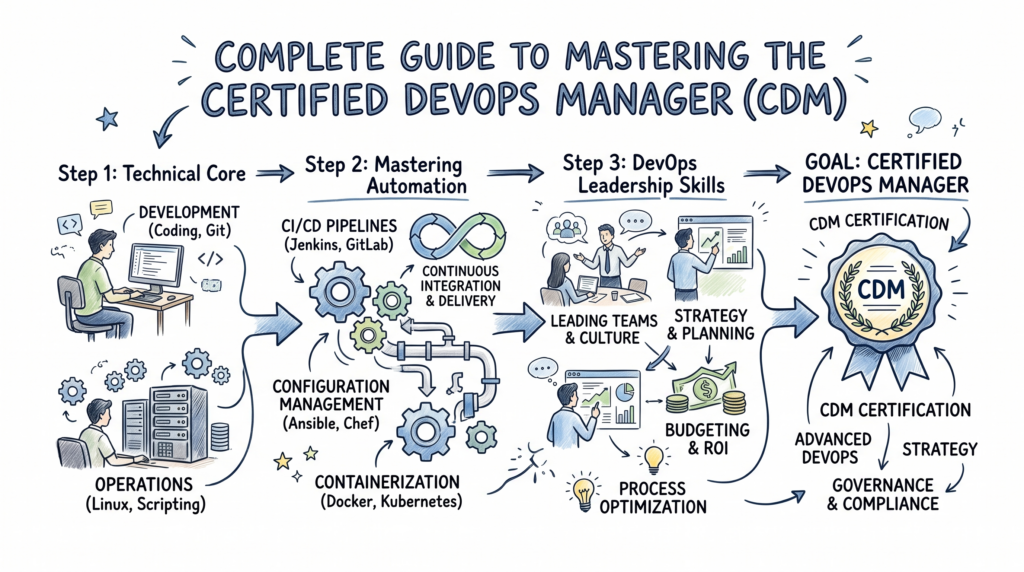
Introduction
The Certified DevOps Manager (CDM) is a specialized credential designed for those stepping into leadership within the modern engineering landscape. In an era dominated by cloud-native architectures and platform engineering, the role of a manager has shifted from simple oversight to technical orchestration. This guide is built for professionals who need to bridge the gap between high-level business goals and the granular realities of continuous integration and delivery.
Navigating a career in 2026 requires more than just knowing how to code or configure a pipeline; it requires the ability to lead teams through cultural and technical transformations. This comprehensive overview explores the Certified DevOps Manager (CDM) framework, helping you understand how it fits into the broader SRE and DevOps ecosystems. By the end of this guide, you will have a clear roadmap for your leadership journey.
What is the Certified DevOps Manager (CDM)?
The Certified DevOps Manager (CDM) represents a standard of excellence for individuals responsible for the strategic implementation of DevOps practices. Unlike purely technical certifications that focus on a single tool, the CDM emphasizes the holistic view of the software delivery lifecycle. It exists to validate a professional’s ability to manage people, processes, and products in a production-focused environment.
In modern enterprise workflows, the CDM acts as the glue between development, operations, and business stakeholders. It aligns with current industry practices such as GitOps, observability, and automated governance. Rather than focusing on theoretical “best case” scenarios, the certification prepares you for the messy, complex reality of managing legacy systems alongside cutting-edge cloud-native platforms.
Who Should Pursue Certified DevOps Manager (CDM)?
The Certified DevOps Manager (CDM) is primarily designed for mid-to-senior level professionals who are either currently in leadership or aspiring to be. This includes Engineering Managers, Team Leads, and Senior DevOps Engineers who want to move beyond daily tickets and into strategic planning. It is equally valuable for SREs and Cloud Architects who need to understand the management side of scaling infrastructure.
Globally, and particularly in the booming tech hubs of India, there is a massive demand for leaders who can handle the “human” side of DevOps. Beginners with a strong foundation in software development will find this certification a useful goal for their five-year plan. For seasoned managers, it serves as a critical update to their skills, ensuring they remain relevant in an AI-driven, automated industry.
Why Certified DevOps Manager (CDM)
As we move deeper into 2026, the initial “hype” of DevOps has settled into a standard requirement for all enterprises. However, the complexity of managing these environments has increased exponentially with the rise of multi-cloud and microservices. The Certified DevOps Manager (CDM) provides the longevity needed in a career because it focuses on core principles that outlast specific tool versions.
The return on investment for this certification is reflected in its high enterprise adoption rate. Companies are looking for managers who can reduce “burnout” while increasing “deployment frequency”—a delicate balance that requires specific training. By holding a CDM, you signal to employers that you understand how to achieve high-velocity delivery without sacrificing the stability of the production environment.
Certified DevOps Manager (CDM) Certification Overview
The program is officially delivered via [https://www.devopsschool.com/certification/certified-devops-manager.html] and is hosted on the devopsschool platform. This certification is structured to be rigorous yet practical, utilizing an assessment approach that goes beyond simple multiple-choice questions. It often involves case studies and scenario-based evaluations that mirror real-world managerial dilemmas.
The ownership of the program lies with industry veterans who have seen the evolution of DevOps from its infancy. The structure is divided into modules that cover cultural transformation, technical strategy, and financial governance. This ensures that a Certified DevOps Manager (CDM) is prepared to handle the diverse challenges of a modern engineering department, from hiring the right talent to choosing the right tech stack.
Certified DevOps Manager (CDM) Certification Tracks & Levels
The certification journey is divided into logical levels to accommodate different stages of a professional’s career. It begins at the Foundation level, which establishes the shared vocabulary and core concepts of DevOps leadership. Moving into the Professional level, the focus shifts toward advanced strategy, scaling, and the integration of security (DevSecOps) and reliability (SRE) into the management framework.
The Advanced or “Leader” level is designed for those managing entire departments or multiple engineering pods. At this stage, the certification covers complex topics like FinOps (financial operations) and MLOps management. These levels align with a typical career progression from a Senior Engineer to a Lead, and finally to a Director or VP of Engineering, providing a clear path for growth.
Complete Certified DevOps Manager (CDM) Certification Table
| Track | Level | Who it’s for | Prerequisites | Skills Covered | Recommended Order |
| Management | Foundation | Aspiring Leads | 2+ Years Exp | DevOps Culture, CI/CD Basics | 1st |
| Strategy | Professional | Current Managers | Foundation Cert | Scaling, Metrics (DORA), ROI | 2nd |
| Leadership | Advanced | Directors/CTOs | 10+ Years Exp | Governance, FinOps, AI Policy | 3rd |
| SRE Lead | Specialized | SRE Managers | SRE Experience | Error Budgets, Incident Mgmt | Optional |
Detailed Guide for Each Certified DevOps Manager (CDM) Certification
Certified DevOps Manager (CDM) – Foundation Level
What it is
This certification validates your understanding of the core philosophy of DevOps from a managerial perspective. It confirms you know how to break down silos between teams and foster a collaborative culture.
Who should take it
It is ideal for Senior Engineers looking to move into management or new managers who have recently taken over an engineering team. It requires a fundamental understanding of the SDLC.
Skills you’ll gain
- Understanding the Three Ways of DevOps (Flow, Feedback, Learning).
- Identifying and removing bottlenecks in the value stream.
- Establishing basic KPIs for team performance.
- Fostering a blameless culture during post-mortems.
Real-world projects you should be able to do
- Perform a Value Stream Mapping (VSM) exercise for a product team.
- Design a basic CI/CD pipeline strategy that aligns with business release cycles.
- Implement a feedback loop between QA and Development teams.
Preparation plan
- 7-14 Days: Focus on the core DevOps Handbook principles and terminology. Review the official syllabus daily.
- 30 Days: Read case studies on successful cultural transformations. Participate in one mock assessment.
- 60 Days: Deep dive into toolchain integration (Jenkins, GitLab, Docker) from an oversight perspective.
Common mistakes
- Focusing too much on specific tool syntax rather than the underlying management philosophy.
- Ignoring the “cultural” aspect of the exam in favor of technical answers.
Best next certification after this
- Same-track option: Certified DevOps Manager (CDM) Professional.
- Cross-track option: Certified SRE Practitioner.
- Leadership option: Agile Leadership Certification.
Certified DevOps Manager (CDM) – Professional Level
What it is
The Professional level validates your ability to scale DevOps across multiple teams and align technical output with organizational ROI. It focuses on the “science” of management through data.
Who should take it
Existing Managers, Project Managers, and Product Owners who need to optimize large-scale engineering operations. It assumes you have mastered the foundational concepts of the CDM.
Skills you’ll gain
- Mastery of DORA metrics (Deployment Frequency, Lead Time, MTTR, Change Failure Rate).
- Implementation of DevSecOps at scale (Shift-left security).
- Resource allocation and capacity planning for cloud-native teams.
- Managing technical debt while maintaining feature velocity.
Real-world projects you should be able to do
- Build a dashboard that tracks real-time team performance metrics across an organization.
- Create a migration strategy for moving a monolithic application to microservices.
- Develop a disaster recovery and business continuity plan for cloud infrastructure.
Preparation plan
- 7-14 Days: Intensive review of metrics and reporting frameworks. Study the “Accelerate” state of DevOps reports.
- 30 Days: Practice scenario-based questions regarding team conflict and technical roadblocks.
- 60 Days: Conduct internal audits of current workflows to apply CDM Professional concepts practically.
Common mistakes
- Over-complicating metrics and losing sight of the actual value being delivered.
- Failing to account for the “people” cost when proposing technical changes.
Best next certification after this
- Same-track option: Certified DevOps Manager (CDM) Advanced.
- Cross-track option: Certified Cloud Architect.
- Leadership option: Executive Program in Tech Management.
Choose Your Learning Path
DevOps Path
The DevOps path for a manager focuses on the continuous improvement of the delivery pipeline. It begins with the CDM Foundation to understand the culture, followed by the Professional level to master the metrics of delivery. This path is perfect for those who want to lead high-performing “two-pizza teams” and ensure that software is released reliably and frequently. You will learn to balance the “need for speed” with the requirements of a stable production environment.
DevSecOps Path
Security is no longer a separate department; it is a fundamental part of the management lifecycle. A manager on this path uses the CDM framework to integrate security checks directly into the CI/CD pipeline. The goal is to move security from a “gatekeeper” role to an automated “enabler” role. You will focus on compliance, vulnerability management, and ensuring that security is a shared responsibility across the entire engineering organization.
SRE Path
The Site Reliability Engineering (SRE) path for a CDM emphasizes system uptime and the management of “Error Budgets.” As a manager, you will learn how to negotiate between the developers’ desire for new features and the operations team’s need for stability. This path is highly technical and data-driven, focusing on observability, incident response, and the automation of “toil.” It is the ideal route for those managing mission-critical infrastructure.
AIOps / MLOps Path
In 2026, managing machine learning models at scale is a primary challenge for many enterprises. A Certified DevOps Manager (CDM) on this path learns how to apply DevOps principles to the data science lifecycle. This includes managing the retraining of models, versioning large datasets, and monitoring for “model drift” in production. You will act as the bridge between data scientists and infrastructure engineers, ensuring that AI projects actually reach production.
DataOps Path
DataOps focuses on the automated, policy-based management of data. A manager on this path uses the CDM framework to ensure that data pipelines are as reliable and repeatable as software pipelines. You will learn about data governance, privacy regulations (like GDPR), and how to provide “data-as-a-service” to the rest of the organization. This path is crucial for organizations that rely on real-time analytics to drive business decisions.
FinOps Path
FinOps, or Financial Operations, is the practice of bringing financial accountability to the variable spend of the cloud. A manager on this path uses their CDM training to optimize cloud costs without hindering development speed. You will learn how to read complex cloud bills, implement tagging strategies, and forecast future spending. This role is increasingly vital as organizations look to maximize the value of their cloud investments in a tight economy.
Role → Recommended (Topic name) Certifications
| Role | Recommended Certifications |
| DevOps Engineer | CDM Foundation, SRE Practitioner |
| SRE | CDM Foundation, Certified SRE Professional |
| Platform Engineer | CDM Professional, Cloud Architect |
| Cloud Engineer | CDM Foundation, Kubernetes Administrator |
| Security Engineer | CDM Foundation, DevSecOps Professional |
| Data Engineer | CDM Foundation, DataOps Specialist |
| FinOps Practitioner | CDM Professional, FinOps Certified Practitioner |
| Engineering Manager | CDM Advanced, Agile Leadership |
Next Certifications to Take After Certified DevOps Manager (CDM)
Same Track Progression
After completing the Certified DevOps Manager (CDM) series, the logical next step is a deep dive into executive leadership or specialized technical management. You might pursue a “Chief Technology Officer” (CTO) training program or an executive MBA tailored for technology leaders. The goal here is to move from managing teams to managing entire business units and setting the long-term technical vision for an organization.
Cross-Track Expansion
If you want to broaden your skills, consider certifications in adjacent fields like Cybersecurity Leadership (CISM) or Data Governance. Expanding into these areas makes you a more versatile leader, capable of overseeing diverse departments beyond just DevOps. Understanding the nuances of “Legal Tech” or “HR Tech” management can also be a significant career differentiator in 2026.
Leadership & Management Track
For those who want to step away from the technical “weeds” entirely, focus on high-level management frameworks. This includes certifications in Project Management (PMP), Change Management, or organizational psychology. These credentials help you understand the human behavior behind team dynamics, enabling you to build more resilient and motivated engineering cultures.
Training & Certification Support Providers for Certified DevOps Manager (CDM)
DevOpsSchool
As the primary provider for the CDM, DevOpsSchool offers an exhaustive curriculum that blends theoretical knowledge with hands-on lab experience. Their programs are designed by industry experts who focus on the practical application of DevOps in large-scale enterprises. Students gain access to a vast library of resources and a community of professionals who are actively working in the field. The support system at DevOpsSchool is robust, providing guidance from the initial enrollment phase through to the final assessment, ensuring that every candidate has the tools they need to succeed.
Cotocus
Cotocus is well-known for its consulting-led approach to training, making it an excellent choice for those who want to see how CDM principles apply in a corporate consulting context. Their trainers often double as active consultants, bringing fresh, real-world problems into the classroom. This provider focuses on high-impact training that helps professionals transition into senior leadership roles quickly. Their CDM support includes personalized mentorship sessions that help students navigate specific career hurdles and technical challenges, making the learning process highly relevant to the individual’s current professional environment.
Scmgalaxy
Scmgalaxy serves as a massive knowledge hub and community for DevOps professionals worldwide. Their support for the Certified DevOps Manager (CDM) program is characterized by an extensive collection of tutorials, blogs, and community forums. For a candidate, Scmgalaxy is the “go-to” place for troubleshooting and staying updated on the latest toolchain trends. Their training modules are often supplemented by community-contributed content, providing a diverse range of perspectives on how to handle managerial challenges in different industries and tech stacks.
BestDevOps
BestDevOps focuses on providing a curated, high-quality learning experience for those who want to master the most efficient paths to certification. Their CDM support is streamlined and focused on the “must-know” elements of the exam, making it ideal for busy professionals who need to manage their time effectively. They offer a range of practice exams and summary guides that are designed to build confidence and ensure a high pass rate. Their approach is very much about “cutting through the noise” to deliver the core value of the certification.
devsecopsschool
As the name suggests, devsecopsschool is the specialist provider for those looking to integrate security into their CDM journey. Their support for the Certified DevOps Manager (CDM) program includes specific modules on automated security, compliance as code, and governance. This is the best choice for managers working in highly regulated industries like finance or healthcare. They provide deep-dive sessions on how to manage the “shift-left” movement within an organization, ensuring that security is never an afterthought in the delivery process.
sreschool
sreschool focuses on the intersection of management and site reliability. For CDM candidates, sreschool provides specialized training on incident management, post-mortems, and the cultural shift required to prioritize reliability. Their support includes hands-on simulations of production failures, allowing managers to practice their response in a safe environment. This provider is essential for any manager who will be overseeing SRE teams, as it provides the technical depth required to lead those teams effectively and with authority.
aiopsschool
aiopsschool is at the forefront of the 2026 trend toward AI-driven operations. Their support for the CDM program involves teaching managers how to oversee the implementation of machine learning tools within the DevOps pipeline. They cover topics like automated anomaly detection and the management of AI-driven root cause analysis. This is a forward-looking provider that ensures a Certified DevOps Manager (CDM) is prepared for the future of automated, intelligent infrastructure management and the complexities it brings.
dataopsschool
dataopsschool addresses the unique challenges of managing data-heavy engineering teams. Their CDM support focuses on the lifecycle of data, from ingestion to analytics, and how to apply DevOps-style automation to these processes. Managers will learn how to oversee data quality, privacy, and the scaling of data lakes. This provider is crucial for those in “Data-First” organizations, providing the specialized knowledge needed to ensure that data flows through the organization as smoothly as code.
finopsschool
finopsschool specializes in the critical area of cloud financial management. For a CDM candidate, finopsschool provides the tools to manage cloud budgets and drive cost-efficiency across multiple teams. Their support includes training on cost-allocation models, forecasting, and how to build a culture of “cost-awareness” among developers. In an era of tightening budgets, the skills taught here are some of the most valued by executive leadership, making this a vital stop on the CDM journey.
Frequently Asked Questions (General)
1. Is a DevOps certification worth it in 2026?
Yes, because the market has shifted from “knowing the tools” to “knowing how to manage the system.” A certification like the CDM validates your ability to lead in a complex, automated environment.
2. How long does it take to get certified?
Depending on your experience level, it typically takes between 30 to 60 days of dedicated study. Those with a strong background in senior engineering roles may find the process faster.
3. What are the prerequisites for the CDM?
While there are no hard barriers for the Foundation level, it is highly recommended that you have at least 2-3 years of experience in an engineering or project management role.
4. Can I take the exam online?
Yes, most providers, including DevOpsSchool, offer remote proctored exams that you can take from anywhere in the world.
5. How much does the Certified DevOps Manager (CDM) cost?
Costs vary by provider and level, but generally, you should budget for the training and the exam fee separately. Check the official URL for current pricing.
6. Does the certification expire?
Most professional certifications require renewal or continuing education credits every 2-3 years to ensure you are up to date with the latest industry standards.
7. Is the CDM recognized globally?
Yes, the CDM framework is based on international standards for DevOps and SRE, making it valid for careers in India, the US, Europe, and beyond.
8. Do I need to know how to code?
As a manager, you don’t need to be a daily coder, but you must understand the coding process and the challenges developers face to lead them effectively.
9. What is the pass rate for the exam?
The exam is rigorous but fair. With proper preparation through a recognized provider, most professional candidates pass on their first or second attempt.
10. How does the CDM differ from a PMP?
The PMP is a general project management certification, while the CDM is specifically tailored for the technical and cultural nuances of the DevOps and software engineering world.
11. Will this help me get a salary raise?
While not guaranteed, holding a CDM often puts you in a higher tier for “Manager” and “Director” roles, which typically carry higher compensation packages.
12. Can I jump straight to the Professional level?
It is usually recommended to follow the sequence, but some providers allow you to skip ahead if you can demonstrate significant prior experience or other relevant certifications.
FAQs on Certified DevOps Manager (CDM)
What is the core focus of the CDM curriculum?
The curriculum focuses on the strategic implementation of DevOps, emphasizing value stream mapping, team culture, and the alignment of technical work with business goals. Who is the typical candidate for the CDM? Most candidates are Senior Engineers or Team Leads transitioning into formal management roles. Is the CDM more technical or managerial? It is a hybrid; it requires a deep understanding of the tech stack but focuses on how to manage and scale it. How does the CDM address remote team management? The certification includes modern strategies for managing distributed engineering teams and maintaining a strong DevOps culture remotely. What tools are covered in the CDM? The focus is on tool categories (CI/CD, Monitoring, Cloud) rather than specific vendors, though popular tools like Jenkins and AWS are often used in examples. Is there a community for CDM holders? Yes, through platforms like DevOpsSchool and Scmgalaxy, you gain access to a global network of peers. How often is the CDM syllabus updated? The syllabus is updated annually to reflect changes in the cloud-native ecosystem and new management trends like AIOps. Does the CDM cover financial management? Yes, the professional and advanced levels include sections on FinOps and cloud cost optimization.
Final Thoughts: Is Certified DevOps Manager (CDM) Worth It?
From my perspective as someone who has seen the industry transition through multiple “revolutions,” the Certified DevOps Manager (CDM) is one of the most practical investments you can make. We are past the era where a manager could simply be a “task master.” Today, you have to be a technical guide, a cultural advocate, and a financial steward all at once.
The CDM doesn’t just give you a badge; it gives you a framework for thinking. It forces you to look at the entire system rather than just the individual parts. If you are serious about moving into a leadership role where you actually make an impact on how software is delivered and how teams feel about their work, this path is the right one. It’s not about the hype—it’s about the reality of modern engineering leadership.
