Introduction
The Master in DevOps Engineering (MDE) is a comprehensive professional roadmap designed to bridge the gap between traditional software development and modern, high-scale operations. This guide is crafted for engineers navigating the complexities of cloud-native ecosystems, microservices, and automated delivery pipelines. As the industry shifts toward platform engineering and decentralized operations, understanding the full lifecycle of an application—from code to production monitoring—is no longer optional. This guide serves as a strategic manual to help you evaluate how this certification fits into your personal career trajectory and the broader global tech market.
What is the Master in DevOps Engineering (MDE)?
The Master in DevOps Engineering (MDE) represents a deep-dive into the technical and cultural methodologies required to run enterprise-grade software. Unlike basic tool-specific courses, this program focuses on production-focused learning, emphasizing how tools like Kubernetes, Terraform, and Jenkins integrate into a cohesive workflow. It exists to provide a standardized framework for mastering automation, continuous integration, and site reliability. By focusing on real-world scenarios, it ensures that practitioners can handle the pressures of high-frequency deployments and complex infrastructure troubleshooting.
Who Should Pursue Master in DevOps Engineering (MDE)?
This program is tailored for a wide spectrum of technical professionals, ranging from backend developers looking to own their infrastructure to sysadmins transitioning into cloud roles. Site Reliability Engineers (SREs), Platform Engineers, and Security professionals will find immense value in the cross-functional modules provided. It is equally relevant for technical leads and engineering managers in India and across the globe who need to oversee DevOps transformations. Whether you are a beginner seeking a structured entry point or a veteran looking to formalize years of “on-the-job” learning, the MDE provides a clear path forward.
Why Master in DevOps Engineering (MDE)
In 2026, the demand for “T-shaped” engineers—those with deep expertise in one area and broad knowledge across others—is at an all-time high. The Master in DevOps Engineering (MDE) ensures longevity by teaching fundamental principles that outlast specific tool versions or cloud provider updates. As enterprises adopt AI-driven operations and complex multi-cloud strategies, the ability to architect resilient systems becomes a premium skill. Investing time in this certification offers a high return by making you indispensable during architectural shifts and ensuring your skills remain sharp in a competitive global market.
Master in DevOps Engineering (MDE) Certification Overview
The program is delivered via the official and is hosted on the devopsschool platform. The certification structure is designed to be practical, moving away from simple multiple-choice questions toward a more holistic assessment of an engineer’s capabilities. It covers various ownership levels, from individual contributors to organizational architects, ensuring that the certification is recognized as a mark of true competency. The curriculum is modular, allowing students to digest complex topics like container orchestration and infrastructure-as-code in a logical, structured manner.
Master in DevOps Engineering (MDE) Certification Tracks & Levels
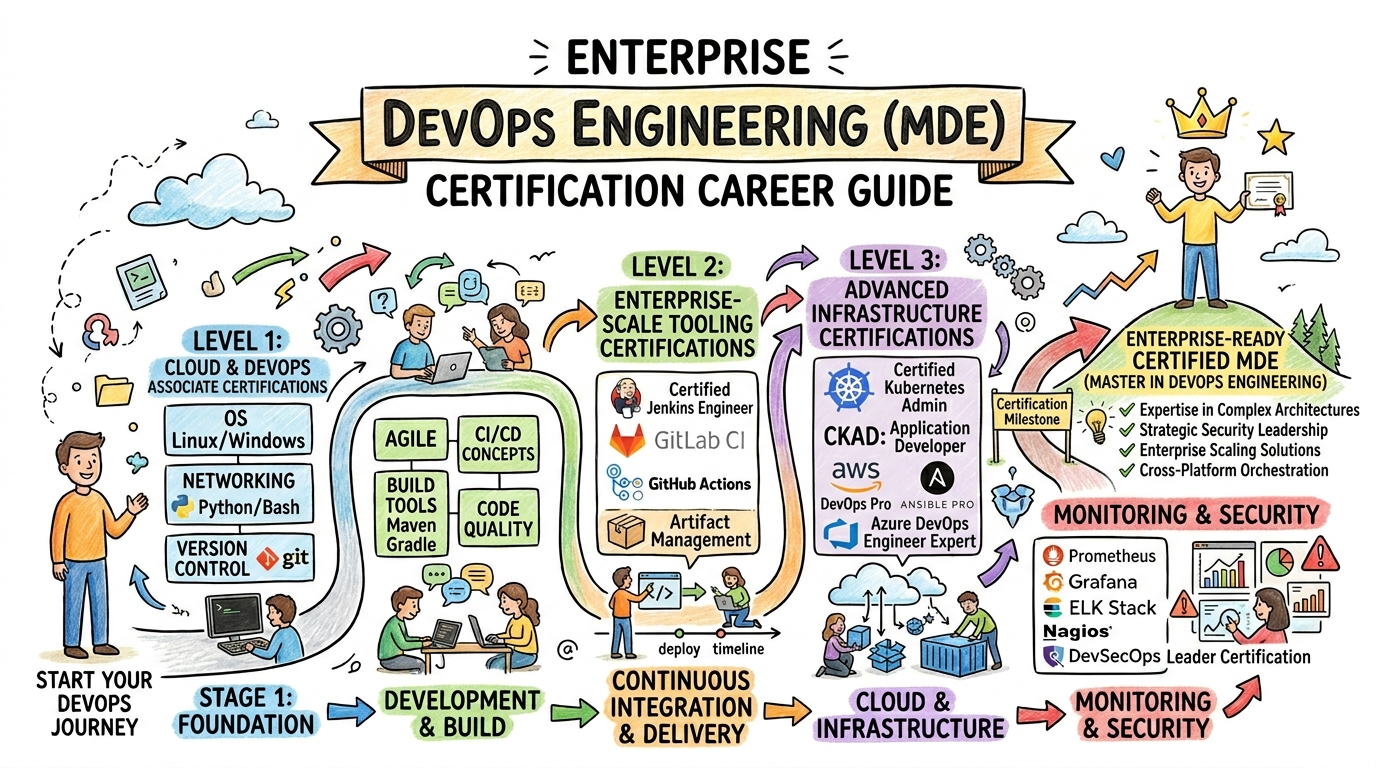
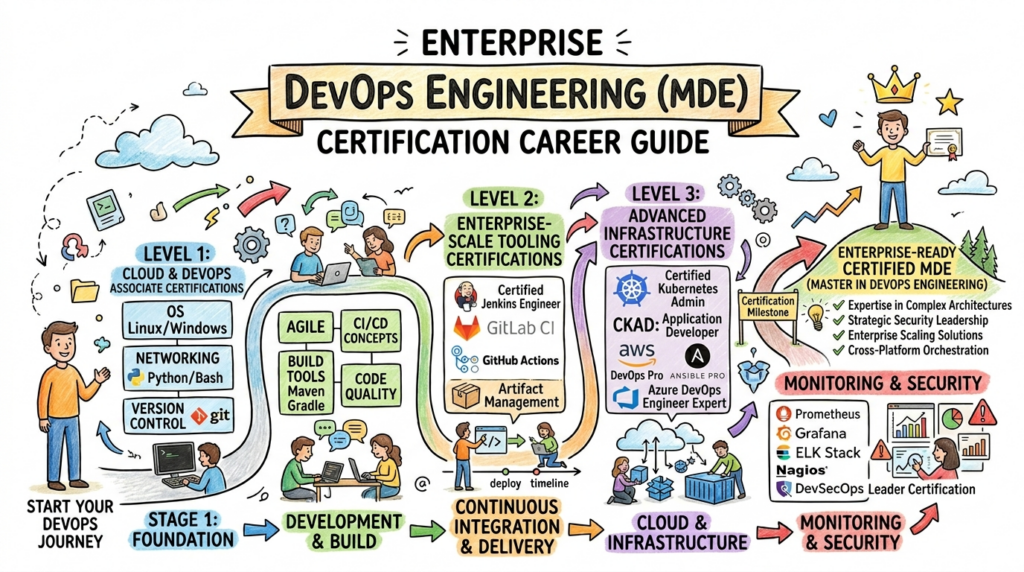
The certification is categorized into three primary levels: Foundation, Professional, and Advanced. The Foundation level focuses on the “what” and “why” of DevOps, establishing a baseline for culture and basic automation. The Professional level shifts into the “how,” requiring hands-on mastery of CI/CD, monitoring, and cloud configuration. Finally, the Advanced level is for those seeking to lead, covering architectural patterns and organizational scaling. These levels align directly with career progression, moving from Junior DevOps roles to Senior Engineer and eventually to Principal or Architect positions.
Complete Master in DevOps Engineering (MDE) Certification Table
| Track | Level | Who it’s for | Prerequisites | Skills Covered | Recommended Order |
| Core DevOps | Foundation | Aspiring Engineers | Basic Linux/Git | CI/CD, Scripting | 1 |
| System Reliability | Professional | SREs/Ops | 2+ Years Experience | Observability, K8s | 2 |
| Security/SecOps | Professional | Security Engineers | Networking Basics | DevSecOps, Vault | 3 |
| Cloud Architect | Advanced | Senior Engineers | Professional Level | Multi-cloud, IaC | 4 |
Detailed Guide for Each Master in DevOps Engineering (MDE) Certification
Master in DevOps Engineering (MDE) – [Foundation Level]
What it is
This certification validates a candidate’s understanding of the core DevOps philosophy and the basic toolchain required for modern software delivery. It serves as the baseline for all further specializations in the program.
Who should take it
It is ideal for fresh graduates, system administrators, or developers who have spent limited time in automated environments and want to understand the “big picture” of DevOps.
Skills you’ll gain
- Proficiency in version control using Git.
- Basic understanding of Continuous Integration (CI) concepts.
- Ability to write basic automation scripts in Bash or Python.
- Familiarity with containerization fundamentals using Docker.
Real-world projects you should be able to do
- Automate a code-to-build pipeline for a simple web application.
- Containerize a multi-tier application and run it locally.
- Manage environment-specific configurations using Git branches.
Preparation plan
- 7–14 Days: Focus on the “Culture of DevOps” and mastering Git commands and branching strategies.
- 30 Days: Build and tear down local environments using Docker and basic Shell scripts daily.
- 60 Days: Complete a full end-to-end project including unit testing and automated builds to solidify your knowledge.
Common mistakes
- Focusing too much on a specific tool rather than the underlying process.
- Skipping the Linux command line fundamentals in favor of GUI-based tools.
Best next certification after this
- Same-track option: MDE Professional Level.
- Cross-track option: Cloud Practitioner Certifications (AWS/Azure).
- Leadership option: Agile Scrum Master.
Master in DevOps Engineering (MDE) – [Professional Level]
What it is
This certification validates the ability to design, implement, and manage complex CI/CD pipelines and container orchestration layers in production environments.
Who should take it
Mid-level engineers with at least 2 years of experience who are responsible for maintaining uptime and scaling application infrastructure.
Skills you’ll gain
- Advanced Kubernetes cluster management and troubleshooting.
- Infrastructure as Code (IaC) mastery using Terraform or Ansible.
- Implementation of automated monitoring and alerting stacks (Prometheus/Grafana).
- Integration of security scanning into the deployment pipeline.
Real-world projects you should be able to do
- Deploy a highly available Kubernetes cluster with auto-scaling enabled.
- Create reusable Terraform modules for multi-region infrastructure deployment.
- Set up a centralized logging system for a microservices architecture.
Preparation plan
- 7–14 Days: Deep dive into Kubernetes manifests, services, and ingress controllers.
- 30 Days: Practice writing and debugging HCL (Terraform) and YAML-based CI pipelines.
- 60 Days: Perform “Chaos Engineering” drills by intentionally breaking and fixing a staging environment.
Common mistakes
- Hardcoding secrets in scripts instead of using secret management tools.
- Over-engineering simple pipelines, making them difficult for the team to maintain.
Best next certification after this
- Same-track option: MDE Advanced Level.
- Cross-track option: Certified Kubernetes Security Specialist (CKS).
- Leadership option: DevOps Leader (DOL).
Choose Your Learning Path
DevOps Path
The standard DevOps path focuses on the seamless integration of development and operations through automation. You will spend your time mastering CI/CD, version control, and configuration management. This is the bedrock of the MDE program and is essential for anyone wanting a career in modern software delivery. It is best for those who enjoy building the “highways” that code travels on.
DevSecOps Path
The DevSecOps path emphasizes that security is a shared responsibility throughout the entire lifecycle. You will learn how to integrate static and dynamic analysis tools directly into the pipeline and manage secrets securely. This path is crucial for engineers working in highly regulated industries like finance or healthcare. It transforms security from a “final hurdle” into a continuous automated process.
SRE Path
The Site Reliability Engineering (SRE) path applies software engineering principles to operations problems. You will focus on service-level objectives (SLOs), error budgets, and building self-healing systems. This path is ideal for those who are obsessed with performance, reliability, and minimizing “toil.” It teaches you how to manage massive scale without manual intervention.
AIOps / MLOps Path
This path focuses on the unique challenges of deploying Machine Learning models and using AI to manage infrastructure. You will learn about data versioning, model monitoring, and automated retraining pipelines. As enterprises integrate more AI, this role ensures that models stay accurate and infrastructure adapts to changing data patterns. It is a bridge between data science and traditional DevOps.
DataOps Path
DataOps is about streamlining the delivery of data and analytics across the organization. You will focus on automating data pipelines, ensuring data quality, and managing large-scale data warehouses. This path is perfect for those who want to apply DevOps rigors to the world of Big Data. It ensures that data is treated with the same version control and testing standards as application code.
FinOps Path
The FinOps path introduces financial accountability to the variable spend model of the cloud. You will learn how to monitor cloud costs, optimize resource usage, and align technical decisions with business budgets. This is a critical role for large organizations looking to prevent “cloud sprawl” and ensure high ROI on their infrastructure spend. It combines technical cloud knowledge with business intelligence.
Role → Recommended Master in DevOps Engineering (MDE) Certifications
| Role | Recommended Certifications |
| DevOps Engineer | MDE Foundation + MDE Professional |
| SRE | MDE Professional + Advanced SRE Modules |
| Platform Engineer | MDE Professional + IaC Specialization |
| Cloud Engineer | MDE Foundation + Multi-Cloud Modules |
| Security Engineer | MDE Professional + DevSecOps Specialization |
| Data Engineer | MDE Foundation + DataOps Path |
| FinOps Practitioner | MDE Foundation + Cloud Economics Modules |
| Engineering Manager | MDE Foundation + Leadership Track |
Next Certifications to Take After Master in DevOps Engineering (MDE)
Same Track Progression
Once you complete the Master in DevOps Engineering (MDE), the natural next step is to seek out specialized “Deep Dive” certifications. For example, if you mastered Kubernetes within MDE, you might pursue the CKA or CKAD to gain vendor-specific recognition. Deep specialization involves moving from being a generalist to a subject matter expert in one specific area of the DevOps stack, such as advanced container networking or performance engineering.
Cross-Track Expansion
The most successful engineers often broaden their skills by moving horizontally. After completing the MDE, consider exploring the Security or Data tracks to become a more versatile asset. For instance, a DevOps Engineer who learns the basics of FinOps can provide significantly more value to a company by optimizing infrastructure costs. This cross-training allows you to speak the “languages” of different departments within your organization.
Leadership & Management Track
For those looking to move away from individual contribution, the MDE provides the technical foundation needed to lead teams. Transitioning to leadership involves focusing on the “People” and “Process” parts of the DevOps trinity. You might look into certifications like the DevOps Leader (DOL) or specialized ITIL modules that focus on strategic value and team dynamics. This path is about scaling the DevOps culture across the entire enterprise.
Training & Certification Support Providers for Master in DevOps Engineering (MDE)
DevOpsSchool
As the primary provider for the MDE, DevOpsSchool offers a robust ecosystem of live training, recorded sessions, and hands-on labs. Their focus is on high-touch mentorship, ensuring that students don’t just pass an exam but actually understand how to solve production-level problems. They are known for their extensive library of real-world use cases.
Cotocus
Cotocus provides specialized consulting and training services that focus on high-end niche technologies within the DevOps space. They are particularly effective for corporate teams looking to upskill quickly on specific tools like Terraform, Kubernetes, or Vault. Their instructors are usually active consultants who bring current industry problems into the classroom.
Scmgalaxy
Scmgalaxy is one of the oldest and most respected communities for Software Configuration Management and DevOps. They provide a wealth of free resources, tutorials, and community support that complement the MDE curriculum perfectly. It is an excellent place for candidates to find peer support and troubleshooting advice during their certification journey.
BestDevOps
BestDevOps focuses on curated learning paths and bootcamps designed to get engineers job-ready in a short amount of time. Their curriculum is strictly aligned with current job market requirements in India and the US. They offer practical interview preparation alongside the technical MDE training, making them a popular choice for career switchers.
DevSecOpsSchool
For those specifically interested in the security aspect of the MDE, DevSecOpsSchool offers deep-dive training into automated security testing and compliance. They provide labs that simulate cyber-attacks and teach students how to build resilient pipelines that can withstand modern threats. Their certification support is top-tier for security-minded engineers.
Sreschool
Sreschool focuses on the reliability and operational excellence side of the MDE program. They specialize in teaching observability, incident management, and post-mortem analysis. For engineers looking to master the art of keeping systems running under high load, their specialized labs provide invaluable hands-on experience that mirrors real-world outages.
Aiopsschool
Aiopsschool is dedicated to the intersection of Artificial Intelligence and IT Operations. They provide the necessary training to understand how machine learning models can be used to predict failures and automate root cause analysis. This is a forward-looking provider that helps MDE students prepare for the future of “autonomous” infrastructure.
Dataopsschool
Dataopsschool bridges the gap between data engineering and DevOps. They provide training on how to apply CI/CD principles to data lakes and analytics pipelines. Their support is essential for MDE candidates who work in data-heavy environments and need to ensure that their data infrastructure is as reliable as their application infrastructure.
Finopsschool
Finopsschool focuses on the financial management aspect of the cloud. They teach MDE students how to read cloud bills, identify waste, and implement cost-saving measures without sacrificing performance. As cloud budgets continue to grow, the support provided by this school becomes increasingly vital for senior technical leadership roles.
Frequently Asked Questions (General)
1. Is the Master in DevOps Engineering (MDE) difficult for a beginner?
While it is comprehensive, the program starts with foundational concepts to ensure beginners can keep up. However, a basic understanding of Linux and programming will significantly help your progress.
2. How long does it typically take to complete the MDE certification?
Most professionals complete the full track in 3 to 6 months, depending on their existing experience and the amount of time they can dedicate to hands-on labs each week.
3. Do I need to know how to code to succeed in this program?
You don’t need to be a senior developer, but you should be comfortable with basic scripting (Bash/Python) and understanding the logic of application code to automate its deployment effectively.
4. What is the ROI of getting an MDE certification?
Certified engineers often see significant salary bumps and are much more likely to be recruited for high-level roles in SRE, Platform Engineering, and Cloud Architecture.
5. Are the labs included in the certification program?
Yes, the program emphasizes hands-on learning, and you will be provided with access to environments where you can practice the tools and techniques discussed in the curriculum.
6. Can I take the levels in a different order?
While you can, it is highly recommended to follow the logical progression from Foundation to Professional to ensure you don’t have gaps in your fundamental knowledge.
7. Is the MDE recognized by global tech companies?
Yes, the curriculum is designed based on industry standards used by major tech firms, making it a valuable credential in both the Indian and international job markets.
8. How often is the MDE curriculum updated?
The curriculum is reviewed and updated regularly to include the latest versions of tools and new industry best practices, such as the shift toward AI-driven operations.
9. Does the certification expire?
Most professional certifications require periodic renewal or continuing education to ensure your skills stay current with the rapidly changing tech landscape.
10. Is there community support for students?
Yes, students have access to forums and chat groups where they can interact with instructors and peers to solve problems and share knowledge.
11. Can this certification help me move into a management role?
Absolutely. By understanding the full lifecycle of software, you gain the technical authority needed to lead engineering teams and make informed strategic decisions.
12. What tools are covered in the MDE program?
The program covers a wide range of industry-standard tools including Git, Jenkins, Docker, Kubernetes, Terraform, Ansible, Prometheus, and various cloud provider services.
FAQs on Master in DevOps Engineering (MDE)
1. Is MDE better than AWS or Azure certifications?
MDE is tool-agnostic and process-focused, whereas cloud certifications are specific to one provider. MDE makes you a better engineer overall; cloud certs make you a better user of a specific platform.
2. Does MDE cover Kubernetes in-depth?
Yes, Kubernetes is a core component of the MDE Professional and Advanced levels, covering everything from basic pods to advanced networking and security.
3. What is the exam format for the MDE?
The exam is a mix of theoretical questions and practical tasks that require you to demonstrate your ability to solve real engineering problems in a lab environment.
4. Is there a prerequisite for the Foundation level?
There are no strict prerequisites, but a curiosity for how software works and a basic comfort level with a computer are essential starting points.
5. How does MDE handle “Soft Skills”?
MDE includes modules on the cultural shift of DevOps, focusing on communication, collaboration, and breaking down silos between departments.
6. Can I get a job just with the MDE certification?
While the cert is powerful, it is your ability to demonstrate the skills in the labs and interviews that will get you the job. MDE gives you the knowledge to do both.
7. Is MDE suitable for someone in a QA role?
Yes, QA engineers find great value in learning how to automate their testing within the CI/CD pipeline, often transitioning into SDET or DevOps roles.
8. Does the program cover FinOps and cost optimization?
Yes, specialized tracks within the MDE focus on cloud economics and ensuring that your infrastructure is as cost-effective as it is performant.
Final Thoughts: Is Master in DevOps Engineering (MDE) Worth It?
From a mentor’s perspective, the value of a certification isn’t in the piece of paper—it’s in the structured discipline it forces upon you. The Master in DevOps Engineering (MDE) provides a roadmap through the often-confusing world of “infinite tools” and “buzzword culture.” If you are looking for a shortcut or a magic pill for a high salary, this isn’t it. However, if you are willing to put in the hours in the lab, break things, and learn why they broke, this program will transform the way you think about systems. It is an investment in your technical foundation that will pay dividends for years, regardless of which cloud provider or tool becomes the “next big thing.” Take the path seriously, and the career growth will follow naturally.
