Introduction
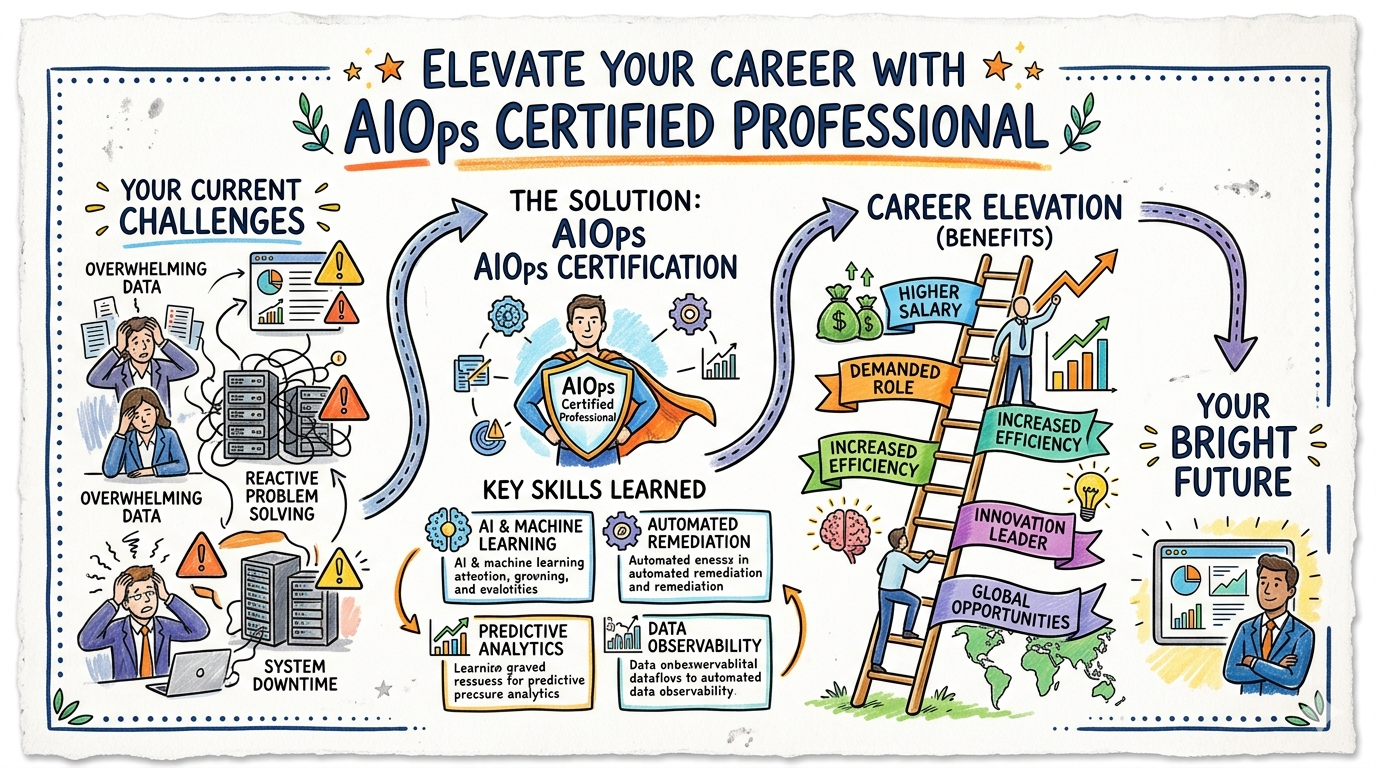
The modern IT landscape is changing quickly as systems become more complex and data-driven. Traditional monitoring is no longer enough to manage large-scale cloud environments, which is why AI-driven operations have become essential. The AiOps Certified Professional (AIOCP) is a specialized program designed for engineers who want to move beyond manual troubleshooting and adopt intelligent automation. This guide is built for professionals looking to understand how artificial intelligence and machine learning can be integrated into the framework to improve system reliability. Whether you are a developer, an operator, or a technical leader, this roadmap will help you navigate the transition from traditional practices to automated, data-centric engineering.
What is the AiOps Certified Professional (AIOCP)?
The AiOps Certified Professional (AIOCP) is a high-level validation of an engineer’s ability to apply AI and ML techniques to IT operations. It represents a shift from reactive firefighting to proactive, predictive system management. Instead of focusing solely on theoretical models, this program emphasizes real-world application, showing how to handle massive amounts of log data, traces, and metrics in production environments. It aligns perfectly with modern engineering workflows by teaching professionals how to build “self-healing” systems that can identify and resolve issues before they impact the end user.
Who Should Pursue AiOps Certified Professional (AIOCP)?
This certification is ideal for a wide range of technical roles, including DevOps engineers, Site Reliability Engineers (SREs), and Cloud Architects who manage high-scale infrastructure. Security professionals and data engineers will also find it beneficial, as the principles of anomaly detection and automated response are universal across these domains. In India and across the global market, enterprises are looking for leaders who can bridge the gap between data science and system administration. Even engineering managers who need to oversee the digital transformation of their teams will find the strategic insights provided here invaluable for long-term planning.
Why AiOps Certified Professional (AIOCP)
As organizations move toward autonomous infrastructure, the demand for professionals who understand algorithmic operations is skyrocketing. This certification provides long-term career longevity because it focuses on logic and data processing rather than just specific, fleeting tools. By mastering these concepts, you ensure that you remain relevant even as specific cloud providers or software versions change over time. The return on investment for your time is significant, as it positions you for senior roles that require a deep understanding of how to reduce operational noise and improve incident response times through intelligent automation.
AiOps Certified Professional (AIOCP) Certification Overview
The program is delivered through a structured curriculum and is hosted on devopsschool. It is designed to be practical and result-oriented, focusing on how to implement AI layers over existing DevOps and SRE toolchains. The assessment approach is built to test your ability to solve real-world problems rather than just memorizing definitions. Ownership of the learning process is encouraged through hands-on labs and case studies that reflect the challenges faced by modern enterprises. This structure ensures that once you finish the program, you have a functional understanding of how to deploy and manage AI models for operational excellence.
AiOps Certified Professional (AIOCP) Certification Tracks & Levels
The certification is divided into logical steps to support career progression, starting from the foundation and moving toward professional and advanced levels. The foundation level introduces core concepts of data science for operations, while the professional level dives into building and deploying models. Specialized tracks allow you to align the training with your specific career path, whether that is focusing on FinOps to optimize cloud costs or SRE to ensure maximum uptime. This tiered approach ensures that both beginners and seasoned veterans can find a starting point that matches their current expertise and future goals.
Complete AiOps Certified Professional (AIOCP) Certification Table
| Track | Level | Who it’s for | Prerequisites | Skills Covered | Recommended Order |
|---|---|---|---|---|---|
| Core AIOCP | Foundation | Aspiring Engineers | Basic IT knowledge | Data basics, AI logic | 1 |
| Operations | Professional | SREs / DevOps | Systems experience | Anomaly detection, ML | 2 |
| Strategic | Advanced | Tech Leads / Managers | Professional level | Strategy, Scaling AI | 3 |
| Integration | Specialist | Data Engineers | AIOCP Foundation | Pipeline automation | 4 |
Export to Sheets
Detailed Guide for Each AiOps Certified Professional (AIOCP) Certification
AiOps Certified Professional (AIOCP) – Foundation Level
What it is This level validates your understanding of the basic relationship between artificial intelligence and IT operations. It ensures you speak the language of both data science and systems engineering.
Who should take it It is suitable for junior engineers, system admins, or any professional who is new to the concept of AI-driven automation and wants a solid starting point.
Skills you’ll gain
- Understanding the lifecycle of operational data.
- Identifying the difference between traditional automation and AI.
- Learning the basic architecture of an intelligent monitoring system.
Real-world projects you should be able to do
- Setting up basic data collection from various cloud sources.
- Categorizing different types of system incidents for future analysis.
Preparation plan
- 7–14 days: Focus on terminology and the core pillars of AIOps.
- 30 days: Review case studies of how large companies use AI for monitoring.
- 60 days: Complete all introductory labs and practice exams.
Common mistakes
- Ignoring the importance of clean data before applying AI models.
- Overcomplicating the logic before understanding the underlying infrastructure.
Best next certification after this
- Same-track: AIOCP Professional
- Cross-track: SRE Foundation
- Leadership: IT Management Essentials
AiOps Certified Professional (AIOCP) – Professional Level
What it is This certification validates your ability to implement and manage machine learning models that specifically address operational bottlenecks and incident management.
Who should take it This is for mid-level engineers, SREs, and DevOps professionals who have at least a few years of experience and want to lead technical implementations.
Skills you’ll gain
- Implementing root cause analysis using machine learning.
- Reducing “alert fatigue” through intelligent noise reduction.
- Automating incident response workflows based on predicted patterns.
Real-world projects you should be able to do
- Building a dashboard that predicts potential downtime based on historical trends.
- Creating a script that automatically scales resources based on incoming traffic spikes.
Preparation plan
- 7–14 days: Deep dive into specific algorithms used for time-series data.
- 30 days: Work on hands-on projects involving log aggregation and analysis.
- 60 days: Perform full-scale simulations of system failures and recoveries.
Common mistakes
- Relying too much on the tool without understanding the logic.
- Failing to integrate the AI tool properly with existing CI/CD pipelines.
Best next certification after this
- Same-track: AIOCP Expert/Advanced
- Cross-track: DevSecOps Professional
- Leadership: Technical Program Manager
Choose Your Learning Path
DevOps Path This path focuses on integrating AI into the software delivery pipeline. You will learn how to use predictive analytics to ensure that code deployments are safe and that the infrastructure can support new features without manual intervention.
DevSecOps Path Security is a major part of operations, and this path teaches you how to use AI for threat detection. You will learn how to identify unusual patterns in user behavior or network traffic that might indicate a security breach.
SRE Path Site Reliability Engineering is about maintaining uptime. This path focuses on using AI to manage error budgets and perform automated post-mortems, helping you keep services running smoothly with minimal human effort.
AIOps Path The AIOps specific path is for those who want to specialize entirely in the data side of operations. It covers the full lifecycle of training, deploying, and maintaining models that specifically monitor and repair IT environments.
MLOps Path This path is for those who want to manage the infrastructure that supports machine learning. It focuses on the operational side of ML, ensuring that models are deployed efficiently and that the data pipelines are reliable.
DataOps Path Data is the fuel for AI, and this path ensures that the fuel is high quality. You will learn how to manage large data sets, ensure data integrity, and automate the flow of information from systems to the AI models.
FinOps Path Cloud costs can spiral out of control, and this path uses AI to predict and optimize spending. You will learn how to use intelligent tools to identify wasted resources and suggest the most cost-effective cloud configurations.
Role → Recommended (AiOps Certified Professional (AIOCP)) Certifications
| Role | Recommended Certifications |
|---|---|
| DevOps Engineer | AIOCP Foundation + AIOCP Professional |
| SRE | AIOCP Professional + Advanced SRE |
| Platform Engineer | AIOCP Foundation + Cloud Architecture |
| Cloud Engineer | AIOCP Professional + Multi-Cloud Strategy |
| Security Engineer | AIOCP Foundation + AI-Driven Security |
| Data Engineer | AIOCP Foundation + DataOps Specialist |
| FinOps Practitioner | AIOCP Foundation + Cloud Economics |
| Engineering Manager | AIOCP Foundation + Strategic Leadership |
Export to Sheets
Next Certifications to Take After AiOps Certified Professional (AIOCP)
Same Track Progression After completing the professional level, you should look toward advanced or master levels. This allows you to become an architect of these systems, designing the high-level strategy for how an entire organization handles its data and automation needs.
Cross-Track Expansion Broadening your skills is essential for a well-rounded career. You might consider moving into DevSecOps to add a security layer to your AI knowledge or SRE to focus more on the reliability and performance side of the business.
Leadership & Management Track For those who want to move away from hands-on coding, the transition to leadership is a natural step. Understanding the technical side of AI allows you to lead teams more effectively and make better decisions regarding tool selection and budget allocation.
Training & Certification Support Providers for AiOps Certified Professional (AIOCP)
DevOpsSchool This provider offers extensive resources and structured training programs for engineers looking to master modern operations. They focus on practical, lab-based learning that prepares students for the realities of production environments.
Cotocus A well-known consultancy and training firm that specializes in high-end technical certifications. They provide expert guidance for professionals looking to stay ahead in the competitive IT market through advanced skill-building.
Scmgalaxy A platform dedicated to configuration management and automation. They offer a wealth of knowledge, tutorials, and community support for those looking to improve their DevOps and AIOps capabilities through continuous learning.
BestDevOps This site provides focused training and certification paths for DevOps professionals. Their curriculum is updated regularly to reflect the latest trends and tools used in the industry, ensuring that learners stay relevant.
devsecopsschool A specialized training provider focusing on the intersection of security and operations. They help engineers integrate security into every step of the development and operational lifecycle using automated tools and AI.
sreschool Dedicated to the principles of Site Reliability Engineering, this provider offers deep-dives into monitoring, reliability, and incident management. They are a great resource for anyone looking to master the art of system uptime.
aiopsschool This platform is the primary hub for learning about AI-driven operations. It provides the specific tools, frameworks, and logic required to transition from manual operations to intelligent, automated systems management.
dataopsschool Focusing on the management and flow of data, this provider helps engineers build the foundational pipelines needed for successful AI implementation. They emphasize data quality and automated delivery systems.
finopsschool A specialized resource for cloud financial management. They teach engineers and managers how to use data and AI to keep cloud costs under control while maintaining high performance and scalability.
Frequently Asked Questions (General)
- How difficult is it to get this certification? While the concepts are advanced, the structured curriculum makes it accessible for anyone with a solid background in IT operations and basic automation.
- How long does it typically take to complete the training? Most professionals find that 30 to 60 days of consistent study is enough to feel confident and pass the required assessments.
- What are the main prerequisites for starting? A basic understanding of Linux, cloud environments, and some experience with automation tools like Python or Ansible is highly recommended.
- Is there a high return on investment for this program? Yes, as companies shift toward automated operations, professionals with AI skills often command higher salaries and have access to more senior roles.
- Do I need to be a data scientist to learn this? No, this program is designed for engineers. You will learn the necessary data science concepts as they apply specifically to operations.
- Can I take the exam online? Yes, most modern certification providers offer remote proctoring, allowing you to take your assessment from the comfort of your home or office.
- How often do I need to renew my certification? Typically, these certifications remain valid for two to three years, after which you may need to take a refresher course or an updated exam.
- Are there any hands-on labs included in the training? Yes, the program emphasizes practical learning, so you will spend a significant amount of time working in real cloud environments and lab settings.
- Will this certification help me get a job in India? Absolutely. The Indian IT market is rapidly adopting AI and cloud-native technologies, making this a highly sought-after credential in major tech hubs.
- What is the difference between DevOps and AIOps? DevOps focuses on the collaboration and automation of software delivery, while AIOps uses artificial intelligence to enhance and automate those operational tasks.
- Should I learn SRE before jumping into this? While not strictly required, having a foundation in SRE principles can make the transition to AI-driven operations much smoother and more intuitive.
- What kind of support is available if I get stuck? Most providers offer community forums, expert-led webinars, and direct support channels to help you through the more challenging parts of the course.
FAQs on AiOps Certified Professional (AIOCP)
- What is the core focus of the AIOCP exam? The exam focuses on your ability to apply machine learning models to solve operational problems like incident detection and resource optimization.
- Are there different levels of AIOCP? Yes, it typically spans from Foundation to Professional and Expert levels, allowing for a gradual increase in technical depth and responsibility.
- Does AIOCP cover specific tools like Splunk or ELK? While it covers the logic used by these tools, the certification is designed to be vendor-neutral so the skills are applicable to any platform.
- How does AIOCP handle data privacy? The training includes best practices for managing operational data securely and ensuring that AI models comply with enterprise privacy standards.
- Is AIOCP recognized globally? Yes, the certification is designed to meet international standards for IT excellence, making it valuable for engineers working in any country or region.
- Can I specialize in a specific cloud provider? While the core concepts are universal, the training often includes labs that allow you to practice on major platforms like AWS, Azure, or Google Cloud.
- What is the passing score for the assessment? The passing score varies depending on the specific track, but generally, a 70% or higher is required to demonstrate professional competence.
- Are there any group discounts for corporate teams? Many training providers offer special pricing for companies that want to certify their entire engineering or operations department at once.
Final Thoughts: Is AiOps Certified Professional (AIOCP) Worth It?
As a mentor who has watched the industry evolve through many cycles, I can tell you that the shift toward AI is not a temporary trend. It is the next logical step in the evolution of engineering. If you are looking for a way to stand out and handle the increasing complexity of modern systems, this certification is a very practical investment. It doesn’t just add a title to your resume; it changes the way you think about solving problems. Instead of looking for a needle in a haystack, you learn how to build a system that finds the needle for you. If you are willing to put in the time to learn the logic behind the data, you will find yourself in a very strong position for years to come.
