Introduction
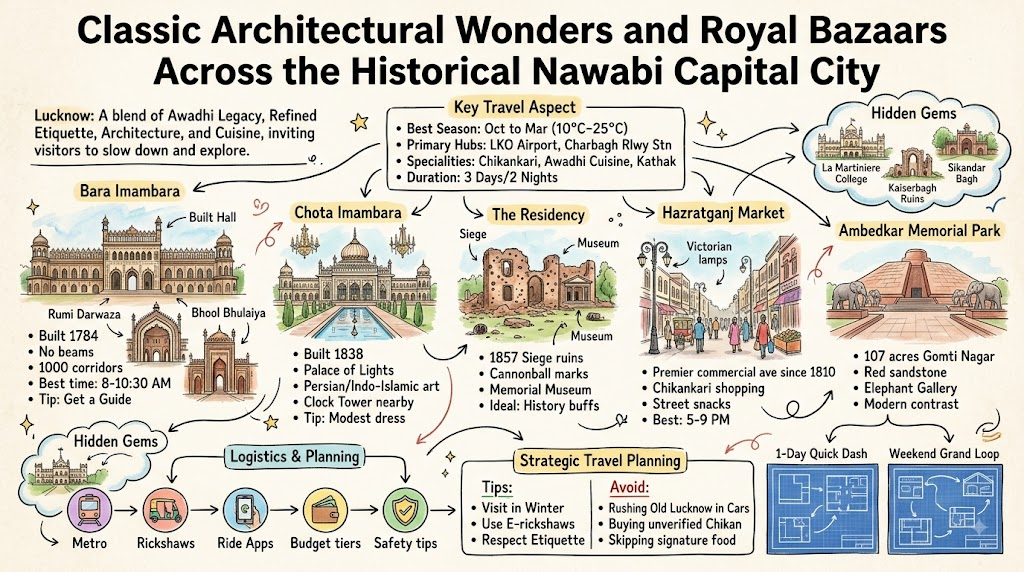
While rush-hour crowds flood standard heritage circuits, Lucknow moves to an entirely different rhythm. Steeped in royal Awadhi legacy, this destination offers an authentic cultural connection where refined etiquette, architectural splendor, and world-renowned culinary arts take center stage.
Instead of hurried tourist loops, the city invites visitors to slow down, explore ornate arched gateways, and immerse themselves in centuries-old markets.
Why Lucknow is a must-visit city
Lucknow holds immense historical, architectural, and artistic weight as the former seat of the Nawabs of Awadh. Geographically positioned along the meandering Gomti River, it bridges the gap between ancient Ganga-Jamuni tehzeeb (syncretic culture) and modern urban expansions. The city is exceptionally accessible via the Lucknow Airport (LKO), Charbagh Railway Station, and major expressways, making it seamless for budget backpackers, heritage enthusiasts, and luxury travelers alike.
The local travel circuit spans two distinct worlds: the atmospheric historic core of Old Lucknow (Chowk and Aminabad) and the wide, manicured avenues of New Lucknow (Gomti Nagar and Hazratganj).
| Key Travel Aspect | Operational & Practical Detail |
| Best Season | October to March (pleasant winter temperatures between 10°C and 25°C) |
| Primary Transit Hubs | Chaudhary Charan Singh International Airport, Lucknow Charbagh Railway Station |
| Cultural Specialities | Chikankari embroidery, Zardozi craft, Awadhi Mughlai cuisine, Kathak dance |
| Ideal Trip Duration | 3 Days / 2 Nights for a comprehensive cultural exploration |
Best Places to Buy Souvenirs in Lucknow
Bara Imambara
Built in 1784 by Nawab Asaf-ud-Daula during a devastating famine, this monumental complex stands as a masterclass in Mughal-Awadhi engineering. The main vaulted hall was constructed without a single wooden beam or iron pillar, relying entirely on interlocking brickwork and lime mortar.
The upper levels house the famous Bhool Bhulaiya, a dense labyrinth of over 1,000 corridors designed to confuse potential invaders while offering acoustic amplification where whispers travel across long walls.
- Location: Machchhi Bhavan, Old Lucknow; roughly 5 km from Charbagh Railway Station.
- Why it is worth visiting: Home to one of the world’s largest unsupported arched halls and an architectural maze with panoramic city views.
- Best things to do: Navigate the corridors of the Bhool Bhulaiya with a licensed guide, admire the Asfi Mosque, and inspect the multi-storied Shahi Baoli (stepwell).
- Best time to visit: 8:00 AM to 10:30 AM to beat midday crowds and capture soft morning light on the brick facade.
- Ideal for whom: History buffs, architecture lovers, photographer enthusiasts, and families.
- Travel tip: Rent a guide at the entrance gate to avoid getting lost in the upper maze and to learn the acoustic secrets of the walls.
Chota Imambara
Constructed in 1838 by Muhammad Ali Shah, the Chota Imambara (or Imambara of Hussainabad) showcases intricate Persian and Indo-Islamic aesthetics. Its interiors are decorated with gilded chandeliers imported from Belgium, gold-bordered calligraphy, and historic mirrors, earning it the moniker “Palace of Lights.”
The courtyard features manicured gardens, a raised water basin reflecting the central dome, and smaller scale replicas of the Taj Mahal that serve as royal tombs.
- Location: Hussainabad, Old Lucknow; about 1.5 km west of Bara Imambara.
- Why it is worth visiting: Outstanding preservation of 19th-century royal interiors, crystal chandeliers, and delicate calligraphy.
- Best things to do: Photograph the reflecting pool, inspect the brass chandeliers inside the prayer hall, and admire the adjacent Husainabad Clock Tower.
- Best time to visit: Late afternoon around 4:30 PM, staying until sunset when the exterior illuminations are turned on.
- Ideal for whom: Cultural travelers, couples, art historians, and solo explorers.
- Travel tip: Modest clothing is required to enter the main hall; ensure your shoulders and knees are covered, and carry a head scarf.
The Residency
The Residency complex consists of preserved ruins where British forces were besieged during the Uprising of 1857. Shaded by ancient trees, the pockmarked brick structures still retain visible cannonball marks and bullet scars from the historic siege.
The site includes the Main House, the ruined Church, stepwells, and an underground museum displaying artifacts, maps, and paintings from the 1850s.
- Location: Mahatma Gandhi Marg, Deep Narayan Road, near Hazratganj.
- Why it is worth visiting: A poignant historical sanctuary offering direct physical evidence of the events of 1857.
- Best things to do: Explore the 1857 Memorial Museum, walk through the overgrown church graveyard, and photograph the cannonball-dented facades.
- Best time to visit: 7:00 AM to 9:30 AM for peaceful morning walks and clear shadows.
- Ideal for whom: Heritage researchers, solo travelers, quiet seekers, and history enthusiasts.
- Travel tip: Carry a water bottle and wear comfortable walking shoes as the complex stretches across several sprawling green acres.
Hazratganj Market
Hazratganj has served as the city’s premier commercial avenue since 1810. Redesigned with Victorian-style Victorian lamp posts, black-and-white unified store signage, and wide footpaths, “Ganging” (promenading here) is a beloved local ritual.
It hosts flagship heritage boutiques for Chikankari embroidery, classic bookshops like Ram Advani, and legendary culinary joints serving local street food.
- Location: Central Lucknow; roughly 3 km from the main railway station.
- Why it is worth visiting: The ultimate destination for authentic Chikankari textile shopping and heritage street snacking.
- Best things to do: Shop for handcrafted Chikankari kurtas at Sewa or Janpath, enjoy a plate of Royal Cafe Basket Chaat, and browse old book stalls.
- Best time to visit: 5:00 PM to 9:00 PM when streetlights turn on and shopping arcades come alive.
- Ideal for whom: Shoppers, street food lovers, urban walkers, and fashion enthusiasts.
- Travel tip: Haggle respectfully in smaller side-lane shops, but stick to fixed-price government emporia for verified hand-loomed textiles.
Ambedkar Memorial Park
Spanning over 107 acres in modern Gomti Nagar, this massive contemporary park is crafted almost entirely from red sandstone brought from Rajasthan. Built to honor historical social reformers, the park features grand avenues flanked by dozens of life-sized stone elephant statues.
The central dome structure and wide elevated plazas present a striking contrast against the city’s older 18th-century monuments.
- Location: Vipul Khand, Gomti Nagar; approximately 8 km from the old city center.
- Why it is worth visiting: A modern architectural scale model showcasing Rajasthan sandstone masonry and grand spatial design.
- Best things to do: Walk down the Elephant Gallery, photograph the central stupa at golden hour, and enjoy views of the nearby Gomti Riverfront.
- Best time to visit: 5:30 PM to 7:30 PM to avoid stone heat during peak sun and experience evening floodlighting.
- Ideal for whom: Modern architecture enthusiasts, evening walkers, and photography buffs.
- Travel tip: The open sandstone plazas radiate heat; carry an umbrella or sun protection if visiting before late afternoon.
Offbeat Exploration: Hidden Gems Tourists Miss
La Martiniere College (Constantia)
Designed and built in the late 18th century by French adventurer Major General Claude Martin, this European-style palace-turned-school is a blend of Italianate arches, Gothic gargoyles, and classical statues. Hidden away from typical tour buses, the grounds feature Martin’s subterranean tomb, grand terrace towers, and heritage hallways.
Kaiserbagh Palace Complex Ruins
While much of the original Kaiserbagh quadrangle was dismantled over time, the remaining gateways (Lakhi Darwaza) and central white pavilion (Safed Baradari) offer a glimpse into royal court life. Strolling through these quiet residential pockets reveals original stucco relief work hidden within residential neighborhoods.
Sikandar Bagh
The site of intense conflict during the Siege of Lucknow in 1857, Sikandar Bagh now stands as a peaceful botanical garden enclosed by original fortification walls. It is an ideal off-the-beaten-path destination for travelers looking to escape noisy city markets while learning about local history.
Detailed Practical Guidance for Travelers
| Destination | Standard Entry Fee | General Timings | Best Local Food Options Nearby | Recommended Nearby Attractions |
| Bara Imambara | ₹50 (Indian), ₹500 (Foreigner) | 6:00 AM – 5:00 PM (Closed Mon) | Tunday Kababi (Chowk), Rahim’s Nihari | Rumi Darwaza, Chota Imambara |
| Chota Imambara | Included in combined ticket | 6:00 AM – 5:00 PM | Idrees Biryani, Street Halwa Paratha | Husainabad Clock Tower, Satkhanda |
| The Residency | ₹25 (Indian), ₹300 (Foreigner) | 7:00 AM – 6:00 PM | Mughal Dastarkhwan, Kulcha Nihari | Hazratganj, General Koba Temple |
| Hazratganj Market | Free entry | 10:00 AM – 11:00 PM | Royal Cafe Basket Chaat, JJ Bakers | Janpath Market, Cathedral Church |
| Ambedkar Park | ₹20 per person | 11:00 AM – 9:00 PM | Cafe Mocha, Gomti Nagar Eateries | Gomti Riverfront Park, Janeshwar Mishra Park |
Logistics & On-Ground Navigation
Local Transport Options
- Lucknow Metro: Fast, clean, and climate-controlled. Excellent for moving north-south between the Airport, Charbagh Railway Station, and Hazratganj.
- Auto-Rickshaws & E-Rickshaws: E-rickshaws are ideal for navigating the narrow, crowded lanes of Chowk and Aminabad where cars cannot easily enter.
- Ride-Sharing Apps: Uber and Ola operate reliably throughout the city for point-to-point travel between Old Lucknow and Gomti Nagar.
- Car Rentals: Recommended only if planning full-day trips out to historical estates or regional suburbs.
Budget Planning
- Budget / Backpacking Tier: ₹1,200 – ₹1,800 per day (Stay in central hostels/budget guesthouses, travel via Metro/E-rickshaws, eat street food in Chowk).
- Mid-Range / Comfort Tier: ₹4,000 – ₹7,000 per day (Stay in heritage hotels or 4-star properties, use private app cabs, dine at sit-down Awadhi restaurants like Dastarkhwan).
Safety and Inclusivity Tips
- For Families: Stick to well-paved heritage spots in the morning; keep children close in crowded bazaars like Aminabad.
- For Couples: Public parks like Janeshwar Mishra Park and Gomti Riverfront offer clean, safe spaces for evening strolls.
- General Safety: Keep valuables secured in front-facing bags while navigating busy markets, and drink bottled water during hot afternoon trips.
Strategic Travel Planning Guardrails
Travel Planning Tips for Lucknow
- Plan around winters: Visit between November and February to comfortably explore open heritage grounds without intense heat.
- Carry cash for Old Lucknow: While digital UPI payments are widespread, cash remains king for small food stalls and rickshaw drivers in Chowk.
- Respect monument etiquette: Remove shoes before stepping onto carpeted prayer areas inside Imambaras; cover shoulders and head where requested.
- Check closing days: Note that select monuments and local markets close on Mondays for weekly maintenance.
- Pace your food trials: Take small food portions when exploring street stalls to sample multiple snacks without overeating.
Common Mistakes to Avoid
- Rushing Old Lucknow in a car: Cars easily get stuck in narrow heritage lanes; walk or use e-rickshaws instead.
- Shopping at high-end tourist traps: Avoid buying Chikankari embroidery at unverified roadside stalls; stick to certified stores or heritage shops.
- Skipping breakfast delicacies: Missing early-morning Nihari Kulcha or Khasta Kachori deprives you of quintessential local cuisine.
- Overpacking daily routes: Trying to visit both Old and New Lucknow monuments on the same morning creates unnecessary transit delay.
- Ignoring non-meat dishes: Assuming Lucknow only caters to meat eaters is a mistake; local vegetarian snacks like Basket Chaat and Badam Milk are exceptional.
Suggested Itinerary Blueprints
- 1-Day Quick Dash (The Heritage & Kebab Express)
- Target Audience: Short-stay business travelers or quick transit visitors.
- Morning: Tour Bara Imambara, Bhool Bhulaiya, and Rumi Darwaza.
- Afternoon: Feast on Galouti Kebabs at Chowk.
- Evening: Promenade along Hazratganj and shop for Chikankari textiles.
- 2-Day Deep-Dive (The Awadhi Culture & Cuisine Circuit)
- Day 1: Explore Old Lucknow—Bara Imambara, Chota Imambara, Husainabad Clock Tower, ending with a food crawl through Chowk.
- Day 2: Visit The Residency in the morning, explore La Martiniere College in the afternoon, and finish with dinner at Hazratganj.
- Complete Weekend Travel Plan (The Grand Royal Loop)
- Friday Evening: Check into your hotel; enjoy modern cafe dining in Gomti Nagar.
- Saturday: Full-day heritage focus—Imambara complexes, Rumi Darwaza, Chowk market bazaars, and evening shopping at Aminabad.
- Sunday: Morning walks at The Residency, La Martiniere exploration, golden hour at Ambedkar Memorial Park, and farewell dinner.
Common Tourist Mistakes to Avoid
- Geographic Blunders: Trying to mix Old Lucknow (Chowk) and New Lucknow (Gomti Nagar) during peak traffic hours causes wasted transit time.
- Commercial Traps: Spending all your shopping budget at air-conditioned malls rather than exploring historical bazaars like Aminabad and Chowk.
- Neglecting Modern Zones: Focusing exclusively on ruins while skipping the expansive parks, riverfronts, and cafes of modern Gomti Nagar.
- Transport Overpayment: Accepting unmetered auto quotes without cross-checking prices on ride-hailing apps like Uber or Ola.
- Luxury Dining Bias: Eating only at fine-dining hotels instead of experiencing historical, family-run food stalls in Chowk.
Frequently Asked Questions
1. What is the best time of year to visit Lucknow?
The ideal period to visit is from October to March when the winter weather is cool and pleasant for outdoor heritage tours.
2. How many days are sufficient for a complete trip?
A 3-day trip provides ample time to explore major monuments, sample classic food stalls, and shop for hand-crafted textiles without rushing.
3. Is Lucknow safe for solo travelers?
Yes, the city is generally safe and welcoming. Standard urban travel precautions apply when navigating busy night markets.
4. What is the most famous souvenir to buy in Lucknow?
Authentic hand-embroidered Chikankari garments and traditional Zardozi textiles are the top items to take home.
5. How do I reach Old Lucknow from the airport?
Take the Lucknow Metro directly from the airport to Charbagh or Hazratganj, then hire an e-rickshaw for entry into Chowk.
6. Are vegetarian food options easily available?
Yes, while famous for meat dishes, options like Basket Chaat, Khasta Kachori, and traditional sweets are widely available across the city.
7. Can I enter the monuments in Western clothes?
Yes, but modest clothing covering shoulders and knees is recommended out of respect for active religious grounds.
8. Is photography permitted inside the Imambara complexes?
Photography is permitted in outdoor courtyards, though flash photography may be restricted inside specific prayer halls.
9. What is the difference between Bara Imambara and Chota Imambara?
Bara Imambara features massive scale, the labyrinthine Bhool Bhulaiya, and stepwells. Chota Imambara is smaller, housing ornate chandeliers, calligraphy, and mirrors.
10. Do I need to book entry tickets in advance?
Tickets can be purchased at on-site counters, though booking online via official ASI portals saves time during peak holiday weekends.
11. What local transport is best for narrow market lanes?
E-rickshaws and auto-rickshaws are the most efficient modes of transport through tight bazaar lanes.
12. What is the signature breakfast dish in Lucknow?
Slow-cooked Kulcha Nihari or crispy Khasta Kachori with spiced potatoes are the quintessential morning meals.
Conclusion
Choosing a journey to Lucknow means stepping beyond standard sightseeing and immersing yourself in a rich living tradition. From the intricate corridors of centuries-old monuments to the vibrant aromas of historic food lanes, this city offers a deeply rewarding travel experience.
