Introduction
Modern shopping malls with sterile glass facades and carbon-copy retail chains have rendered contemporary travel shopping predictable and devoid of soul. Aminabad Market in Lucknow dramatically shatters this monotony, offering an intoxicating immersion into centuries of living Nawabi trade, artisanal mastery, and sensory splendor. Stepping onto its sun-dappled cobblestones and bustling lanes instantly connects you with an authentic urban ecosystem where history is actively woven, stitched, and cooked daily.
While mainstream travelers drift toward sterile commercial zones, those who venture into Aminabad unlock the true cultural heartbeat of Awadh. Here, the clinking of brass utensils, the delicate fragrance of pure attar, and the rustle of hand-embroidered Chikan silk tell stories passed down through generations. Visiting this timeless marketplace is not merely a shopping trip; it is an irreplaceable rite of passage for cultural explorers seeking raw, unapologetic authenticity.
Why Aminabad Market Lucknow is a must-visit city
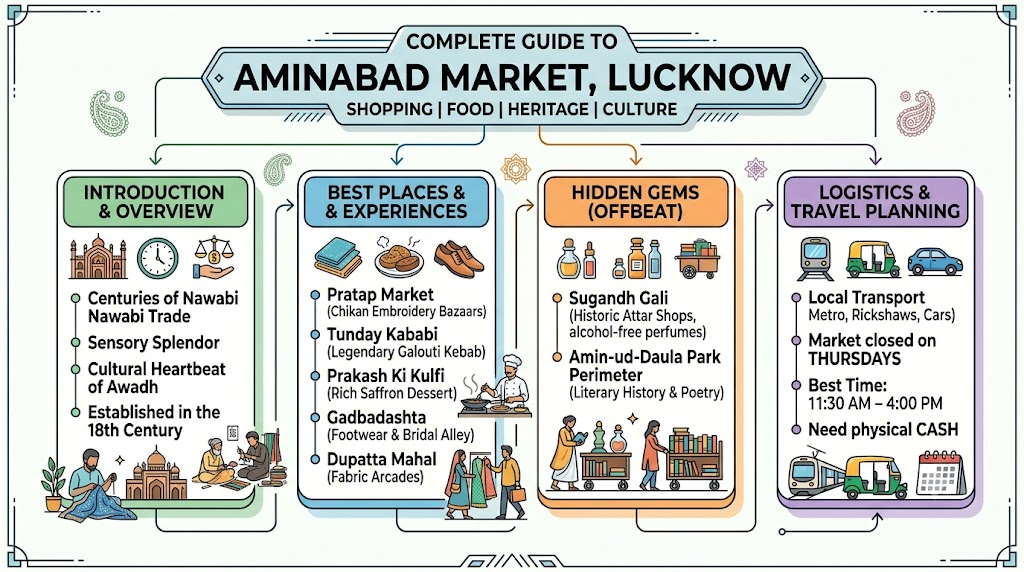
Aminabad Market stands as an indispensable chapter in India’s regional commercial history, functioning continuously as a premier trade powerhouse since the era of the Nawabs of Awadh. Established initially during the 18th century and later expanded by Nawab Imdad Husain Khan Amin-ud-Daula, the market sits at the geographical and cultural intersection of Lucknow. Its strategic position inside the city center makes it easily accessible via direct highway routes, Charbagh Railway Station, and the modern Lucknow Metro, accommodating every travel archetype from budget backpackers to luxury culture hunters.
The travel circuit surrounding Aminabad seamlessly bridges historic commerce, legendary gastronomy, and sacred architecture. Within a single square kilometer, visitors transition from century-old Chikan embroidery ateliers to legendary street kitchens that pioneered royal Awadhi recipes.
| Key Metric / Category | Market Detail |
| Market Designation | Historic Commercial & Heritage Bazaar District |
| Nearest Airport | Chaudhary Charan Singh International Airport (LKO) (~14 km) |
| Nearest Transit Stations | Lucknow Charbagh Railway Station (~2.5 km), Hazaratganj / Charbagh Metro |
| Signature Craft Specialties | Chikan Embroidery, Zardozi Work, Handcrafted Footwear (Juttis) |
| Famous Culinary Staples | Tunday Kababi Galouti, Prakash Ki Kulfi, Biryani, Sheermal |
Best Places or Experiences
Chikan Embroidery Bazaars of Pratap Market
Pratap Market, nestled firmly within the sprawling wings of Aminabad, serves as the global heartland for authentic hand-embroidered Lucknowi Chikan work. For generations, master artisans and generational merchants have traded here, offering delicate stitches such as Bakhiya, Phanda, and Tepchi carved delicately onto soft muslins, silks, and georgettes. Walking through these tightly packed lanes reveals fabric displays bursting with pastels and intricate geometric florals that reflect royal Awadhi aesthetics.
Unlike mass-produced factory alternatives found in modern shopping centers, the textiles sold here carry the distinct touch of regional craft families. Navigating the cozy shops allows travelers to witness fine textile evaluation firsthand while interacting with merchants who possess decades of material knowledge.
- Location: Central Aminabad Circle, 2.5 kilometers from Charbagh Railway Station.
- Why it is worth visiting: It offers the world’s most extensive selection of genuine, hand-stitched Chikan garments directly from master wholesale houses.
- Best things to do: Examine fine hand-stitch craftsmanship against light, negotiate for authentic handmade cotton kurtas, and custom-tailor bespoke ethnic wear.
- Best time to visit: Late morning between 11:30 AM and 2:00 PM when crowds are manageable and daylight highlights fabric detail.
- Ideal for whom: Fashion enthusiasts, textile collectors, culture lovers, and wedding shoppers.
- Travel tip: Always inspect the reverse side of Chikan garments; neat, delicate hand-knotting indicates authentic handcraft rather than stiff machine replication.
Tunday Kababi Historic Outlet
Tunday Kababi in Aminabad is an iconic culinary sanctuary world-renowned for its melt-in-your-mouth Galouti Kebabs. Established in 1905 by Haji Murad Ali, the legendary outlet gained fame for perfecting a recipe incorporating over 100 aromatic spices, designed originally for a toothless Nawab. The tiny, unpretentious dining hall hums with fast-paced energy, smoky aromas, and non-stop crowds of eager food lovers.
Tasting these velvety kebabs paired with hot, flaky Parathas offers a direct, sensory connection to the culinary secrets of the royal Awadhi courts. It remains an absolute landmark experience that defines the street food identity of the region.
- Location: Nazirabad Lane, Aminabad, 3 kilometers from Lucknow City Center.
- Why it is worth visiting: It is the birthplace of the world-famous Galouti Kebab, serving an unchanged century-old secret recipe.
- Best things to do: Savor fresh Galouti Kebabs with crispy Mughlai Parathas, watch skilled cooks flip kebabs on massive brass skillets, and absorb the bustling historic atmosphere.
- Best time to visit: Early afternoon at 1:00 PM or early evening around 6:30 PM to avoid peak dinner wait times.
- Ideal for whom: Culinary travelers, food historians, non-vegetarian gourmets, and solo explorers.
- Travel tip: Arrive slightly ahead of traditional meal hours because queues can wrap around the alley during peak lunch and dinner hours.
Prakash Ki Kulfi
Operating since 1956, Prakash Ki Kulfi stands as Aminabad’s undisputed dessert temple, famous for its rich, velvety Kesar Pista Falooda Kulfi. Crafted using churned condensed milk infused with pure saffron and pistachios, this legendary sweet treat is served topped with golden yellow starch noodles. The small, brightly lit shop stays continuously packed with happy visitors cooling off after intensive market shopping.
The dessert offers a rich, satisfying contrast to the savory, spiced kebabs of neighboring eateries. Spending ten minutes here enjoying a plate is a classic ritual for anyone exploring the market lanes.
- Location: Main Aminabad Intersection, directly opposite Janpath Market entrances.
- Why it is worth visiting: It serves the region’s premier saffron-infused Kulfi Falooda, maintaining strict traditional recipes for over half a century.
- Best things to do: Enjoy a signature plate of Kesar Falooda Kulfi, photograph the vibrant golden presentation, and enjoy late-night dessert culture.
- Best time to visit: Late afternoon to late night (4:00 PM to 10:30 PM) for the ultimate post-shopping refresher.
- Ideal for whom: Families, sweet lovers, dessert fans, and tired shoppers needing an energy boost.
- Travel tip: Payment is processed quickly at a central counter first; secure your paper token before queueing up at the dessert counter.
Gadbadashta Footwear and Bridal Alley
Gadbadashta represents the vibrant, glittering arterial lane of Aminabad dedicated exclusively to traditional Indian footwear, embellished Juttis, and ornate bridal accessories. Lined with hundreds of stacked shelves displaying shimmering sequins, velvet lacings, and handcrafted leather footwear, this alley visually dazzles from end to end. Artisans fit custom shoes on the spot, adapting traditional footwear designs for modern comfort.
The vibrant atmosphere, marked by spirited price negotiations and sparkling window displays, captures the celebratory spirit of classic Indian wedding preparations.
- Location: Western wing of Aminabad Market, 2.8 kilometers from Charbagh Metro Station.
- Why it is worth visiting: Unbeatable variety and prices for hand-stitched leather Mojris, Juttis, and handcrafted accessories.
- Best things to do: Try on hand-embroidered velvet Juttis, shop for embellished wedding bangles, and watch shoe craftsmen stretch footwear for custom fits.
- Best time to visit: 3:00 PM to 6:00 PM for peak energy and fully opened vendor stalls.
- Ideal for whom: Festive shoppers, footwear lovers, photographers, and culture travelers.
- Travel tip: Wear comfortable slip-on socks when testing multiple pairs of Juttis to ensure easy fitting and personal hygiene.
Dupatta Mahal and Fabric Arcades
Dupatta Mahal is a multi-story market enclave entirely dedicated to fine drapes, flowing scarves, and custom-dyed fabrics. Thousands of hung dupattas in every conceivable fabric—from shimmering Banarasi brocades and delicate Chanderi silks to featherlight Kota doria—create a vivid canopy of colors overhead. Skilled dye masters operate nearby, matching fabric shades to customer specifications using traditional hand-dyeing basins.
For creative dressmakers and design travelers, this destination offers endless opportunities to craft custom ethnic outfits at fraction of designer costs.
- Location: Central Aminabad Plaza, near Sri Ram Tower lane.
- Why it is worth visiting: The highest concentration of specialized fabric dyers, matchers, and luxury drape vendors under one roof.
- Best things to do: Source rare handcrafted dupattas, watch live custom fabric dyeing in adjoining lanes, and match contrast trims for custom outfits.
- Best time to visit: 12:00 PM to 3:00 PM when shops are fully stocked and lighting allows accurate color matching.
- Ideal for whom: DIY fashion designers, shoppers, brides, and textile enthusiasts.
- Travel tip: Bring a small swatch of your base outfit if you intend to custom-dye or match dupattas accurately under natural light.
Offbeat Exploration: Hidden Gems Tourists Miss
The Historic Attar Shops of Sugandh Gali
Tucked silently behind the bustling main fashion corridors lies Sugandh Gali, a quiet alley home to traditional perfume distillers operating since the Nawabi era. These historic perfumers formulate pure, alcohol-free Attars using ancient steam-distillation techniques, capturing botanical essences like Mitti (baked earth), Ruh Gulab (pure rose), and Kewra inside decorated glass vessels (Kupis).
Insider Cultural Tip: Ask the elder shopkeepers for a whiff of authentic Attar Gill, which accurately captures the exact olfactory fragrance of fresh rain falling on dry summer earth.
Amin-ud-Daula Park Heritage Perimeter
While tourists usually zoom past to hit shops, the historic perimeter around Amin-ud-Daula Park offers a quiet glimpse into 19th-century urban planning and literary history. The park was once a famous gathering ground for freedom fighters, poets, and intellectual debates during India’s independence movement.
Walking along its perimeter reveals aged colonial-era archways, second-hand heritage book carts, and quiet tea stalls where elderly locals gather to recite traditional Urdu poetry (Shayari).
Detailed Practical Guidance for Travelers
| Destination | Standard Entry Fee | General Timings | Best Local Food Options Nearby | Recommended Nearby Attractions |
| Pratap Market | Free Public Access | 11:00 AM – 9:00 PM | Netram Sweets (Kachori), Alamgir Hotel | Chowk Heritage Zone, Janpath Market |
| Tunday Kababi | Free (Meal Costs Apply) | 12:30 PM – 11:00 PM | Galouti Kebabs, Mutton Biryani at outlet | Nazirabad Bazaar, Sri Ram Tower |
| Prakash Ki Kulfi | Free (Item Costs Apply) | 11:00 AM – 11:00 PM | Kesar Pista Falooda Kulfi | Amin-ud-Daula Park, Dupatta Mahal |
| Gadbadashta Lane | Free Public Access | 11:30 AM – 9:00 PM | Street Chaat, Matka Kulfi stalls | Pratap Market, Garbar Jhala |
| Dupatta Mahal | Free Public Access | 11:00 AM – 8:30 PM | Royal Cafe Chaat (short drive), Netram | Janpath Market, Hazratganj |
Logistics & On-Ground Navigation
Local Transport Options
- Lucknow Metro Rail: The most stress-free option; disembark at Charbagh or Hazaratganj stations and take a 5-minute electric rickshaw to the main market arch.
- Auto-Rickshaws & E-Rickshaws: Ideal for direct drop-offs right at the narrow entries of Nazirabad or Pratap Market where standard passenger cars get stuck.
- Private Cars & App Cabs: Not recommended for direct market entry due to heavy congestion; ask drivers to drop you off at the outer perimeter near Sri Ram Tower.
Budget Planning
- Backpacker / Shoestring Tier: ₹1,000 – ₹1,800 per day; covers street food meals (kebabs and kulfi), e-rickshaw transit, and modest shopping for cotton Chikan accessories.
- Comfort / Mid-Range Tier: ₹3,500 – ₹7,000 per day; covers comfortable hotel base outside the market, private cab transfers, extensive Chikan suits, footwear purchases, and sit-down dining.
Safety and Inclusivity Tips
- For Families: Keep small children close by hand or in front carriers; dense crowd surges in lanes like Gadbadashta make traditional strollers impractical.
- For Couples & Solo Female Travelers: Dress in modest attire (slacks, kurtas, or modest tops) to blend in smoothly; secure cross-body bags firmly across your chest to prevent pickpocketing.
- General Safety Note: Keep wallets and smartphones inside secured front pockets while navigating densely packed street stalls.
Strategic Travel Planning Guardrails
Travel Planning Tips for Aminabad Market Lucknow
- Market Days: Remember that Aminabad Market remains strictly closed on Thursdays; plan your itinerary accordingly to avoid empty locked lanes.
- Payment Preferences: While modern stores accept UPI and cards, small street vendors, rickshaws, and eateries require crisp physical cash.
- Footwear Choices: Wear comfortable, easy-to-remove flat walking shoes or sandals because you will be walking constantly over uneven surfaces.
- Bargaining Etiquette: Polite bargaining is widely accepted at non-fixed price street stalls; start negotiations at roughly 60–70% of the initial quoted price.
- Optimal Visiting Window: Aim to visit between 11:30 AM and 4:00 PM to avoid the intense, overwhelming crowd rush of late evening hours.
Common Mistakes to Avoid
- Driving Personal Vehicles Inside: Do not attempt to drive a full-sized sedan or rental car directly into the market interior; parking is virtually impossible.
- Accepting Unsolicited Shopping Touts: Politely decline aggressive street brokers who offer to take you to “secret wholesale factories”—they charge heavy commissions.
- Confusing Machine Work with Hand Chikan: Avoid buying stiff, perfectly symmetrical embroidery without checking if the back reveals intricate manual thread work.
- Skipping Hydration: Avoid getting dehydrated during long shopping walks; carry bottled water or drink fresh coconut water from verified vendors.
- Overpacking Daily Itineraries: Do not attempt to combine Aminabad shopping with long trips to distant outlying monuments on the same afternoon.
Suggested Itinerary Blueprints
1 Day Quick Dash (The Express Shopper & Foodie Route)
- Target Audience: Fast-paced travelers, business visitors, and short-stop tourists.
- 11:00 AM – 1:30 PM: Arrive via E-Rickshaw at Pratap Market; shop for authentic Chikan suits and cotton kurtas.
- 1:30 PM – 3:00 PM: Walk over to Tunday Kababi in Nazirabad for a historic Galouti Kebab and Paratha lunch.
- 3:00 PM – 4:30 PM: Explore Dupatta Mahal, wrap up with Kesar Kulfi at Prakash, and exit comfortably via Metro.
2 Day Deep-Dive (Textile Mastery & Heritage Gastronomy)
- Day 1 (Culture & Crafts):
- Spend the morning exploring Pratap Market and Gadbadashta footwear lanes.
- Enjoy lunch at Netram Sweets (famous for traditional Puri-Kachori).
- Spend the afternoon discovering hidden Attar shops in Sugandh Gali and shopping for bridal wear.
- Day 2 (Food & Surrounding Heritage):
- Spend the morning exploring nearby historical sites like the British Residency.
- Head to Aminabad by mid-day for an extensive food crawl covering Tunday Kababi, Alamgir, and Prakash Ki Kulfi.
- End the day browsing vintage books near Amin-ud-Daula Park.
Complete Weekend Travel Plan (The Ultimate Awadhi Immersion)
- Friday Evening: Arrive in Lucknow, check into your hotel, and enjoy an introductory evening tea near Hazratganj.
- Saturday (The Deep Aminabad Exploration):
- Full-day immersion inside Aminabad Market covering textiles, custom dyeing, footwear shopping, and iconic street food stops.
- Sunday (Heritage & Sunset Circuit):
- Morning visit to Old Lucknow monuments (Bara Imambara, Rumi Darwaza).
- Afternoon return to Aminabad perimeter for souvenir packing, attar purchases, and final culinary treats before departure.
Common Tourist Mistakes to Avoid
- Geographic Blunders: Trying to schedule Aminabad shopping on the exact same morning as distant attractions located in outer Gomti Nagar.
- Commercial Traps: Spending your entire budget inside modern air-conditioned shopping malls instead of buying direct from heritage traders in historic bazaars.
- Neglecting Modern/Alternative Zones: Focusing entirely on old markets without exploring quieter, artistic cafe hubs nearby like Hazratganj or Riverside arcades.
- Transport Overpayment: Paying inflated fares to auto-rickshaws; always insist on standard rates or cross-reference prices using ride-sharing apps on your phone.
- Luxury Dining Bias: Eating exclusively inside hotel buffets and missing out on authentic street culinary spots like Tunday Kababi and Prakash Ki Kulfi.
Frequently Asked Questions
1. Is Aminabad Market open on all days of the week?
No, Aminabad Market is officially closed every Thursday for weekly maintenance, though a few isolated street vendors operate.
2. What is the nearest metro station to reach Aminabad Market directly?
Charbagh Metro Station and Hazratganj Metro Station are the closest stops, located roughly 2 to 2.5 kilometers away from the market entries.
3. How do I differentiate between real hand-made Chikan work and cheap machine embroidery?
Hand-made Chikan features delicate, slightly irregular thread knots on the underside of the fabric, whereas machine embroidery is perfectly uniform and stiff.
4. Are digital payments like UPI accepted across shops in Aminabad?
Most established stores accept UPI and credit cards, but small street stalls, rickshaws, and traditional eateries still require cash.
5. Is Aminabad Market safe for solo female shoppers late in the evening?
Yes, the market is generally safe due to high foot traffic and police presence, though keeping belongings secure in crowded lanes is advised.
6. What are the essential dishes to eat during a food tour of Aminabad?
Must-try food items include Galouti Kebabs at Tunday Kababi, Mutton Stew at Alamgir, Puri-Kachori at Netram, and Falooda Kulfi at Prakash.
7. Can I negotiate prices when buying clothes and shoes in Aminabad?
Yes, polite bargaining is expected at open street stalls and non-fixed price stores, particularly when buying items in bulk.
8. Is parking available if I bring my own car to the market?
Parking inside the market core is extremely difficult; it is best to park at designated complex lots near Sri Ram Tower on the perimeter.
9. What are the best items to buy as authentic local souvenirs from Aminabad?
Top souvenirs include hand-embroidered Chikan kurtas, traditional handcrafted leather Juttis, alcohol-free Attars, and Awadhi spice mixes.
10. What time of day is best to avoid the heaviest market crowds?
Visiting during early business hours between 11:30 AM and 2:00 PM provides a much calmer shopping environment than late evenings.
11. Are strollers accessible inside the shopping lanes of Aminabad?
No, strollers are impractical due to narrow lanes, uneven surfaces, and dense pedestrian crowds; light baby carriers work much better.
12. Can tailor shops inside Aminabad alter or stitch clothing on the same day?
Yes, numerous quick-service alterations shops around Pratap Market offer express stitching and custom fitting within a few hours.
Conclusion
Choosing to immerse yourself in the vibrant lanes of Aminabad Market yields rewards far beyond standard retail therapy. It offers a rare, sensory-rich passage into the living soul of Lucknow—where historic craftsmanship, royal flavors, and warm street hospitality thrive side by side. Stepping away from predictable commercial centers and embracing this dynamic bazaar grants you an unforgettable connection with the true heritage of Awadh.
