Introduction
Leave behind the frantic pace of typical tourist traps and step into a city where the past refuses to fade quietly into textbooks. Lucknow offers an authentic encounter with bygone centuries, far removed from modern tourist corridors. Here, the air carries whispers of royal courts, poetic salons, and seismic anti-colonial rebellions.
Every crumbling archway, ornate gateway, and arched courtyard tells a gripping tale of Nawabi ambition and dramatic historical clashes. For the traveler drawn to architectural genius, lost aristocratic rituals, and living history, this city provides an unforgettable journey through time.
Why Lucknow is a must-visit city
Lucknow represents a vital chapter in the cultural and political chronicles of the Indian subcontinent. As the epicenter of Awadh rule during the eighteenth and nineteenth centuries, it cultivated a sophisticated hybrid culture known as the Ganga-Jamuni tehzeeb. Beyond monumental architecture, the city fostered distinctive traditions in classical music, Urdu poetry, Kathak dance, and world-renowned slow-cooked culinary craft.
Logistically, the city is easily reachable for global explorers, heritage researchers, and road-trippers alike. Modern expressways link it seamlessly across northern India, while the Chaudhary Charan Singh International Airport and the historic Charbagh Railway Station ensure smooth connectivity.
The primary travel circuit transitions gracefully from the labyrinthine avenues of Old Lucknow (Hussainabad and Chowk) to the battle-scarred colonial enclaves along the Gomti River, before culminating in the European-classical facades of its southern cantonment borders.
| Key Fact | Travel Summary |
| Historical Epoch | 18th-century Nawabi Dynasty & 1857 First War of Independence |
| Geographic Core | Central Awadh Basin along the winding Gomti River |
| Best Exploration Season | October to March (Crisp mornings, pleasant afternoons) |
| Ideal Circuit Duration | 2 to 3 Days for full immersion |
| Culinary & Craft Pillars | Dum Pukht cuisine, Tunday kebabs, hand-stitched Chikankari embroidery |
Best Places or Experiences
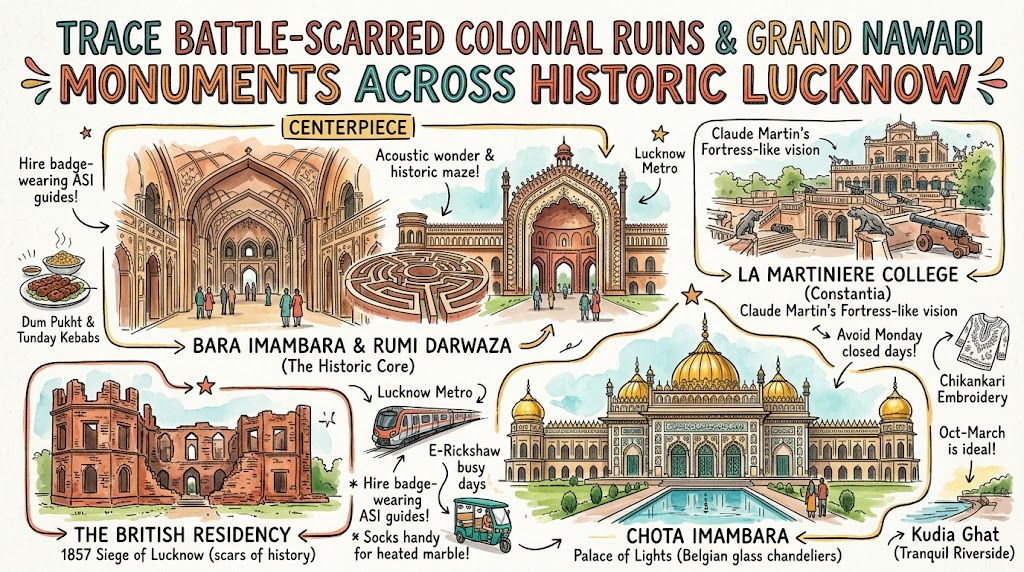
Bara Imambara Complex and Bhulbhulaiya
Commissioned in 1784 by Nawab Asaf-ud-Daula as an expansive famine-relief employment initiative, the Bara Imambara stands as a peerless masterpiece of indigenous engineering. Built entirely without European structural influences or iron girders, its central vault remains one of the largest unsupported vaulted halls in the world, held together solely by interlocking brickwork and lime mortar.
Directly above this grand prayer chamber lies the legendary Bhulbhulaiya, an intricate three-dimensional labyrinth of hundreds of identical arched passages, hidden staircases, and acoustic apertures. Stepping through its shadowy corridors reveals how sound travels effortlessly along internal stone conduits, while its rooftop opens onto breathtaking panoramic vistas of historic Hussainabad.
- Location: Machchhi Bhavan, Hussainabad; approximately 5.5 km north of Charbagh Railway Station.
- Why it is worth visiting: Extraordinary eighteenth-century architectural engineering, acoustic wonders, and Asia’s most celebrated historic three-dimensional maze.
- Best things to do: Test the remarkable acoustic echo across opposite walls of the central hall, navigate the labyrinthine tunnels with an authorized heritage guide, and inspect the five-tiered Shahi Baoli stepwell.
- Best time to visit: Early morning between 8:30 AM and 10:30 AM to explore before noon foot traffic and high humidity.
- Ideal for whom: Architectural historians, curious puzzle enthusiasts, photographers, and families with older kids.
- Travel tip: Hire only an authorized, badge-wearing ASI guide right at the ticket desk; navigating the maze without expert guidance can be disorienting and causes you to miss secret acoustic channels.
The British Residency
Set amidst tranquil, terraced gardens along the Gomti, the British Residency stands frozen in 1857. This vast compound of residential quarters, banquet halls, churches, and hospital quarters served as the headquarters of the British East India Company’s commissioner until it became the dramatic epicenter of the Siege of Lucknow.
The brick ruins remain peppered with visible cannonball indentations and rifle shrapnel scars from months of fierce close-quarters combat. Walking among the silent roofless walls, the underground cellars where women and children sheltered, and the quiet cemetery creates a deeply moving encounter with one of history’s defining moments.
- Location: Mahatma Gandhi Marg, Deep Manak Nagar, roughly 4 km from Hazratganj.
- Why it is worth visiting: The most evocative and completely preserved archaeological monument to the 1857 uprising in South Asia.
- Best things to do: Tour the on-site ASI Museum housing the original 1857 siege diorama, explore the subterranean Begum Kothi vaults, and trace cannonball impact craters across the Banquet Hall ruins.
- Best time to visit: 2:30 PM to 5:00 PM when soft winter sunlight illuminates the weathered brick facades.
- Ideal for whom: Military history scholars, war heritage enthusiasts, solo travelers, and reflective walkers.
- Travel tip: Don’t miss the basement museum display located inside the restored administrative wing; it contextualizes the physical layout of the siege before you walk the grounds.
Rumi Darwaza
Rising sixty feet above the bustling streets of Old Lucknow, the Rumi Darwaza is the undisputed visual symbol of Nawabi identity. Erected under Nawab Asaf-ud-Daula in the 1780s, this colossal gate was modeled after the ancient Sublime Porte of Constantinople, earning it the moniker of the “Turkish Gate.”
Its eastern face presents a grand triumphal arch crowned by intricate floral detailing, while its western facade reveals a striking triple-arched gate structure. Historically illuminated at night by hundreds of oil lamps placed inside carved alcoves, it framed the ceremonial royal procession route into the courtly quarter.
- Location: Hussainabad, positioned between the Bara Imambara and Chota Imambara complexes.
- Why it is worth visiting: The premier triumph of Awadhi gateway architecture, featuring breathtaking symmetry and intricate stucco patterns.
- Best things to do: Photograph the dramatic contrast between the morning light and evening floodlit masonry, observe the floral stone details from the pedestrian plaza, and watch daily life pulse through historic archways.
- Best time to visit: Late evening between 6:00 PM and 8:00 PM when surrounding floodlights accentuate its ornate plaster moldings.
- Ideal for whom: Street photographers, urban architecture buffs, and cultural travelers.
- Travel tip: Heavy traffic formerly crossed the central opening, but pedestrianized preservation buffers make walking up close for wide-angle photographs safe and effortless.
Chota Imambara (Husainabad Imambara)
Erected in 1838 by Nawab Muhammad Ali Shah to serve as his own mausoleum, the Chota Imambara offers an intimate, visually dazzling counterpart to the massive scale of Bara Imambara. Its pristine white exterior features refined gilded calligraphy, graceful golden domes, and a central reflecting pool that mirrors the surrounding structures.
Inside, the atmosphere is unforgettable. Known as the Palace of Lights, the main hall displays an extraordinary collection of vintage Belgian glass chandeliers, ornate silver pulpits, and delicate mirrors collected from nineteenth-century Europe and Persia, transforming the chamber into a shimmering palace during ceremonial periods.
- Location: Daulatganj, Hussainabad, about 1.2 km west of Rumi Darwaza.
- Why it is worth visiting: Unmatched collection of historic Belgian glass crystal, gold-leaf calligraphy, and refined Indo-Islamic funerary architecture.
- Best things to do: Walk around the reflecting pool to view the miniature Taj Mahal-inspired tomb across the courtyard, view the Nawab’s authentic silver throne, and examine nineteenth-century brass chandeliers.
- Best time to visit: 10:00 AM to 1:00 PM when natural light pours through stained glass panels into the interior halls.
- Ideal for whom: Art lovers, decorative arts historians, and heritage couples.
- Travel tip: Shoes must be removed at the central gate platform; carry an extra pair of cotton socks during warm midday hours to comfortably walk across heated marble surfaces.
La Martiniere College (Constantia)
Conceived and constructed in the late eighteenth century by Claude Martin, a French adventurer turned major general in the British East India Company, Constantia represents an astonishing fusion of European and Indian designs. The estate combines Italian Renaissance terraces, Gothic gargoyles, Corinthian pillars, and Mughal turrets into a singular palatial vision.
It remains one of the premier residential academies in India and is the only school in the world awarded a British Royal battle honor for its staff and boys defending the Residency during the 1857 uprising. Its subterranean crypt houses Martin’s actual tomb beneath a fortress-like stone foundation surrounded by historical artillery.
- Location: Martin Purva, South-Eastern Lucknow; 4.5 km from Hazratganj.
- Why it is worth visiting: Rare blend of French, Italian, and Awadhi palatial styles with military school traditions dating back over two centuries.
- Best things to do: Admire the grand outdoor facade and battle cannons, step inside the historic chapel with its preserved bas-relief stucco panels, and view Claude Martin’s underground vault.
- Best time to visit: Weekends or late weekday afternoons between 3:00 PM and 5:00 PM to avoid disrupting academic classes.
- Ideal for whom: Colonial history buffs, architecture students, and educational heritage travelers.
- Travel tip: Check at the security gatehouse for campus visiting permissions; visiting on Sundays or during academic holidays ensures easier access to historic courtyards.
Offbeat Exploration: Hidden Gems Tourists Miss
The Neglected Splendor of Kudia Ghat
Located a short distance upstream from the bustling monuments of Hussainabad, Kudia Ghat is the oldest stone embankment along the Gomti River. Associated with Sage Kudil, this tranquil spot features stone staircases, historic pavilions, and quiet river views away from modern city life.
Satkhanda (The Unfinished Watchtower)
Commissioned by King Muhammad Ali Shah in the late 1830s as a towering observation minaret and astronomical watchtower, this red-brick structure was abandoned after only four stories following the ruler’s death. Its distinctive octagonal windows and Greek-influenced arched tiers offer an intriguing glimpse into nineteenth-century royal ambitions.
Shah Najaf Imambara and River Gardens
Often bypassed for its Hussainabad counterparts, this whitewashed domed mausoleum along Rana Pratap Marg holds the remains of Ghazi-ud-Din Haidar. Replicating the sacred tomb of Ali at Najaf in Iraq, its serene inner chamber is surrounded by historic chandeliers and quiet riverside gardens ideal for contemplative walks.
Detailed Practical Guidance for Travelers
| Destination | Standard Entry Fee | General Timings | Best Local Food Options Nearby | Recommended Nearby Attractions |
| Bara Imambara | ₹50 (Indians) / ₹500 (Foreigners) Combo ticket | 6:00 AM – 5:00 PM (Closed Mondays) | Rahim’s Kulcha Nihari (Chowk) | Rumi Darwaza, Shahi Baoli |
| The British Residency | ₹25 (Indians) / ₹300 (Foreigners) | 7:00 AM – 6:00 PM (Museum: 9:00 AM – 5:00 PM) | Dastarkhwan (Hazratganj) | General Wali Kothi, Gomti Riverbank |
| Rumi Darwaza | Free Public Monument | Open 24 Hours (Best viewed at night) | Tunday Kababi (Chowk branch) | Hussainabad Clock Tower, Picture Gallery |
| Chota Imambara | Included in Bara Imambara combo ticket | 6:00 AM – 5:00 PM daily | Mubeen’s Pasanda & Parathas (Akbari Gate) | Satkhanda, Husainabad Tank |
| La Martiniere College | Free (Campus gate check required) | 9:00 AM – 5:00 PM (Strict school rules) | Royal Cafe (Hazratganj) | Dilkusha Kothi ruins, Golf Club |
Logistics & On-Ground Navigation
Local Transport Options
- Metro Network: Clean, swift, and fully air-conditioned, the North-South metro corridor links Charbagh to Hazratganj, providing a traffic-free backbone across central districts.
- E-Rickshaws: The most efficient way to navigate the narrow alleys of Chowk, Akbari Gate, and Hussainabad where cars get trapped in congestion.
- Auto-Rickshaws & App Cabs: Uber and Ola run consistently throughout Lucknow, providing dependable options between hotels and major monuments.
- Private Car Hire: Ideal for combining distant heritage stops, such as pairing La Martiniere with the ruins of Dilkusha Kothi and the outer cantonment.
Budget Planning
- Backpack/Budget Tier: ₹1,500 – ₹2,200 per day (utilizing shared e-rickshaws, metro lines, heritage combo passes, and authentic Chowk street stalls).
- Mid-Range Comfort Tier: ₹4,000 – ₹7,000 per day (dedicated app-cabs, authorized ASI guides at key sites, sit-down Awadhi restaurants, and comfortable boutique hotels).
Safety and Inclusivity Tips
- Families: Major monument grounds feature flat walking paths and park benches; keep water bottles handy for younger travelers during monument explorations.
- Couples: The expansive gardens of the British Residency and the river promenade provide relaxed, welcoming atmospheres for heritage strolls.
- General Safety: Watch your step on the steep stone stairs inside the Bhulbhulaiya and historic stepwells, and store valuables securely in crowded bazaar corridors.
Local Heritage Insight: Buy the comprehensive ASI Combined Entry Ticket at Bara Imambara; it covers Bara Imambara, Chota Imambara, the Picture Gallery, and Shahi Baoli, saving you time at individual ticket booths.
Strategic Travel Planning Guardrails
Travel Planning Tips for Lucknow
- Plan your trip between November and February to enjoy crisp, clear days that make outdoor walking tours a pleasure.
- Keep cash handy; while QR-code UPI works widely across modern shops, street vendors in Chowk prefer physical bills.
- Dress respectfully when visiting active religious monuments like the Imambaras by covering shoulders and knees, and bringing a light scarf.
- Book licensed ASI guides at monument gates rather than hiring touts along outer parking approaches.
- Keep comfortable slip-on shoes ready, as you must remove your footwear at multiple religious courtyards.
Common Mistakes to Avoid
- Cramming Old Lucknow and the far-flung southern cantonment into a single morning rush.
- Forgetting to bring socks for hot stone surfaces in outdoor courtyards.
- Assuming you can easily drive large SUVs through the narrow alleys of Chowk and Akbari Gate.
- Dining solely at upscale hotel buffets instead of tasting authentic slow-cooked recipes in heritage neighborhoods.
- Skipping the Residency Museum diorama before exploring its historic grounds.
Suggested Itinerary Blueprints
1-Day Quick Dash (Royal Awadh Highlights)
Designed for travelers on a tight schedule who want to capture the architectural essence of Nawabi rule in a single day.
- Morning: Begin promptly at 8:30 AM at Bara Imambara, exploring the acoustic grand hall, the Bhulbhulaiya labyrinth, and the Shahi Baoli.
- Afternoon: Stroll past the monumental Rumi Darwaza into Chota Imambara, followed by a classic lunch of Galawat kebabs at Akbari Gate in Chowk.
- Evening: Conclude your day walking the quiet grounds of The British Residency before heading to Hazratganj for evening tea.
2-Day Deep-Dive (From Nawabs to the Raj)
A balanced two-day itinerary separating Islamic court architecture from 1857 colonial battlegrounds.
- Day 1: Dedicate the entire day to the Hussainabad and Chowk heritage corridors. Explore Bara Imambara, Rumi Darwaza, Satkhanda, and Chota Imambara. Cap off the evening with a guided heritage food walk through Akbari Gate.
- Day 2: Spend a reflective morning exploring the ruins and museum at The British Residency. Head to La Martiniere College in the afternoon, and wrap up with a quiet sunset at the ruins of Dilkusha Kothi.
Complete Weekend Travel Plan (The Definitive Heritage Loop)
A comprehensive three-day loop covering monuments, colonial estates, and living cultural crafts.
- Friday: Arrive, settle in, and spend a relaxing afternoon at the British Residency. Head to Hazratganj in the evening for book browsing and dinner at a traditional Awadhi restaurant.
- Saturday: Spend the morning exploring Bara Imambara and its maze. Stroll down to Chota Imambara, visit the Picture Gallery, and spend the afternoon discovering Chikankari needlework workshops in Chowk.
- Sunday: Visit La Martiniere College and the ruins of Dilkusha Kothi in the morning. Wrap up your weekend with an early evening heritage boat ride from Kudia Ghat along the Gomti.
Common Tourist Mistakes to Avoid
- Geographic Blunders: Don’t attempt to combine the old quarters of Hussainabad with the southern estates of Dilkusha Kothi in the same two-hour window. Traffic across the Gomti bridges can be unpredictable.
- Commercial Traps: Avoid spending limited afternoon hours in modern shopping centers on the outskirts when you could be exploring century-old perfumeries and embroidery ateliers in Chowk.
- Neglecting Modern/Alternative Zones: Don’t focus exclusively on ancient ruins while missing out on relaxed heritage cafes and artistic bookshops around Hazratganj.
- Transport Overpayment: Cross-check quoted auto-rickshaw fares against rideshare app estimates to avoid inflated prices at transit hubs.
- Luxury Dining Bias: Sticking only to international multi-cuisine hotel restaurants denies you the true flavors of Lucknow’s slow-cooked Dum Pukht cuisine and aromatic biryanis.
Frequently Asked Questions
1. Is it safe to explore the Bhulbhulaiya without a tour guide?
Navigating the maze alone is not recommended for first-time visitors because its identical stairwells and dark intersecting corridors can be disorienting. Authorized guides provide crucial historical context, demonstrate hidden acoustic phenomena, and guide you directly to panoramic rooftop exits without unnecessary delay.
2. How much time is needed to fully see the British Residency complex?
Plan for at least two to two and a half hours to walk the grounds and museum. This provides ample time to explore the landscaped ruins, read memorial inscriptions, and view the preserved siege diorama in the basement museum.
3. What is the dress code for visiting the Imambaras in Lucknow?
Both Bara and Chota Imambara are active places of worship that observe modest dress codes. Visitors should cover their shoulders and legs completely. Carrying an easily packable scarf to cover your head when entering indoor prayer chambers is strongly recommended.
4. Can you visit La Martiniere College on regular weekdays?
La Martiniere is an active boarding academy, meaning interior campus access during class hours is restricted. Weekend visits or late weekday afternoon arrivals between 3:30 PM and 5:00 PM are ideal for touring the exterior architecture and historic chapel grounds.
5. Which historical monument in Lucknow offers the best photography opportunities?
The Chota Imambara provides exceptional compositions thanks to its central reflecting pool, golden domes, and antique chandeliers. The elevated rooftops of Bara Imambara and the grand arch of Rumi Darwaza at dusk also offer wonderful vistas.
6. What is the single best culinary experience for a visiting history lover?
Savoring freshly prepared melt-in-mouth Galawat kebabs paired with Mughlai parathas at century-old food stalls near Akbari Gate in Chowk offers an authentic culinary connection to original royal court recipes perfected in nineteenth-century Awadh.
7. Are monuments in Lucknow wheelchair-accessible for elderly travelers?
The British Residency features gently sloping paved garden trails suitable for wheelchairs. However, historic sites like the Bhulbhulaiya and Shahi Baoli contain narrow, steep stone staircases and uneven masonry that make full access difficult for individuals with limited mobility.
8. Is the Rumi Darwaza currently open for pedestrian visitors?
Yes, the public plaza surrounding the gate accommodates pedestrian viewing and photography, though motor vehicle traffic has been rerouted onto parallel access roads to protect its historic foundation from vibration damage.
9. How do I get to Lucknow from New Delhi using express train routes?
Multiple fast rail services connect the cities daily, including the Swarna Shatabdi Express and the Vande Bharat Express from New Delhi Railway Station, both reaching Lucknow Charbagh in under six and a half hours.
10. Do foreign travelers require special permits to view historic sites in Lucknow?
Foreign passport holders do not require special travel permits to tour the public monuments, galleries, or ASI complexes in Lucknow. Standard entrance tickets are purchased directly at site entrances or via digital ticketing portals using regular identification.
11. Where can tourists buy authentic handmade Chikankari embroidery?
Avoid commercial souvenir stalls around parking areas; instead, head directly to established artisan cooperatives and generations-old master craftsman shops nestled inside the heritage markets of Chowk, Aminabad, and Hazratganj.
12. When is the best time of year to walk through Old Lucknow’s alleys?
The winter months from November through February provide comfortable weather with daily temperatures hovering around twenty degrees Celsius. These conditions make walking through open-air monuments and crowded bazaar streets pleasant and refreshing.
Conclusion
A journey through Lucknow is far more than an ordinary sightseeing trip; it is an intimate encounter with a cultured world that shaped the artistic soul of northern India. Walking these arched corridors and historic avenues connects you to an extraordinary legacy of architectural daring, refined courtly manners, and heroic resilience. Long after the dust of the road settles, the grace of Awadh stays with you, reminding us that true heritage is found not just in silent stones, but in the enduring spirit of a city that honors its past.
