Introduction
Mainstream tourist circuits often trap travelers in artificial spectacles, hurried queues, and manufactured heritage. Lucknow resists that superficial rush, anchoring its magic in deep generational roots, quiet dignity, and slow living. This historic capital of Awadh does not perform for the camera; it simply lives through the clatter of copper degs, the poetic cadence of its Urdu-laced Hindi, and timeless monuments. Here, a weekend becomes an unhurried cultural pilgrimage where labyrinthine old alleys, aristocratic dining rooms, and majestic riverside boulevards welcome curious wanderers with unmatched hospitality.
Why Lucknow is a must-visit city
- Geographically poised on the fertile plains along the Gomti River, Lucknow carries immense architectural and sociopolitical weight as the zenith of eighteenth-century Awadhi refinement. Seamlessly connected by world-class expressways (Agra-Lucknow and Purvanchal), an efficient international airport, and the iconic Charbagh railway junction, the city easily accommodates road-trippers, solo backpackers, and family heritage travelers alike.
- The travel circuit divides gracefully into two distinct rhythms: the sensory, historic maze of the Old City (Husainabad and Chowk) steeped in Mughal-Baroque architecture and culinary lore, and the elegant, tree-lined boulevards of Hazratganj and Gomti Nagar offering curated boutiques, colonial cafes, and riverside parks.
- Below is a snapshot of essential facts for trip planning:
| Travel Parameter | Details |
| Best Travel Season | October to March (Pleasantly cool days and crisp, atmospheric evenings) |
| Ideal Trip Duration | 2 to 3 Days (Perfect for a comprehensive 48-hour to 72-hour weekend) |
| Connectivity Hubs | CCS International Airport (AMA), Lucknow Charbagh Railway Station (LKO) |
| Primary Cultural Highlights | Nawabi Architecture, Chikankari Craftsmanship, Mughlai-Awadhi Gastronomy |
| Daily Walking Expectation | 8,000 to 14,000 steps through heritage zones and bazaars |
Best Places or Experiences
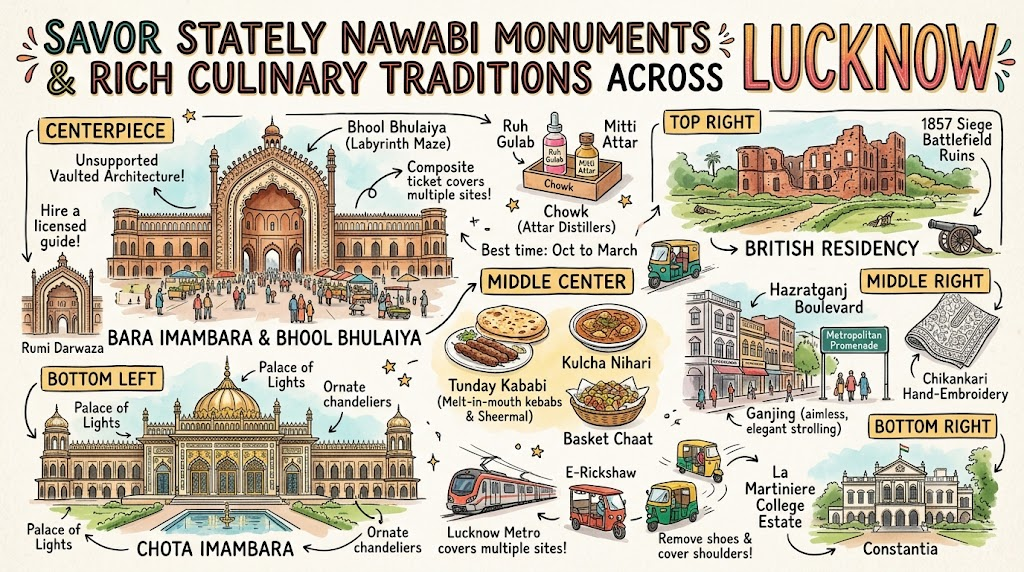
Bara Imambara & Bhool Bhulaiya
Commissioned in 1784 by Nawab Asaf-ud-Daula as a visionary famine relief initiative, this monumental complex stands as one of the world’s most astonishing feats of unsupported vaulted architecture. The central hall spans over 50 meters in length and rises nearly 15 meters without a single supporting pillar, utilizing interlocking Lakhauri brickwork and a lightweight mortar composed of lentils, jaggery, and lime.
Above this magnificent hall lies the legendary Bhool Bhulaiya, an intricate three-dimensional maze composed of 489 identical doorways and hundreds of echoing interconnected passages. Beyond its defensive genius, the labyrinth opens onto rooftop balconies offering sweeping panoramic views across the minarets and skyline of historic Husainabad.
- Location: Husainabad, Old Lucknow (approx. 6 km northwest of Charbagh Railway Station).
- Why it is worth visiting: The world’s largest arched hall unsupported by wooden or iron beams, paired with an authentic medieval acoustic maze.
- Best things to do: Test the extraordinary whispering acoustics along the hollow labyrinth corridors, admire the five-story deep stepwell at the Shahi Baoli, and climb up to the rooftop terrace for golden hour vistas.
- Best time to visit: Arrive at 8:30 AM before tourist coaches pull in, or visit at 3:30 PM for softer photography lighting.
- Ideal for whom: Architecture enthusiasts, curious history buffs, photographers, and families.
- Travel tip: Always hire a government-approved licensed guide at the ticket counter to navigate the maze safely and understand the hidden acoustic vents.
Rumi Darwaza
Rising 60 feet into the sky directly adjacent to the Bara Imambara, the Rumi Darwaza serves as the indelible signature gate of Awadhi identity. Erected under Nawab Asaf-ud-Daula, its grand arch was modeled after the historical Sublime Porte in Istanbul, earning it the moniker of the “Turkish Gate.”
The structure showcases ornate ornamental detailing: the eastern facade features a massive semi-circular arch adorned with intricately carved floral petals, while the western side presents a triple-arched entryway. At dusk, as streetlamps flicker on and traffic swirls through its shadow, the monument radiates romantic, regal power.
- Location: Husainabad Road, between Bara Imambara and Chota Imambara (approx. 6.5 km from Hazratganj).
- Why it is worth visiting: An architectural bridge between Persian, Ottoman, and indigenous Awadhi structural design.
- Best things to do: Walk through the paved pedestrian plaza, photograph the grand arch framed against dramatic cloud formations, and examine the Lakhauri brick detailing on the crown.
- Best time to visit: 5:30 PM to 7:00 PM when architectural floodlights illuminate the intricate plasterwork.
- Ideal for whom: Street photographers, heritage walkers, and solo explorers.
- Travel tip: The plaza area is pedestrianized; walk 100 meters down toward the Husainabad Clock Tower to capture an unobstructed, wide-angle perspective.
Chota Imambara (Husainabad Imambara)
Erected in 1838 by Muhammad Ali Shah, the third Nawab of Awadh, the Chota Imambara functions as a dazzling sanctuary of devotion and light. In stark contrast to the austere, colossal scale of Bara Imambara, this monument delights with elaborate gold-leaf calligraphy, delicate turrets, and an ornate white marble facade.
Inside the prayer hall, travelers encounter the famed “Palace of Lights.” Hundreds of gilded Belgian chandeliers, Bohemian crystal lamps, and ceremonial silver shrines fill the vaulted ceilings. The complex courtyard also features a central reflecting pool flanked by graceful scale replicas of the Taj Mahal that serve as family mausoleums.
- Location: Husainabad, roughly 1.5 km west of Bara Imambara (approx. 7.5 km from Charbagh).
- Why it is worth visiting: Unmatched collection of nineteenth-century European chandeliers and Persian decorative craft under a gilded brass dome.
- Best things to do: Admire the delicate Quranic calligraphy carved across exterior walls, observe the Belgian chandeliers inside the main hall, and pause alongside the water canal reflecting the miniature Taj Mahal tombs.
- Best time to visit: Midday between 11:30 AM and 1:30 PM, when natural sunlight refracts dramatically through the coloured glass chandeliers.
- Ideal for whom: Art lovers, spiritual seekers, and cultural connoisseurs.
- Travel tip: Remove your shoes at the entrance gate and ensure shoulders and knees are modestly covered; wraps are available if required.
The British Residency
Set amidst 33 acres of peaceful rolling gardens, the British Residency preserves the bullet-scarred ruins of the fateful 1857 Siege of Lucknow. Constructed between 1780 and 1800 for the British Resident General, the sprawling compound once housed multi-story banquet halls, barracks, a church, and grand residential quarters.
During the uprising of 1857, the buildings sustained relentless artillery bombardment for nearly six months. Today, the hollow brick skeletons, overgrown with moss and creepers, remain untouched by modern restoration. Strolling through these quiet brick ruins provides an evocative window into colonial turbulence and revolutionary bravery.
- Location: Mahatma Gandhi Marg, Qaiserbagh (approx. 4 km north of Charbagh Station).
- Why it is worth visiting: India’s most significant, physically preserved 1857 battlefield and war memorial ruins.
- Best things to do: Inspect the artillery cannonball marks embedded into the Banquet Hall walls, visit the on-site ASI memorial museum, and wander down into the cool underground Tahkhana chambers.
- Best time to visit: 8:00 AM to 11:00 AM when the morning mist clears and the gardens are serene and quiet.
- Ideal for whom: Military history researchers, book lovers, and peaceful morning strollers.
- Travel tip: The on-site museum closes on Mondays; plan your visit on a Saturday or Sunday morning to see the original diorama maps and sketches.
Hazratganj Boulevard & Heritage Walk
Conceived in 1810 by Nawab Saadat Ali Khan and redesigned in the 1930s with British imperial styling, Hazratganj is the beating cosmopolitan heart of Lucknow. Known locally as “Ganjing”—the art of aimless, elegant strolling—this iconic promenade blends classic cream-and-black Victorian facade architecture with traditional bazaars and modern retail.
Beyond high-end boutiques, the arcades shelter historic literary bookshops, vintage cinemas, generational sweetmakers, and celebrated street chaat counters. Spending an evening walking down its wide pavements lets you experience the city’s effortless transition from Nawabi royalty to vibrant modern life.
- Location: Hazratganj Central Business District (approx. 3.5 km east of Charbagh).
- Why it is worth visiting: The quintessential urban evening experience that blends colonial architecture, vintage bookshops, and legendary street food.
- Best things to do: Indulge in the famous five-flavored Basket Chaat at Royal Cafe, browse vintage collections at Universal Booksellers, and shop for hand-embroidered Chikankari kurtas at government showrooms.
- Best time to visit: 5:00 PM to 9:30 PM when the Victorian street lamps light up and foot traffic enlivens the verandas.
- Ideal for whom: Shoppers, food lovers, couples, and urban culture enthusiasts.
- Travel tip: Parking here is strictly regulated in multi-level complexes; take the Lucknow Metro to Hazratganj Station and exit directly into the marketplace.
Offbeat Exploration: Hidden Gems Tourists Miss
La Martiniere College Estate
Designed and built in 1795 by French adventurer and military strategist Major General Claude Martin, “Constantia” is one of the grandest colonial buildings in India. Blending Italian Renaissance bastions, Corinthian pillars, Gothic gargoyles, and Mughal pavilions, this working private school is an architectural wonder that few casual tourists explore.
The Craft Alley of Chowk: Phool Wali Gali & Attar Distillers
While most shoppers flock to crowded commercial hubs, the quiet alleyways behind Chowk’s main artery conceal century-old Ittr (natural perfume) apothecaries. Here, skilled perfumers still distill pure floral extracts—such as Ruh Gulab, Motia, and the world-renowned Mitti Attar (the scent of baked earth after first rain)—using ancient copper stills without chemical bases.
Husainabad Picture Gallery & Satkhanda Watchtower
Perched across a reflective brick tank near the Chota Imambara, the Picture Gallery houses life-sized oil portraits of Awadh’s Nawabs. Painted by European masters, their optical illusion ensures the shoes and eyes of the royals appear to follow your movement across the room. Adjacent stands the Satkhanda, an incomplete four-story red-brick leaning watchtower modeled after the Tower of Pisa.
Detailed Practical Guidance for Travelers
| Destination | Standard Entry Fee | General Timings | Best Local Food Options Nearby | Recommended Nearby Attractions |
| Bara Imambara | ₹50 (Indians), ₹500 (Foreigners) | 6:00 AM – 5:00 PM (Tues–Sun) | Tunday Kababi (Phool Wali Gali, Chowk) | Rumi Darwaza, Shahi Baoli |
| Chota Imambara | ₹50 (Indians), ₹500 (Foreigners) | 6:00 AM – 5:00 PM (Daily) | Rahim’s Kulcha Nihari (Akbari Gate) | Husainabad Clock Tower, Satkhanda |
| The British Residency | ₹25 (Indians), ₹300 (Foreigners) | 7:00 AM – 6:00 PM (Museum: 10–5) | Netram Ajay Kumar (Puri-Jalebi, Aminabad) | General Neill’s Memorial, Begum Kothi |
| Hazratganj Promenade | Free Public Access | 10:30 AM – 10:00 PM | Royal Cafe Basket Chaat, Marksmen Pastries | GPO, Begum Hazrat Mahal Park |
| La Martiniere Estate | Free (Prior permission required) | 9:00 AM – 4:00 PM (Sundays ideal) | Dastarkhwan (Lalbagh, short cab ride) | Dilkusha Kothi ruins, Golf Club |
Logistics & On-Ground Navigation
Local Transport Options
- Lucknow Metro Rail: The North-South corridor provides clean, fast transit between the Airport, Charbagh Railway Station, and Hazratganj.
- E-Rickshaws: The most efficient way to navigate tight alleys around Chowk, Akbari Gate, and Aminabad where cars cannot easily maneuver.
- Auto-Rickshaws (Vikram / Shared Autos): Readily available for budget hops along main arterial roads. Always negotiate or confirm meter usage before boarding.
- Ride-Sharing App Cabs (Uber, Ola, Rapido): Best for crossing between Hazratganj, Gomti Nagar, and suburban monuments comfortably with air conditioning.
Budget Planning
- Backpack/Budget Tier: ₹1,500 – ₹2,200 per person per day. Includes clean heritage dorms or guesthouses, metro and shared e-rickshaw transit, street feasts, and standard ASI monument entries.
- Mid-Range Comfort Tier: ₹4,500 – ₹7,500 per person per day. Covers boutique hotels, private app-cab rentals for full days, formal Awadhi dining rooms, guided walking tours, and artisanal shopping budgets.
Safety and Inclusivity Tips
- For Families: Wide heritage complexes like Bara Imambara and the Residency feature accessible paved grounds; carry umbrellas and water bottles during afternoon outings.
- For Couples: Hazratganj, the Residency gardens, and Gomti Riverfront are exceptionally welcoming and safe for shared evening strolls.
- General Safety: Pickpocketing can occur in packed market choke-points like Aminabad and Chowk; secure daypacks to your chest and keep wallets inside zippered pockets.
Local Secret: Do not purchase individual tickets if you plan to see multiple sites. The composite ASI/HUT ticket bought at Bara Imambara includes entry to Chota Imambara, the Picture Gallery, and Shahi Baoli, saving money and queue times.
Strategic Travel Planning Guardrails
Travel Planning Tips for Lucknow
- Book your hotel near Hazratganj or Qaiserbagh to balance transit times between the Old City and modern Gomti Nagar.
- Winters bring heavy morning fog between late December and mid-January; schedule flights or trains with reasonable buffer hours.
- While digital UPI payments are accepted almost everywhere, keep ₹1,000 in small cash notes (₹10, ₹20, ₹50) for old bazaar snack stalls and e-rickshaws.
- Dress respectfully with covered shoulders and knees when visiting working religious shrines like the Imambaras.
- Keep footwear easy to slip off and on, as you must remove shoes before entering the sanctums of sacred buildings.
- Schedule shopping excursions for afternoons or early evenings, as heritage bazaars rarely open before 11:30 AM.
Common Mistakes to Avoid
- Trying to drive personal or rental SUVs through the inner passages of Chowk or Aminabad.
- Skipping street-side breakfast stalls to eat basic hotel continental buffet meals.
- Assuming that Chikankari embroidery sold at ultra-cheap roadside stalls is authentic handmade craft rather than cheap machine prints.
- Scheduling all your monument visits on Mondays, when major museums and select historic compounds remain closed.
- Forgetting that the Bara Imambara complex closes ticket counters at 5:00 PM sharp.
- Rushing through lunch in under 30 minutes; authentic Awadhi Dum cooking demands patient, celebratory indulgence.
Suggested Itinerary Blueprints
1-Day Quick Dash (The Essential Awadh Express)
Designed for travelers on a tight 24-hour business stopover or rapid transit layover.
- Morning (8:30 AM – 1:00 PM): Start early at Bara Imambara to tour the grand hall and Bhool Bhulaiya. Walk past Rumi Darwaza to reach the glittering Chota Imambara.
- Lunch (1:30 PM – 3:00 PM): Head straight to Akbari Gate in Chowk for melt-in-mouth Galawati kebabs at Tunday Kababi and fresh sheermal.
- Afternoon to Evening (3:30 PM – 9:00 PM): Take an e-rickshaw to The British Residency for a quiet historical walk, then finish your night strolling and shopping along the Hazratganj promenade.
2-Day Deep-Dive (Heritage, Flavors & Hidden Alleys)
The ideal 48-hour weekend split balancing high-profile architecture with deep culinary culture.
- Day 1: Monarchy, Miracles, and Mazes
- 09:00 AM: Full immersion at Bara Imambara, Shahi Baoli stepwell, and the Bhool Bhulaiya labyrinth.
- 12:30 PM: Walk through Rumi Darwaza and visit the Husainabad Picture Gallery.
- 02:00 PM: Lunch at Rahim’s for slow-cooked Nihari with fluffy Kulcha.
- 04:00 PM: Explore Chota Imambara as afternoon light hits the chandeliers.
- 06:30 PM: Evening guided food walk through the fragrance-filled lanes of Chowk.
- Day 2: Rebellion, Aristocracy, and Modernity
- 08:30 AM: Morning walk and museum visit across the scarred ruins of The British Residency.
- 11:30 AM: Architectural stop at the magnificent Constantia campus of La Martiniere College.
- 01:30 PM: Traditional Awadhi Thali lunch at Dastarkhwan or Oudhyana.
- 03:30 PM: Authentic Chikankari textile shopping at Sewa Chikan or UP Handlooms in Hazratganj.
- 06:00 PM: High tea and Basket Chaat at Royal Cafe, followed by a twilight stroll along Gomti Riverfront Park.
Complete Weekend Travel Plan (The Grand 72-Hour Awadh Circuit)
A relaxed Friday-to-Sunday loop taking in rural estates, living heritage, and grand bazaars.
- Friday: Royal Introductions
- Arrive by mid-afternoon, check into your hotel, and take a gentle orientation stroll through Hazratganj.
- Dinner at Falak Numa for rooftop Awadhi dining accompanied by classical live sitar music.
- Saturday: The Great Historic Heart
- Dedicate the entire day to Old Lucknow: Bara Imambara, Bhool Bhulaiya, Rumi Darwaza, and Chota Imambara.
- Mid-day food crawl sampling street chaat, Makhan Malai (in winter), and freshly made kebabs in Chowk.
- Twilight visit to the Husainabad Clock Tower and Satkhanda.
- Sunday: Colonial Footprints & Craft Legacies
- Morning walking exploration of The British Residency and the nearby tomb of Saadat Ali Khan.
- Afternoon trip out to the historic estate of Dilkusha Kothi and La Martiniere College.
- Conclude with an evening shopping expedition through the bustling lanes of Aminabad for brassware, perfumes, and embroidered textiles.
Common Tourist Mistakes to Avoid
- Geographic Blunders: Don’t attempt to mix geographically opposed zones—such as visiting the outlying Kukrail reserve and Old Chowk bazaars—on the same morning. Cluster Old Lucknow monuments together, and reserve another day for Hazratganj and Gomti Nagar.
- Commercial Traps: Don’t waste precious weekend hours wandering through modern suburban shopping malls like Phoenix Palassio when authentic heritage experiences await across Hazratganj and Chowk.
- Neglecting Modern/Alternative Zones: While historic ruins define Lucknow’s past, overlooking its modern cultural expansions—such as the massive Janeshwar Mishra Park or vibrant riverside cafes in Gomti Nagar—deprives you of experiencing the modern local lifestyle.
- Transport Overpayment: Refrain from accepting arbitrary prices quoted by auto-rickshaw drivers outside Charbagh Station. Open your ride-sharing apps (Uber or Ola) to check base rates before negotiating with local street autos.
- Luxury Dining Bias: Eating only inside five-star hotel dining rooms misses the city’s culinary heart. The most legendary Awadhi recipes are preserved at humble street stalls in Chowk, Akbari Gate, and Aminabad.
Frequently Asked Questions
1. Is two days genuinely enough to experience the highlights of Lucknow?
Yes, a well-planned 48-hour itinerary is ideal for exploring the city’s primary highlights. You can comfortably explore the grand monuments of Old Lucknow, tour the historic British Residency, embark on an authentic culinary food crawl, and browse traditional Chikankari embroidery shops without feeling rushed, provided you group your sightseeing by geographic zones.
2. What is the single best time of year to visit Lucknow?
The best months to visit are from October through March, when temperatures hover pleasantly between 12°C and 25°C. Crisp winter mornings and cool evenings provide ideal conditions for walking through open-air ruins and bustling street bazaars, unlike the scorching summer months between April and June when daytime heat can easily exceed 42°C.
3. How much should I expect to spend on an average weekend trip?
A budget traveler can comfortably get by on ₹1,500 to ₹2,200 per day by utilizing the metro and enjoying street-side eateries. Mid-range travelers seeking boutique accommodations, private app-based cabs, sit-down Mughlai restaurants, and heritage guides should plan for approximately ₹4,500 to ₹7,500 per day for an upscale, comfortable experience.
4. Can vegetarian travelers find good local food options in Lucknow?
While Lucknow is celebrated globally for its non-vegetarian kebabs, its vegetarian cuisine is equally exceptional. You can feast on authentic crispy Basket Chaat at Royal Cafe, creamy winter Makhan Malai in Chowk, kachori-jalebi breakfasts at Netram in Aminabad, and rich vegetarian Mughlai specialties like Dal Makhani and Shahi Paneer across Hazratganj.
5. Is it safe for solo female travelers to explore Lucknow independently?
Lucknow is generally safe, warm, and hospitable for solo female travelers. Standard urban precautions apply: stick to well-lit public areas like Hazratganj and Gomti Nagar after dark, use app-tracked rides like Uber or the metro for transit, dress modestly when entering historic religious monuments, and avoid deserted alleys late at night.
6. Do I really need to hire a guide inside the Bhool Bhulaiya?
Yes, hiring an official, licensed guide at the Bara Imambara ticket desk is strongly recommended. The maze features nearly 500 identical-looking corridors and balconies designed deliberately to disorient intruders. A licensed guide not only keeps you from getting lost, but also demonstrates the ingenious whispering wall acoustics and hidden defense architecture.
7. Where can I buy authentic, hand-embroidered Chikankari clothing?
Avoid cheap roadside stalls that sell machine-printed imitations. Instead, visit trusted institutions like SEWA Lucknow, the UP Government Handloom Emporiums in Hazratganj, or established generational cloth merchants in the Chowk market area. Genuine handmade pieces showcase intricate shadow work and embossed needlecraft (Murri and Phanda) that can be felt distinctly on the fabric reverse.
8. What is the dress code for visiting the Imambaras?
Because both Bara Imambara and Chota Imambara are revered religious shrines, visitors must dress modestly. Both men and women should wear clothing that covers their shoulders and knees. You will also need to remove your footwear before entering the interior prayer halls, so wearing easily slip-on shoes with clean socks is recommended.
9. How does one get from Lucknow Airport to the central city area?
The Chaudhary Charan Singh International Airport is well connected to the city center via the Lucknow Metro Red Line. Trains run every few minutes directly to Charbagh Railway Station and Hazratganj, taking only 25 minutes. Alternatively, pre-paid airport taxi booths and app-cabs operate 24/7 right outside the arrivals terminal.
10. What is Makhan Malai and where can I find it?
Makhan Malai (also known elsewhere as Daulat ki Chaat) is a cloud-like winter dessert crafted from whipped morning dew-condensed milk froth, flavored with saffron, cardamom, and silver foil. It is available exclusively between November and February from traditional street vendors who set up stalls around Chowk and Gol Darwaza early in the morning.
11. Is photography permitted inside all the major historic monuments?
Personal mobile phone and amateur DSLR photography is permitted across all major sites, including Bara Imambara, Chota Imambara, and the Residency grounds. However, tripods, professional film gear, and drone cameras are strictly prohibited unless you have obtained prior written permits and clearance from the Archaeological Survey of India (ASI) or Hussainabad Trust.
12. How does the composite monument ticket work in Lucknow?
The composite ticket is an economical pass issued at the Bara Imambara ticket counter. Priced at ₹60 for Indian nationals and ₹600 for foreign visitors, it grants unified access to Bara Imambara, the Bhool Bhulaiya, Shahi Baoli, Chota Imambara, the Picture Gallery, and Satkhanda, saving time and money compared to individual tickets.
Conclusion
Leaving Lucknow at the close of a weekend evokes the gentle melancholy of bidding farewell to an old, noble friend. Long after your train departs Charbagh or your plane ascends over the winding Gomti, sensory impressions remain vivid: the comforting aroma of saffron-infused kebabs sizzling over charcoal, the cool touch of ancient Lakhauri brickwork beneath your fingertips, and the soft, courteous cadence of “Pehle Aap.” In an increasingly rushed and homogenized world, choosing Lucknow is not merely taking a holiday—it is slowing down to remember what true human warmth, architectural majesty, and culinary art feel like.
