Introduction
Step away from crowded tourist circuits and enter the sensory rhythm of the City of Nawabs. Lucknow is not a destination you simply tour; it is a storied cultural fabric you inhabit. Where typical heritage destinations overwhelm visitors with commercial noise, Lucknow retains a rare, unhurried courtly grace defined by tehzeeb (sophistication) and adab (respect).
Here, centuries of artistic patronage, revolutionary history, and legendary Awadhi cuisine intertwine effortlessly. Wandering through shadowy arched corridors and listening to evening calls across ancient riverbanks grounds the soul. A three-day journey reveals a living civilization where ancient craftsmanship and historic hospitality remain woven into daily community life.
Why Lucknow is a must-visit city
Lucknow anchors the heart of Northern India’s heritage map, standing as the supreme epicenter of Awadhi culture, Indo-Islamic architecture, and political evolution. Perched gracefully along the banks of the Gomti River, it represents an era when poetry, delicate textiles, and culinary refinement were elevated to royal sciences. Unlike congested metropolitan cities, Lucknow offers wide historical boulevards, extensive green parks, and well-preserved architecture that allow travelers to explore at an authentic, contemplative pace.
The city offers exceptional accessibility for every type of traveler. It connects directly via the Agra-Lucknow Expressway and Purvanchal Expressway, operates an expansive rail network via the regal Lucknow Charbagh Railway Station, and hosts international flights through Chaudhary Charan Singh International Airport. An efficient north-south metro corridor, abundant luxury boutique hotels, and historic homestays make touring both effortless and deeply comfortable.
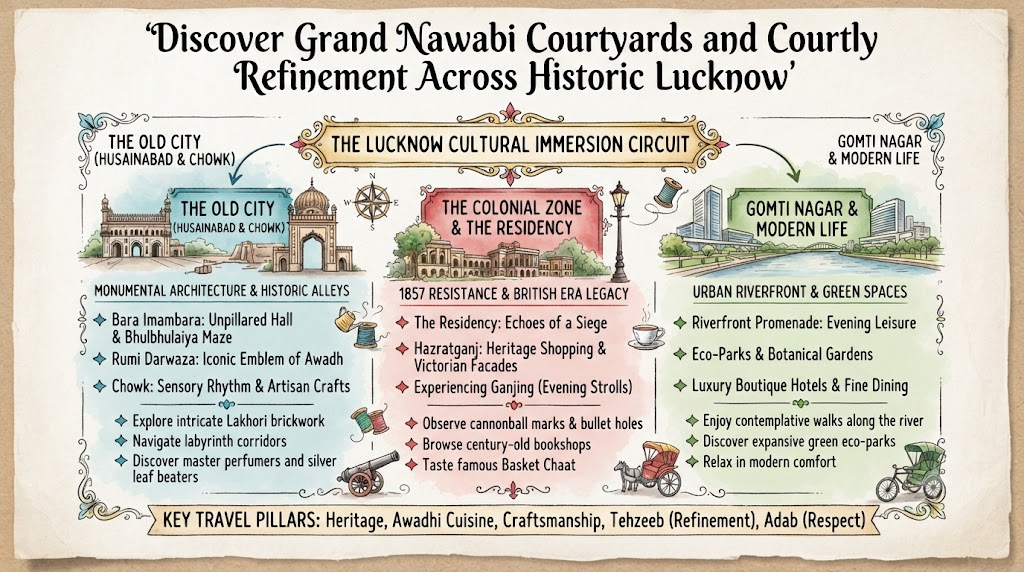
The classic exploration circuit divides the city into three distinct geographical chapters. The Old City circuit in Husainabad and Chowk presents monumental architecture and historic alleys. The colonial and administrative zone spans The Residency and Hazratganj, showcasing nineteenth-century struggles and classic British-era shopping promenades. Across the Gomti, modern Gomti Nagar provides expansive urban riverfronts and vast green eco-parks.
| Circuit Component | Operational Fact & Traveler Metric |
|---|---|
| Best Travel Months | October to March (Pleasant sunny days, cool atmospheric evenings) |
| Ideal Exploration Window | 72 Hours (3 Full Days) for heritage, food, and craft immersion |
| Primary Transit Corridors | Chaudhary Charan Singh International Airport (CCSIA), Charbagh Railway Junction |
| Cultural Specialization | Awadhi Gastronomy, Chikan & Zardozi needlework, Indo-Persian Architecture |
| Local Mobility Index | Fast Metro transit, dense E-rickshaw networks, app-based cabs |
Best Places or Experiences
Bara Imambara & Bhulbhulaiya
Commissioned in 1784 by Nawab Asaf-ud-Daula as a royal famine-relief project, the Bara Imambara stands as an engineering feat of the medieval world. The central vaulted hall stretches over 50 meters long and 15 meters high without a single supporting pillar or iron girder, constructed purely from interlocking Lakhori brickwork and lime-mortar plaster.
Above this cavernous hall winds the legendary Bhulbhulaiya, an intricate three-dimensional maze of over a thousand interconnected passages, secret balconies, and acoustic wall channels. Outside, the complex houses the stepped well known as the Shahi Baoli, which historically offered natural cooling alongside guarded sightlines during royal visits.
Bara Imambara architectural complex.
- Location: Husainabad, Old Lucknow (Approximately 5 km northwest of Charbagh Railway Station).
- Why it is worth visiting: The world’s largest unsupported vaulted hall paired with an authentic acoustic maze offering panoramic views of Old Lucknow.
- Best things to do: Test the whisper acoustics across opposite corridor corners, navigate the labyrinth corridors to reach the rooftop view, and observe the stepped architecture of the Shahi Baoli.
- Best time to visit: 8:30 AM to 10:30 AM before afternoon heat and large weekend crowds gather.
- Ideal for whom: History buffs, architecture lovers, and curious families.
- Travel tip: Hire only an authorized, badge-wearing government guide at the gate to avoid getting disoriented inside the upper maze.
Rumi Darwaza
Standing 60 feet tall between the Bara and Chota Imambaras, the Rumi Darwaza is the grand architectural emblem of Lucknow. Modeled after the historic Sublime Porte in Istanbul, this soaring gateway represents the pinnacle of Awadhi architectural ingenuity, featuring floral stone carvings, arched niches, and ornamental guldastas.
In centuries past, a lantern perched atop the arch illuminated the boulevard at night, while water jets spouted from carved stone petals along its foundation. Today, it remains the grand historic entry point into the old royal district, standing as a testament to eighteenth-century craftsmanship.
The historic Rumi Darwaza gateway.
- Location: Husainabad Road, Old Lucknow (Adjacent to Asafi Mosque and Bara Imambara).
- Why it is worth visiting: An iconic 60-foot architectural gateway showcasing the union of Persian, Ottoman, and Awadhi design.
- Best things to do: Photograph the intricate plaster ornamentation from the eastern garden, view the structure illuminated at nightfall, and study the contrasting facade patterns on either side.
- Best time to visit: 5:30 PM to 7:00 PM to see daytime architectural details transform under warm golden evening floodlights.
- Ideal for whom: Street photographers, architectural enthusiasts, and culture travelers.
- Travel tip: The road running directly through the gate experiences local traffic; stand on the adjacent elevated pedestrian lawns for clean photo angles.
Chota Imambara
Built in 1838 by Nawab Muhammad Ali Shah, the Chota Imambara—formally known as the Imambara Husainabad Mubarak—serves as the jewel-box monument of Awadh. In stark contrast to the grand scale of the Bara Imambara, this monument focuses on delicate ornamental detail, calligraphy, and gilded gold domes reflecting across quiet garden pools.
The interior holds a breathtaking collection of Belgian crystal chandeliers, silver minarets, and hand-painted glass lanterns that earned it the moniker “The Palace of Lights.” Within the manicured complex also stand the incomplete Satkhanda watchtower and a scaled replica of the Taj Mahal that houses royal family tombs.
Chota Imambara palace of lights.
- Location: Husainabad, Old Lucknow (Roughly 1 km west of Rumi Darwaza).
- Why it is worth visiting: An ornate assembly of nineteenth-century Belgian glassware, calligraphic tilework, and Persian-inspired garden waterways.
- Best things to do: View the historic silver pulpit and antique glass lamps inside the central chamber, inspect the unfinished Satkhanda watchtower across the road, and stroll around the central reflection canal.
- Best time to visit: 2:00 PM to 4:30 PM when sunlight filters through the antique colored glass panes.
- Ideal for whom: Art lovers, heritage connoisseurs, and couples seeking quiet courtyards.
- Travel tip: Visitors must remove their shoes at the raised marble terrace; bring clean socks to comfortably walk across the sun-warmed courtyard stones.
The British Residency
The British Residency stands as an open-air historical sanctuary across 33 tranquil, tree-lined acres. Built between 1780 and 1800 for the British Resident General, the sprawling compound became the epicenter of the fierce 1857 Siege of Lucknow during India’s First War of Independence.
Today, the red-brick ruins remain preserved exactly as they stood when the smoke cleared, with cannonball marks and bullet holes visible across the banquet halls, churches, and hospital quarters. The on-site museum preserves battle sketches, period letters, and a detailed relief model depicting the siege defenses.
The British Residency memorial grounds.
- Location: Deep Narayan Sen Marg, Qaiserbagh (About 4 km north of Charbagh Station).
- Why it is worth visiting: An evocative, battle-scarred historical site preserved within a serene, park-like botanical setting.
- Best things to do: Examine preserved cannon scars on the main building walls, visit the 1857 Memorial Museum in the basement hall, and spend quiet moments in the landscaped cemetery and banquet ruins.
- Best time to visit: 9:00 AM to 12:00 PM for comfortable outdoor walking and soft photographic lighting.
- Ideal for whom: Modern history scholars, colonial architecture researchers, and solo travelers.
- Travel tip: The grounds are expansive; allocate at least two uninterrupted hours and carry drinking water, as concession stands are located outside the gate.
Hazratganj Heritage Boulevard
Hazratganj is the historic beating heart of central Lucknow, established in 1827 by Nawab Nasir-ud-Din Haider and later reimagined during the British Raj. In 2010, the iconic street underwent uniform Victorian architectural restoration, featuring uniform cream-and-black signage, cast-iron lampposts, and wide pedestrian walkways.
To stroll without haste along this avenue is known locally as Ganjing—a cherished ritual of browsing century-old bookshops, stepping into iconic handicraft stores, and stopping for sweet street snacks. The area bridges old-world charm and modern culture, housing traditional hand-embroidery showrooms alongside bustling tea stalls and modern bistros.
- Location: Hazratganj, Central Business District, Lucknow.
- Why it is worth visiting: The quintessential urban cultural experience of Lucknow, combining historic shopping, vintage cafes, and preserved colonial street facades.
- Best things to do: Sample the famous basket chaat at Royal Cafe, browse vintage titles at the historic Ram Advani Booksellers, and visit state government handicraft showrooms for genuine Chikan garments.
- Best time to visit: 5:00 PM to 9:30 PM when the boulevard lights up and street life reaches its lively peak.
- Ideal for whom: Shoppers, street food lovers, culture enthusiasts, and families.
- Travel tip: Parking on the main avenue is strictly restricted; use the multi-level parking facility near Mayfair Cinema and walk through the promenade.
Offbeat Exploration: Hidden Gems Tourists Miss
La Martiniere College (Constantia)
Located along the southeastern bends of the Gomti, Constantia is one of the most remarkable architectural estates in India. Built in the late eighteenth century by French adventurer Major General Claude Martin, the palace combines Gothic arches, Italian gargoyles, Roman statues, and classical Mughal terraces. Today it houses one of India’s premier heritage schools, offering an extraordinary, uncrowded look into early European influences across Awadh.
Dilkusha Kothi & Hunting Estate
Tucked inside the quiet roads of the Lucknow Cantonment, Dilkusha Kothi was built around 1800 by Nawab Saadat Ali Khan as a summer lodge and game hunting palace. Modeled after Seaton Delaval Hall in England, its roofless baroque towers now stand amid sprawling, manicured green lawns. It remains free of tour groups, making it an ideal hideaway for reading, sketching, and quiet afternoon contemplation.
The Craftsmanship Alleys of Chowk (Firangi Mahal & Phool Wali Gali)
Beyond the main market streets of Chowk lies a labyrinth of alleys where artisans have practiced hereditary crafts for over two centuries. Here you will find master perfumers blending winter attar of Mitti (rain scent) using copper degs, bone carvers crafting intricate buttons, and generational families beating silver leaf (vark) onto marble slabs. Exploring this quarter on foot with a local guide reveals authentic craft traditions that modern showrooms rarely display.
Detailed Practical Guidance for Travelers
| Destination | Standard Entry Fee | General Timings | Best Local Food Options Nearby | Recommended Nearby Attractions |
|---|---|---|---|---|
| Bara Imambara | ₹50 (Indians) / ₹500 (Foreigners) (Combined Ticket) | 6:00 AM – 5:00 PM | Rahim’s Kulcha Nihari (Chowk) | Rumi Darwaza, Husainabad Picture Gallery |
| Rumi Darwaza | Free (Public Monument View) | Open 24 Hours (Best viewed evening) | Tunday Kababi (Original Chowk lane) | Clock Tower, Husainabad Tank |
| Chota Imambara | Included in Combined Monument Ticket | 6:00 AM – 5:00 PM | Idrees Biryani (Patanala Crossing) | Satkhanda Tower, Jama Masjid |
| The Residency | ₹25 (Indians) / ₹300 (Foreigners) | 7:00 AM – 6:00 PM | Marksmen Restaurant (Hazratganj) | Shaheed Smarak, Qaiserbagh Palace Complex |
| Hazratganj | Free (Commercial Walking Boulevard) | 10:30 AM – 10:00 PM | Royal Cafe Basket Chaat, Sharma Tea Stall | General Post Office, Janeshwar Mishra Park |
Logistics & On-Ground Navigation
Local Transport Options
- Lucknow Metro Rail: The North-South Red Line offers fast, air-conditioned, and affordable transit between CCS Airport, Charbagh Railway Junction, and Hazratganj.
- E-Rickshaws: These compact electric vehicles rule the older quarters of Chowk and Husainabad, navigating narrow alleys where larger cars cannot enter.
- Auto-Rickshaws & App Cabs: Ola and Uber operate throughout the city for point-to-point family travel, while local autos offer quick transit along main thoroughfares.
- Car Rentals: Best reserved for day-long customized itineraries covering outer heritage monuments, Cantonment estates, and riverfront parks.
Budget Planning
- Backpack / Budget Tier: ₹1,400 – ₹2,200 per day (Covering clean budget homestays, public metro rides, shared e-rickshaws, monument tickets, and street food meals).
- Mid-Range / Comfort Tier: ₹4,500 – ₹7,500 per day (Covering heritage boutique stays, private AC cabs, licensed monument guides, sit-down Awadhi dining, and artisanal shopping).
Safety and Inclusivity Tips
- Families: Public parks and heritage complexes feature security guards, level walking paths, and shaded resting spots well-suited for young children and seniors.
- Couples: Stick to well-traveled garden boulevards, busy markets, and designated riverfront zones during evening hours.
- General Safety: Watch your footing along historic stone staircases and keep small cash notes handy for entry tokens, shoe storage, and refreshments.
Local Travel Hack: Purchase the official Combined Monument Ticket at the Bara Imambara counter. It covers entry to Bara Imambara, Chota Imambara, Shahi Baoli, and the Picture Gallery, saving you both money and ticket lines.
Strategic Travel Planning Guardrails
Travel Planning Tips for Lucknow
- Plan your trip between November and February to enjoy pleasant afternoon weather suited for outdoor sightseeing.
- Carry small cash currency alongside UPI payment apps for quick payments at street food stalls and shoe depositories.
- Wear comfortable, slip-on shoes since multiple monuments require removing footwear before entering historical halls.
- Pack modest, shoulder-covering attire to respect cultural and religious traditions inside living places of worship.
- Hire only official, badge-bearing guides registered with Uttar Pradesh Tourism to ensure accurate history and pricing.
Common Mistakes to Avoid
- Cramming sites from Old Lucknow and Gomti Nagar into a single afternoon, leading to long delays in cross-city traffic.
- Relying exclusively on private cars inside the tight alleyways of Chowk where e-rickshaws move far faster.
- Skipping street-level culinary vendors in favor of hotel buffet dinners that lack authentic Awadhi slow-cooking technique.
- Forgetting a secure phone pocket or bag strap when walking through crowded evening market lanes in Aminabad and Chowk.
- Assuming shopping bazaars open early; most traditional artisan shops in Chowk and Hazratganj open after 11:30 AM.
Suggested Itinerary Blueprints
1. Day Quick Dash (The Royal Awadh Whirlwind)
Designed for travelers on a tight schedule who want to capture the architectural highlights and legendary flavors of the city in a single day.
- Morning: Begin at 8:30 AM exploring the magnificent halls and upper maze corridors of Bara Imambara, followed by quick photos at Rumi Darwaza.
- Afternoon: Tour the gilded interior of Chota Imambara, followed by an authentic lunch of soft Galawat Kababs and Roomali Roti in Chowk.
- Evening: Conclude with a sunset walk through the bullet-marked grounds of The Residency, followed by an evening stroll and dinner along Hazratganj.
2. Day Deep-Dive (Heritage, Resistance & Palaces)
A balanced two-day itinerary separating historic royal monuments from colonial landmarks and craft districts.
- Day 1 (The Nawabi Splendors): Spend your morning immersed in the Husainabad complex, exploring Bara Imambara, Shahi Baoli, and Chota Imambara. Dedicate your afternoon to exploring Chowk’s hidden craft alleys, and finish with slow-cooked biryani at Patanala.
- Day 2 (Colonial Struggles & Civil Lines): Begin with a morning tour of The Residency and its 1857 museum. After lunch, visit the baroque architecture of La Martiniere College, enjoy late afternoon tea at Hazratganj, and browse artisanal Chikankari showrooms.
3. Complete Weekend Travel Plan (The Definitive Awadhi Immersion)
A three-day cultural journey balancing grand monuments, colonial landmarks, artisanal shopping, and evening riverside relaxation.
- Friday: Arrive and check into your hotel. Spend your late afternoon wandering through The Residency, followed by tea and bun-maska at Hazratganj and dinner at Royal Cafe.
- Saturday: Devote your morning to Bara Imambara, Rumi Darwaza, and Chota Imambara. Spend your afternoon on a guided craft walk through Chowk’s perfumers and zardozi workshops, and finish with a late-night street food tour of Aminabad.
- Sunday: Take a quiet morning trip to the ruins of Dilkusha Kothi and the grounds of La Martiniere College. Spend your afternoon shopping for GI-tagged Chikan embroidery at government-certified stores, and wrap up your journey watching the sunset from Gomti Riverfront Park.
Common Tourist Mistakes to Avoid
- Geographic Blunders: Group your stops by neighborhood rather than bouncing back and forth across the river, which wastes hours in downtown traffic.
- Commercial Traps: Avoid buying synthetic fabric embroidery from tourist-trap stalls outside monument gates; purchase certified, GI-tagged hand-embroidery from recognized artisan cooperatives in Chowk or Hazratganj.
- Neglecting Modern/Alternative Zones: Focusing only on crowded monuments overlooks the open lawns and walking spaces of Gomti Nagar, such as Janeshwar Mishra Park and the riverside promenade.
- Transport Overpayment: Always confirm auto-rickshaw fares before boarding or cross-check fares using app-based services like Ola, Uber, or Rapido to prevent price gouging.
- Luxury Dining Bias: Restricting your meals to hotel buffets misses the legendary slow-cooked flavors of authentic dum pukht and century-old street vendors who perfected these recipes over generations.
Frequently Asked Questions
1. Is a 3-day itinerary truly sufficient to experience Lucknow properly?
Yes, 72 hours is the ideal window to experience the city’s key attractions without rushing. A well-planned three-day trip lets you explore the grand Nawabi monuments of Husainabad, walk the colonial grounds of The Residency, browse the lively shopping promenade of Hazratganj, and embark on authentic food walks across historic Chowk.
2. What is the most reliable way to navigate between Old Lucknow and Gomti Nagar?
App-based cabs like Uber and Ola offer the most convenient transit between these contrasting districts across the Gomti River. Within the old corridors of Chowk and Husainabad, transfer to local e-rickshaws to navigate narrow streets easily without getting stuck in traffic or struggling to park a car.
3. Do visitors need a licensed guide to explore the Bhulbhulaiya maze safely?
Hiring an authorized, badge-wearing guide from the monument entrance is strongly recommended. The upper labyrinth features hundreds of near-identical corridors, stairwells, and dead ends that easily confuse first-time visitors, and a guide will demonstrate the famous acoustic design and pinpoint hidden viewpoints overlooking the old city.
4. What are the best authentic dishes that vegetarian travelers should enjoy in Lucknow?
While Lucknow is globally renowned for its meat dishes, Awadhi vegetarian cuisine is equally rich and sophisticated. Vegetarians must try the crisp Basket Chaat at Royal Cafe, freshly griddled Dal Khasta, soft Galawat kebabs made with yam or raw banana, aromatic Subz Dum Biryani, and Malai Makhan during winter mornings.
5. How can travelers tell authentic hand-embroidered Chikankari from cheaper machine counterfeits?
Authentic handmade Chikankari displays subtle variations in stitch tension, tiny thread knots on the fabric’s reverse side, and is typically worked onto breathable cotton, georgette, or muslin. Machine-made counterfeits feel uniform, feature loose synthetic threads on the underside, and are mass-produced on cheaper poly-blend materials.
6. Is Lucknow a welcoming and safe destination for solo women travelers?
Lucknow is generally safe, welcoming, and hospitable for solo women travelers. Staying in well-connected neighborhoods like Gomti Nagar or Hazratganj, using app-based transport for evening travel, and dressing respectfully when visiting functioning religious sites will ensure a smooth, comfortable journey.
7. Which winter month offers the finest atmospheric weather for a leisure trip?
November, December, and January provide the most pleasant weather of the year. Daytime temperatures stay between 18°C and 24°C under mild winter sunshine, making it comfortable to explore expansive outdoor grounds, while cool evenings create the perfect backdrop for piping-hot street food and hot spiced tea.
8. Are tourist photography and mobile videography allowed inside the main historical monuments?
Personal mobile phone photography is allowed across the Bara Imambara, Chota Imambara, and The Residency complexes. Professional cameras, tripods, and drone setups require prior written permission from the Archaeological Survey of India or monument authorities, and photography is prohibited inside designated active prayer halls.
9. What time do the primary shopping markets in Hazratganj and Chowk open each day?
Traditional markets in Lucknow follow a relaxed daily rhythm. Heritage shops in Chowk and commercial stores along Hazratganj open between 11:00 AM and 12:00 PM and stay vibrant until 9:30 PM. Keep in mind that many traditional shops in Hazratganj close on Sundays, whereas Chowk remains lively throughout the weekend.
10. What makes the construction of the Bara Imambara historically unique?
The monument’s main arched hall spans 50 meters in length and 15 meters in height without a single structural pillar, iron beam, or wooden truss supporting its massive weight. Built as a famine-relief initiative, it was constructed from lightweight Lakhori bricks bonded with a mortar of lime, lentils, and jaggery.
11. Where can visitors buy genuine, authentic local perfumes in the city?
Head straight into the historic perfumery lanes of Chowk, home to century-old generational attar merchants like Sugandh Co. and traditional shops near the Chota Imambara gate. These shops distill pure, alcohol-free essential oils extracted from sandalwood, seasonal rose, fragrant jasmine, and earthen clay.
12. Can travelers walk comfortably through the entire British Residency complex?
Yes, the 33-acre complex features paved footpaths winding across manicured lawns and historic building ruins. Exploring the central memorial, the hospital ruins, and the indoor 1857 museum requires about two hours of easy walking; bring along a water bottle and sun protection during midday visits.
Conclusion
Choosing a journey to Lucknow offers far more than an ordinary sightseeing escape; it is an intimate encounter with a gracious, artistic way of life that time has not eroded. Walking past soaring arched gates, listening to the afternoon hum of age-old craft quarters, and tasting slow-cooked recipes perfected across generations leaves an indelible impression. You arrive looking for monuments and architecture, but you leave transformed by the enduring courtesy, warmth, and hospitality of Awadh.
