Introduction
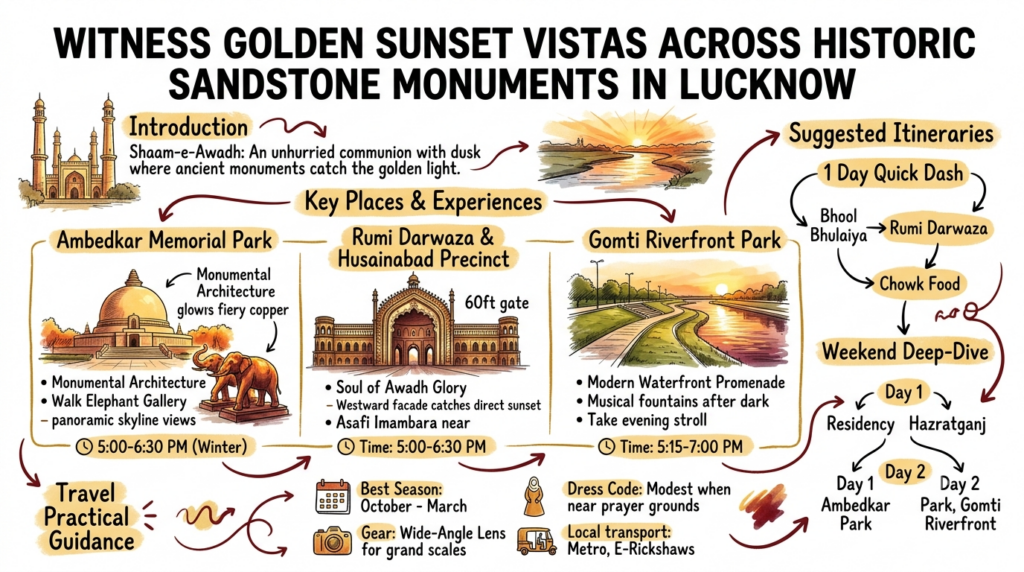
While mass-tourism circuits hustle visitors through overcrowded hill retreats and commercial beachfronts, Lucknow offers something far more soulful: an unhurried communion with dusk. The historic phrase Shaam-e-Awadh (Evening in Awadh) was not coined by mere chance; it celebrates an atmospheric phenomenon that has captivated poets and monarchs for centuries. As the afternoon glare softens, the capital of Uttar Pradesh transforms into a canvas of golden hues, where ancient minarets, grand sandstone monuments, and calm riverbanks catch the fading light. Experiencing dusk here is an authentic cultural ritual that invites you to slow down and savor the poetic heart of the city.
Why Lucknow is a must-visit city
Lucknow stands as Northern India’s undisputed cultural anchor, carrying monumental architectural, literary, and culinary weight. The city is the birthplace of sophisticated Tehzeeb (refined etiquette) and monumental Awadhi architecture that broke away from conventional Mughal norms. Sitting proudly across the fertile plains of the Gomti River, it boasts modern infrastructure that makes navigating its heritage treasures effortless.
High-speed expressways, an ultra-clean metro rail system, and Chaudhary Charan Singh International Airport link Lucknow seamlessly to all major travel corridors. The travel circuit is intuitively organized, moving from the labyrinthine nawabi lanes of Chowk and Husainabad in the west to the palatial, sprawling urban promenades of Gomti Nagar in the east.
| Key Travel Metric | Strategic Overview |
|---|---|
| Geographic Anchor | Central Uttar Pradesh, Gomti River Basin |
| Primary Transit Hubs | Lucknow Charbagh Railway Station (LKO), Amausi Airport (LKO) |
| Best Golden Hour Season | October through March (Crisp air, fiery crimson sunsets) |
| Circuit Dynamic | Historic Awadh in the West; Modern Eco-Architecture in the East |
| Cultural Signature | Shaam-e-Awadh, Chikankari craftsmanship, Awadhi Dastarkhwan |
Best Places or Experiences
Ambedkar Memorial Park
Carved entirely from red sandstone brought from Rajasthan, Ambedkar Memorial Park is an architectural marvel spread across 107 acres. As the sun begins to descend, the polished stone plazas, towering colonnades, and bronze-cast elephant statues reflect a breathtaking fiery copper glow.
The colossal central dome sits elevated against the sky, creating dramatic, stark silhouettes as twilight falls. The sheer scale and open horizon provide an unobstructed perspective of the sun dipping beneath the cityscape, making it an extraordinary visual retreat for travelers seeking calm amidst architectural splendor.
Ambedkar Memorial Park during twilight.
- Location: Vipul Khand, Gomti Nagar; approximately 6 km from Lucknow Charbagh Railway Station.
- Why it is worth visiting: Monumental neoclassical architecture that catches the setting sun like a glowing crimson desert sanctuary.
- Best things to do: Walk through the monumental Elephant Gallery during the golden hour, sit near the central stupa steps for panoramic skyline views, and photograph dramatic shadow lines along the colonnades.
- Best time to visit: 5:00 PM to 6:30 PM (November to February) or 6:00 PM to 7:15 PM (March to June).
- Ideal for whom: Architectural photographers, couples, solo travelers, and culture buffs.
- Travel tip: Wear comfortable slip-on footwear, as you must remove shoes to ascend the upper plinth of the central sanctum.
Gomti Riverfront Park
Developed alongside the tranquil curves of the Gomti River, this modern waterfront promenade offers an idyllic natural setting for dusk lovers. The expansive grass steps slope gently toward the water, reflecting the shifting evening colors from pale gold to deep purple.
The river breezes pick up right as the sun touches the horizon, cooling the city after warm afternoons. Walking paths framed by contemporary art installations and water fountains give visitors a refreshing space to relax before the city lights up for the night.
Waterfront evening promenade lights.
- Location: Vipin Khand, Gomti Nagar; about 7 km from the central station.
- Why it is worth visiting: Pristine river views coupled with illuminated promenades and cool evening drafts.
- Best things to do: Watch the sunset reflection across the calm Gomti waters, take an evening stroll along the paved bank, and enjoy the musical fountain shows starting right after dark.
- Best time to visit: 5:15 PM to 7:00 PM for the sunset-to-twilight lighting shift.
- Ideal for whom: Leisure seekers, families, and jogging enthusiasts.
- Travel tip: Enter through the gate near the musical fountain plaza to access the widest, cleanest viewing decks.
Rumi Darwaza & Husainabad Heritage Precinct
The monumental 60-foot-tall Rumi Darwaza, modeled after the historic Sublime Porte in Istanbul, is the soul of Awadh’s architectural glory. Built in 1784 under the reign of Nawab Asaf-ud-Daula, this ornate gateway serves as the grand entrance to the Old City.
During sunset, the westward-facing facade of the gate catches the direct dying embers of the sun, highlighting intricate stucco floral details and archways. Flanked by the grand Asafi Imambara and Husainabad Clock Tower, the entire heritage corridor evokes a timeless nawabi spectacle.
Rumi Darwaza glowing at dusk.
- Location: Husainabad, Old Lucknow; roughly 5 km northwest of Hazratganj.
- Why it is worth visiting: Quintessential Shaam-e-Awadh setting featuring towering 18th-century gateways glowing in amber hues.
- Best things to do: Stand at the raised plaza near the Asafi pond to capture Rumi Darwaza framing the sunset, observe birds nesting in the arch recesses, and head straight to nearby Old City food stalls after nightfall.
- Best time to visit: 5:00 PM to 6:30 PM for optimum street photography and backlight.
- Ideal for whom: History purists, heritage photographers, and cultural explorers.
- Travel tip: The roads around the gate are bustling; watch out for local traffic while positioning yourself on roadside pedestrian sidewalks.
The British Residency Grounds
The British Residency stands preserved in haunting ruins, bearing the battle scars of the historic Siege of 1857. Surrounded by rolling, terraced lawns and ancient shade trees, the crumbled brick buildings take on a warm, golden radiance when illuminated by late afternoon light.
The historical weight here is palpable as long shadows fall across cannonball-marked walls, quiet graveyards, and ruined banquet halls. It offers one of the quietest vantage points in the city to reflect on Lucknow’s turbulent history while the day settles into night.
Serene brick ruins at The Residency.
- Location: Mahatma Gandhi Marg, Deep Manak Nagar, Qaisar Bagh; 3.5 km from Hazratganj.
- Why it is worth visiting: An evocative historical setting where peaceful nature and poignant ruins merge at dusk.
- Best things to do: Explore the brick-and-mortar ruins of the Banquet Hall under golden light, read the historical siege markers along the green lawns, and watch the sunset from the high mounds near the memorial cross.
- Best time to visit: 4:00 PM to 5:30 PM (gates strictly close at dusk).
- Ideal for whom: Historical researchers, solo travelers, and writers looking for quiet spaces.
- Travel tip: Security strictly ushers visitors out at sunset; arrive well before 4:30 PM to have ample time to walk the extensive grounds.
Kukrail Forest Reserve
Located on the northeastern outskirts of the metropolis, Kukrail Forest Reserve is a dense deer park and gharial rehabilitation center. It provides a distinct contrast to the urban monuments, immersing travelers in woodland trails and quiet water bodies.
As sunset filters through towering timber canopies, the woodland fills with the evening calls of migratory birds returning to roost. The lake reflects the changing twilight sky, offering an authentic wilderness escape just a short drive from the city center.
Wildlife conservation at Kukrail Forest.
- Location: Indira Nagar / Kukrail Forest Area; 11 km from Hazratganj.
- Why it is worth visiting: Raw biodiversity, crocodile breeding grounds, and tranquil woodland sunsets far from city traffic.
- Best things to do: Spot freshwater gharials basking in the last rays of sunlight, walk the shaded forest trails, and watch evening birds gathering near the water reservoirs.
- Best time to visit: 3:30 PM to 5:30 PM.
- Ideal for whom: Wildlife enthusiasts, birdwatchers, and families traveling with kids.
- Travel tip: Forest gates close promptly by 5:00 PM in the winter, so aim for an early afternoon arrival.
Offbeat Exploration: Hidden Gems Tourists Miss
La Martiniere College Back Lawns
This majestic institution, built by French Major-General Claude Martin in the late 18th century, features a blend of European, Italian, and Nawabi architecture. While tourists admire the main facade, the rear terrace overlooking the artificial lake and historic stone column (Lat) offers an incredible, uncrowded sunset panorama.
Kudiya Ghat
Tucked behind the Husainabad monuments on the banks of the Gomti, Kudiya Ghat is a stone ghat that remains one of the oldest river landings in Awadh. Free from tourist crowds, it offers steps right down to the river where locals feed fish while twilight falls over the old city skyline.
Dilkusha Kothi Terraces
The skeletal brick ruins of Dilkusha Kothi, built as a baroque hunting lodge for the Nawabs in 1800, sit amid quiet military cantonment parkland. With virtually no crowds, watching the sunset glow through its tall baroque arches offers an unforgettable experience.
Detailed Practical Guidance for Travelers
| Destination | Standard Entry Fee | General Timings | Best Local Food Options Nearby | Recommended Nearby Attractions |
|---|---|---|---|---|
| Ambedkar Memorial Park | ₹20 per person | 11:00 AM – 9:00 PM | Dastarkhwan (Gomti Nagar branch) for Galawati Kebabs | Gomti Riverfront Park, Janeshwar Mishra Park |
| Gomti Riverfront Park | ₹10 per person | 6:00 AM – 10:00 PM | Modern cafes at Summit Building and Riverside Mall | Ambedkar Memorial, Lohia Park |
| Rumi Darwaza & Husainabad | Free public access | Open 24 Hours (Best at sunset) | Tunday Kababi (Chowk) & Rahim’s Kulcha Nihari | Bada Imambara, Chhota Imambara, Clock Tower |
| The British Residency | ₹25 (Indians), ₹300 (Foreigners) | 10:00 AM – 5:00 PM | Marksmen and Rovers at Hazratganj | Begum Hazrat Mahal Park, Qaisar Bagh Palace ruins |
| Kukrail Reserve | Free entry | 9:00 AM – 5:00 PM | Local tea stalls and dhabas along Ring Road | Indira Gandhi Pratishthan, Munshipulia Market |
Logistics & On-Ground Navigation
Local Transport Options
- Lucknow Metro: Clean, rapid transit running directly from the airport to Munshipulia via Charbagh and Hazratganj. It bypasses old-city road congestion effortlessly.
- E-Rickshaws: Abundant and affordable, making them ideal for hopping between heritage gates in Husainabad and Chowk where larger vehicles stall.
- Auto-Rickshaws & App Cabs: Ola, Uber, and Rapido run reliably across Gomti Nagar, Aliganj, and the cantonment area.
- Pre-Booked Car Rentals: Highly recommended if you plan to link Kukrail Forest or suburban viewpoints in a single travel loop.
Budget Planning
- Budget / Solo Backpacker: ₹1,200 – ₹1,800 per day. Covers public metro, shared e-rickshaws, nominal park entries, and street feasts in Chowk.
- Mid-Range / Comfort Traveler: ₹3,500 – ₹6,000 per day. Covers dedicated app cabs, boutique stays near Hazratganj, sit-down Awadhi fine dining, and guided heritage tours.
Safety and Inclusivity Tips
- Families: Public parks (Ambedkar, Gomti Riverfront) are gated, well-lit, and monitored by security, making them safe for kids and seniors.
- Couples: Stick to central promenades in riverfront zones and avoid deserted corners of outlying forest preserves after dusk.
- General Safety: Watch your pockets in crowded Chowk bazaars near sunset, and always confirm whether your app cab driver matches the app’s vehicle details.
Local Secret: Park entry booths stop issuing physical tickets approximately 45 minutes prior to listed closing times. Always arrive an hour ahead to ensure entry.
Strategic Travel Planning Guardrails
Travel Planning Tips for Lucknow
- Plan your trip between November and February to enjoy golden hour without summer heat.
- Carry a balance of UPI digital payments and physical banknotes, as street kiosks in Old Lucknow often have patchy connectivity.
- Wear footwear that slips off easily, as many monuments and park terraces require removing shoes.
- Dress modestly when visiting monuments adjoining active prayer grounds in Husainabad.
- Pack a wide-angle lens to capture the vast scale of Ambedkar Park and Rumi Darwaza during golden hour.
Common Mistakes to Avoid
- Trying to combine Old City heritage sights and Gomti Nagar riverfront walks on the same afternoon.
- Relying on large rental cars to navigate the narrow alleys of Chowk during evening traffic peaks.
- Leaving sunset locations prematurely before the golden hour transitions into the blue hour.
- Skipping traditional Old City street stalls in favor of predictable food courts in shopping malls.
- Forgetting that the Residency strictly clears out all visitors exactly at 5:00 PM.
Suggested Itinerary Blueprints
1. Day Quick Dash (The Classic Awadh Sunset)
Designed for travelers on a tight schedule who want to capture the essence of Shaam-e-Awadh in one afternoon.
- 3:00 PM: Explore the sprawling labyrinth (Bhool Bhulaiya) inside the Bada Imambara complex.
- 4:30 PM: Walk through the monumental courtyards to position yourself beside the Rumi Darwaza.
- 5:15 PM – 6:15 PM: Savor the sunset lighting up the terracotta facade of Rumi Darwaza.
- 6:30 PM: Head straight into the Chowk market for hot Kashmiri chai and authentic Galawati Kebabs.
2. Day Deep-Dive (Heritage Architecture to Modern Horizons)
A comprehensive two-day split balancing historic and contemporary sunset vistas.
- Day 1 (Nawabi Heritage): Spend the afternoon touring the quiet grounds of the British Residency. Catch sunset colors washing over the ruins, followed by an evening heritage stroll through Hazratganj.
- Day 2 (Modern Riverside Awadh): Spend midday visiting La Martiniere College. Transition to Ambedkar Memorial Park at 4:30 PM for sunset across the red sandstone, and finish with a walk along the Gomti Riverfront.
3. Complete Weekend Travel Plan (The Grand Awadhi Circuit)
A full three-day journey designed for photographers and cultural enthusiasts.
- Friday: Arrive, check in near Hazratganj, and spend a relaxed first evening soaking in the sunset from Kudiya Ghat.
- Saturday: Explore old Husainabad in the morning, rest midday, then head out to the British Residency for golden hour followed by a feast in Chowk.
- Sunday: Take an early morning nature drive to Kukrail Reserve, followed by an afternoon architectural tour and sunset photography session at Ambedkar Memorial Park.
Common Tourist Mistakes to Avoid
- Geographic Blunders: Attempting to visit Kukrail Forest Reserve in the northeast and then rush to Rumi Darwaza in the northwest for the same sunset is impossible due to cross-city traffic. Keep your afternoons zoned to one sector.
- Commercial Traps: Spending the golden hour wandering enclosed shopping malls in Gomti Nagar instead of sitting beside the river or enjoying open stone plazas.
- Neglecting Modern Zones: Dismissing Gomti Nagar as just another suburb. Its massive public parks showcase some of the finest public landscape architecture built in contemporary India.
- Transport Overpayment: Agreeing to fixed-rate auto-rickshaw fares outside major stations without comparing prices on ride-hailing apps or asking for the meter.
- Luxury Dining Bias: Restricting your dinners to luxury hotel buffets. Skipping street-level institutions like Chowk’s Tunday Kababi or Hazratganj’s Sharma Tea Stall misses the true heart of local cuisine.
Frequently Asked Questions
1. What does the term Shaam-e-Awadh mean for travelers visiting the city?
It translates to “Evening in Awadh,” referring to the historic cultural phenomenon celebrating the arrival of dusk in Lucknow. The soft twilight, cool river breezes, and social gatherings create a poetic atmosphere unique to the region that poets and rulers have celebrated for centuries.
2. Which sunset location in Lucknow offers the best vantage point for photography?
Ambedkar Memorial Park is arguably the finest location for evening photography. The massive red sandstone structures, dramatic colonnades, and bronze elephant statues catch the golden light cleanly without interference from nearby buildings or tangled utility cables.
3. Are boat rides available along the Gomti River during the sunset hour?
Yes, pedal boats and motorized boating facilities are frequently available at Gomti Riverfront Park and nearby Janeshwar Mishra Park. These rides let you view the setting sun and the modern skyline reflected over calm water surfaces.
4. What are the photography restrictions and camera fees at the British Residency?
Standard mobile photography is permitted across the grounds without issue. However, carrying professional DSLRs, mirrorless setups, or tripods often attracts nominal equipment charges at the ticket counter, and commercial film shooting requires prior written permissions from the Archaeological Survey of India.
5. How much time should a traveler set aside to explore Ambedkar Memorial Park?
Plan for at least 1.5 to 2 hours to walk its extensive sandstone grounds comfortably. Arriving by 4:30 PM gives you enough time to explore the inner sanctum, observe the architecture, and position yourself on the elevated steps for sunset.
6. Can you access the roof of Rumi Darwaza to view the sunset from above?
No, public access to the upper levels and roof of Rumi Darwaza is closed to preserve structural integrity. The best viewpoints are from the ground level plazas on the eastern approach or from the steps of the Asafi pond.
7. Is the Husainabad heritage area safe for solo travelers walking after dusk?
Yes, the Husainabad area is vibrant, well-lit, and bustling with local families, vendors, and police patrols well into the late evening. Standard travel caution regarding personal belongings in dense bazaar crowds is all that is required.
8. What should travelers wear when visiting monuments around sunset?
Wear comfortable, breathable clothing along with easy-to-remove walking shoes, as several heritage monuments require removing footwear. Modest attire covering shoulders and knees is also recommended when entering sites that house active shrines or prayer halls.
9. Are picnic snacks and outside food allowed inside the British Residency grounds?
Light personal snacks and water bottles are generally allowed on the lawns, but visitors must carry their trash out to keep the grounds clean. Large catering spreads or commercial food setups are strictly prohibited by site caretakers.
10. How far is Kukrail Forest Reserve from the Hazratganj city center?
Kukrail Reserve is situated approximately 11 kilometers northeast of Hazratganj. The drive takes about 30 to 45 minutes depending on traffic conditions along Ring Road, making it an easy afternoon getaway.
11. Does the Lucknow Metro connect directly to the primary sunset spots?
The metro takes you close to several central spots. You can ride to Hazratganj, KD Singh Babu Stadium, or Vishwavidyalaya stations, and then take a short 10-minute e-rickshaw ride directly to the British Residency or riverfront parks.
12. What iconic local culinary dish should you try right after watching the sunset?
Head directly to the old alleys of Chowk or Aminabad for freshly made Galawati Kebabs served with flaky Mughlai Parathas. Pair it with hot sweet tea or saffron-infused milk to wrap up your evening.
Conclusion
Catching a sunset in Lucknow is far more than marking off a sightseeing spot; it is a quiet invitation into the city’s living, poetic heritage. Watching the golden light fade across century-old nawabi brickwork and sweeping sandstone terraces reminds us why Shaam-e-Awadh has endured through the ages. By stepping away from rushed itineraries and pausing on these historic riverbanks and peaceful lawns, you experience the genuine soul of Awadh—one glowing horizon at a time.
