Introduction
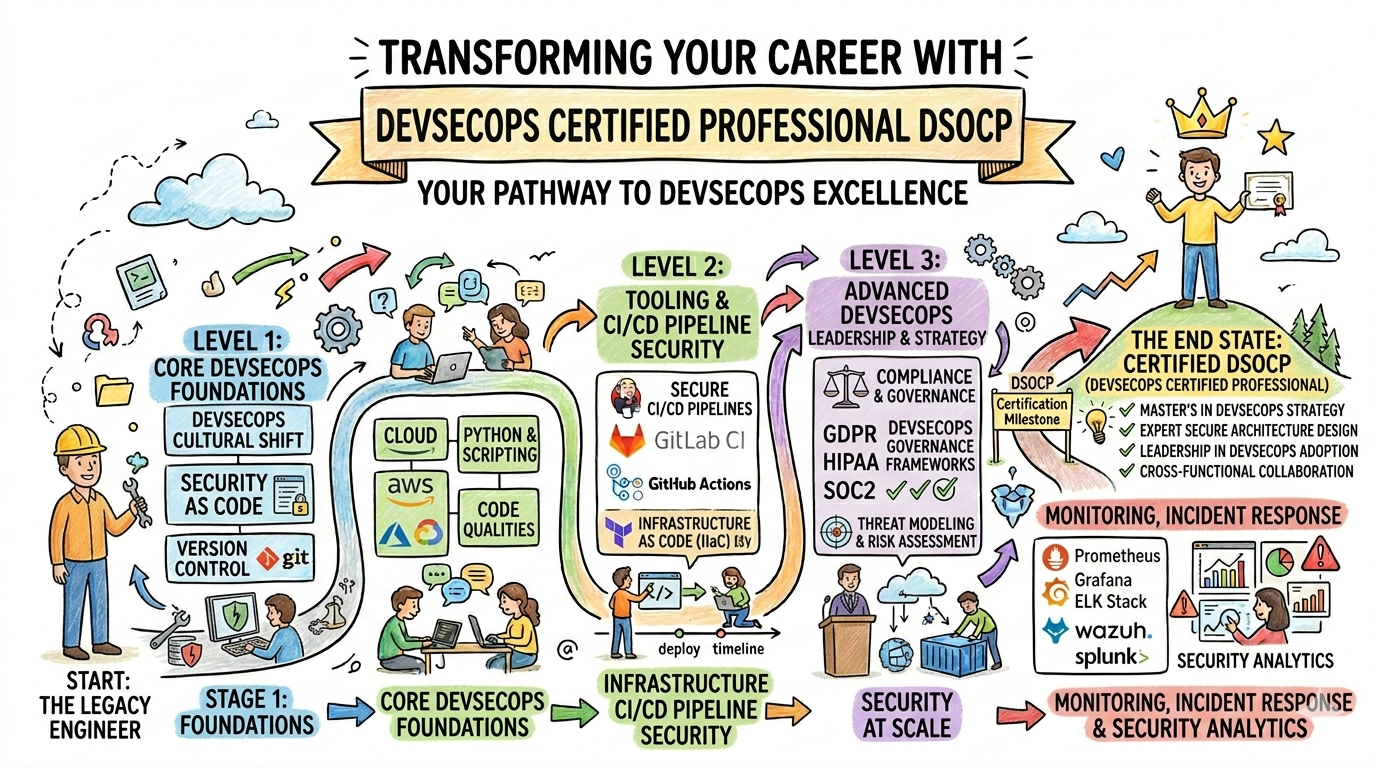
The DevSecOps Certified Professional (DSOCP) is a comprehensive program designed for engineers who want to integrate security into every stage of the software development lifecycle. This guide is for developers, operations experts, and security professionals who realize that “bolting on” security at the end of a project no longer works in a cloud-native world. As organizations move toward rapid deployment cycles, the ability to automate security checks is becoming a mandatory skill rather than an optional one. This guide helps you navigate the DSOCP landscape, allowing you to make an informed decision about your next career move and how to stay ahead in the evolving platform engineering market.
What is the DevSecOps Certified Professional (DSOCP)?
The DevSecOps Certified Professional (DSOCP) represents a shift from traditional security silos to a collaborative, automated culture. It exists because the industry needs engineers who can bridge the gap between development speed and rigorous security compliance. Instead of focusing solely on theoretical frameworks, DSOCP emphasizes production-focused learning, where you handle real-world scenarios like automated vulnerability scanning and secrets management. It aligns perfectly with modern enterprise practices where security is treated as code, ensuring that your skills remain relevant in high-velocity engineering environments.
Who Should Pursue DevSecOps Certified Professional (DSOCP)?
This certification is ideal for DevOps engineers, SREs, and cloud architects who want to specialize in the “Sec” part of the pipeline. It is equally beneficial for security analysts who need to understand how to operate within an agile, CI/CD-driven workflow. Whether you are a beginner looking to build a strong foundation or a technical leader aiming to implement secure governance across teams, DSOCP provides the necessary roadmap. Given the massive digital transformation across India and the global tech hubs, having a DSOCP credential marks you as a professional capable of handling sensitive enterprise data.
Why DevSecOps Certified Professional (DSOCP)
In 2026, the demand for DevSecOps expertise has reached an all-time high as cyber threats become more sophisticated and automated. Organizations are no longer looking for “generalists” but for specialists who can ensure longevity and reliability in their cloud infrastructure. DSOCP helps you stay relevant because it focuses on core principles that persist even as specific tools change. The return on investment for this certification is reflected in higher salary brackets and the ability to lead high-stakes projects that involve complex compliance requirements like SOC2 or GDPR.
DevSecOps Certified Professional (DSOCP) Certification Overview
The DSOCP program is officially delivered via and is hosted on the devopsschool platform. The certification is structured to take a candidate from fundamental concepts to advanced architectural implementation. It uses a practical assessment approach where candidates must prove their ability to configure tools and fix security loopholes in a simulated environment. This ownership-driven model ensures that once you are certified, you possess the hands-on confidence to execute DevSecOps strategies in a live corporate setting.
DevSecOps Certified Professional (DSOCP) Certification Tracks & Levels
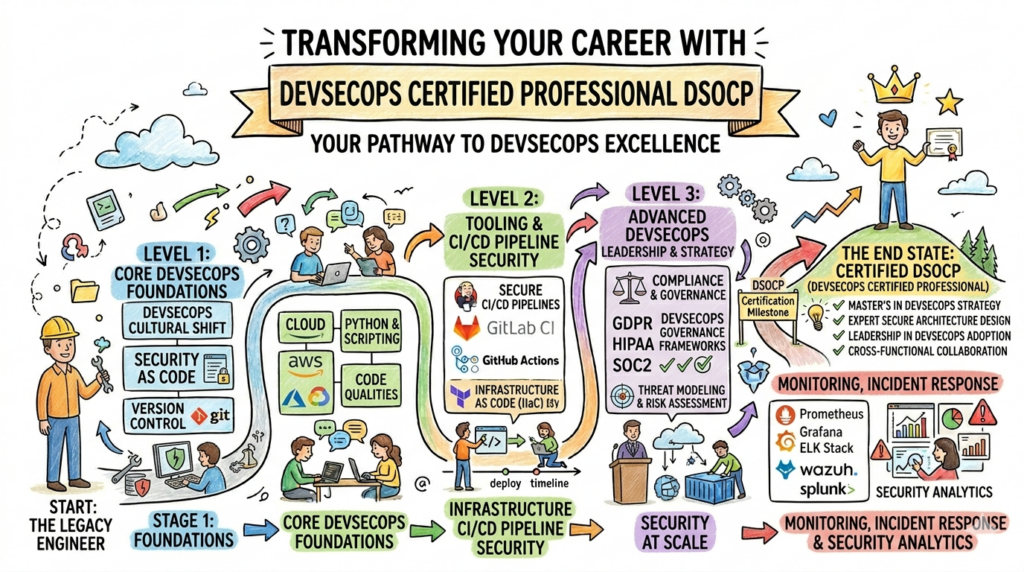
The DSOCP journey is divided into three distinct levels: Foundation, Professional, and Advanced. The Foundation level focuses on the “Shift Left” philosophy and basic tool integration, while the Professional level dives deep into orchestration and container security. The Advanced level is geared toward those looking to lead DevSecOps transformations or specialize in niches like FinOps-aligned security or AI-driven threat detection. These levels are designed to align with your career progression, moving from individual contributor roles to specialized architect and leadership positions.
Complete DevSecOps Certified Professional (DSOCP) Certification Table
| Track | Level | Who it’s for | Prerequisites | Skills Covered | Recommended Order |
| Foundation | Associate | Junior Engineers | Basic Linux & Git | SAST, DAST, Shift-Left | 1st |
| Engineering | Professional | DevOps/SREs | 2+ Years Exp | Container Sec, Vault | 2nd |
| Architecture | Advanced | Lead Engineers | Professional Cert | Compliance as Code | 3rd |
| Leadership | Expert | Managers | 5+ Years Exp | Sec Governance, ROI | Optional |
Detailed Guide for Each DevSecOps Certified Professional (DSOCP) Certification
DevSecOps Certified Professional (DSOCP) – Foundation Level
What it is
This certification validates your understanding of the DevSecOps lifecycle and your ability to integrate basic security checkpoints into a standard Jenkins or GitLab CI pipeline.
Who should take it
It is suitable for junior developers or traditional QA engineers who want to transition into a more security-conscious infrastructure role without needing prior deep security experience.
Skills you’ll gain
- Understanding the “Shift Left” mindset.
- Basic Static Application Security Testing (SAST).
- Managing dependencies and software composition analysis (SCA).
- Implementing automated security gates in CI/CD.
Real-world projects you should be able to do
- Build a pipeline that automatically fails if a high-level vulnerability is found in the code.
- Generate automated security audit reports for every build.
Preparation plan
- 7–14 Days: Focus on the theory of DevSecOps and learning the basic terminology of vulnerabilities (OWASP Top 10).
- 30 Days: Set up a local lab with Jenkins and integrate a free tool like SonarQube to practice code scanning.
- 60 Days: Deep dive into containerizing applications and running basic scans on Docker images.
Common mistakes
- Ignoring the cultural aspect of DevSecOps and focusing only on the tools.
- Over-complicating the initial pipeline with too many security tools at once.
Best next certification after this
- Same-track option: DSOCP Professional Level.
- Cross-track option: SRE Certified Professional.
- Leadership option: Engineering Manager Track.
DevSecOps Certified Professional (DSOCP) – Professional Level
What it is
This certification validates advanced technical skills in securing Kubernetes environments, managing secrets with HashiCorp Vault, and implementing Dynamic Application Security Testing (DAST).
Who should take it
Experienced DevOps engineers or Security engineers who are responsible for maintaining large-scale, production-ready cloud environments.
Skills you’ll gain
- Advanced Kubernetes security and network policies.
- Implementing Secrets Management solutions.
- Runtime security monitoring and incident response.
- Policy as Code using tools like OPA (Open Policy Agent).
Real-world projects you should be able to do
- Secure a multi-node Kubernetes cluster against common attacks.
- Implement a zero-trust architecture for internal microservices communication.
Preparation plan
- 7–14 Days: Review advanced networking and Linux kernel security concepts (Seccomp, AppArmor).
- 30 Days: Practice implementing HashiCorp Vault for dynamic secret injection in a CI/CD flow.
- 60 Days: Focus on Kubernetes-native security tools like Falco or Trivy for real-time monitoring.
Common mistakes
- Failing to understand how security impacts system performance (latency).
- Hardcoding credentials during the practice labs instead of using secret managers.
Best next certification after this
- Same-track option: DSOCP Advanced Architect.
- Cross-track option: FinOps Certified Practitioner.
- Leadership option: CTO/VP of Engineering Track.
Choose Your Learning Path
DevOps Path
For those on the DevOps path, the focus is on speed and reliability. You will use DSOCP to ensure that the rapid delivery of features does not introduce new risks. This path prioritizes the automation of security tests within the CI/CD pipeline so that feedback is provided to developers in seconds rather than days.
DevSecOps Path
This is the core specialization track where security is the primary focus. You will learn to treat security as a first-class citizen in the infrastructure. This path covers everything from threat modeling at the design stage to automated remediation in production, making you a vital asset for any security-conscious organization.
SRE Path
Site Reliability Engineers use DSOCP to ensure that security measures do not compromise system availability. In this path, you learn how to balance the “Security Budget” with the “Error Budget.” It focuses on monitoring security events as part of the overall health of the platform.
AIOps / MLOps Path
As AI becomes central to software, securing the data pipeline is critical. This path uses DevSecOps principles to secure machine learning models and data sets. You will learn how to prevent “data poisoning” and ensure that AI deployments are compliant with privacy regulations.
DataOps Path
DataOps professionals focus on securing the flow of data between sources and analytics engines. Using DSOCP, you will learn to implement data masking, encryption at rest, and secure access controls for big data environments. This ensures that the data pipeline is both fast and leak-proof.
FinOps Path
The intersection of security and cloud cost management is a growing field. In this path, you learn how security misconfigurations (like unoptimized firewalls or orphaned encrypted volumes) can lead to “cloud sprawl” and unnecessary costs. You’ll align security compliance with financial accountability.
Role → Recommended (Topic name) Certifications
| Role | Recommended Certifications |
| DevOps Engineer | DSOCP Foundation, DSOCP Professional |
| SRE | DSOCP Professional, SRE Certified Professional |
| Platform Engineer | DSOCP Advanced, Kubernetes Security Specialist |
| Cloud Engineer | DSOCP Foundation, Cloud Security Certifications |
| Security Engineer | DSOCP Professional, DSOCP Advanced |
| Data Engineer | DSOCP Foundation, DataOps Specialist |
| FinOps Practitioner | DSOCP Foundation, FinOps Certified |
| Engineering Manager | DSOCP Foundation, Leadership Track |
Next Certifications to Take After (Topic name)
Same Track Progression
Once you have mastered the Professional level of DSOCP, the natural next step is to move toward Advanced Architecture. This involves mastering “Compliance as Code,” where you learn to automate legal and regulatory audits. Deep specialization here makes you the “go-to” person for high-level security strategy in large enterprises.
Cross-Track Expansion
If you want to broaden your skills, consider moving into SRE or FinOps. A DevSecOps professional who understands site reliability is incredibly rare and valuable. This expansion allows you to oversee the entire platform lifecycle, from security and stability to cost efficiency, essentially becoming a Full-Stack Infrastructure Engineer.
Leadership & Management Track
For those looking to move away from hands-on keyboard work, the DSOCP knowledge serves as a foundation for becoming a CISO (Chief Information Security Officer). You will transition from implementing tools to managing teams, budgets, and organizational security policies, using your technical background to make better executive decisions.
Training & Certification Support Providers for DSOCP
DevOpsSchool
This provider offers extensive DSOCP training with a focus on live, instructor-led sessions. They are known for their practical labs and provide a robust support system for students, including lifetime access to updated course materials and a dedicated community for clearing technical doubts during the certification journey.
Cotocus
Cotocus focuses on corporate-level training for DSOCP, offering customized modules for engineering teams. Their approach is highly professional, ensuring that the training aligns with specific enterprise needs, making them a preferred choice for companies looking to upskill their entire DevOps workforce at once.
Scmgalaxy
As a long-standing community hub, Scmgalaxy provides a wealth of free resources, tutorials, and community support for DSOCP candidates. It is an excellent place for self-learners to find real-world troubleshooting guides and connect with other professionals who have already cleared the certification.
BestDevOps
This platform provides a curated learning experience for DSOCP, focusing on the latest toolsets and industry trends. Their curriculum is updated frequently to reflect changes in the cloud-native ecosystem, ensuring that candidates are learning skills that are currently in high demand by top-tier tech firms.
devsecopsschool
Dedicated entirely to the security aspect of DevOps, this provider offers deep-dive DSOCP courses that go beyond the basics. They focus heavily on the “Security as Code” philosophy, providing intensive bootcamps that prepare candidates for the rigors of high-level professional exams and real-world security challenges.
sreschool
While focused on reliability, sreschool offers specialized DSOCP modules that show how security fits into the SRE framework. This is perfect for engineers who want to learn how to keep systems secure without sacrificing the high availability and performance metrics required in modern SRE roles.
aiopsschool
This provider integrates DSOCP principles into the world of AI and automation. They focus on how to secure automated decision-making systems and AI-driven infrastructure, making it a unique destination for engineers looking to stay at the cutting edge of DevSecOps and Artificial Intelligence.
dataopsschool
Dataopsschool provides DSOCP training specifically tailored for data professionals. They emphasize the security of data pipelines and storage systems, teaching you how to apply DevSecOps automation to ensure data integrity and compliance across various big data platforms and cloud warehouses.
finopsschool
Focusing on the financial side of operations, this provider shows how DSOCP can help in reducing cloud waste through better security management. They offer a unique perspective on how secure configurations lead to better cost-visibility and prevent expensive security-related cloud bill spikes.
Frequently Asked Questions (General)
1. How difficult is the DSOCP certification for a beginner?
While the foundation level is accessible, it requires a solid understanding of Linux and basic coding to succeed.
2. How much time does it take to prepare for DSOCP?
Most professionals spend 30 to 60 days of consistent study to feel confident for the professional exam.
3. Are there any strict prerequisites for the DSOCP exam?
There are no hard barriers, but having experience with Git and CI/CD tools is highly recommended.
4. What is the ROI of getting a DSOCP certification?
Certified professionals often see a 20-30% increase in salary offers due to the high demand for security skills.
5. Does DSOCP cover specific tools like Jenkins or GitLab?
Yes, it covers the principles of these tools and how to integrate security plugins into their workflows.
6. Is the DSOCP exam theoretical or practical?
The exam is designed to be highly practical, often involving lab-based scenarios where you fix real security issues.
7. Can I take the DSOCP certification online?
Yes, the certification and training are available digitally via the official platform and hosting sites.
8. How long is the DSOCP certification valid?
Typically, it is valid for two to three years, after which recertification or moving to a higher level is encouraged.
9. Does DSOCP help in getting a job abroad?
Yes, DevSecOps is a global requirement, and DSOCP is recognized as a standard for technical competency worldwide.
10. Should I do DevOps or DevSecOps certification first?
It is usually better to understand basic DevOps workflows before specializing in DevSecOps via the DSOCP program.
11. Does the course include cloud security for AWS or Azure?
The principles taught are cloud-agnostic but are frequently demonstrated using popular providers like AWS and Azure.
12. Is there community support available for DSOCP students?
Yes, providers like DevOpsSchool and Scmgalaxy offer active forums and chat groups for student interaction.
FAQs on DevSecOps Certified Professional (DSOCP)
How does DSOCP differ from a general security certification? DSOCP focuses specifically on automation and integration within the development pipeline, whereas general security certs often focus on networking or auditing. Is coding required for DSOCP? Yes, you should be comfortable with basic scripting (Bash or Python) and YAML configuration files. What tools are emphasized? Expect to work with SonarQube, Snyk, HashiCorp Vault, and Kubernetes security tools. Can DSOCP help me move into a Lead role? Absolutely; it proves you can manage complex cross-departmental security strategies. Is there a retake policy for the exam? Yes, specific retake policies are provided on the official website.
Final Thoughts: Is DevSecOps Certified Professional (DSOCP) Worth It?
As a mentor who has seen the industry evolve over two decades, I can tell you that the era of the “siloed” security officer is over. Today’s most successful engineers are those who take ownership of the full lifecycle of their applications. The DSOCP certification is a practical, no-fluff way to prove you have these skills. It isn’t just about a badge on your LinkedIn profile; it’s about the confidence you gain when you know your code is secure before it ever hits production. If you are willing to put in the work to master the labs and understand the mindset shift, DSOCP is a significant and worthwhile investment in your professional future.
