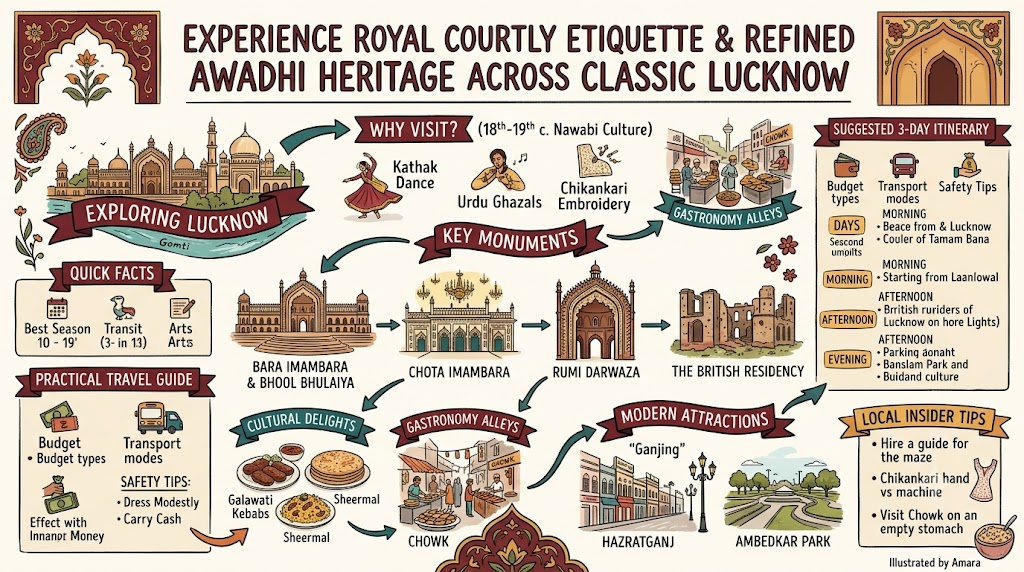
Introduction
In an era of generic, hyper-commercialized holiday circuits, Lucknow offers an antidote: a world rooted in aristocratic grace, living traditions, and unhurried charm. This is the fabled epicenter of Awadh, where refined etiquette (tehzeeb), lingering poetry, and imperial grandeur still dictate the pulse of daily life. Rather than jostling through manufactured tourist avenues, traveling here feels like stepping across the threshold of a historic royal court.
From the aroma of slow-simmered stews drifting out of centuries-old alleyways to monumental gateways framing the horizon, the city welcomes you with genuine warmth. It invites travelers to slow down, listen to the echoes of past courtiers, and discover the living soul of authentic Nawabi heritage.
Why Lucknow is a must-visit city
Lucknow occupies a revered position in India’s cultural and architectural tapestry. Originally flourishing under the Nawabs of Awadh in the 18th and 19th centuries, it evolved into an intellectual sanctuary of classical music, Kathak dance, delicate Chikankari embroidery, and refined culinary arts. Geographically nestled along the serene bends of the Gomti River in the heart of Uttar Pradesh, its historical gravitas is matched by modern infrastructure, making it remarkably accessible.
High-speed expressways link it smoothly to Delhi and Agra, while Chaudhary Charan Singh International Airport and the historic Charbagh Railway Station welcome long-distance travelers. World-class boutique hotels, restored heritage homestays, and budget guest accommodations ensure smooth hospitality across backpacker, family, and luxury segments.
The urban travel circuit divides naturally into two distinct worlds: the atmospheric heritage core of Old Lucknow (Hussainabad and Chowk) and the sophisticated colonial-to-modern avenues (Hazratganj and Gomti Nagar). Navigating between these zones reveals an unbroken narrative of North Indian royalty.
| Key Fact | Details |
|---|---|
| Geographic Zone | Central Uttar Pradesh, Northern India (Gomti River Basin) |
| Best Travel Season | October to March (Crisp, sunny days and cool evenings) |
| Primary Transit Hubs | Charbagh Railway Station (LKO) & CCS International Airport (LKO) |
| Signature Cultural Arts | Chikankari embroidery, Zardozi, Kathak dance, Urdu ghazals |
| Culinary Identity | Dum Pukht cuisine, Galawati Kebabs, Sheermal, Nihari Kulcha |
| Ideal Exploration Window | 3 to 4 Days for a comprehensive, unhurried cultural immersion |
Best Places or Experiences
Bara Imambara & Bhool Bhulaiya
Commissioned in 1784 by Nawab Asaf-ud-Daula as a visionary famine-relief initiative, the Bara Imambara stands as a triumphant achievement of Mughal-Awadhi engineering. Its central vaulted hall—measuring over 50 meters in length and three storeys high—stands without a single pillar, girder, or support beam, defying traditional gravity-defying constraints through an intricate interlocking brick-and-mortar arch system.
Above this majestic sanctuary lies the legendary Bhool Bhulaiya, a complex labyrinth of 489 identical doorways, acoustic corridors, and secret passages designed to confound invaders while funneling fresh air throughout the structure. Climbing to its breezy rooftop terraces rewards travelers with a cinematic panorama overlooking the city’s domes and minarets.
Bara Imambara’s grand facade and gardens.
- Location: Machchhi Bhavan, Hussainabad; approximately 5.5 km from Charbagh Railway Station.
- Why it is worth visiting: Home to the world’s largest unsupported vaulted hall and India’s only authentic architectural labyrinth.
- Best things to do: Hire a licensed ASI guide to navigate the secret paths of Bhool Bhulaiya, test the whispering acoustic walls inside the hall galleries, and climb to the top for sunset views across Old Lucknow.
- Best time to visit: October to February, ideally arriving at 8:30 AM before tourist queues build up.
- Ideal for whom: Architectural purists, history scholars, curious explorers, and families.
- Travel tip: Navigating the upper maze without an official guide is disorienting and strictly discouraged; wear comfortable socks as outdoor footwear must be deposited at the entrance counter.
Chota Imambara (Husainabad Imambara)
Erected by Muhammad Ali Shah in 1838 to serve as his own mausoleum, the Chota Imambara—frequently termed the Palace of Lights—exudes unmatched romanticism. Its whitewashed exterior features graceful calligraphy, gilded onion domes, and intricate stucco plasterwork that glows golden in afternoon light.
Inside, the visual grandeur multiplies exponentially under a forest of imported Belgian crystal chandeliers, stained-glass lamps, and silver-plated royal pulpits (mimbar). Flanked by reflective garden pools and miniature replicas of the Taj Mahal, this serene sanctuary showcases the decorative refinement that defined high Nawabi aesthetic taste.
Chota Imambara illuminated at dusk.
- Location: Hussainabad, Old Lucknow; situated 1.5 km west of Bara Imambara.
- Why it is worth visiting: An intimate look at imperial ornamentation, featuring rare 19th-century European chandeliers and delicate Islamic calligraphy.
- Best things to do: Admire the 19th-century Belgian glass lanterns, observe Muhammad Ali Shah’s ornate silver crown, and photograph the reflection of the central monument in the courtyard pool.
- Best time to visit: Late afternoon (around 4:00 PM) to watch daylight soften and courtyard illumination commence.
- Ideal for whom: Fine-art admirers, cultural photographers, and romantic couples.
- Travel tip: Dress modestly with shoulders and knees covered; women must bring a headscarf to enter the central sacred prayer chambers.
Rumi Darwaza
Soaring sixty feet into the northern sky, the Rumi Darwaza represents the quintessential icon of Lucknow’s regal identity. Modelled loosely after the historic Sublime Porte in Istanbul, this monumental gateway was constructed under the supervision of Nawab Asaf-ud-Daula using slender Lakhori bricks overlaid with carved stucco ornamentation rather than conventional dressed stone.
The arch features an enormous carved floral crest on its western facade and an intricate tripartite gateway design on its eastern exposure. In royal times, a massive decorative lantern at its apex was lit each evening, casting ambient warmth across traveling horse carriages and imperial processions entering the city.
Rumi Darwaza: Majestic gateway to Old Lucknow.
- Location: Hussainabad Heritage Zone, situated right between Bara Imambara and Chota Imambara.
- Why it is worth visiting: One of the most expressive and monumental freestanding gateway arches in Islamic architectural history.
- Best things to do: Study the floral motifs carved into the Lakhori brick stucco, photograph the sunrise alignment through the arch, and watch evening city traffic pass beneath this living monument.
- Best time to visit: Dawn (6:00 AM – 7:30 AM) for tranquil, traffic-free photography and dramatic morning lighting.
- Ideal for whom: Street photographers, urban historians, and cultural walkers.
- Travel tip: Stand on the pedestrian plaza opposite the clock tower to frame wide-angle architectural shots without vehicular obstruction.
The British Residency
Set inside thirty-three acres of rolling, terraced green gardens, the ruins of the British Residency preserve a dramatic chapter of the 1857 Indian Uprising. Built between 1780 and 1800 by Nawab Saadat Ali Khan II for the British Resident, this sprawling compound bore witness to the famous five-month Siege of Lucknow.
Its red-brick walls remain pockmarked by cannonballs and musket fire, standing surrounded by calm lawns, towering banyan trees, and flowerbeds. The on-site museum, housed in the restored Model Room, features original lithographs, hand-drawn maps, and period weaponry, creating an immersive historical sanctuary within the city
.
Ruins of the historic British Residency.
- Location: Deep Narayan Sen Marg, Qaisar Bagh; roughly 4 km north of Charbagh Station.
- Why it is worth visiting: An evocative, open-air historical record depicting the complex 1857 rebellion alongside peaceful gardens.
- Best things to do: Search for cannonball scars on the banqueting hall brickwork, explore the basement taikhana where British civilians sought refuge, and visit the museum’s historical dioramas.
- Best time to visit: 9:00 AM to 12:00 PM during bright winter mornings when museum lighting and garden paths are most pleasant.
- Ideal for whom: Modern history researchers, war buffs, peaceful walkers, and solo sketch artists.
- Travel tip: Hire an authorized ASI audio guide or guide at the ticket window, as contextual history enriches every ruin on the grounds.
The Culinary Alleys of Chowk
To truly grasp Nawabi heritage, one must engage all five senses in the narrow, labyrinthine alleys of Chowk. This historic market sector has cultivated authentic Awadhi cooking techniques for over two centuries, refining the delicate art of Dum Pukht (slow-cooking sealed within clay pots).
The streets hum with sensory richness: sizzling platters of cardamom-scented kebabs, towering mounds of butter-enriched sheermal flatbreads, and large brass pots simmering aromatic bone broth (Nihari). Eating here is not just dinner; it is an intimate encounter with recipes preserved quietly across generations.
- Location: Chowk Bazaar, Old Lucknow; roughly 6 km northwest of central Hazratganj.
- Why it is worth visiting: The global epicenter of royal Awadhi gastronomy, where historic recipes remain untouched by commercial compromise.
- Best things to do: Savor melt-in-the-mouth Galawati kebabs paired with roomali roti, sample morning mutton Nihari with crisp Kulcha, and finish with creamy, saffron-infused Makhan Malai.
- Best time to visit: Evening (6:30 PM to 10:00 PM) for vibrant street energy, or early morning (7:00 AM to 9:00 AM) exclusively for Nihari.
- Ideal for whom: Culinary enthusiasts, food critics, daring eaters, and experiential travelers.
- Travel tip: Carry plenty of physical cash, as narrow alleys frequently suffer from weak mobile network connections for digital UPI payments.
Hazratganj Evening Promenade (“Ganjing”)
Established in 1810 by Nawab Amjad Ali Shah, the historic shopping promenade of Hazratganj captures the elegant intersection of Nawabi patronage and British imperial commerce. In local vernacular, spending an unhurried evening window-shopping and socializing along this boulevard is elevated to a verb: “Ganjing.”
Under modern heritage revitalization bylaws, every storefront along the street features uniform imperial Victorian facades, wrought-iron lampposts, and stone benches. The boulevard provides a peaceful space where literary bookshops sit alongside generations-old garment houses and traditional tea rooms.
- Location: Hazratganj Boulevard, Central Lucknow; 3 km north of Charbagh Station.
- Why it is worth visiting: Experience Lucknow’s signature social ritual along an aesthetically unified, pedestrian-friendly shopping boulevard.
- Best things to do: Browse hand-loomed Chikankari kurtas at century-old state emporiums, enjoy a cup of tea paired with bun-makhan at Sharma Tea Stall, and sample savory basket chaat.
- Best time to visit: 5:00 PM to 8:30 PM, when street lamps flicker on and the boulevard fills with local families and promenaders.
- Ideal for whom: Casual shoppers, book lovers, architecture enthusiasts, and family groups.
- Travel tip: Hazratganj market remains closed on Sundays; plan your visit between Monday and Saturday to enjoy full access to all heritage stores.
Offbeat Exploration: Hidden Gems Tourists Miss
Kaiserbagh Palace Complex & Baradari
Constructed by Wajid Ali Shah—the tragic last Nawab of Awadh and an accomplished poet, playwright, and musician—the Kaiserbagh Palace was conceived as an earthly paradise. While much of the original palace quadrant was destroyed following 1857, the white stone Safed Baradari (palace of twelve arches) still stands in quiet majesty.
Wander into its central hall to visualize where Wajid Ali Shah staged experimental musical dramas and refined classical Kathak dance movements. The surrounding courtyards offer an unhurried, crowd-free atmosphere rarely found at more prominent tourist attractions.
Picture Gallery & Hussainabad Clock Tower
Overlooking a large step-well tank (Shahi Baoli) in Hussainabad, the Picture Gallery houses life-size oil paintings of the historic Nawabs of Awadh. Painted by European masters, these portraits feature an intriguing optical illusion where the subject’s gaze and shoe tips seem to follow you across the wooden floorboards.
Just outside rises the 221-foot Hussainabad Clock Tower, erected in 1881. Displaying Victorian-Gothic proportions built entirely of red brick, this towering landmark remains one of India’s tallest standalone historic clock towers.
La Martiniere College (Constantia)
Located along the eastern outskirts of the city, this magnificent educational institution is housed inside Constantia, the fortified country estate of French Major-General Claude Martin. Built in 1795, the building features an extraordinary blend of Italian Renaissance terraces, Roman statues, classical European gargoyles, and Mughal bas-relief plasterwork.
The underground crypt holds General Martin’s tomb, while the building’s cannon-flanked battlements preserve bullet marks from the 1857 siege. Walking these leafy grounds provides an unusual, rewarding perspective on European adventurers who embraced Nawabi culture.
Detailed Practical Guidance for Travelers
| Destination | Standard Entry Fee | General Timings | Best Local Food Options Nearby | Recommended Nearby Attractions |
|---|---|---|---|---|
| Bara Imambara | ₹50 (Indians), ₹500 (Foreigners) (Includes Chota Imambara & Picture Gallery) | 6:00 AM – 5:00 PM (Daily, except Muharram observances) | Rahim’s Kulcha Nihari (Akbari Gate, Chowk) | Rumi Darwaza, Shahi Baoli, Asafi Mosque |
| Chota Imambara | Covered under composite ticket | 6:00 AM – 5:00 PM (Daily) | Idrees Biryani (Patanala, Chowk) | Hussainabad Clock Tower, Satkhanda |
| Rumi Darwaza | Free Public Access (External monument) | Accessible 24 Hours | Street chaat stalls around Hussainabad | Bara Imambara, Teele Wali Masjid |
| The British Residency | ₹25 (Indians), ₹300 (Foreigners) | 7:00 AM – 6:00 PM (Museum closed on Mondays) | Marksmen Restaurant (Hazratganj) | Shaheed Smarak, General Wali Kothi |
| Chowk Food Circuit | Free Access (Pay-as-you-eat) | 7:00 AM – 11:30 PM (Peak vibes after 6:30 PM) | Tunday Kababi, Mobeen’s, Radhey Lal Sweets | Gol Darwaza, Phool Wali Gali |
| Hazratganj Boulevard | Free Public Access | 10:30 AM – 9:30 PM (Stores shut on Sundays) | Royal Cafe (Basket Chaat), Sharma Chai | General Post Office, Janeshwar Mishra Park |
Logistics & On-Ground Navigation
Local Transport Options
- Lucknow Metro Rail: A clean, modern North-South corridor connecting CCS International Airport and Charbagh Station directly to Hazratganj and Vishwavidyalaya. Highly efficient for skipping cross-city traffic jams.
- Electric Auto-Rickshaws (E-Rickshaws): The best option for short trips through the narrow lanes of Chowk, Hussainabad, and Aminabad. Inexpensive, quiet, and eco-friendly.
- App-Based Taxis & Autos: Ola, Uber, and Rapido operate throughout the city, providing upfront pricing and easy transit between the central city and outer areas like Gomti Nagar.
- Private Car Rentals: Recommended if planning day excursions out to Nawabganj Bird Sanctuary or rural mango orchards in Malihabad.
Budget Planning
- Backpacking / Budget Explorer: ₹1,200 to ₹1,800 per day. Covers authentic heritage dormitory stays, Metro and e-rickshaw travel, street dining in Chowk, and composite monument tickets.
- Mid-Range / Comfort Traveler: ₹4,000 to ₹7,000 per day. Covers boutique 3-star or 4-star heritage hotels, private app cabs, sit-down Mughlai dinners, licensed tour guides, and artisanal Chikankari shopping.
Safety and Inclusivity Tips
- For Families: The wide, grassy lawns of the British Residency and Janeshwar Mishra Park provide safe, open spaces for children and seniors. Keep children close inside the unlit, winding corridors of Bhool Bhulaiya.
- For Couples: Hazratganj and the illuminated Gomti Riverfront promenade offer welcoming, safe, and atmospheric environments for evening walks.
- General Traveler Safety: Lucknow is generally safe and hospitable. In dense shopping areas like Aminabad and Chowk, carry backpacks in front to safeguard against occasional pickpocketing.
Local Insider Tip: Composite monument tickets cover Bara Imambara, Chota Imambara, and the Picture Gallery. Keep your physical ticket stub safe, as you will need it to enter all three sites.
Strategic Travel Planning Guardrails
Travel Planning Tips for Lucknow
- Book your journey between November and February to enjoy cool, pleasant weather ideal for full-day heritage walks.
- Carry a mix of digital UPI apps and physical banknotes; roadside vendors and small heritage stalls in Chowk rely largely on cash.
- Dress respectfully when visiting functioning religious sites; keep shoulders covered and pack an easily stowed scarf for your head.
- Set aside at least half a day exclusively for culinary tasting rather than treating food as an afterthought between monuments.
- Verify museum opening schedules before heading out; the Residency Museum and State Museum remain closed on Mondays.
Common Mistakes to Avoid
- Cramming Old Lucknow’s heritage monuments and distant eastern parks into the same morning, losing hours to midday cross-town traffic.
- Buying mass-produced machine embroidery from roadside souvenir shops instead of visiting certified artisan societies for genuine hand-sewn Chikankari.
- Agreeing to flat-rate auto-rickshaw rides outside railway hubs without first checking standard app rates.
- Arriving in the street food alleys of Chowk with a full stomach; visit with an appetite ready for multi-stop tastings.
- Entering the Bhool Bhulaiya labyrinth without an authorized guide, which often leads to missing hidden acoustic chambers and historical details.
Suggested Itinerary Blueprints
1. Day Quick Dash (The Royal Core)
Tailored for travelers on a 24-hour transit stop who want to experience the city’s essential royal architecture and world-famous cuisine.
- Morning (8:30 AM – 1:00 PM): Start early at Bara Imambara, explore the Bhool Bhulaiya with an official guide, and walk past Rumi Darwaza to marvel at the Chota Imambara’s crystal chandeliers.
- Afternoon (1:30 PM – 4:00 PM): Head straight to Akbari Gate in Chowk for a lunch of Galawati Kebabs and hot sheermal, followed by a walk through the surrounding perfume and embroidery lanes.
- Evening (5:00 PM – 8:30 PM): Travel south to Hazratganj for an evening of “Ganjing,” sample famous basket chaat, and shop for hand-embroidered textiles before your departure.
2. Day Deep-Dive (Heritage, History & Craft)
A balanced two-day exploration pairing monument discoveries with in-depth craft and history explorations.
- Day 1: Architectural Splendors of Awadh
- Morning: Tour Bara Imambara, the acoustic corridors of Bhool Bhulaiya, and the quiet step-wells of Shahi Baoli.
- Afternoon: Stroll past the Rumi Darwaza for lunch at historic street kitchens in Chowk, sampling saffron-spiced Nihari.
- Late Afternoon to Evening: Visit the Picture Gallery and watch the sunset reflect off the pools of Chota Imambara.
- Day 2: Colonial Echoes & Modern Culture
- Morning: Walk through the shaded grounds and war-scarred brick ruins of the British Residency.
- Afternoon: Tour the striking Anglo-Indian architecture of La Martiniere College, then explore the historic rooms of Kaiserbagh Palace.
- Evening: Conclude with an evening shopping walk down Hazratganj, stopping for traditional tea and local pastries.
3. Complete Weekend Travel Plan (The Ultimate Nawabi Loop)
A comprehensive three-day loop covering the entire cultural, culinary, and historic spectrum of Lucknow.
- Friday:
- Check into your hotel by early afternoon and relax.
- Spend a relaxing evening along the illuminated Gomti Riverfront Park.
- Enjoy a traditional Awadhi dinner featuring slow-cooked biryanis and gentle instrumental classical music.
- Saturday:
- Spend the morning navigating the Hussainabad heritage circuit: Bara Imambara, Rumi Darwaza, and Chota Imambara.
- Dive into Chowk during the afternoon to discover traditional attar perfumeries, silver foil (waraq) beaters, and kebab kitchens.
- Return via the Kaiserbagh quadrant to view the historic Safed Baradari.
- Sunday:
- Start with an early morning walk across the quiet lawns of the British Residency.
- Travel to the eastern quarter to study the intricate stonework of La Martiniere College.
- Wrap up your journey with an afternoon of Chikankari shopping in Hazratganj, followed by hot tea at Sharma Tea Stall.
Common Tourist Mistakes to Avoid
- Geographic Blunders: Combining Hussainabad in the west with Gomti Nagar in the east within the same afternoon leads to unnecessary time stuck in traffic. Organize your itinerary by distinct geographic districts.
- Commercial Traps: Spending afternoons wandering generic glass-fronted shopping malls instead of exploring authentic bazaars like Chowk, Aminabad, and Janpath.
- Neglecting Modern/Alternative Zones: Focusing solely on older monuments and missing out on the contemporary public art, spacious pathways, and cafes in Gomti Nagar.
- Transport Overpayment: Always cross-check auto-rickshaw fares using rideshare apps to ensure you are paying standard local rates.
- Luxury Dining Bias: Eating only inside luxury hotel dining rooms misses the city’s greatest culinary treasures, which are perfected over hot coals in historic street-side kitchens.
Frequently Asked Questions
1. What is the single best time of year to visit Lucknow for cultural sightseeing?
The ideal window runs from October through March. During these months, temperatures range from a comfortable 10°C to 25°C, providing clear skies and pleasant weather for daytime walking tours. Summers bring intense heat above 42°C, while July and August see heavy monsoon rains that make exploring heritage lanes challenging.
2. Are the entry tickets for Bara Imambara and Chota Imambara separate?
The Archaeological Survey of India (ASI) offers a combined ticket covering the Bara Imambara, Chota Imambara, and the Picture Gallery. Indian citizens pay ₹50, while foreign nationals pay ₹500. Retain your physical ticket stub throughout the day, as entrance attendants stamp it at each landmark.
3. Is hiring a local guide inside the Bhool Bhulaiya maze really necessary?
Hiring an authorized guide is highly recommended. The labyrinth features 489 identical doorways and dark passages designed specifically to confuse intruders. Beyond keeping you from getting turned around, a licensed guide demonstrates the hall’s whispering acoustic engineering and shares the architectural history that brings the monument to life.
4. How does one distinguish authentic hand-embroidered Chikankari from machine-made copies?
Inspect the back side of the fabric. Genuine hand-embroidered Chikankari displays slight, charming irregularities in stitch tension, loose thread ends, and delicate French knots (murri work). Machine-embroidered fabrics show identical, rigid uniformity on both sides and usually feature thicker synthetic thread rather than soft, fine cotton thread.
5. What is the difference between traditional Galawati Kebabs and Seekh Kebabs?
Galawati kebabs are made from finely ground meat tenderized with raw papaya and over a hundred spices, resulting in a patty that melts on the tongue without chewing. In contrast, Seekh kebabs are shaped around skewers and roasted over open coals, giving them a firmer, chewier texture with a smoky exterior.
6. Can female travelers safely explore the heritage markets of Old Lucknow alone?
Yes, Lucknow has a welcoming, safe reputation for solo female travelers. People in Old Lucknow are generally polite and helpful. Dressing modestly by covering shoulders and knees helps you blend in comfortably, and sticking to well-lit main streets after 9:00 PM ensures a relaxed, hassle-free visit.
7. Where can visitors sample the most authentic morning breakfast in Lucknow?
Head to Akbari Gate in Chowk between 7:30 AM and 9:30 AM for slow-simmered beef or mutton Nihari served alongside warm, leavened Kulcha from century-old ovens. For a sweet vegetarian breakfast, try crisp, syrup-soaked Jalebis paired with spiced vegetable Khasta Kachori in Hazratganj or Aminabad.
8. Are photography and videography permitted inside historical monuments?
Personal mobile phone and basic camera photography are permitted inside most monuments, including the courtyards of the Imambaras and the British Residency grounds. However, professional tripods, drone cameras, and video gear are strictly banned unless you obtain formal, advance clearance from the ASI office.
9. How many days are needed to explore Lucknow without feeling rushed?
Three full days provide the ideal balance. This lets you dedicate one day to the grand Hussainabad complex and Chowk bazaars, a second to the British Residency, Kaiserbagh, and Hazratganj, and a third to exploring craft workshops, La Martiniere College, and modern riverside parks.
10. What dress etiquette is required when visiting active Imambaras and shrines?
Modest clothing is essential. Both men and women should wear clothing that covers their legs and shoulders. Women must carry a scarf to cover their hair before entering inner sanctuaries. You must also remove your footwear at the entrance gates of all active halls and courtyards.
11. Is the water and street food safe for foreign or sensitive stomachs?
Street food is generally freshly prepared over high heat, but drinking municipal tap water is not advised. Drink only sealed bottled mineral water or purified RO water, avoid unpeeled fruits from open carts, and sample delicate sweets from reputable, long-running establishments with high customer turnover.
12. Can tourists explore the interior of La Martiniere College during school hours?
Because La Martiniere functions as an active private school, visitors are generally limited to the grounds during weekday class hours. The best time to tour the central hall, chapel, and General Claude Martin’s crypt is on Saturday afternoons or Sunday mornings when classes are not in session.
Conclusion
Choosing a journey through Lucknow over an ordinary vacation is an invitation to experience history as a living tradition rather than a museum piece. The city’s charm reveals itself in quiet, poetic moments: the morning call across centuries-old arches, the delicate scent of attar and slow-simmered spices in narrow alleys, and the soft rustle of embroidered muslin. Awadh does not demand your attention with manufactured attractions; instead, it welcomes you with timeless grace, leaving you enriched by its genuine warmth long after you return home.
