Introduction
While mainstream tourist hubs often overwhelm travelers with artificial setups and packaged itineraries, Lucknow stands apart as an enduring chronicle of imperial artistry. Stepping through its historic corridors is not merely sightseeing; it is an intimate encounter with a sophisticated civilization where refined manners, poetic expression, and architectural daring coalesce. The scent of blooming ittar drifts across sunlit courtyards of crushed brick and lime plaster, grounding you in centuries of lived artistic tradition.
For travelers craving raw authenticity over manufactured tourist circuits, the city reveals its stories through labyrinthine alleys, forgotten gardens, and quiet brick facades scarred by nineteenth-century artillery. Each turn through these neighborhoods offers an unhurried communion with artisans, calligraphers, and master chefs who safeguard traditions passed down across dynasties.
Why Lucknow is a must-visit city
Lucknow occupies an essential chapter in the world’s architectural and cultural anthology, functioning historically as the epicentre of the Awadh dynasty. Geographically balanced along the Gomti River basin, this urban jewel blossomed when eighteenth-century Nawabs turned their capital into an incubator for secular arts, sophisticated music, refined gastronomy, and breathtaking masonry engineering. The city’s landscape reflects an ingenious marriage of Indo-Islamic symmetry, Persian ornamentation, and European neoclassical styles.
Beyond its artistic genius, Lucknow provides accessible logistics for all kinds of travelers. Modern expressways link it smoothly across the plains, while Charbagh Railway Station—an architectural marvel resembling an intricate chess set—welcomes broad-gauge rail traffic from all corners of the country. A modern metro spine, premium heritage stays, and welcoming local guesthouses make navigating between ancient streets and open riverside esplanades seamless.
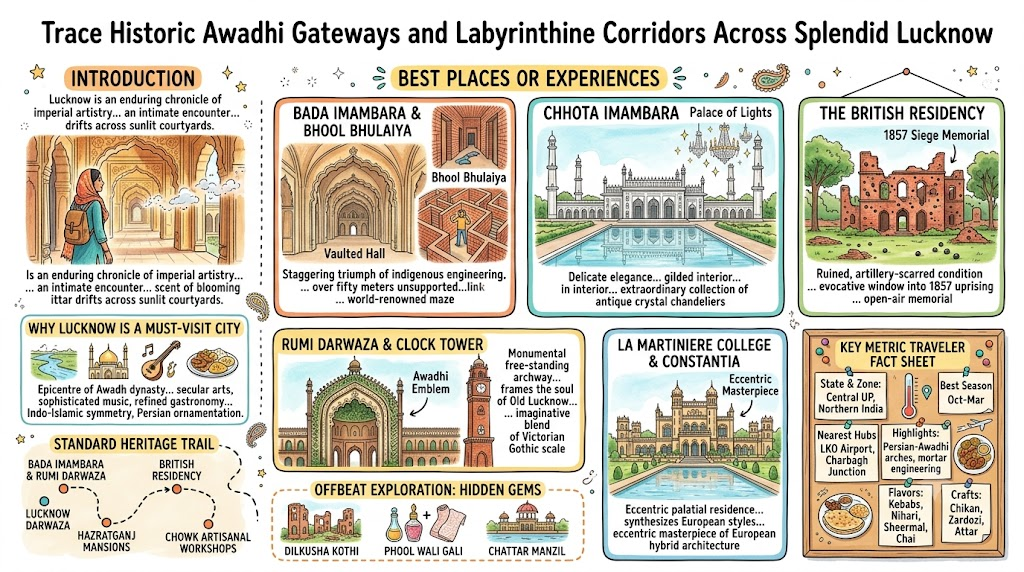
The standard heritage trail winds along an organic historical trajectory. It commences amidst the grand Imambara complexes of Hussainabad, winds through the bullet-shattered arches of the British Residency, explores the European mansions of Hazratganj, and concludes across the artisanal workshops of Chowk.
| Key Metric | Traveler Fact Sheet |
|---|---|
| State & Geographical Zone | Central Uttar Pradesh, Northern India |
| Best Travel Season | October through March (Crisp mornings, pleasant daytime temperatures) |
| Nearest Transit Hubs | CCS International Airport (LKO), Lucknow Charbagh Railway Junction |
| Key Heritage Highlights | Persian-Awadhi arches, mortar engineering without iron girders, 1857 siege memorials |
| Signature Local Flavors | Galawati Kebabs, Nihari Kulcha, Sheermal, Shahi Tukda, Kashmiri Chai |
| Traditional Crafts | Handcrafted Chikan needlework, Zardozi metal embroidery, bespoke Attar perfumery |
Best Places or Experiences
Bada Imambara & Bhool Bhulaiya
Commissioned in 1784 by Nawab Asaf-ud-Daula as a visionary famine-relief initiative, the Bada Imambara stands as a staggering triumph of indigenous engineering. The central vaulted hall spans over fifty meters in length and fifteen meters in height without a single structural pillar, wood framing, or iron support beam. Instead, skilled Nawabi masons locked interlocking Lakhori bricks together using a cohesive mortar forged from lime, lentils, raw sugar, and ground seashell paste.
Suspended directly above this cavernous central chamber is the world-renowned Bhool Bhulaiya, a three-dimensional maze woven from over a thousand interconnected stairwells, false balconies, and acoustic tunnels. Navigating this labyrinth reveals a sophisticated defensive network that could disorient invaders while funneling sweeping breezes and natural daylight into the lower royal vaults.
The majestic facade of Bada Imambara.
- Location: Machchhi Bhavan, Hussainabad; approximately 5.5 km north of Charbagh Railway Station.
- Why it is worth visiting: It represents one of the largest unsupported vaulted arched ceilings in existence alongside an intricate defensive maze.
- Best things to do: Hire a licensed historian to decipher the acoustic corridors, locate the panoramic roof overlooking Hussainabad, and walk through the subterranean five-story stepwell (Shahi Baoli).
- Best time to visit: 06:30 AM to 09:30 AM to explore the chambers before crowd volumes and midday temperatures peak.
- Ideal for whom: Architecture aficionados, structural engineers, history lovers, and older children intrigued by mazes.
- Travel tip: Wear slip-on footwear or carry a dedicated shoe bag, as shoes must be removed before entering the sanctified prayer halls.
Chhota Imambara
Built in 1838 by Nawab Muhammad Ali Shah as his personal mausoleum, the Chhota Imambara—formally titled the Imambara Husainabad Mubarak—exudes delicate elegance. The monument features dazzling white facades adorned with intricate Arabic and Persian calligraphy, balanced around an axis of reflective stone water basins, manicured pathways, and ornate minarets.
Within its gilded interior rests an extraordinary collection of antique crystal chandeliers imported from Belgium, mirrored mosaic glass fixtures, and ornate silver mimbars. During sacred observances, when thousands of suspended oil lamps catch the crystal facets, the entire structure transforms into an incandescent jewel box, giving rise to its enduring title: The Palace of Lights.
The gleaming exterior of Chhota Imambara.
- Location: Daulatganj, Hussainabad; approximately 1.5 km west of Bada Imambara along the heritage corridor.
- Why it is worth visiting: It houses one of Asia’s finest preserved collections of nineteenth-century European crystal, silverwork, and calligraphic relief.
- Best things to do: Admire the historic chandeliers hanging inside the central chamber, inspect the unfinished watchtower (Satkhanda) across the street, and study the Persian Quranic verses etched into the stucco walls.
- Best time to visit: 03:30 PM to 05:30 PM to capture golden afternoon light reflecting across the exterior water channels.
- Ideal for whom: Decorative art collectors, calligraphy lovers, solo cultural wanderers, and romantic couples.
- Travel tip: Modest attire covering shoulders and knees is strictly mandated for entering the central sanctum.
The British Residency
Preserved precisely in its ruined, artillery-scarred condition, the British Residency offers a somber, evocative window into the 1857 uprising. Built between 1780 and 1800 for the British Resident stationed in the court of Awadh, this sprawling thirty-three-acre complex of brick structures, banqueting halls, and church ruins witnessed an intense five-month siege that redefined colonial rule in the subcontinent.
Sunlight filters through mature neem and tamarind branches, casting dappled shadows across crumbling red-brick masonry still pockmarked by cannonball blasts and musket volleys. The on-site museum preserves poignant artifacts, scale models of the original fortifications, and historic letters that evoke the lives caught in this fierce historical watershed.
Historic brick ruins at The British Residency.
- Location: Mahatma Gandhi Marg, Deep Manak Nagar, Qaiserbagh; roughly 4 km from Hazratganj.
- Why it is worth visiting: It stands as India’s foremost open-air memorial of the 1857 revolt, kept in its raw, battle-worn state under the Archaeological Survey of India.
- Best things to do: Trace the cannon impact craters across the banquet hall walls, examine the 1857 scale model inside the museum basement, and wander through the ruined cemetery and St. Mary’s churchyard.
- Best time to visit: November through February from 08:00 AM to 11:30 AM when morning mist drifts across the green lawns.
- Ideal for whom: Military historians, war memorial researchers, documentary photographers, and contemplative travelers.
- Travel tip: The sprawling park requires extensive walking over broken masonry pathways; sturdy, closed-toe walking shoes are essential.
Rumi Darwaza & The Hussainabad Clock Tower
Soaring over sixty feet above the bustling Hussainabad artery, the Rumi Darwaza is the grand architectural emblem of Lucknow. Constructed in 1784 under Nawab Asaf-ud-Daula, its outward-facing silhouette mirrors the historic Bab-i-Humayun gate in Istanbul, yet its ornamental execution is distinctly Awadhi. Intricate foliage carvings, arched balconies, and hollow fluted crests once held flame lanterns that illuminated the royal approach at dusk.
Just a short walk down the road stands the Hussainabad Clock Tower, a 221-foot brick campanile built in 1881 to commemorate Sir George Couper. Showcasing an imaginative blend of Victorian Gothic scale and Awadhi ornamental sensibility, it houses an immense brass pendulum clock overlooking the deep turquoise waters of the Husainabad Picture Gallery reservoir.
The monumental arch of Rumi Darwaza.
- Location: Hussainabad Heritage Zone, positioned directly between the Bada and Chhota Imambaras.
- Why it is worth visiting: It is one of the most expressive and monumental free-standing archways in South Asia, framing the soul of Old Lucknow.
- Best things to do: Photograph the crown of the arch against a clear morning sky, walk around the Clock Tower reflecting pool, and observe the historic portrait collection inside the adjacent Picture Gallery.
- Best time to visit: 05:30 AM for clear, traffic-free street perspectives, or directly at sunset when monument illumination begins.
- Ideal for whom: Urban sketchers, landscape photographers, and cultural strollers.
- Travel tip: The immediate street circle experiences active traffic; position yourself on the pedestrianized paved plazas for safe, unobstructed photographs.
La Martiniere College & Constantia
Rising dramatically from forested lawns along the city’s southeastern bend, Constantia is one of the most eccentric palatial residences in South Asia. Designed in the late eighteenth century by Claude Martin—a French soldier of fortune who rose to become a major-general in the Awadh court—this monumental mansion defies clean architectural categorization. It boldly synthesizes Italian Renaissance balustrades, classical Roman busts, Gothic pinnacles, and traditional Indian defensive bastions into a singular estate.
Now housing one of the country’s most prestigious educational institutions, La Martiniere College preserves Martin’s original subterranean vaults, his stone sarcophagus, and sweeping ballrooms adorned with neoclassical plasterwork. The exterior grounds feature broad reflecting lakes and historic cannons, offering an unexpected French-colonial imprint embedded in royal Awadhi ground.
- Location: Aashiana Road, Martin Purwa; approximately 4 km east of Hazratganj.
- Why it is worth visiting: It represents an eccentric masterpiece of European hybrid architecture with deep military ties to the events of 1857.
- Best things to do: Tour the subterranean crypt beneath the central hall, admire the neoclassical relief murals inside the chapel, and view the massive historic cannon “Lord Cornwallis” situated on the grounds.
- Best time to visit: Saturday afternoons or scheduled school vacation days between 10:00 AM and 01:00 PM.
- Ideal for whom: Colonial architecture buffs, biographers, educators, and design scholars.
- Travel tip: Since this remains a working school campus, visitors must present valid photo identification at the security gate and adhere strictly to visitor hours.
Offbeat Exploration: Hidden Gems Tourists Miss
Dilkusha Kothi & Surrounding Hunting Grounds
Tucked away in the quiet, tree-lined lanes of the Lucknow Cantonment, Dilkusha Kothi was built around 1800 by British officer Gore Ouseley for Nawab Saadat Ali Khan as a peaceful summer palace and hunting lodge. Modeled loosely on Seaton Delaval Hall in Northumberland, its weathered Baroque towers, exposed red-brick shells, and grand arched porticos now stand amidst peaceful manicured lawns. Away from the dense tourist trails of Hussainabad, Dilkusha offers a serene sanctuary where you can sit beneath old-growth trees and reflect on royal life without distraction.
The atmospheric ruins of Dilkusha Kothi.
The Artisanal Chikan & Attar Byways of Phool Wali Gali
While standard souvenir seekers crowd the glittering showrooms of major shopping streets, culture lovers should turn into the historic alleys of Phool Wali Gali inside the Chowk bazaar. Here, behind modest wooden doorways, families have distilled pure botanical essences—such as Mitti Attar, which captures the scent of rain hitting parched soil—using traditional copper deg-bhapka systems for over two centuries. Interspersed between these perfumeries are quiet verandas where master embroiderers hand-stitch shadow-work Tepchi, Bakhiya, and Phanda Chikan patterns onto translucent cotton muslin.
Chattar Manzil (The Umbrella Palace)
Commanding the south bank of the Gomti River, the Chattar Manzil derives its name from the gleaming gilded parasol that crowns its highest dome. Commissioned by Nawab Ghazi-ud-Din Haidar and completed by his son Nasir-ud-Din Haidar, this dynamic palace complex features deep subterranean chambers (tehkhanas) that were cooled directly by river currents during the intense summer heat. Following meticulous architectural restoration, its striking blend of French classical facades and Awadhi motifs provides an exceptional vantage point on riverfront court life.
Detailed Practical Guidance for Travelers
| Destination | Standard Entry Fee | General Timings | Best Local Food Options Nearby | Recommended Nearby Attractions |
|---|---|---|---|---|
| Bada Imambara | ₹50 (Indians), ₹500 (Foreigners) [Combo Ticket] | 06:00 AM – 05:00 PM (Closed Mon) | Tunday Kababi (Chowk), Rahim’s Kulcha Nihari | Rumi Darwaza, Husainabad Picture Gallery |
| Chhota Imambara | Included in Imambara Combo Ticket | 06:00 AM – 05:00 PM (Closed Mon) | Mubeen’s Pasanda & Parathas, Kashmiri Chai | Satkhanda, Hussainabad Clock Tower |
| The British Residency | ₹25 (Indians), ₹300 (Foreigners) | 07:00 AM – 06:00 PM (Daily) | Marksmen Hazratganj, Royal Cafe Basket Chaat | Qaiserbagh Palace Complex, Begum Hazrat Mahal Park |
| Rumi Darwaza & Clock Tower | Free public access to outdoor plazas | Open 24 Hours (Best viewed 06:00 AM – 09:00 PM) | Idrees Biryani (Patanala, Chowk), Radhey Lal Sweets | Shahi Baoli, Teele Wali Masjid |
| La Martiniere College | Free (Prior security clearance at gate) | 09:00 AM – 04:00 PM (Sundays/Holidays best) | The Cherry Tree Cafe, Rovers Hazratganj | Dilkusha Kothi, National Botanical Research Institute |
Logistics & On-Ground Navigation
Local Transport Options
- Lucknow Metro Corridor: Highly efficient, air-conditioned, and reliable, connecting CCS Airport directly to Charbagh, Hazratganj, and northern terminals from 06:00 AM to 10:00 PM daily.
- E-Rickshaws: The undisputed masters of Old City navigation. These battery-operated vehicles glide quietly through the narrowest Chowk alleys where passenger cars cannot fit.
- Auto-Rickshaws & Ride-Hailing Cabs: App-based services like Uber and Ola operate extensively across the city, providing clear, upfront pricing for cross-town trips between Gomti Nagar and Hussainabad.
- Private Car Rentals: Best suited for full-day excursions that combine outlying estates like Dilkusha Kothi, La Martiniere, and Nawabganj sanctuaries into a single relaxed loop.
Budget Planning
- Backpack/Budget Tier: ₹1,200 – ₹1,800 per day. Covers clean local guesthouses near Charbagh, shared e-rickshaw travel, metro commutes, combined monument tickets, and generous street-food meals.
- Mid-Range Comfort Tier: ₹3,800 – ₹6,500 per day. Includes atmospheric heritage hotels near Hazratganj, private air-conditioned app taxis, dedicated guided heritage walking tours, and dining at classic Awadhi establishments.
Safety and Inclusivity Tips
- Families: The paved promenades of the Residency and major Imambara gardens accommodate folding baby strollers well, though navigating the multi-tiered staircases of Bhool Bhulaiya requires active hand-holding.
- Couples: The expansive gardens of the Residency and Dilkusha offer peaceful, well-patrolled environments; dress respectfully when entering active religious complexes in Old Lucknow.
- General Safety: The city is widely recognized for its gracious culture and warm hospitality. Keep small-denomination cash bills tucked safely for quick street purchases in crowded markets.
Strategic Travel Planning Guardrails
Travel Planning Tips for Lucknow
- Secure train reservations or flights well in advance if visiting between November and February, when cultural festivals and pleasant winter weather attract travelers from across the world.
- Maintain a balance of physical cash and digital UPI payments; while modern eateries and ticket counters accept digital payments, heritage craftsmen and street vendors prefer cash.
- Dress modestly with breathable natural fabrics, and pack a light shawl or scarf to cover your head when entering active mosques, dargahs, or sanctified shrines.
- Pack durable slip-on shoes with cushioned soles to simplify removing footwear at monument entry points throughout the day.
- Always verify public holiday schedules and prayer closures before heading out, as several heritage monuments adjust their operational hours on Fridays.
Common Mistakes to Avoid
- Attempting to cover Old Lucknow’s labyrinthine markets in a personal or rented automobile, which invariably leads to frustrating traffic gridlock.
- Rushing through the Bhool Bhulaiya without an officially badge-accredited local guide, causing you to miss the clever acoustic tricks and hidden air shafts built into the walls.
- Confining your culinary explorations exclusively to hotel dining rooms, thereby missing the wood-fired ovens and iron skillets of street-side Awadhi masters.
- Packing overly rigid, minute-by-minute itineraries that clash with Lucknow’s famously relaxed, unhurried pace of daily life.
- Discarding monument admission stubs; the official ASI combo ticket covers multiple historic sites across Hussainabad throughout the same day.
Suggested Itinerary Blueprints
1-Day Quick Dash (The Imperial Heritage Spine)
Designed for travelers on a tight schedule who want to experience the city’s essential royal landmarks in a single, focused day.
- Morning: Arrive early at Bada Imambara by 07:30 AM to explore the cavernous hall and the Bhool Bhulaiya before the midday heat, followed by an exterior photo walk beneath Rumi Darwaza.
- Afternoon: Head over to The British Residency to explore its museum galleries and peaceful park grounds, then break for lunch along Hazratganj.
- Evening: Wrap up your day exploring the silver and glass interiors of Chhota Imambara at dusk, finishing with an authentic Awadhi dinner in the bustling lanes of Chowk.
2-Day Deep-Dive (Dynastic Architecture & Living Traditions)
A balanced two-day exploration pairing monument discoveries with authentic neighborhood life and culinary traditions.
- Day 1: Dedicate your first day entirely to the Hussainabad district. Trace the historical timeline from Bada Imambara and Shahi Baoli in the morning to the Clock Tower and Chhota Imambara in the afternoon. End your evening with an in-depth street-food tasting walk through the historic lanes of Chowk.
- Day 2: Begin your morning walking through the quiet ruins of The British Residency. Transition across midday to Claude Martin’s Constantia at La Martiniere, and conclude your journey with a sunset walk through the quiet hunting grounds of Dilkusha Kothi.
Complete Weekend Travel Plan (The Connoisseur’s Awadh Odyssey)
A comprehensive three-day cultural loop designed for architecture lovers, historians, and street-food enthusiasts.
- Friday: Arrive and check into your hotel, then spend a relaxing afternoon strolling through Hazratganj’s colonial colonnades. Enjoy tea at a heritage bakery, take in an evening walk along the Gomti Riverfront, and prepare for a full weekend of exploration.
- Saturday: Spend the morning exploring Bada Imambara, the Bhool Bhulaiya maze, and Rumi Darwaza. In the afternoon, venture into the hidden courtyards of Chowk to observe Zardozi embroiderers, Chikan artisans, and traditional Attar perfumers at work. Conclude with an evening feast of Galawati kebabs and Mughlai delicacies.
- Sunday: Start with early morning reflections among the battle-scarred brick arches of the British Residency. Head to La Martiniere College by late morning to tour its eclectic interior chapel and crypts, enjoy a slow Awadhi lunch, and wrap up your weekend taking in golden-hour light against the stone walls of Dilkusha Kothi.
Common Tourist Mistakes to Avoid
- Geographic Blunders: Group your sightseeing logically. Trying to pair the far-eastern suburban grounds of La Martiniere with the deep-western markets of Chowk on the same morning will leave you stuck in heavy cross-city traffic.
- Commercial Traps: Do not spend precious travel time wandering modern shopping malls along the ring roads. The true heart of Lucknow’s craft community beats inside historical bazaars like Chowk, Aminabad, and Nakhas.
- Neglecting Modern/Alternative Zones: Focusing exclusively on eighteenth-century monuments can cause you to overlook the city’s vibrant modern additions, such as the grand public parks and contemporary open-air cafes of Gomti Nagar.
- Transport Overpayment: Always cross-reference prices on ride-hailing apps like Uber or Ola before negotiating flat cash rates with unmetered three-wheelers waiting outside major tourist exits.
- Luxury Dining Bias: While upscale dining rooms prepare delicious meals, skipping street-side specialists means missing out on the irreplaceable smoky aromas of charcoal-grilled kebabs, rich slow-simmered Nihari, and freshly baked Sheermal straight from clay tandoors.
Frequently Asked Questions
1. Is it safe to wander through the Bhool Bhulaiya maze without a local guide?
While the maze is secure, venturing through its winding staircases alone can disorient you. Hiring an officially accredited ASI guide ensures you navigate the interconnected passages safely while learning about the clever hidden acoustics, wall-ventilation shafts, and strategic lookouts that make this monument such an architectural triumph.
2. What is the single best time of day to photograph the historic Rumi Darwaza?
The most rewarding window for photography is just after dawn, between 06:00 AM and 07:15 AM. During this quiet period, the golden morning light illuminates the western archway, and the streets are blissfully free of passing buses, auto-rickshaws, and daily commuter traffic, allowing you to capture crisp, unobstructed architectural shots.
3. What specific clothing etiquette should travelers observe when visiting Imambaras?
Because both Bada and Chhota Imambaras remain active, sacred prayer grounds for the local community, all visitors must dress respectfully. Keep your shoulders, chest, and knees fully covered, avoid excessively tight clothing, and keep a clean scarf handy, as women are required to cover their heads before entering the interior prayer halls.
4. Are outside shoes allowed inside the monuments of the Hussainabad heritage circuit?
Footwear is strictly prohibited inside the main sanctums, central prayer halls, and mosques of both Imambaras. You may leave your footwear at the supervised shoe-counter stands near the main entrance gates for a nominal tip, or slip your shoes into a lightweight cloth carry-bag to bring them along as you tour the open grounds.
5. How much time should culture lovers set aside to explore the British Residency?
Plan for at least two to two-and-a-half hours to explore the British Residency properly. The landscaped grounds span over thirty acres, and fully appreciating the memorial ruins, cannon impact sites, cemetery grounds, and the historic basement museum requires an unhurried, thoughtful walk across the campus.
6. Can regular travelers walk into La Martiniere College to view the Constantia building?
Because La Martiniere functions as an active educational institution, access during standard school hours is limited to maintain campus security. The best windows to visit are Sunday mornings, official school breaks, and public holidays, when visitors can register at the primary security gate to view the exterior facades, historical chapel, and crypt.
7. Where can travelers find authentic, hand-embroidered Lucknowi Chikan garments?
Skip the generic, machine-embroidered souvenir stalls and head directly to the heritage lanes of Chowk, Janpath Market, or the state-run UPica handloom emporiums. Look for pieces featuring hand-stitched Murri, Phanda, and Keel Kangan motifs on fine, unbleached cotton or sheer muslin, and purchase directly from recognized artisan collectives.
8. What makes the culinary preparation of the Galawati Kebab so historically unique?
Legend holds that the Galawati Kebab was originally crafted for an aging Awadhi Nawab who had lost his teeth but refused to give up his passion for rich meats. Master chefs tenderized finely minced meat with raw green papaya and infused it with over one hundred aromatic spices, creating a delicate patty that melts effortlessly on the tongue.
9. Is an entry permit required to take photographs inside the heritage sites of Lucknow?
Casual, non-commercial photography using smartphones and handheld mirrorless cameras is permitted across most monuments, though select interiors prohibit flash. Using heavy tripods, specialized lighting gear, or commercial video rigs requires prior written permission and permit clearance from the Archaeological Survey of India office.
10. How accessible are the heritage monuments of Lucknow for travelers with limited mobility?
The ground-level courtyards of the British Residency and the exterior plazas of the Imambaras feature paved pathways that accommodate wheelchairs reasonably well. However, the steep, narrow, and uneven stone staircases of the Bhool Bhulaiya, Shahi Baoli, and historic watchtowers are inaccessible to visitors with significant mobility challenges.
11. What is the practical difference between the Bada Imambara and the Chhota Imambara?
The Bada Imambara is celebrated primarily for its colossal scale, majestic vaulted brick ceiling, stepwell, and defensive maze. In contrast, the Chhota Imambara is smaller and more intimate, distinguished by its refined decoration, calligraphic relief murals, and world-class interior collection of nineteenth-century European crystal chandeliers.
12. Can travelers visit the historical monuments of Lucknow during the month of Muharram?
Yes, visitors are welcome during Muharram, but keep in mind that the Imambaras become focal points for deeply moving religious observances and mourning processions. Travelers visiting during this period should dress in subdued, modest attire, remain quiet and respectful during public gatherings, and expect temporary road closures throughout the Old City.
Conclusion
Choosing to explore the heritage of Lucknow over an ordinary, hurried vacation is a transformative travel choice. It invites you to step outside the frantic pace of modern itineraries and embrace a lifestyle where gracious hospitality, poetic conversation, and architectural wonder still reign supreme. As the warm afternoon light fades behind the domes of the Old City and the soulful call to prayer drifts over the riverbanks, you come to realize that Lucknow is not merely a collection of historic brick monuments—it is an enduring state of mind, an artful way of living that leaves an indelible mark on every traveler fortunate enough to walk its paths.
