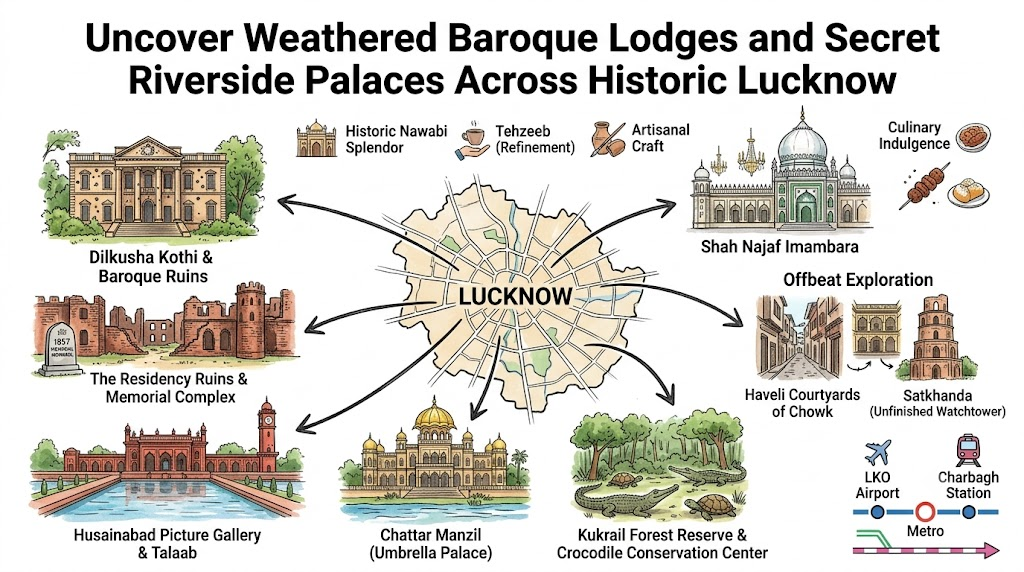
Introduction
Most travelers arrive in Lucknow chasing well-trodden trails: the vaulted arches of Bara Imambara, the lively evening bustle of Hazratganj, and the famed kebab counters of Aminabad. Yet, beneath the city’s well-documented Nawabi splendor lies a quieter, deeply layered world where history whispers from forgotten stucco walls and time slows down.
While typical tourist hubs feel overcrowded and commercialized, Lucknow’s hidden sanctuaries preserve a rare and unhurried authenticity. Stepping off the standard sightseeing circuit reveals neglected riverside palaces, secret Sufi shrines, forgotten European lodges, and quiet forest canopies that invite true cultural connection.
Why Lucknow is a must-visit city
Lucknow is an essential chapter in the subcontinent’s cultural history, defined by the refined Nawabi court ethos known as Tehzeeb and its pivotal role during the 1857 uprising. Geographically cradled along the bends of the Gomti River, it blends grand Indo-Islamic, Mughal, and neoclassical European architecture across its vibrant neighborhoods. Modern transit connects the city effortlessly through Chaudhary Charan Singh International Airport, the historic Lucknow Charbagh Railway Station, and multi-lane expressways like the Agra-Lucknow and Purvanchal highways.
The traveler circuit branches across three distinct zones: the labyrinthine lanes of the Old City (Chowk and Husainabad), the heritage colonial core (Hazratganj and Qaiserbagh), and the modern residential expansions along Gomti Nagar. Exploring this multi-layered urban fabric reveals a city where artisanal craft, poetic refinement, and royal indulgence still define everyday living.
| Key Fact | Specification |
|---|---|
| Geographic Location | Central Uttar Pradesh along the Gomti River Basin |
| Best Travel Season | October to March (mild, crisp winters ideal for walking) |
| Nearest Transit Hubs | Lucknow Airport (LKO) and Charbagh Junction (LJN) |
| Core Heritage Circuit | Husainabad, Qaiserbagh Palace Complex, Old Chowk, Dilkusha |
| Culinary Signatures | Galawati Kebabs, Sheermal, Nihari Kulcha, Malai Paan, Revdi |
Best Places or Experiences
Dilkusha Kothi & Surrounding Gardens
Constructed around 1800 by British officer Major Gore Ouseley for Nawab Saadat Ali Khan, Dilkusha Kothi was designed as a countryside hunting retreat and summer villa. Built in the English Baroque style, it mirrored Seaton Delaval Hall in Northumberland, presenting an unusual departure from traditional Awadhi architecture. During the siege of 1857, the palace sustained intense cannon fire, leaving dramatic brick skeletons and soaring corner towers framed against open sky.
Today, Dilkusha Kothi stands enveloped by quiet, expansive lawns maintained by the Archaeological Survey of India. Unlike the crowded monuments downtown, here you will encounter only rustling neem trees, resting migratory birds, and the eerie, romantic charm of weathered stone.
Dilkusha Kothi English Baroque ruins.
- Location: Dilkusha Cantonment area, approximately 6 km southeast of Charbagh Railway Station.
- Why it is worth visiting: It is a hauntingly beautiful, crowd-free ruin displaying rare English Baroque architecture in the heart of Awadh.
- Best things to do: Photograph the dramatic light passing through ruined arched windows, inspect historic cannonball scars on brick facades, and unpack a quiet mid-morning sketchbook session on the manicured perimeter lawns.
- Best time to visit: November to February, preferably between 7:30 AM and 10:00 AM for golden morning light.
- Ideal for whom: Architecture enthusiasts, solo photographers, and heritage purists seeking solitude.
- Travel tip: The Cantonment zone has strict driving rules and limited mobile signal near outer defense perimeters; keep offline maps downloaded.
The Residency Ruins & Memorial Complex
Built between 1780 and 1800 for the British Resident General, the sprawling Residency complex served as the epicenter of the historic 147-day Siege of Lucknow in 1857. Over 3,000 residents were besieged inside its fortified brick structures, with buildings pounded continuously by artillery and rifle fire.
Now preserved in its ruined state, the site is framed by ancient banyan trees, creeping ivy, and tranquil flower gardens. The main museum inside the banquet hall cellar preserves original model maps, artillery fragments, and poignant diaries documenting the intense conflict.
The historic Residency memorial complex.
- Location: Mahatma Gandhi Marg, Deep Manak Nagar, roughly 4 km north of Charbagh Railway Station.
- Why it is worth visiting: It offers an emotionally profound walk through untouched 1857 conflict ruins left exactly as they stood after the siege.
- Best things to do: Explore the subterranean cooling chambers (taikhana) used as siege shelters, locate original bullet-riddled cemetery markers, and visit the curated ASI memorial museum.
- Best time to visit: 8:00 AM to 11:30 AM or 3:30 PM to 5:30 PM on cool winter afternoons.
- Ideal for whom: War history scholars, heritage walkers, and contemplative travelers.
- Travel tip: Purchase a digital composite ASI ticket online at the entrance gate using UPI to bypass the manual kiosk queue.
Husainabad Picture Gallery & Talaab
Erected in 1838 by Nawab Mohammad Ali Shah, this imposing red-brick pavilion overlooks an enormous stone water reservoir (talaab). Built initially as an ornate summer gallery, the upper hall houses rare, life-sized oil portraits of the Nawabs of Awadh painted on imported canvas by visiting European artists.
The paintings feature an optical illusion: the shoes, eyes, and canes of the Nawabs appear to follow your movement across the grand hall. Outside, stone steps descend into the shimmering reflection tank, bordered by the soaring red Husainabad Clock Tower and the nearby Chhota Imambara.
The soaring Husainabad Clock Tower.
- Location: Husainabad heritage zone, about 6.5 km northwest of Charbagh Station.
- Why it is worth visiting: Fascinating visual optical-illusion paintings housed inside a magnificent, quiet waterfront pavilion.
- Best things to do: Test the moving-perspective visual tricks with the on-site curator, capture waterfront reflections of the brick clock tower, and walk the perimeter arcade at sundown.
- Best time to visit: 3:00 PM to 5:30 PM, right before golden hour settles over the water reservoir.
- Ideal for whom: Curious visual learners, families with older children, and art collectors.
- Travel tip: Shoes must be removed before entering the carpeted portrait room upstairs; wear socks for convenience.
Chattar Manzil (Umbrella Palace)
Set directly along the south bank of the Gomti River, Chattar Manzil was conceived by Nawab Ghazi-ud-din Haidar and completed by Nasir-ud-din Haidar. The palace derives its name from the brilliant gilded umbrella (chattar) that caps its high octagonal dome, historically signaling royal presence across the river.
The palace incorporates European neoclassical facades with traditional subterranean river chambers designed for natural cooling during hot Awadhi summers. Having served various roles after 1857, including housing a national drug research laboratory, ongoing conservation has revived its ornate stucco cornices and riverside pavilions.
Chattar Manzil on the Gomti River.
- Location: Kaiserbagh heritage quarter, about 4.5 km north of Charbagh Station.
- Why it is worth visiting: A rare surviving riverside palace displaying unique subterranean vaults built directly into river mudbanks.
- Best things to do: Admire the gilded dome against the river skyline, photograph the neoclassical exterior pillars, and take a riverside walk toward the nearby Farhat Baksh complex.
- Best time to visit: Early morning between 7:00 AM and 9:00 AM when the eastern light highlights the gilded roof finial.
- Ideal for whom: Architectural historians, urban sketchers, and cultural researchers.
- Travel tip: Certain interior rooms undergo periodic preservation; check with local conservation guards for authorized walking zones.
Kukrail Forest Reserve & Crocodile Conservation Center
Established in the 1970s along the Kukrail drainage basin, this sprawling forest reserve serves as a vital ecological green lung and a breeding ground for endangered Gharials and Mugger crocodiles. It offers a total contrast to urban concrete, housing open woodlands of sal, eucalyptus, and scrub canopy.
The facility focuses on rescuing, rearing, and releasing freshwater reptiles into the Chambal and Girwa rivers. Wooded paths weave around natural ponds, allowing curious visitors to observe juvenile crocodiles, native wetland turtles, and scores of wintering waterfowl.
- Location: Kukrail Ring Road, Indiranagar fringe, roughly 12 km northeast of the city center.
- Why it is worth visiting: An educational conservation forest harboring rare crocodilians away from tourist-heavy city sights.
- Best things to do: Observe juvenile gharial pods inside breeding enclosures, walk the peaceful nature trails through pine scrub, and spot wintering kingfishers around the marsh banks.
- Best time to visit: 10:00 AM to 2:00 PM during winter months when reptiles emerge to bask on sunny sandbanks.
- Ideal for whom: Nature enthusiasts, wildlife photographers, and traveling families.
- Travel tip: Outside food is strictly restricted inside breeding grounds; carry personal reusable water flasks.
Shah Najaf Imambara
Located along Rana Pratap Marg near the Gomti River, Shah Najaf Imambara serves as the mausoleum of Nawab Ghazi-ud-din Haidar and his wives. Inspired by the tomb of Hazrat Ali in Najaf, Iraq, the structure features a pure white spherical dome, clean parapets, and an unassuming exterior that hides an extravagant interior.
Inside, the central chamber dazzles with antique Belgian cut-glass chandeliers, historic silver tazia replicas, stained-glass lanterns, and vintage military battle banners from the 19th century. Its quiet garden courtyard offers a peaceful spiritual refuge rarely interrupted by large tour groups.
- Location: Rana Pratap Marg, Hazratganj periphery, approximately 5 km from Charbagh Station.
- Why it is worth visiting: An astonishing collection of antique European cut-glass chandeliers housed in a peaceful, under-visited sanctuary.
- Best things to do: View the vintage crystal and colored glass light fixtures suspended throughout the dome, pay respects at the marble cenotaphs, and stroll through the quiet floral quadrangle.
- Best time to visit: 4:00 PM to 6:30 PM when evening light filters through colored glass lanterns.
- Ideal for whom: Seekers of quiet heritage, sacred architecture admirers, and collectors of craft traditions.
- Travel tip: Dress modestly with arms and legs covered, and remove footwear at the perimeter gatehouse.
Offbeat Exploration: Hidden Gems Tourists Miss
The Labyrinthine Haveli Courtyards of Chowk
Beyond the main market streets of Chowk lies a dense network of narrow alleyways (kuchas) filled with centuries-old residential havelis. Walking through Phool Wali Gali or past the forgotten gates of Firangi Mahal reveals crumbling stucco facades, vintage cast-iron balconies, and family-run perfume distilleries brewing pure rose water and khus attar in traditional copper stills (deg-bhapka).
Satkhanda (The Unfinished Watchtower)
Standing across from the Husainabad Talaab, this red-brick tower was envisioned by King Mohammad Ali Shah in 1840 to rival the Leaning Tower of Pisa and the Qutub Minar. Planned as a seven-story astronomical observatory and palace watchtower, construction abruptly ceased at four stories following the king’s death, leaving a striking, open-air octagonal curiosity.
La Martiniere College French Crypt and Grounds
Conceived and designed by French adventurer Major General Claude Martin in the late 18th century, Constantia (now La Martiniere College) combines gothic turrets, classical gargoyles, and Roman statues in a singular palace. Beneath the grand hall lies Claude Martin’s stone tomb inside a vaulted underground crypt, accessible with courteous prior permission from the school groundskeeper.
Detailed Practical Guidance for Travelers
| Destination | Standard Entry Fee | General Timings | Best Local Food Options Nearby | Recommended Nearby Attractions |
|---|---|---|---|---|
| Dilkusha Kothi | Free Entry | Sunrise to Sunset (6:00 AM – 6:00 PM) | Awadhi Parathas at Cantonment Dhabas | Bibiyapur Kothi, Dilkusha Stables |
| The Residency | ₹25 (Indians), ₹300 (Foreign Nationals) | 7:00 AM – 5:30 PM (Museum closed Mondays) | Makhan Malai stalls at Golaganj crossroad | Saadat Ali Khan Tomb, Begum Hazrat Mahal Park |
| Husainabad Picture Gallery | ₹20 (Indians), ₹200 (Foreign Nationals) | 8:00 AM – 5:00 PM | Rahim’s Kulcha Nihari in Chowk | Husainabad Clock Tower, Satkhanda |
| Chattar Manzil | Free Entry (Outer zones accessible) | 9:00 AM – 5:00 PM (Weekdays) | Moti Mahal chaat counters in Hazratganj | Kaiserbagh Palace Complex, Lal Baradari |
| Kukrail Reserve | Free Entry (Parking fees apply) | 9:00 AM – 5:00 PM | Local roadside tea stalls near picnic gate | Indira Gandhi Pratishthan, Gomti Green Corridor |
| Shah Najaf Imambara | Free Entry | 6:00 AM – 8:00 PM | Royal Cafe Basket Chaat on MG Road | Sikander Bagh, National Botanical Research Institute |
Logistics & On-Ground Navigation
Local Transport Options
- Metro Network: The North-South corridor connects Chaudhary Charan Singh Airport directly to Charbagh, Hazratganj, and Munshipulia, offering clean, air-conditioned transit across the city.
- Electric Auto-Rickshaws (E-Rickshaws): Best for navigating tight lanes inside Chowk, Aminabad, and Kaiserbagh; fares run between ₹10 and ₹30 for short hops.
- Ride-Hailing Cabs & Autos: Uber and Ola operate reliably throughout Lucknow, making them ideal for reaching outer sites like Kukrail Reserve or Dilkusha.
- Private Car Rentals: Recommended for full-day family itineraries requiring flexible point-to-point transit across distant heritage clusters.
Budget Planning
- Budget / Solo Explorer Tier: ₹1,200 – ₹1,800 per day. Includes clean hostel or budget hotel stays, street-food meals (nihari, basket chaat, sheermal), and public metro or e-rickshaw travel.
- Mid-Range / Comfort Tier: ₹3,500 – ₹6,000 per day. Covers three-star boutique heritage hotels, app-hailed private cabs, formal Awadhi dining experiences (Dastarkhwan, Oudhyana), and entrance guides.
Safety and Inclusivity Tips
- Families: Major heritage sites like The Residency and Janeshwar Mishra Park offer clean paved paths suitable for strollers and elderly members.
- Couples: Stick to well-monitored historical gardens and open riverfront promenades during daylight and early evening hours.
- General Safety: Keep small cash notes for local entry kiosks; remain vigilant against pickpockets inside crowded old bazaar crossroads at night.
Local Secret: When shopping for genuine Chikankari embroidery in Chowk, ask for traditional hand-crafted fanda and jaali work on mulmul cotton, rather than cheaper machine-stitched pieces sold along tourist avenues.
Strategic Travel Planning Guardrails
Travel Planning Tips for Lucknow
- Book your trip between November and February to enjoy comfortable walking weather and seasonal winter delicacies like creamy Makhan Malai.
- Carry physical cash in small denominations (₹10, ₹20, ₹100), as many traditional bazaar stalls in Chowk do not rely on digital payments.
- Dress conservatively with shoulders and knees covered when entering functioning places of worship, including Shah Najaf Imambara.
- Carry comfortable, slip-off footwear, as entering many historical shrines and carpeted portrait galleries requires removing shoes.
- Hire verified ASI-licensed guides at major monuments to avoid unreliable architectural claims from casual touts.
- Pack a light warm layer for winter evenings when temperatures can drop toward 8°C along open riverbanks.
Common Mistakes to Avoid
- Cramming distant heritage sights into a single half-day, leaving little time to absorb the city’s relaxed pace.
- Visiting old bazaar quarters in private rental cars where narrow streets guarantee severe gridlock.
- Planning monument itineraries on Mondays, when state museums and specific historical enclosures remain closed.
- Relying exclusively on high-end hotel restaurants and missing out on authentic street-level Awadhi culinary counters.
- Assuming auto-rickshaw drivers will always turn on meters; always establish fares beforehand or check app benchmarks.
- Skipping local water precautions; stick to packaged or verified reverse-osmosis filtered water at street vendors.
Suggested Itinerary Blueprints
1. Day Quick Dash (Classic Heritage & Culinary Loop)
Geared for travelers with limited time who want to capture essential heritage points alongside legendary culinary stops.
- Morning: Arrive at The Residency by 8:30 AM to explore the quiet ruins, followed by an exterior photo stop at Chattar Manzil.
- Afternoon: Head into Chowk for a traditional lunch of Kulcha Nihari at Rahim’s, followed by visits to the Husainabad Picture Gallery and Satkhanda.
- Evening: Wrap up with evening shopping for authentic Chikankari garments in Hazratganj, punctuated by dinner at Royal Cafe.
2. Day Deep-Dive (Curious Explorer’s Circuit)
A two-day journey balancing major historical monuments with secluded architectural ruins.
- Day 1: Begin at Dilkusha Kothi early in the morning. Continue to La Martiniere College to view the exterior grounds and French crypt, followed by an afternoon visit to Shah Najaf Imambara and sunset along the Gomti Riverfront.
- Day 2: Start your morning at The Residency complex, followed by an exploration of the historic Chowk alleyways, a stop at the Husainabad Talaab, and late-afternoon street food tasting in Aminabad.
3. Complete Weekend Travel Plan (The Ultimate Awadhi Immersion)
A comprehensive three-day loop covering serene forest reserves, historical treasures, and culinary traditions.
- Friday: Arrive, settle into your hotel, and spend an unhurried late afternoon exploring Dilkusha Kothi. Head to Hazratganj for an evening stroll and dinner.
- Saturday: Dedicate your morning to the wildlife of Kukrail Forest Reserve. Head back into town for lunch, explore the ornate interiors of Shah Najaf Imambara, and enjoy a slow evening walk through Sikander Bagh.
- Sunday: Dive into the heart of the Old City: explore the Husainabad Picture Gallery, walk through Chowk’s hidden haveli courtyards, shop for handcrafted perfumes (attar), and end with Galawati kebabs at Tunday Kababi.
Common Tourist Mistakes to Avoid
Geographic Blunders
Attempting to pair distant locations like Kukrail Forest Reserve with the busy alleys of Chowk in the same afternoon is a classic mistake. Lucknow’s traffic can crawl during evening hours. Always group your stops by zone: keep Old Lucknow sites grouped together on one day, and cluster Cantonment or Gomti Nagar attractions on another.
Commercial Traps
Many first-time visitors spend valuable evening hours wandering modern shopping malls in Gomti Nagar. Modern malls offer the exact same brands found in every major city. True local life thrives inside heritage bazaars like Chowk, Nakhas, and Hazratganj, where family-run establishments have traded for generations.
Neglecting Modern/Alternative Zones
Focusing solely on crumbling ruins can cause visitors to overlook the city’s thriving contemporary side. Neighborhoods across Gomti Nagar feature open public art parks, expansive riverside promenades, and specialty cafes serving single-origin Indian coffees alongside local bakeries.
Transport Overpayment
Hailing unmetered auto-rickshaws directly outside Charbagh Station often leads to paying double the local rate. Always cross-check destination distances on ride-hailing apps like Uber or Ola before agreeing to cash fares, or use pre-paid auto booths where available.
Luxury Dining Bias
Relying exclusively on hotel dining rooms keeps you from experiencing the city’s true culinary soul. Legendary preparations like soft galawati kebabs, slow-simmered nihari, and delicate sheermal flatbreads are perfected at unassuming street-side counters that have used the same family spice blends for a century.
Frequently Asked Questions
1. What makes Dilkusha Kothi different from other monuments in Lucknow?
Dilkusha Kothi stands apart because it was constructed in the English Baroque style rather than traditional Awadhi Indo-Islamic architecture. Modeled after an 18th-century English country house, its dramatic brick towers, open-air arches, and peaceful lawns offer a quiet experience away from the bustling city center.
2. Is a camera permit required to take photographs inside The Residency?
Standard still photography with smartphones and digital cameras is permitted free of charge across the open garden grounds. However, commercial video production, tripods, and drone photography require formal advance clearance from the Archaeological Survey of India office located near the entrance gate.
3. Can tourists access the underground crypt at La Martiniere College?
Access to the subterranean crypt containing Major General Claude Martin’s tomb is situated within an active school campus. Visitors must seek courteous permission at the security office during non-school hours or weekend mornings to enter the central Constantia building without disrupting academic activities.
4. Where can I experience authentic traditional perfume distillation in Lucknow?
The oldest surviving attar distilleries operate inside the narrow lanes of Chowk, particularly along Phool Wali Gali. Here, master perfumers still extract concentrated botanical essences of pure damask rose, vetiver (khus), and baked earth (mitti attar) using ancient wood-fired copper stills.
5. How much time should a curious traveler spend visiting the Husainabad Picture Gallery?
Plan to spend approximately 45 minutes to an hour inside the pavilion. This provides enough time to observe the optical-illusion oil portraits guided by the hall curator, study historic sketches of Awadh, and walk the exterior stone steps overlooking the massive water reservoir.
6. Are vegetarian food options available near the Old City heritage sites?
While Old Lucknow is famous for its slow-cooked meats, vegetarian travelers will find fantastic options nearby. Excellent choices include crisp kachoris at Bajpayee Kachodi Bhandar, savory basket chaat at Royal Cafe, and seasonal winter sweets like saffron-dusted Makhan Malai across Chowk.
7. Is Kukrail Reserve safe for travelers with small children?
Kukrail Reserve provides safe, fenced viewing enclosures and paved walking pathways designed specifically for families and nature enthusiasts. Children can safely observe gharials, freshwater turtles, and local birds, provided visitors stay along designated public paths and follow forest guidelines.
8. What is the best way to travel between Chowk and Hazratganj?
Shared or private e-rickshaws and app-based autos offer the most practical way to travel between Chowk and Hazratganj. They easily bypass narrow bottlenecks along historical roads, typically completing the 5-kilometer transit within twenty to thirty minutes depending on time of day.
9. Why was construction on the Satkhanda watchtower never finished?
Construction of Satkhanda was halted abruptly in 1842 following the sudden death of its patron, King Mohammad Ali Shah. Work was abandoned out of local superstition and a lack of royal funds, leaving the ambitious seven-story design standing incomplete at four levels.
10. What dress code is expected when visiting Shah Najaf Imambara?
Visitors should dress modestly out of respect for this active sacred burial site. Ensure shoulders and knees are covered with loose, respectful clothing. Both men and women must remove their footwear at the main courtyard threshold, and women may find carrying a scarf useful.
11. Can we explore the subterranean chambers beneath Chattar Manzil?
While ongoing conservation occasionally limits access to sensitive underground sections, authorized portions of the riverside palace ground floor are open to travelers. Check with on-site ASI conservation personnel during morning hours to see which interior halls are accessible during your visit.
12. When is the Makhan Malai street delicacy available in Lucknow?
Makhan Malai is an ephemeral winter specialty available exclusively from late November through early March. This light, frothy milk confection is traditionally prepared under open morning dew and flavored with saffron, cardamom, and silver foil, best enjoyed in Chowk before noon.
Conclusion
Choosing to explore Lucknow’s hidden corners rewards you with far more than an ordinary checklist holiday. It invites you into a slower, more thoughtful journey through history. Sitting amid the silent, sunlit ruins of Dilkusha Kothi, listening to classical melodies drift through quiet imambaras, or walking ancient alleyways where distillers craft timeless perfumes connects you to the living heart of Awadh. This city does not demand your attention with loud spectacles; instead, it reveals its enduring elegance to those patient enough to seek it out.
