Introduction
Leave behind the frantic, overcrowded tourist circuits and commercialized hill stations. Lucknow offers a rare rhythm where genuine hospitality (tehzeeb), architectural grace, and soul-stirring culinary traditions thrive side by side. Rather than merely sightseeing, entering Lucknow feels like stepping into an intimate living room filled with aristocratic folklore, intricate craftsmanship, and timeless leisure.
From the labyrinthine corridors of ancient monuments to tranquil riverside promenades and sensory-rich culinary alleys, the city invites travelers to slow down. Here, true discovery happens when you embrace local conversations, savor freshly prepared delicacies, and explore stories that mainstream travel guides routinely overlook.
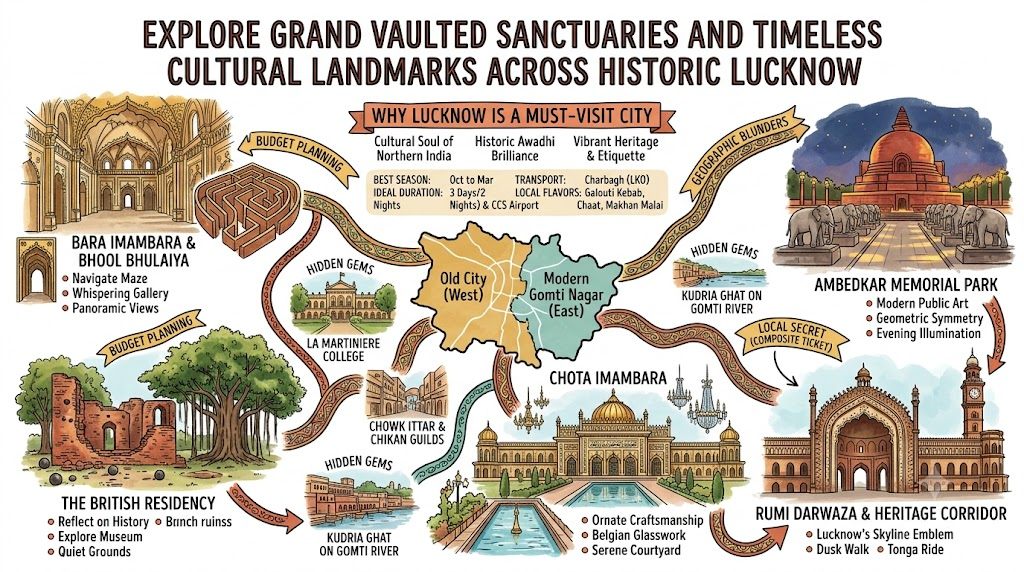
Why Lucknow is a must-visit city
Lucknow stands as the cultural soul of Northern India, bridging historic Awadhi brilliance with thoughtful contemporary urban design. Flowing gracefully along the Gomti River, this storied capital carries immense architectural weight, showcasing striking vaulted halls built without iron or European beams, tranquil gardens, and neoclassical ruins. For culture enthusiasts, photographers, and passionate food lovers, it presents an unmatched sensory landscape where centuries of art and etiquette remain actively woven into daily modern life.
Navigating the city is extraordinarily accessible across all traveler profiles. Broad arterial expressways, an efficient international airport, and high-frequency railway terminals connect the region seamlessly. The primary travel circuit neatly divides into two distinct experiences: the atmospheric, heritage-dense Old City zone in the west and the expansive, landscaped modern avenues of Gomti Nagar to the east.
| Key Fact | Details |
|---|---|
| Best Travel Season | October to March (Crisp mornings and pleasant evenings) |
| Ideal Circuit Duration | 3 Days / 2 Nights |
| Key Transport Hubs | Lucknow Charbagh Station (LKO) & CCS International Airport (LKO) |
| Signature Local Flavors | Galouti Kebab, Sheermal, Nihari-Kulcha, Basket Chaat, Malaiyyo / Makhan Malai |
| Renowned Crafts | Handcrafted Chikan embroidery and natural floral Ittar |
Best Places or Experiences
Bara Imambara & Bhool Bhulaiya
Commissioned in 1784 by Nawab Asaf-ud-Daula as a visionary famine-relief initiative, the Bara Imambara is an engineering marvel that defies standard architectural logic. Its colossal central hall—the Asfi Mosque complex—stretches over 50 meters in length and stands three stories tall without a single structural pillar or iron beam supporting its vaulted roof.
Above this majestic cavern rests the legendary Bhool Bhulaiya, an intricate labyrinth comprising over a thousand interconnected, nearly identical passageways and secret balconies designed to disorient invaders. Walking through its whispering galleries, where acoustic architecture allows faint whispers to travel along solid walls, provides an unforgettable journey into medieval defense craftsmanship and royal grandeur.
The majestic Bara Imambara complex.
- Location: Machchhi Bhavan, Old Lucknow; approximately 5.5 km northwest of Charbagh Railway Station.
- Why it is worth visiting: Home to one of the world’s largest unsupported vaulted halls and the iconic three-dimensional acoustic maze of Bhool Bhulaiya.
- Best things to do: Hire a certified guide to navigate the deceptive maze corridors, test the unique whispering-wall acoustics in the central chamber, and climb to the rooftop terrace for panoramic views over Old Lucknow.
- Best time to visit: 8:30 AM to 11:00 AM to avoid crowds and afternoon heat.
- Ideal for whom: Architecture aficionados, curious history buffs, and families.
- Travel tip: Wear slip-on shoes with socks, as footwear is strictly deposited outside the sanctum steps, and the stone courtyard warms up quickly by midday.
The British Residency
Set amidst sweeping, manicured botanical lawns, the British Residency stands frozen in time as a quiet witness to the fierce 1857 First War of Independence. Originally constructed between 1780 and 1800 for the British Resident General, the sprawling compound was transformed into a besieged fortress during the protracted 147-day Siege of Lucknow.
Today, its weathered brick facades remain etched with authentic cannonball indentations and rifle fire scars. The tranquil, park-like grounds, shaded by giant ancient banyans and flowering bougainvillea, offer a deeply reflective space accompanied by a museum housing rare lithographs, original maps, and colonial artifacts.
Historic British Residency grounds.
- Location: Mahatma Gandhi Marg, Deep Manak Nagar, roughly 4 km from Charbagh Railway Station.
- Why it is worth visiting: An evocative, open-air historical site capturing a pivotal turning point in modern Indian history.
- Best things to do: Inspect the authentic cannon shot impacts preserved on the main banquet hall walls, explore the quiet subterranean banquet basements (tahkhanas), and visit the ASI Residency Museum.
- Best time to visit: 3:30 PM to 5:30 PM for golden-hour photography and cooler outdoor temperatures.
- Ideal for whom: Solo travelers, contemplative historians, and heritage photographers.
- Travel tip: Carry a personal umbrella and water bottle, as walking the full length of the expansive compound requires around two hours on foot.
Chota Imambara
Constructed in 1838 by Nawab Muhammad Ali Shah, the Chota Imambara—formally known as the Imambara Husainabad Mubarak—exemplifies ornate Awadhi-Islamic craftsmanship. Intricately adorned with detailed calligraphy, gilded domes, and geometric plasterwork, the monument was designed as a mausoleum and congregation hall.
Its grand interior houses a breathtaking collection of Belgian crystal chandeliers, stained-glass lanterns, silver-plated pulpits, and period brass mirrors, earning it the beloved title of the “Palace of Lights.” Across the pristine courtyard, reflecting pools mirrored by ornamental mini-shrines create a calm, dignified atmosphere.
Chota Imambara’s reflective water courts.
- Location: Husainabad, roughly 1.5 km west of the Bara Imambara.
- Why it is worth visiting: Spectacular European crystal glasswork and delicate Awadhi architectural flourishes.
- Best things to do: Marvel at the grand Belgian chandelier ceiling installation, photograph the symmetrical reflecting pools framing the main facade, and observe the scale model tomb modeled after the Taj Mahal.
- Best time to visit: Late afternoon between 4:00 PM and 6:00 PM when internal lanterns catch the fading daylight.
- Ideal for whom: Art lovers, couples, and cultural explorers.
- Travel tip: The combined ticket purchased at the Bara Imambara includes entry here; keep your physical stub handy.
Rumi Darwaza & Husainabad Heritage Corridor
Standing 60 feet tall between the two great Imambaras, the majestic Rumi Darwaza is the defining emblem of Lucknow’s skyline. Built under the patronage of Nawab Asaf-ud-Daula in 1784, its design draws inspiration from the Bab-i-Humayun gateway in Istanbul, showcasing an iconic arched gateway crowned with a decorative semi-circular fan vault.
Flanking this monumental portal is the Husainabad Heritage Corridor, home to the imposing 221-foot Victorian Husainabad Clock Tower, the grand Picture Gallery, and the serene Husainabad Talaab. A leisurely evening walk through this open-air heritage plaza immerses you in the living pulse of Old Lucknow
.
The historic Rumi Darwaza archway.
- Location: Husainabad Road, Old Lucknow.
- Why it is worth visiting: An architectural masterpiece that symbolizes the city’s architectural peak.
- Best things to do: Admire the delicate stucco carvings across the upper arches, photograph the Victorian Clock Tower, and take a gentle horse-drawn tonga ride along the cobbled perimeter.
- Best time to visit: Dusk (6:00 PM to 8:00 PM) when surrounding heritage lights cast a warm glow across the facade.
- Ideal for whom: Street photographers, urban explorers, and casual evening wanderers.
- Travel tip: This is an open public thoroughfare; keep an eye out for local traffic when taking street-level photographs.
Ambedkar Memorial Park
Constructed entirely from red sandstone sourced from Rajasthan, the colossal Dr. Bhimrao Ambedkar Memorial Park in Gomti Nagar showcases modern public architecture on an impressive scale. Spanning over 100 acres, this expansive public memorial honors icons of social justice with geometric symmetry, massive stone columns, and sweeping courtyards.
The main avenue is lined with 62 majestic, hand-carved stone elephant statues leading to an imposing 112-foot-high central dome. At night, extensive illumination turns the plaza into a dramatic, cinema-like expanse that contrasts beautifully with the ancient monuments of Old Lucknow.
Nighttime illumination at Ambedkar Park.
- Location: Vipul Khand 2, Gomti Nagar; roughly 7 km east of Charbagh.
- Why it is worth visiting: Modern monumental stone masonry, striking symmetry, and peaceful, uncluttered public spaces.
- Best things to do: Walk the grand elephant colonnade, visit the central stupa gallery, and capture dramatic dusk photography against the red sandstone pillars.
- Best time to visit: 5:30 PM to 8:30 PM to enjoy illuminated water features and cooler stone walkways.
- Ideal for whom: Modern architecture enthusiasts, evening strollers, and photographers.
- Travel tip: The vast stone courtyards absorb heat during the day; avoid visiting during peak sunny afternoons.
Offbeat Exploration: Hidden Gems Tourists Miss
La Martiniere College (Constantia)
Hidden away on sprawling grounds near the golf course, Constantia is one of the world’s most dramatic Anglo-Indian palaces. Built in the late 18th century by French adventurer Major General Claude Martin, it combines Italian neoclassical terraces, gothic gargoyles, and ornate plaster ceilings. Visiting the inner chapel and basement crypt reveals a fascinating, little-known chapter of Lucknow’s multicultural past.
Chowk Ittar & Chikan Guilds
Step beyond tourist retail shops and venture deep into the quiet residential alleys of Chowk. Here, master embroiderers handcraft delicate Shadow Work and Tepchi stitches onto fine muslin, while heritage perfumers distill traditional, alcohol-free floral oils (Ruh Gulab, Mitti Attar, and Shamama) using century-old copper degs.
Kudria Ghat on the Gomti
Situated upstream from modern concrete riverfront parks, Kudria Ghat retains the rustic charm of ancient river steps. Lined with time-worn pavilions, miniature stone temples, and traditional wooden rowboats, this peaceful spot offers a quiet setting to watch priests perform evening river rituals away from urban noise.
Detailed Practical Guidance for Travelers
| Destination | Standard Entry Fee | General Timings | Best Local Food Options Nearby | Recommended Nearby Attractions |
|---|---|---|---|---|
| Bara Imambara | ₹50 (Indians), ₹500 (Foreigners) | 6:00 AM – 5:00 PM (Closed Mon) | Tunday Kababi, Rahim’s Kulcha Nihari (Akbari Gate) | Rumi Darwaza, Husainabad Clock Tower |
| The British Residency | ₹25 (Indians), ₹300 (Foreigners) | 7:00 AM – 6:00 PM (Daily) | Netram Sweets (Kachori-Jalebi), Hazratganj Eateries | Begum Hazrat Mahal Park, GPO |
| Chota Imambara | Covered under Bara Imambara composite ticket | 6:00 AM – 5:00 PM (Daily) | Kashmiri Chai kiosks, Mubeen’s Pasanda | Picture Gallery, Satkhanda |
| Rumi Darwaza | Free Public Access | Open 24 Hours | Local Malai Makhan stalls (Chowk in winter) | Husainabad Talaab, Shahi Baoli |
| Ambedkar Memorial Park | ₹20 per person | 11:00 AM – 9:00 PM (Daily) | Royal Cafe (Basket Chaat), modern Gomti Nagar cafes | Janeshwar Mishra Park, Gomti Riverfront |
Logistics & On-Ground Navigation
Local Transport Options
- Metro Network: The clean, air-conditioned North-South metro line provides fast connectivity between CCS Airport, Charbagh Railway Station, and Hazratganj.
- E-Rickshaws: The most efficient way to navigate the bustling alleys of Chowk, Aminabad, and Husainabad without getting stuck in traffic.
- Auto-Rickshaws & App Cabs: Uber and Ola run reliably across the city, making them ideal for point-to-point travel between Old Lucknow and Gomti Nagar.
- Car Rentals: Recommended for private day trips to outlying heritage structures or evening dining circuits across town.
Budget Planning
- Backpack/Budget Tier: ₹1,200 – ₹1,800 per day (covering budget homestays, public metro/e-rickshaws, shared meals at legendary street dhabas, and public monument tickets).
- Mid-Range Comfort Tier: ₹3,500 – ₹5,500 per day (including boutique heritage hotels, private app-cab transfers, guided heritage walks, and full-service dining).
Safety and Inclusivity Tips
- Families: Major monuments and parks offer spacious walkways suitable for children and seniors; carry light hydration and sun protection.
- Couples: Hazratganj, the Residency grounds, and Gomti Riverfront provide safe, comfortable, and well-patrolled spaces for evening walks.
- General Safety: Old town market lanes can be dense and crowded; secure personal belongings and keep modest physical cash on hand for street vendors.
Local Secret: Always purchase the ASI Composite Ticket at Bara Imambara. It includes entry to Chota Imambara, the Picture Gallery, and Shahi Baoli, saving you time at ticket counters.
Strategic Travel Planning Guardrails
Travel Planning Tips for Lucknow
- Plan your visit between November and February to enjoy crisp, pleasant daytime weather and classic winter delicacies like Makhan Malai.
- Carry small paper currency alongside digital UPI apps, as many heritage street stalls and rickshaw drivers prefer cash.
- Dress modestly when visiting functioning religious sites such as the Imambaras; carry a light stole or scarf to cover your head.
- Wear comfortable, easily removable walking shoes, as most sacred complexes require shoes to be left at the entrance.
- Schedule your monument visits for the morning to leave afternoons open for relaxed market strolls and culinary tours.
Common Mistakes to Avoid
- Trying to combine distant ends of the city on the same afternoon; group Old Lucknow and Gomti Nagar into separate days.
- Relying exclusively on large private cars in narrow old-quarter alleys where e-rickshaws are much more maneuverable.
- Dining only at modern hotel restaurants and skipping historic, family-run street stalls.
- Scheduling visits to Bara Imambara on Mondays when key interior monument sections are closed.
- Buying mass-produced, machine-made embroidery sold outside major gates instead of visiting authentic artisan workshops.
Suggested Itinerary Blueprints
1. Day Quick Dash (Classic Awadh Heritage Route)
Designed for travelers on a tight schedule who want to experience the core architectural and culinary highlights in a single day.
- Morning: Start early at Bara Imambara, explore the Bhool Bhulaiya with a guide, and admire the Rumi Darwaza.
- Afternoon: Head into Chowk for authentic street food, visit Chota Imambara, and browse traditional attar perfumeries.
- Evening: Stroll down heritage-lined Hazratganj, sample the famous Basket Chaat, and relax at a classic tea parlor.
2. Day Deep-Dive (Heritage, Craft & Modern Vistas)
A balanced two-day itinerary blending historic landmarks with artisan craft workshops and modern urban parks.
- Day 1: Explore Old Lucknow in depth, covering Bara Imambara, Shahi Baoli, Chota Imambara, and evening food trails around Akbari Gate.
- Day 2: Spend a quiet morning at the British Residency and La Martiniere College, browse authentic Chikan workshops, and conclude with an evening sunset stroll at Ambedkar Memorial Park.
3. Complete Weekend Travel Plan (The Grand Cultural Immersion)
A complete three-day weekend journey spanning historic architecture, artisan traditions, and scenic riverfront vistas.
- Friday: Arrive, settle into your hotel, take an evening walk through Hazratganj, and enjoy a traditional Awadhi dinner.
- Saturday: Spend a full day exploring the historic corridor (Bara and Chota Imambaras, Rumi Darwaza, and old bazaars), followed by tea near the Husainabad Clock Tower.
- Sunday: Discover offbeat sites like Constantia and Kudria Ghat, enjoy an afternoon tasting tour in Aminabad, and conclude with an evening stroll along Gomti Riverfront Park.
Common Tourist Mistakes to Avoid
- Geographic Blunders: Don’t book morning tickets in Gomti Nagar and attempt an early lunch in Chowk. The cross-city traffic can easily cost you an hour. Group your visits by zone instead.
- Commercial Traps: Avoid spending your afternoons inside generic, glass-walled shopping malls. Lucknow’s authentic charm lives in its open colonnades, historic bazaars, and traditional markets.
- Neglecting Modern/Alternative Zones: While Old Lucknow holds deep heritage value, overlooking Gomti Nagar means missing out on the city’s impressive modern public architecture, expansive parks, and vibrant cafe culture.
- Transport Overpayment: Always cross-reference prices on ride-hailing apps like Uber or Ola before agreeing to fixed private auto-rickshaw fares outside major transit stations.
- Luxury Dining Bias: Don’t limit your meals to high-end hotel buffets. Iconic culinary traditions thrive in century-old street eateries where recipes have been perfected across generations.
Frequently Asked Questions
1. What is the single best time of year to explore Lucknow comfortably?
The ideal window runs from October through March, when daytime temperatures hover comfortably between 15°C and 25°C. Winters bring a pleasant morning chill that makes exploring open stone courtyards and bustling outdoor bazaars comfortable. Summers, by contrast, regularly exceed 42°C, making midday sightseeing exhausting.
2. Is a certified guide necessary when exploring Bhool Bhulaiya at Bara Imambara?
Hiring an authorized, badge-wearing guide is strongly recommended inside the Bhool Bhulaiya. The maze contains hundreds of nearly identical, interconnected corridors designed to confuse visitors. A knowledgeable guide helps you navigate smoothly while explaining the acoustic tricks, hidden observation slits, and structural history.
3. What is the difference between Bara Imambara and Chota Imambara?
Bara Imambara is famous for its grand scale, pillarless vaulted hall, and the intricate Bhool Bhulaiya maze. In contrast, Chota Imambara is more intimate and renowned for its elaborate ornamentation, including gilded domes, fine calligraphy, and an extensive collection of Belgian crystal chandeliers.
4. Where can visitors find authentic, hand-embroidered Chikankari clothing?
Head directly to the heritage markets of Chowk or authorized state handloom emporiums like UPICA and Gangotri in Hazratganj. Avoid purchasing from aggressive hawkers outside major monument gates, who often sell synthetic, machine-printed imitations rather than authentic handwork.
5. Are the historic monuments in Lucknow open to the public on Mondays?
The Residency and state parks remain open on Mondays. However, the Bara Imambara complex and its associated monuments observe weekly closures or restricted hours for internal maintenance on Mondays. Always verify operating schedules beforehand.
6. What are the signature dishes food lovers should not miss?
Must-try specialties include melt-in-the-mouth Galouti Kebabs, aromatic Awadhi Dum Biryani, slow-cooked Nihari paired with freshly baked Kulcha, and crispy Basket Chaat. During the cooler winter months, don’t miss Makhan Malai, a light, saffron-infused milk foam dessert.
7. Can the British Residency be toured with a wheelchair or stroller?
The main peripheral walking paths winding through the Residency grounds are paved and accessible for wheelchairs and strollers. However, entering the interior ruin chambers and basement exhibits requires navigating historic stone steps and uneven brick thresholds.
8. How much time is needed to experience Lucknow’s main highlights?
A well-planned two- to three-day visit allows you to explore the major historic monuments in Old Lucknow, stroll through the contemporary gardens of Gomti Nagar, browse traditional craft bazaars, and sample the city’s legendary food scene without feeling rushed.
9. Is modern app-based cab transport widely available throughout the city?
App-based services such as Uber, Ola, and Rapido operate reliably across all primary residential, commercial, and tourism districts. For shorter hops through crowded old-city bazaars like Aminabad and Chowk, electric rickshaws are much faster and more convenient.
10. What dress code should travelers observe when visiting religious sites?
Visitors should dress modestly when touring functioning religious spaces like the Imambaras and Dargahs. Ensure your shoulders and knees are covered, and carry a scarf or handkerchief to cover your head when stepping inside prayer halls.
11. Is Lucknow safe for solo travelers and families at night?
Lucknow is generally safe and welcoming. Popular areas like Hazratganj, Gomti Riverfront, and major commercial districts remain well-lit and active until late evening. As with any bustling city, keep an eye on your belongings in crowded market lanes.
12. What makes Awadhi cuisine distinct from typical North Indian Mughlai food?
Awadhi cooking emphasizes gentle, slow-pot cooking (Dum Pukht) using subtle whole spices, floral essences like saffron and screwpine water (kewra), and carefully balanced aromatic marinades, producing refined flavors rather than intense chili heat.
Conclusion
A journey through Lucknow is far more than an ordinary sightseeing tour; it is a warm, immersive encounter with an artistic way of life that values elegance, hospitality, and quiet pride. Pausing under the massive arches of the Imambaras, walking past the battle-scarred walls of the Residency, and sharing aromatic meals in time-worn alleyways reveals the enduring spirit of Awadh. In a fast-moving world, Lucknow gently reminds us of the joy found in taking our time.
