Introduction
Most modern vacation hotspots deliver sensory overload without substance: packed queues, overpriced cafes, and commercial traps that erase local heritage. Lucknow operates on a completely different frequency. Rooted in centuries of aristocratic Awadhi elegance, this riverfront city invites travelers into a living civilization shaped by polite conversation, intricate culinary alchemy, and soaring lime-mortar architecture.
A single day here is not a shallow pitstop; it is an intimate sensory masterclass. Wandering between medieval gateways and aromatic alleyways, you encounter a rare cultural depth where authentic traditions have outlived imperial dynasties.
Why Lucknow is a must-visit city
Lucknow anchors the historic soul of northern India, balancing Mughal grandeur, Persian aesthetic refinement, and dramatic British colonial history. Geographically seated along the fertile Gomti basin, the city served as the lavish capital of the Nawabs of Awadh before transforming into a decisive flashpoint during the 1857 uprising. Its cultural weight endures through refined Hindustani classical arts, delicate hand embroidery, and a culinary ethos that treats hospitality as an art form.
Practical accessibility makes Lucknow an effortless single-day detour or weekend launchpad. The city connects seamlessly via the high-speed Agra-Lucknow Expressway, an expansive international airport, and the historic Charbagh rail terminal. A modern North-South metro line and widespread app-based transport make cross-city transfers smooth for solo wanderers, heritage enthusiasts, and multi-generational families.
The essential travel circuit divides into three distinct zones: the historic core of Old Lucknow around Husainabad, the solemn colonial enclave surrounding The Residency, and the neoclassical promenade of Hazratganj.
| Metric / Fact | Details |
|---|---|
| Ideal Travel Season | October to March (Crisp mornings, pleasant afternoons) |
| Primary Transit Hubs | Charbagh Railway Station (LKO), Chaudhary Charan Singh Airport (LKO) |
| Core Transit Spine | Lucknow Metro Red Line (Airport to Munshipulia) |
| Signature Local Craft | Handcrafted Chikan and Zardozi needlework |
| Culinary Heritage | Awadhi Dum Cooking, Galawati Kebabs, Sheermal |
Best Places or Experiences
Bara Imambara & Bhool Bhulaiya
Commissioned in 1784 by Nawab Asaf-ud-Daula as a relief project during a devastating famine, the Bara Imambara stands as an architectural wonder of the pre-modern world. Its central arched hall spans more than 50 meters in length and rises three stories high without a single load-bearing pillar or iron girder. The entire structure relies on lightweight Lakhori bricks bonded by a traditional mortar mixture of lime, molasses, lentils, and river clay.
Above this immense vault lies the legendary Bhool Bhulaiya, an intricate labyrinth of 489 identical doorways and interconnected corridors designed to confuse invading forces while circulating cool breezes. From the rooftop terrace, panoramic vistas reveal the domes, minarets, and river bends of historic Husainabad
.
The imposing Bara Imambara complex.
- Location: Machchhi Bhavan, Husainabad; approximately 6 km northwest of Charbagh Railway Station.
- Why it is worth visiting: Unrivaled vault engineering and the only operational historic labyrinth open to travelers in India.
- Best things to do: Test acoustic whispering walls in the main hall, navigate the labyrinth corridors, and peer through passive-defense arrow slits onto the courtyard.
- Best time to visit: 8:30 AM to 10:30 AM before midday tour groups arrive.
- Ideal for whom: History buffs, architecture lovers, and curious travelers.
- Travel tip: Hire an officially licensed government guide wearing a photo ID badge at the main ticket booth; navigating the rooftop maze unassisted can be disorienting.
Rumi Darwaza
Rising 60 feet over the Husainabad heritage road, the Rumi Darwaza is the defining emblem of Lucknow’s skyline. Built under Nawab Asaf-ud-Daula in the 1780s, its design draws inspiration from the historic Bab-i-Humayun gate in Istanbul, earning it the moniker “Turkish Gate.” The structure showcases Awadhi brickwork adorned with carved floral patterns, multi-foil arches, and upper parapets that once held lantern lamps at night.
The western facade greets approaching travelers with an immense half-dome arch, while the eastern facade reveals a stepped three-story configuration. Standing at the base of this portal offers an intimate glimpse into the ceremonial pageantry of royal Awadh, where elephant processions once marched beneath its arches.
Architectural grandeur of Rumi Darwaza.
- Location: Husainabad Heritage Corridor; adjacent to Bara Imambara.
- Why it is worth visiting: The monumental public gateway of Awadhi architecture and Lucknow’s primary photography landmark.
- Best things to do: Frame wide-angle photographs from the peripheral pedestrian pathway, examine the intricate floral plasterwork, and watch the structure glow during golden hour.
- Best time to visit: 4:30 PM to 6:00 PM for warm golden-hour lighting.
- Ideal for whom: Street photographers, casual walkers, and cultural explorers.
- Travel tip: The road passing through the central gate arch is pedestrianized or traffic-calmed for heritage preservation; stick to designated sidewalk walkways to take pictures safely.
Chota Imambara
Constructed in 1838 by Muhammad Ali Shah as his personal mausoleum, the Chota Imambara—formally known as Imambara Husainabad Mubarak—presents a striking contrast to the massive, austere Bara Imambara down the road. The exterior sparkles with gilded brass domes, slender minarets, and calligraphy panels etched into whitewashed walls. A central reflecting canal divides the paved courtyard, bordered by miniature replicas of the Taj Mahal and royal treasury pavilions.
Step inside the main prayer chamber and you enter a radiant treasure trove of glass and bronze. Hundreds of antique crystal chandeliers imported from Belgium, silver-plated pulpits, and ornate hand-blown glass lanterns hang from the ceilings, giving the complex its nickname: “The Palace of Lights.”
Chota Imambara, the Palace of Lights.
- Location: Husainabad, roughly 1.5 km west of the Bara Imambara.
- Why it is worth visiting: Opulent 19th-century interior artistry featuring rare Belgian glass chandeliers and decorative royal relics.
- Best things to do: Inspect the imported chandeliers in the prayer hall, stroll along the central reflecting pool, and visit the royal bathhouse ruins nearby.
- Best time to visit: 11:00 AM to 1:00 PM when interior hall lighting best illuminates the colored crystal glass.
- Ideal for whom: Art connoisseurs, cultural historians, and design enthusiasts.
- Travel tip: Shoes must be deposited at the outer marble courtyard gate, and modest attire covering shoulders and knees is mandatory.
The British Residency
The British Residency stands frozen in time as a haunting open-air monument to the 1857 Siege of Lucknow. Built between 1780 and 1800 for the British Resident assigned to the Awadh court, this expansive complex of banquet halls, private quarters, barracks, and churches became the sanctuary for roughly 3,000 soldiers and civilians during an intense six-month siege.
Today, sun-bleached red brick walls scarred by cannon fire and musket balls stand quietly amid 33 acres of immaculate lawns and old-growth trees. A small museum housed in the restored Model Room contains period battlefield dioramas, historic lithographs, and personal journals that detail the intense fighting that unfolded here.
Quiet brick ruins at The Residency.
- Location: Deep Narayan Sen Marg, Qaisar Bagh; roughly 4 km north of Hazratganj.
- Why it is worth visiting: The most evocative and well-preserved colonial siege site on the Indian subcontinent.
- Best things to do: Trace artillery damage along the outer cemetery walls, inspect the tactical relief model inside the museum, and take a quiet walk beneath the banyan trees.
- Best time to visit: 2:30 PM to 4:30 PM when the midday heat softens.
- Ideal for whom: Military historians, solo strollers, and quiet contemplation seekers.
- Travel tip: The on-site museum closes at 5:00 PM; head inside the Model Room first before exploring the sprawling exterior garden grounds.
Hazratganj Promenade
Created in 1842 by Nawab Amjad Ali Shah and redesigned during the British Raj, Hazratganj is Lucknow’s timeless downtown shopping corridor. Under a municipal restoration initiative, the entire avenue carries a unified Victorian aesthetic: uniform cream-and-black shop facades, cast-iron streetlamps, wide stone sidewalks, and carved stone balustrades.
Strolling along this boulevard—a pastime long celebrated by locals as “Ganjing”—immerses travelers in lively city life. Here, heritage bookshops, generations-old bakeries, and fine Awadhi dining establishments sit alongside traditional boutiques packed with delicate hand-embroidered textiles.
Colonial shopping boulevard of Hazratganj.
- Location: Mahatma Gandhi Marg, Central Lucknow; 3 km north of Charbagh Station.
- Why it is worth visiting: The premier urban promenade for heritage shopping, iconic street food, and authentic people-watching.
- Best things to do: Shop for authentic Chikan embroidery, browse art books at Ram Advani Booksellers, and stop for evening snacks at Royal Cafe.
- Best time to visit: 6:00 PM to 9:30 PM when storefronts light up and the avenue bustles with local shoppers.
- Ideal for whom: Food lovers, shoppers, couples, and evening wanderers.
- Travel tip: Vehicle parking along the main road is strictly regulated; ask your taxi driver to drop you near the multi-level parking complex at Janpath Market.
Offbeat Exploration: Hidden Gems Tourists Miss
Picture Gallery & Hussainabad Clock Tower Lawns
Standing midway between the two grand Imambaras, the Hussainabad Clock Tower—constructed in 1881—is the tallest clock tower in India, standing 221 feet high in Victorian-Gothic red brick. Adjacent to it lies the Picture Gallery, an elegant red brick pavilion overlooking a tranquil stepped reservoir (Talab).
Inside, full-length portraits of the Nawabs of Awadh reveal an optical illusion: the eyes, shoes, and sword tips of each monarch appear to follow you across the room regardless of where you stand.
The Culinary Alleys of Akbari Gate & Chowk
While casual tourists stick to contemporary restaurants, true food lovers venture past Akbari Gate into the heart of Old Lucknow. Down these narrow lanes, iron skillets hiss with succulent Galawati and Pasanda kebabs, seasoned with secret mixtures containing up to 160 aromatic spices.
Here you can observe master craftsmen hammering ultra-thin edible silver foil (warq), savor saffron-infused winter Makhan Malai, and watch artisans embroider gossamer cotton using ancestral stitching patterns.
La Martiniere College Estate
Rarely featured on standard single-day bus tours, Constantia—the central mansion of La Martiniere College—ranks among the most extraordinary architectural hybrids in Asia. Built in the late 18th century by French adventurer Major General Claude Martin, this fortress-like estate blends Italian Baroque, European Gothic, and Awadhi palace styles, topped by classical warrior sculptures and supported by subterranean tombs.
A quiet walk through its grounds in the morning provides a completely different perspective on the city’s multicultural past.
Detailed Practical Guidance for Travelers
| Destination | Standard Entry Fee | General Timings | Best Local Food Options Nearby | Recommended Nearby Attractions |
|---|---|---|---|---|
| Bara Imambara | ₹50 (Indian), ₹500 (Foreigner) (Includes Chota Imambara & Picture Gallery) | 6:00 AM – 5:00 PM (Closed on religious holidays) | Tunday Kababi (Chowk Branch), Rahim’s Kulcha Nihari | Rumi Darwaza, Asafi Mosque, Husainabad Baoli |
| Rumi Darwaza | Free (Public Landmark) | Open 24 Hours | Street vendors along Husainabad Road | Husainabad Clock Tower, Picture Gallery |
| Chota Imambara | Included in Bara Imambara Composite Ticket | 6:00 AM – 5:00 PM | Kashmiri Chai & Shahi Tukda stalls near gate | Satkhanda watchtower, Husainabad Tank |
| The Residency | ₹25 (Indian), ₹300 (Foreigner) | 7:00 AM – 6:00 PM (Museum: 9:00 AM – 5:00 PM) | Dastarkhwan (Tulsi Theatre complex), Naushijaan | Qaisar Bagh Palace ruins, Begum Hazrat Mahal Park |
| Hazratganj | Free (Commercial District) | 10:30 AM – 10:00 PM (Shops closed Sunday) | Royal Cafe (Basket Chaat), Marksmen, Rovers | Janpath Market, General Post Office, State Museum |
Logistics & On-Ground Navigation
Local Transport Options
- Metro Network: The modern Lucknow Metro runs directly from the airport through Charbagh Railway Station up to Hazratganj, making it the fastest way to skip morning road traffic.
- Electric Auto-Rickshaws (E-Rickshaws): Essential for zipping through the dense historic lanes of Chowk and Husainabad where cars cannot pass easily.
- App-Based Rides (Uber & Ola): Readily available for hops between Hazratganj, The Residency, and outer avenues.
- Pre-Booked Cabs: Hiring an air-conditioned car for an 8-hour block offers maximum comfort for families, though navigating old-city traffic requires patience.
Budget Planning
- Budget / Solo Tier (₹1,500 – ₹2,200 per day): Public metro transit, shared e-rickshaw rides, standard entry tickets, street food meals at Chowk, and shared auto transfers.
- Mid-Range / Comfort Tier (₹4,500 – ₹7,000 per day): Private app cabs for all transfers, composite tickets with certified guides, full sit-down Awadhi dinners, and boutique shopping for cotton Chikan kurtas.
Safety and Inclusivity Tips
- Families: The spacious lawns of Bara Imambara and The Residency provide safe, open spaces for children and seniors, though parents should hold hands tightly inside the dark stairs of the Bhool Bhulaiya.
- Couples: Hazratganj and The Residency grounds are welcoming and safe for evening strolls; dress respectfully around functioning mosques and mausoleums.
- General Safety: Keep your wallet and phone secure in zippered pockets around crowded Chowk bazaars; avoid unofficial guides near parking lots.
Insider Tip: Purchase the composite ASI ticket at Bara Imambara; it covers entry to Bara Imambara, Chota Imambara, and the Picture Gallery, saving you multiple ticket lines.
Strategic Travel Planning Guardrails
Travel Planning Tips for Lucknow
- Plan your visit between November and February to enjoy crisp, sunny weather ideal for walking outdoors.
- Keep ₹500 in small cash notes on hand; while Hazratganj uses UPI QR codes, historic street vendors and shoe caretakers accept cash only.
- Wear comfortable slip-on shoes with socks, as religious sites require leaving footwear at the entrance.
- Dress modestly with shoulders and knees covered, and bring a light scarf or shawl for entry into sacred Imambaras.
- Start your itinerary early by 8:30 AM to explore the heritage complex before tour buses arrive.
- Stay hydrated with sealed bottled water while exploring the vast stone terraces during midday hours.
Common Mistakes to Avoid
- Cramming distant attractions across both riverbanks into a single morning rush.
- Hiring unlicensed guides lingering outside the gate rather than booking certified ASI guides with ID badges.
- Visiting Hazratganj on Sundays when most historic retail shops and artisan boutiques remain closed.
- Relying exclusively on private cars inside the narrow street grid of Chowk.
- Skipping traditional Old Lucknow street food stalls out of unfounded hesitation; stick to bustling, freshly cooked vendors.
- Buying unverified synthetic embroidery marketed as authentic handmade Chikan needlework.
Suggested Itinerary Blueprints
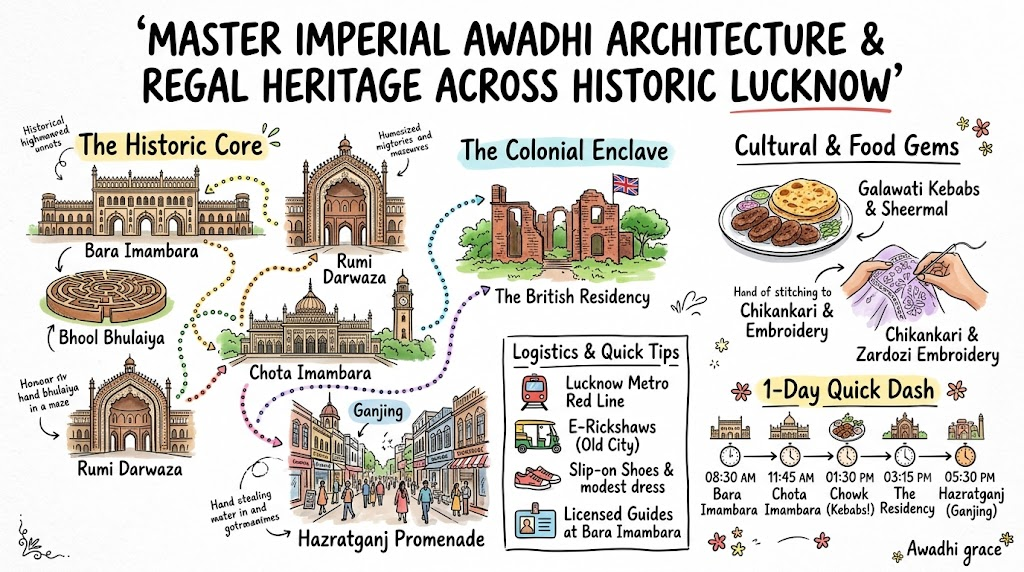
1-Day Quick Dash (The Royal Awadh Heritage Sprint)
Built for day-trippers and transit travelers with under 12 hours to explore the city’s primary highlights:
- 08:30 AM – 11:30 AM: Explore the Bara Imambara, labyrinth pathways, and step outside for photos of Rumi Darwaza.
- 11:45 AM – 01:15 PM: Ride an e-rickshaw to Chota Imambara to see its glittering crystal hall.
- 01:30 PM – 02:45 PM: Head into Chowk for a classic lunch of melt-in-the-mouth kebabs and saffron sheermal.
- 03:15 PM – 05:00 PM: Walk through the shaded battleground ruins of The British Residency.
- 05:30 PM – 08:30 PM: Spend your evening strolling Hazratganj, snacking on basket chaat, and picking up handmade souvenirs.
2-Day Deep-Dive (Imperial History to Modern Gastronomy)
A balanced 48-hour plan that pairs morning monument visits with evening cultural excursions:
- Day 1: Dedicate the entire day to Old Lucknow. Tour the Bara and Chota Imambaras in the morning, visit the Clock Tower and Picture Gallery in the afternoon, and take a guided culinary walk through Chowk at night.
- Day 2: Spend the morning exploring The British Residency and Constantia at La Martiniere. After lunch, discover the art galleries of Qaisar Bagh, enjoy an afternoon tea in Hazratganj, and finish with a sunset walk at Gomti Riverfront Park.
Complete Weekend Travel Plan (The Grand Awadhi Circle)
A relaxed three-day weekend itinerary designed for culture and leisure travelers:
- Friday: Arrive by evening, check into your hotel, and start with dinner and dessert in Hazratganj.
- Saturday: Explore the complete Husainabad monument corridor from 8:30 AM to 2:00 PM. Follow with lunch in Chowk, a late-afternoon stroll at The Residency, and dinner at Dastarkhwan.
- Sunday: Visit La Martiniere College in the morning, shop for certified Chikan embroidery at Sewa or Janpath, relax at Janeshwar Mishra Park, and depart by evening.
Common Tourist Mistakes to Avoid
- Geographic Blunders: Don’t attempt to shuttle between Gomti Nagar parks and Old Lucknow monuments back and forth throughout the day. Group your morning stops around the western Husainabad cluster, and keep your afternoon and evening in central Hazratganj.
- Commercial Traps: Don’t waste your limited hours inside air-conditioned suburban shopping malls. Lucknow’s charm thrives within atmospheric outdoor spaces like Chowk, Janpath, and Hazratganj.
- Neglecting Modern/Alternative Zones: Don’t overlook the creative, quieter expansions of the city. Modern Gomti Nagar boasts broad riverside promenades and contemporary art spaces that show how the city is evolving.
- Transport Overpayment: Always cross-reference auto-rickshaw quotes with current ride-sharing apps (Uber, Ola, Rapido) before agreeing to unmetered cash fares at railway and monument exits.
- Luxury Dining Bias: Sticking only to multi-cuisine hotel buffets misses the point of visiting Lucknow. The city’s soul lives in historic family stalls that have perfected dum biryani, kulcha nihari, and basket chaat over generations.
Frequently Asked Questions
1. Can you truly experience the highlights of Lucknow in just one day?
Yes, you can experience the very best of Lucknow in one day by focusing on a concentrated heritage circuit. Dedicate your morning to the Husainabad monument complex, explore The Residency during the afternoon, and spend your evening enjoying food and shopping along the Hazratganj promenade.
2. What is the smartest way to travel between attractions during a single day?
The most efficient transit strategy combines app-based cabs for longer trips between districts with nimble electric rickshaws for navigating old-city alleys. For quick travel from the airport or Charbagh station straight to Hazratganj, use the clean and punctual Lucknow Metro line to bypass road congestion.
3. Is hiring a local guide necessary when exploring the Bhool Bhulaiya?
Hiring a certified guide makes a major difference inside the Bhool Bhulaiya. The maze comprises 489 nearly identical doors and dark stairwells designed specifically to disorient visitors. A knowledgeable guide helps you navigate safely while explaining the hidden acoustic engineering and ventilation systems throughout the upper balconies.
4. What should visitors wear when entering the historic Imambaras of Lucknow?
Visitors must wear modest clothing that fully covers both shoulders and knees to show respect at these functioning religious sites. Shoes must be removed before stepping onto prayer hall floors, and women may be asked to cover their heads with a scarf inside the main sanctum areas.
5. Where can travelers find the most authentic Galawati Kebabs in the city?
The most authentic Galawati Kebabs are prepared in the old lanes of Chowk near Akbari Gate, where the Tunday Kababi family has practiced its culinary craft since 1905. Another excellent, centrally located alternative is Dastarkhwan near Tulsi Theatre, celebrated for flavorful Mughlai curries and warm sheermal flatbreads.
6. How do I make sure I am buying authentic handmade Chikankari clothing?
Authentic handmade Chikankari features slight irregularities in the reverse-side stitching, which confirms genuine hand-needlework rather than uniform machine embroidery. To ensure fair pricing and support local women artisans, shop at cooperative outlets such as SEWA Lucknow or established emporiums in Hazratganj and Janpath Market.
7. Is a single day in Lucknow suitable for traveling with young children?
Yes, Lucknow works well for families because key monuments like the Bara Imambara and The Residency feature sprawling green lawns where children can rest. Keep in mind that strollers cannot be used inside the historic stairwells and cobblestone paths, so baby carriers are much more practical.
8. Which monument offers the most photogenic sunset views across Lucknow?
The upper open terraces of the Bara Imambara and the park grounds around the Hussainabad Clock Tower offer the best sunset views in the old city. For modern skyline perspectives, the landscaped promenade of Gomti Riverfront Park catches lovely pastel reflections over the water at dusk.
9. What are the best regional vegetarian specialties to try on a one-day trip?
Lucknow offers incredible vegetarian cuisine beyond its famous kebabs. Must-try specialties include the crispy Basket Chaat at Royal Cafe, creamy Matar ki Chaat at Dixit Chaat House in Chowk, warm Poori-Kachori breakfasts at Netram Sweets, and saffron-infused Makhan Malai foam during winter mornings.
10. Do major monuments in Lucknow accept digital UPI and card payments?
Archaeological Survey of India monuments like The Residency and Bara Imambara support digital QR ticket booking at their entry gates. However, you should still carry around ₹500 in physical cash for shoe storage fees, drinking water, e-rickshaw hops, and historic street food stalls.
11. Is it safe to wander through the alleys of Old Lucknow after dark?
Old Lucknow remains busy, vibrant, and generally safe into late evening hours because locals shop and dine late. Standard urban precautions apply: keep personal belongings secure in crowded bazaars, stick to well-lit main shopping lanes around Chowk, and book app-based rides for late-night returns to your hotel.
12. When is the best time of year to take an outdoor walking tour of the city?
The best months to explore the city are November through February, when cool mornings and mild afternoon temperatures make walking enjoyable. Summer months from April through June bring high heat, so outdoor sightseeing during that time is best limited to the early morning hours.
Conclusion
Leaving Lucknow after a whirlwind day feels like closing the cover of a great epic halfway through. While the capital city of Uttar Pradesh has adapted smoothly to modern commerce, rapid transport, and urban sprawl, its soul remains anchored in warm hospitality, architectural balance, and poetic charm. By trading generic tourist resorts for an afternoon spent under centuries-old lime-mortar arches and an evening enveloped in the aroma of toasted spices, you carry home far more than snapshots. You depart with a genuine appreciation for Awadh’s timeless elegance—a reminder that in our fast-moving world, the finest things in life are still meant to be savored slowly.
