Introduction
Leave behind the frantic pace of cookie-cutter tourist hubs and enter the soul-stirring elegance of Awadh. Lucknow does not demand you rush; it invites you to slow down, listen to centuries of living history, and savor culinary traditions refined over generations. Where modern holiday destinations offer manufactured attractions, the Uttar Pradesh capital delivers profound cultural authenticity.
From the aroma of slow-cooked yakhni lingering in narrow cobblestone lanes to the delicate rustle of handmade Chikankari fabric, every street corner tells a story. Here, a weekend journey is a sensory immersion into imperial courts, architectural marvels, and timeless hospitality.
Why Lucknow is a must-visit city
Lucknow anchors the cultural identity of Northern India, serving as the cradle of refined Urdu poetry, Kathak classical dance, and sophisticated culinary crafts. Historically governed by the Nawabs of Awadh, the city turned architecture and gastronomy into high art, leaving behind monuments engineered with astonishing mathematical ingenuity. Geographically resting in the fertile plains of the Gomti basin, it bridges timeless historic quarters with state-of-the-art urban hubs.
Getting here is smooth and straightforward for any traveler. Chaudhary Charan Singh International Airport connects all primary domestic metros and Gulf hubs, while the historic Lucknow Charbagh Railway Station stands as one of India’s most connected rail terminals. For road travelers, the Agra-Lucknow Expressway and Purvanchal Expressway offer world-class highway connections.
The typical travel circuit divides neatly into two cohesive halves: the evocative Old City Heritage Belt around Husainabad and Chowk, and the sophisticated Civil Lines & Gomti Nagar Modern Circuit showcasing manicured riverfront promenades and upscale cultural cafes.
| Key Travel Metric | Strategic Fact |
|---|---|
| Ideal Trip Duration | 48 to 72 Hours (2-3 Days) |
| Best Travel Season | October to March (Crisp mornings, pleasant afternoons) |
| Primary Hub Connectivity | CCS International Airport (LKO), Charbagh Rail (LJN) |
| Core Heritage Circuit | Husainabad, Chowk, Kaiserbagh, Hazratganj |
| Signature Cultural Crafts | Chikan embroidery, Zardozi, Attar perfumery |
| Culinary Identity | Awadhi Dum cooking, Galawati kebabs, Makhan Malai |
Best Places or Experiences
Bara Imambara & Bhool Bhulaiya
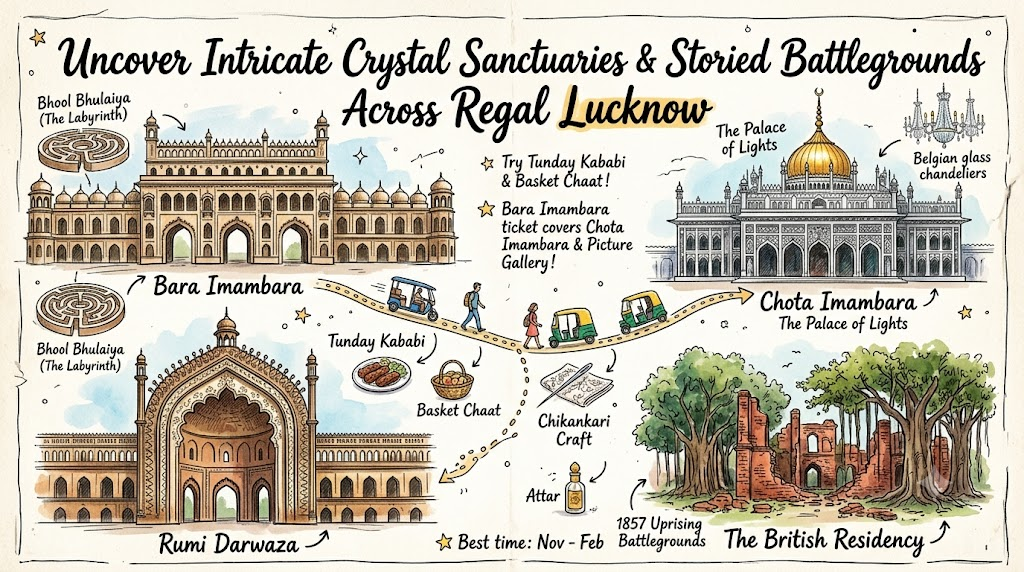
Commissioned in 1784 by Nawab Asaf-ud-Daula as a relief initiative during a catastrophic drought, the Bara Imambara stands as an engineering miracle. Its central vaulted hall measures 50 meters long and 15 meters high without a single supporting pillar or wooden beam, constructed entirely of interlocking Lakhori bricks and an adhesive mortar blended with lentils, molasses, and limestone.
Rising above this majestic prayer hall is the legendary Bhool Bhulaiya, an intricate labyrinth of over 1,000 interlocking passageways designed to confuse invaders and distribute structural weight. Stepping onto its upper terraces reveals panoramic vistas across the historic Old City skyline and the meandering Gomti River below.
The majestic Bara Imambara complex.
- Location: Husainabad Heritage Corridor, approximately 5.5 km from Lucknow Charbagh Railway Station.
- Why it is worth visiting: Home to the world’s largest unsupported vaulted ceiling and India’s only authentic palace labyrinth.
- Best things to do: Test the remarkable acoustics in the central whispering gallery, navigate the winding stairwells of the Bhool Bhulaiya with an authorized guide, and admire the multi-tiered Shahi Baoli stepwell.
- Best time to visit: 6:30 AM to 9:00 AM for soft morning light and fewer crowds.
- Ideal for whom: Architectural purists, history enthusiasts, and curious travelers.
- Travel tip: Hire an officially licensed guide at the monument entry gate to avoid getting hopelessly disoriented inside the upper maze.
Chota Imambara
Built in 1838 by Nawab Muhammad Ali Shah, the Chota Imambara (also known as the Imambara of Husainabad) is often called the Palace of Lights. In stark contrast to the austere grandeur of the Bara Imambara, this monument delights with exquisite Indo-Islamic and Persian craftsmanship, featuring a gilded dome, intricate calligraphy, and pure white plaster carvings.
Step inside the ornate hall to find a dazzling collection of 19th-century Belgian glass chandeliers, gilt-edged mirrors, and ornamental silver pulpits. Outside, the reflecting pool mirrors the monument’s minarets, creating one of Lucknow’s most serene visual compositions.
Chota Imambara Palace of Lights.
- Location: Husainabad, 1.2 km west of Bara Imambara.
- Why it is worth visiting: Remarkable collection of antique Belgian glassware, historic royal artifacts, and delicate calligraphy.
- Best things to do: Inspect the royal silver throne, walk past the miniature replicas of the Taj Mahal flanking the pool, and capture the symmetrical reflections on clear mornings.
- Best time to visit: 3:30 PM to 5:30 PM to catch golden-hour light reflecting across the chandeliers.
- Ideal for whom: Art lovers, heritage photographers, and cultural explorers.
- Travel tip: Keep your shoes in the managed outer shoe rack; conservative dress covering shoulders and knees is mandatory inside.
The British Residency
The British Residency stands frozen in time as a haunting monument to the Siege of Lucknow during the 1857 Uprising. Built between 1780 and 1800 for the British Resident General, the sprawling 33-acre complex transformed from an aristocratic estate into a fierce military battleground.
Today, its weathered red-brick ruins, preserved by the Archaeological Survey of India, remain scarred by cannonballs and musket fire. Peaceful lawns and ancient banyan trees surround the damaged banquet halls and cemetery, creating an atmospheric sanctuary for quiet contemplation.
The British Residency historic ruins.
- Location: Deep Narayan Verma Marg, River Bank Colony, roughly 4 km from Hazratganj.
- Why it is worth visiting: One of the most significant, emotionally charged memorial complexes connected to the 1857 Indian Uprising.
- Best things to do: Explore the basement museum displaying original lithographs and siege models, locate cannonball marks on the banquet hall walls, and sit under the ancient neem canopies.
- Best time to visit: 8:00 AM to 11:00 AM on quiet weekday mornings.
- Ideal for whom: Military history buffs, solitude seekers, and thoughtful walkers.
- Travel tip: Don’t miss the 1857 Memorial Museum in the basement; it provides essential context for the surrounding ruins.
Rumi Darwaza
Standing 60 feet tall between the two imambaras, the Rumi Darwaza serves as the iconic gateway of Lucknow. Erected in 1784 under Nawab Asaf-ud-Daula, the arch draws inspiration from the historic Sublime Porte in Istanbul, showcasing the international architectural tastes of the Awadhi court.
The gateway’s upper section features an ornate semi-circular arch decorated with carved floral patterns and carved vents that once held lanterns. At dusk, as the setting sun silhouettes its grand silhouette against the sky, it captures the majestic scale of Old Lucknow like nothing else.
The iconic Rumi Darwaza gateway.
- Location: Husainabad Heritage Strip, directly adjacent to Bara Imambara.
- Why it is worth visiting: The definitive architectural symbol of Awadh, blending Ottoman and Persian design.
- Best things to do: Frame wide-angle shots from the northern lawn, admire the carved details on the arch, and watch the evening lights come alive.
- Best time to visit: 5:00 PM to 6:30 PM for magical sunset light.
- Ideal for whom: Street photographers, architecture fans, and evening strollers.
- Travel tip: The road passing directly through the arch has been rerouted for preservation; enjoy the peaceful pedestrian zone from the outer viewing platforms.
Hazratganj Boulevard & Heritage Walk
Built in 1810 by Nawab Saadat Ali Khan and transformed during British rule, Hazratganj remains Lucknow’s premier downtown promenade. Known locally as “Ganjing”—the leisurely art of strolling without a destination—the boulevard retains its colonial charm with uniform cream facades, wrought-iron lampposts, and covered arcades.
Beneath this old-world exterior beats a vibrant modern pulse. Historic bookshops and legacy sweet stalls sit right beside modern boutiques, giving travelers a firsthand look at Lucknow’s modern civic culture.
- Location: Central Commercial District, 3 km from Charbagh Station.
- Why it is worth visiting: The cultural heart of modern Lucknow, blending historic architecture with great shopping and classic street food.
- Best things to do: Savor the legendary multi-layered Basket Chaat at Royal Cafe, browse vintage collections at the Universal Book Depot, and admire the Victorian-style lampposts at dusk.
- Best time to visit: 4:30 PM to 8:30 PM, when the arcades buzz with local evening crowds.
- Ideal for whom: Shoppers, street food lovers, and casual city explorers.
- Travel tip: Hazratganj is best explored on foot; avoid taking auto-rickshaws directly down the main shopping strip during peak evening traffic.
Offbeat Exploration: Hidden Gems Tourists Miss
La Martiniere College Architecture
Commissioned by French adventurer Major General Claude Martin in the late 18th century, “Constantia” blends European Renaissance, Gothic, and Mughal design. Massive stone gargoyles, Roman-style statues, and bastions rise above peaceful lawns.
Visiting on Sunday mornings offers a quiet look at this living school, Martin’s underground tomb, and one of India’s most extraordinary colonial buildings.
The Scent Masters of Akbari Gate
Behind the bustling food stalls of Akbari Gate lie century-old perfumeries practicing deg-bhapka—traditional hydro-distillation. Master perfumers blend pure botanicals into sandalwood bases without synthetic additives.
Stop by a traditional itardaan counter to sample Mitti Attar, which captures the evocative scent of baked summer earth meeting first monsoon rain.
Picture Gallery & Husainabad Clock Tower Lawns
Overlooking a large ornamental tank stands the Husainabad Clock Tower, India’s tallest clock tower at 221 feet, built in 1881 with Victorian-Gothic details.
Right next door is the historic Picture Gallery, housing life-size portraits of the Nawabs of Awadh. Painted using optical illusions, the eyes and shoes of the portraits seem to follow you as you move across the room.
Detailed Practical Guidance for Travelers
| Destination | Standard Entry Fee | General Timings | Best Local Food Options Nearby | Recommended Nearby Attractions |
|---|---|---|---|---|
| Bara Imambara | ₹50 (Indians), ₹500 (Foreigners) | 6:00 AM – 5:00 PM | Rahim’s Kulcha Nihari (Chowk) | Rumi Darwaza, Shahi Baoli |
| Chota Imambara | Covered under combined Imambara ticket | 6:00 AM – 5:00 PM | Idrees Biryani (Patanala) | Husainabad Clock Tower, Picture Gallery |
| The British Residency | ₹25 (Indians), ₹300 (Foreigners) | 7:00 AM – 6:00 PM | Marksmen (Hazratganj), Moti Mahal | General Kothi, Begum Hazrat Mahal Park |
| Rumi Darwaza | Free Public Access (Exterior view) | 24 Hours Open | Tunday Kababi (Original Chowk lane) | Husainabad Heritage Arcade |
| Hazratganj Boulevard | Free Public Walkway | 10:30 AM – 9:30 PM | Royal Cafe Basket Chaat, Sharma Tea | Capitol Cinema, Janeshwar Mishra Park |
Logistics & On-Ground Navigation
Local Transport Options
- Lucknow Metro Rail: Clean, air-conditioned, and efficient, running from CCS International Airport through Charbagh, Hazratganj, and into Munshipulia. It offers the fastest route between south and north hubs.
- Electric Rickshaws (E-Rickshaws): Best for short hops through busy heritage lanes like Chowk, Aminabad, and Husainabad, where regular cabs cannot easily navigate.
- Auto-Rickshaws & App Cabs: Ola, Uber, and local auto services run city-wide. Use ride-hailing apps to ensure fair rates for cross-city travel.
- Pre-Booked Private Rentals: Ideal for Day 1 when moving between multiple monuments with young children or elderly travelers.
Budget Planning
- Budget / Solo Traveler Tier: ₹1,200 – ₹1,800 per day. Covers clean hostel or budget hotel stays, metro and e-rickshaw travel, historic street food meals, and standard monument tickets.
- Mid-Range / Comfort Tier: ₹3,800 – ₹6,500 per day. Covers boutique heritage hotel accommodations, private app-cab rides, guided walking tours, sit-down dining, and authentic craft purchases.
Safety and Inclusivity Tips
- For Families: The wide, grassy lawns at the Residency and Janeshwar Mishra Park are safe and kid-friendly. Keep in mind that older monuments like the Bhool Bhulaiya have steep, narrow stairs that require careful supervision.
- For Couples: Hazratganj, Gomti Riverfront, and the British Residency offer safe, scenic spaces for relaxed daytime walks.
- General Safety: Lucknow is generally warm and welcoming. Take ordinary precautions in crowded bazaars like Aminabad by keeping your bags zipped and carrying small currency notes for street purchases.
Local Secret: Buy the combined ASI heritage ticket at the Bara Imambara counter. It covers the Bara Imambara, Chota Imambara, and Picture Gallery, saving you from waiting in line at each stop.
Strategic Travel Planning Guardrails
Travel Planning Tips for Lucknow
- Plan your trip between November and February to enjoy pleasant afternoon weather without the harsh summer sun.
- Most street vendors accept digital UPI payments, but keep ₹1,000 to ₹1,500 in physical cash for shoe minders, shared e-rickshaws, and small sweet stalls.
- Wear easy slip-on shoes; you will need to remove footwear at the Imambaras and several sacred heritage sites.
- Women should carry a lightweight cotton scarf or dupatta for covering heads when entering religious monuments.
- Start your mornings early by 7:30 AM to explore heritage monuments before tour buses and heavy traffic arrive.
Common Mistakes to Avoid
- Cramming Old City monuments and modern Gomti Nagar parks into the same morning; cross-town traffic will eat up your day.
- Skipping historical street vendors in Chowk just to eat inside air-conditioned shopping malls.
- Accepting inflated auto-rickshaw quotes outside Charbagh Station without checking app-based rates first.
- Over-planning your day with six or seven landmarks instead of giving yourself time for leisurely street walks.
- Buying mass-produced machine embroidery sold as authentic hand-embroidered Chikankari; always look for hand-stitched stitches.
Suggested Itinerary Blueprints
1-Day Quick Dash (Nawabi Highlights Circuit)
Designed for travelers on a tight schedule who want to experience the city’s essential monuments and flavors in a single day.
- Morning: Arrive at 7:30 AM at Bara Imambara, explore the Bhool Bhulaiya labyrinth with a guide, and admire the nearby Rumi Darwaza.
- Afternoon: Head into the alleyways of Chowk for lunch at Tunday Kababi, then take a quiet walk through Chota Imambara.
- Evening: End your day in Hazratganj with Basket Chaat at Royal Cafe, browsing through classic Chikankari shops along the main strip.
2-Day Deep-Dive (Imperial Awadh & Living Culture)
The balanced 48-hour itinerary covering heritage sights, living craft culture, and classic culinary stops.
- Day 1 (Imperial Husainabad & The Old City): Start early at the Bara Imambara and Shahi Baoli. Walk past the Rumi Darwaza toward Chota Imambara and the Husainabad Clock Tower. In the afternoon, explore Chowk’s perfumeries, savor Kulcha Nihari, and finish with evening sweets like Malai Paan at Ram Asrey.
- Day 2 (Colonial Legacies, Crafts & Modern Promenades): Spend your morning walking through the quiet ruins of The British Residency. Head to Hazratganj for lunch and bookshop browsing. In the afternoon, visit the craft workshops of Chowk or SEWA for authentic Chikankari. Wrap up your trip with a sunset walk at Gomti Riverfront Park.
Complete Weekend Travel Plan (Grand Awadhi Experience Loop)
A complete three-day loop for long weekend travelers.
- Friday: Arrive by noon, check in, and spend the late afternoon enjoying tea and snacks at Hazratganj. Catch the sunset along the modern promenades of Gomti Riverfront Park.
- Saturday: Dedicate the day to the historic Old City—Bara Imambara, Bhool Bhulaiya, and Chota Imambara. Enjoy lunch at Rahim’s, followed by an afternoon hunting for perfumes and Chikankari along Akbari Gate.
- Sunday: Tour the historical grounds of The British Residency and La Martiniere College. Spend the afternoon relaxing at Janeshwar Mishra Park before your evening departure.
Common Tourist Mistakes to Avoid
- Geographic Blunders: Group your stops by district. Trying to visit Kukrail Forest Reserve in the morning, rushing to Chowk for lunch, and heading back east for shopping wastes hours in traffic.
- Commercial Traps: Spending your afternoons inside generic shopping malls. Modern retail centers look the same everywhere; spend your time exploring the open courtyards and bazaars of Hazratganj instead.
- Neglecting Modern/Alternative Zones: Focusing only on 18th-century monuments and skipping the modern side of the city. Spend an evening exploring the riverside parks and contemporary cafes in Gomti Nagar.
- Transport Overpayment: Agreeing to fixed auto fares outside major transit hubs without checking prices on Uber or Ola first. Use app prices as your baseline when bargaining with local drivers.
- Luxury Dining Bias: Eating all your meals at upscale hotel buffets. Doing so misses the heart of Awadhi cooking—century-old recipes and delicate spices perfected by street-side masters over generations.
Frequently Asked Questions
1. Is two days truly sufficient to experience Lucknow?
A two-day trip provides enough time to see the primary Nawabi monuments, experience the historic food culture, and browse authentic craft bazaars. By dedicating Day 1 to the Old City heritage loop and Day 2 to colonial sites, shopping, and riverside parks, you can enjoy the city without feeling rushed.
2. What is the single best time of year to visit Lucknow?
The best months to visit are November through February, when winter brings crisp, pleasant days with temperatures between 10°C and 25°C. Summer temperatures from April to June regularly cross 40°C, making outdoor sightseeing and bazaar walks uncomfortably hot.
3. How do I distinguish genuine handmade Chikankari from machine work?
Examine the reverse side of the fabric. Authentic handmade Chikankari shows slight stitch variations, delicate knots, and occasional loose thread tails, while machine embroidery looks perfectly uniform and flat. Authentic hand embroidery uses traditional stitches like Bakhiya, Phanda, and Keel Kangan on natural fabrics like mulmul, cotton, and georgette.
4. Can vegetarian travelers enjoy Lucknow’s famous food scene?
Yes, Lucknow offers fantastic vegetarian dishes alongside its famous meat dishes. Vegetarian highlights include crisp Tokri Chaat at Royal Cafe, slow-steamed Makhan Malai in Chowk, Bajpayee’s spiced Poori Kachori, and century-old sweets like Malai Gilori at Ram Asrey.
5. What is the smartest way to hire a guide at Bara Imambara?
Hire only authorized, badge-wearing ASI guides from the official ticket counter inside the main gate. Agree on the fee upfront based on the posted government rate board, and clarify that the tour includes the main Imambara, the Bhool Bhulaiya labyrinth, and the Shahi Baoli stepwell.
6. Are credit cards and digital UPI payments accepted everywhere across the markets?
Digital UPI payments work across roughly 90 percent of shops, including small street-food vendors and tea stalls. However, carrying ₹1,000 to ₹1,500 in physical cash remains essential for shared e-rickshaws, monument shoe deposits, and older stalls in the narrow lanes of Chowk.
7. Is it safe for solo female travelers to explore the heritage markets?
Lucknow is generally safe and welcoming for solo female travelers. Standard travel precautions apply: dress modestly when visiting active religious monuments, use ride-hailing apps for late-night transit, and stick to well-lit shopping areas like Hazratganj and Aminabad during evening hours.
8. What makes the Bhool Bhulaiya maze structurally unique?
The maze is an engineering feat designed to support the immense weight of the pillarless hall below without adding heavy solid brickwork. Its 1,000 interconnected passages create natural ventilation, acoustic whispering galleries, and an impenetrable defensive layout that trapped potential invaders.
9. Which metro stations are most convenient for sightseeing?
The most useful stations are Hazratganj for the central shopping strip and dining, Charbagh for railway connections, and Vishwavidyalaya or KD Singh Babu Stadium for reaching the British Residency and historic heritage zones by short e-rickshaw rides.
10. How much does a round-trip e-rickshaw ride cost between key monuments?
A shared e-rickshaw ride between Bara Imambara and Chota Imambara costs about ₹10 to ₹20 per passenger. If you hire a private e-rickshaw for the same short route, expect to pay between ₹50 and ₹100 depending on the time of day.
11. Where can I experience authentic Awadhi perfume distillation?
Visit the heritage perfumeries clustered near Akbari Gate in Chowk, where family-owned shops have blended natural extracts for over a century. You can sample non-alcoholic botanical perfumes distilled in copper stills, including the seasonal winter Ruh Khus and the famous Mitti Attar.
12. What dress code is expected when visiting the Imambaras?
Both the Bara and Chota Imambaras are active religious sites requiring respectful, conservative clothing. Visitors must remove their shoes at designated counters, cover their knees and shoulders, and avoid sleeveless tops or short skirts. Women should bring a scarf to cover their heads.
Conclusion
A weekend spent in Lucknow is an encounter with a grander, more poetic way of life. The city stays with you through quiet echoes in the brick arches of the Bhool Bhulaiya, the aroma of cardamom and saffron in bustling lanes, and the genuine courtesy of its residents. Long after you return home, you will remember Lucknow not as just another tourist checklist, but as an authentic cultural journey through the living heart of Awadh.
