Introduction
Mainstream tourist hubs often churn visitors through packaged illusions and crowded selfie lines, leaving little room for genuine introspection. Lucknow, by striking contrast, is a soulful sanctuary crafted for the observant solo voyager. Here, history is not preserved under sterile glass; it thrives within the gentle, lyrical cadence of Awadhi courtesy, known locally as tehzeeb.
Walking alone through this regal capital allows you to absorb the intoxicating aromas of simmering copper cauldrons, admire weathered stucco arcades, and pause beside quiet riverbanks without the friction of a group schedule. Traveling independently across Lucknow means discovering an intimate, unhurried world where locals still address strangers as honored guests.
Why Lucknow is a must-visit city
Lucknow serves as the emotional and architectural heart of Awadh, anchoring centuries of revolutionary history, refined culinary mastery, and exquisite artistic movements. Positioned centrally in the fertile plains of Uttar Pradesh along the winding Gomti River, it bridges the classical Mughal past with early British colonial memory. The city’s effortless accessibility—anchored by Chaudhary Charan Singh International Airport, the historic Charbagh Railway terminus, and world-class expressways—ensures solitary explorers can navigate its urban expanse with unmatched independence.
The solo travel circuit cleanly bifurcates into two distinct visual worlds: the atmospheric, maze-like heritage alleys of Old Lucknow (Husainabad and Chowk) and the wide, manicured boulevards, public parks, and chic cafes of modern Gomti Nagar. This duality lets you pivot between contemplative solitude among antique ruins and lively evenings within vibrant social quarters.
| Key Fact | Solo Traveler Details |
| Best Travel Season | October to March (Crisp mornings, cool walking afternoons, pleasant evenings) |
| Ideal Solo Trip Duration | 2 to 3 Full Days |
| Primary Connectivity Hubs | Lucknow Charbagh Railway Station (LKO), CCS International Airport (LKO) |
| City Transit System | Fully air-conditioned Lucknow Metro, pervasive E-rickshaws, app cabs |
| Culinary Identity | Slow-cooked Awadhi Dum cuisine, street kebabs, winter Malaiyo/Makhan Malai |
| Dominant Cultural Ethos | Pehle Aap hospitality, Urdu poetic traditions, intricate Chikankari textiles |
Best Places or Experiences
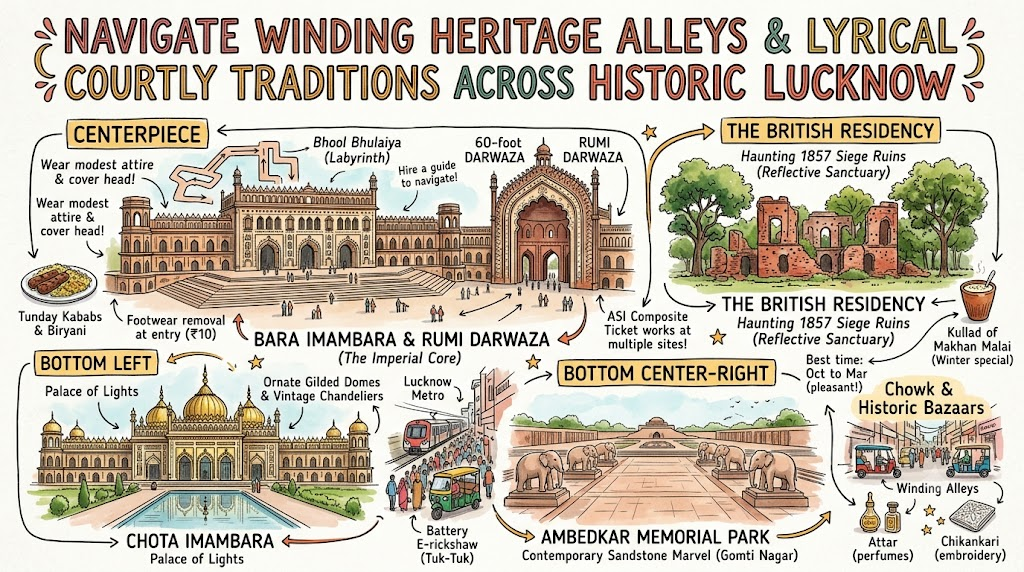
Bara Imambara & Bhool Bhulaiya
Commissioned in 1784 by Nawab Asaf-ud-Daula as an ingenious famine-relief initiative, the Bara Imambara is an engineering marvel that defies conventional architectural logic. Its colossal central hall spans nearly 50 meters in length without a single supporting pillar or iron girder, held aloft solely by interlocking brickwork and indigenous lime-mortar plaster. Solo visitors can stand within this cavernous sanctuary to absorb the hushed, cavernous acoustics that have remained untouched across centuries.
Above this grand hall winds the famed Bhool Bhulaiya, an intricate three-dimensional labyrinth of hundreds of identical arched passages, concealed balconies, and blind stairwells designed to confound invading armies. Exploring the maze alone with an official guide reveals whispering walls and tactical ventilation shafts that overlook the vibrant sprawl of the old city below.
- Location: Husainabad, Old Lucknow; approximately 6 km from Charbagh Railway Station.
- Why it is worth visiting: Unrivaled Mughal-Awadhi engineering featuring Asia’s largest unsupported arched hall and a world-famous historical labyrinth.
- Best things to do: Test the acoustic whispering galleries inside the maze, hire a licensed guide to navigate the deceptive dead ends, and climb to the terrace for sweeping skyline vistas.
- Best time to visit: 6:30 AM to 8:30 AM right at opening time to beat tour groups and experience uninterrupted solitude.
- Ideal for whom: Independent history enthusiasts, architectural photographers, and solo explorers.
- Travel tip: Never venture into the upper labyrinth without an authorized guide; taking a photo of your entry stairs on your phone helps reorient your exit.
The British Residency
The British Residency stands as a haunting, silent witness to the prolonged 1857 Siege of Lucknow. Built between 1780 and 1800 for the British Resident General, this expansive complex of residential quarters, banquet halls, chapels, and barracks was reduced to crumbling brick shells during five months of relentless bombardment. Today, manicured lawns and towering mahogany trees frame these bullet-scarred ruins, offering a deeply reflective open-air sanctuary away from city traffic.
For the solitary traveler, wandering through the ruined banquet hall and the subterranean rooms where women and children sheltered provides an intensely evocative connection to India’s First War of Independence. An on-site museum preserves poignant artifacts, lithographs, and an authentic relief model mapping the original siege perimeter.
- Location: Mahatma Gandhi Marg, Deep Manak Nagar, roughly 4.5 km from the city center.
- Why it is worth visiting: The most poignant, tranquil, and emotionally resonant 1857 war-memorial landscape on the subcontinent.
- Best things to do: Examine artillery impacts still embedded in the brick facade, read archival diary entries in the Residency Museum, and read a book under the shade trees.
- Best time to visit: Late afternoon from 3:30 PM to 5:30 PM when golden light filters through broken archways.
- Ideal for whom: Solo walkers, historical researchers, and contemplative journal writers.
- Travel tip: Carry a water bottle and umbrella, as the complex spans several peaceful acres with limited concession stands inside.
Chota Imambara
Constructed in 1838 by Muhammad Ali Shah, the Chota Imambara (or Imambara Husainabad Mubarak) is an ornate masterpiece of gilded domes, calligraphic stuccowork, and Persian design aesthetics. Flanked by a tranquil reflecting pool and landscaped gardens, the structure exudes an intimate, jewel-box charm that contrasts with the sheer scale of Bara Imambara.
Inside the prayer hall hangs an extraordinary collection of vintage Belgian crystal chandeliers, gilt-edged mirrors, and ornamental lamps that earned the building its moniker: the Palace of Lights. Solitary wanderers can sit quietly along the central canal admiring the minarets and the nearby unfinished watchtower, Satkhanda.
- Location: Husainabad, roughly 1.5 km west of the Bara Imambara complex.
- Why it is worth visiting: Exquisite interior artistry featuring antique European chandeliers, Persian calligraphy, and manicured reflective gardens.
- Best things to do: View the historic chandeliers inside the main hall, photograph the symmetry across the water pool, and inspect the tomb of Princess Zinat Algiya.
- Best time to visit: 9:00 AM to 11:00 AM when sunlight illuminates the gold-leaf detailing and stained glass panels.
- Ideal for whom: Art appreciators, solo photographers, and heritage purists.
- Travel tip: Dress conservatively with knees and shoulders covered; shoes must be removed and left at the entrance shoe stand for a nominal fee.
Rumi Darwaza & Husainabad Clock Tower
Towering sixty feet above the heritage corridor, the Rumi Darwaza is the grand archway of Lucknow, erected in 1784 under the reign of Nawab Asaf-ud-Daula. Modeled loosely after the historic Sublime Porte in Istanbul, its massive arched portal is carved with delicate floral patterns and topped by a traditional lantern dome that once held night-time torches.
Just down the paved street stands the Husainabad Clock Tower, India’s tallest standalone clock tower, soaring 221 feet with Victorian-Gothic flourishes. Walking this heritage stretch on foot gives solo travelers an unvarnished look at the bustling intersection of everyday Awadhi life and monumental royal architecture.
- Location: Husainabad Heritage Corridor, connecting Bara and Chota Imambaras.
- Why it is worth visiting: The quintessential silhouette of Lucknow, showcasing grandiose Awadhi civic engineering without an entry gate.
- Best things to do: Capture wide-angle street shots from across the heritage plaza, admire the ornamental brick carving, and take an evening walk toward the clock tower gardens.
- Best time to visit: 5:30 PM to 7:00 PM as the structure is illuminated against the twilight sky.
- Ideal for whom: Street photographers, architectural sketchers, and backpackers.
- Travel tip: Be careful of vehicular traffic around the roundabout, and walk along the pedestrian sidewalks for safety.
Ambedkar Memorial Park
Occupying over 100 acres in Gomti Nagar, the Ambedkar Memorial Park is a striking departure from old-world terracotta and stucco. Built entirely from chiselled pink red sandstone imported from Rajasthan, this contemporary monument features sprawling public plazas, soaring domed pavilions, and rows of carved stone elephant statues.
For the solo wanderer, the park offers surreal geometric vistas and sweeping open skies that feel completely isolated from northern India’s dense urban fabric. At night, warm architectural floodlighting transforms the sandstone into a luminous landscape, perfect for a solitary evening walk.
- Location: Vipul Khand, Gomti Nagar; roughly 7 km from Lucknow Junction.
- Why it is worth visiting: Monumental scale, exquisite stone carving, and dramatic architectural symmetry that offers unmatched visual tranquility.
- Best things to do: Walk through the Elephant Gallery lined with 62 carved pachyderms, photograph the illuminated central dome at dusk, and write or journal across the open stone terraces.
- Best time to visit: 6:00 PM to 8:30 PM to watch the transition from sunset to architectural night illumination.
- Ideal for whom: Modernist architecture fans, night strollers, and solo creatives seeking quiet spaces.
- Travel tip: Wear slip-resistant footwear, as the polished stone pathways can become slippery during morning dew or rains.
Offbeat Exploration: Hidden Gems Tourists Miss
La Martiniere College Estate & Constantia
Built in 1795 by French Major-General Claude Martin, this sprawling school estate combines French neo-classical architecture, Italian statuary, and Gothic bastions. Solo travelers can explore the striking facade of Constantia, locate General Martin’s underground tomb, and admire ornate ceiling frescoes that rarely appear on standard sightseeing routes.
Chowk’s Secret Phool Wali Gali & Attar Distilleries
Beyond the main apparel bazaars of Old Lucknow hides a network of perfumers distilling pure botanical fragrances (attar) using copper cauldrons unchanged since nawabi times. Stepping into century-old family shops lets you sample pure mitti attar (the distilled scent of rain-soaked earth) and seasonal ruh gulab directly from master perfumers.
Kaiserbagh Palace Complex & Baradari
Commissioned by Nawab Wajid Ali Shah, the surviving pavilions of Kaiserbagh offer a glimpse into the tragic twilight of Awadh’s royal court. The white stone Baradari sits at the center of quiet gardens, where you can reflect on the poetry, classical kathak dance, and music that once flourished here.
Detailed Practical Guidance for Travelers
| Destination | Standard Entry Fee | General Timings | Best Local Food Options Nearby | Recommended Nearby Attractions |
| Bara Imambara & Maze | ₹50 (Indians), ₹500 (Foreigners) | 6:00 AM – 5:00 PM (Closed Mondays) | Rahim’s Kulcha Nihari in Chowk | Rumi Darwaza, Asafi Mosque |
| The British Residency | ₹25 (Indians), ₹300 (Foreigners) | 7:00 AM – 6:00 PM | Marksmen Restaurant, Hazratganj | General Wheeler’s Trench, Museum |
| Chota Imambara | Composite ticket with Bara Imambara | 6:00 AM – 5:00 PM | Idris Biryani, Raja Bazar | Satkhanda, Husainabad Tank |
| Rumi Darwaza | Free (Public monument) | Open 24 Hours | Tunday Kababi, original Akbari Gate | Clock Tower, Picture Gallery |
| Ambedkar Memorial Park | ₹20 per person | 11:00 AM – 9:00 PM | Street food carts along Riverfront Road | Gomti Riverfront, Marine Drive |
Logistics & On-Ground Navigation
Local Transport Options
- Lucknow Metro Rail: The North-South corridor provides an air-conditioned link from the airport straight to Charbagh, Hazratganj, and the university, making arrival stress-free.
- E-Rickshaws (Tuk-Tuks): Abundant and quiet, these battery-powered rickshaws cost ₹10 to ₹20 per hop across old-city alleys where cars cannot fit.
- App-Based Rides (Uber / Ola / Rapido): Excellent for long transfers across the river between Hazratganj and Gomti Nagar; bike taxis (Rapido) are fast and cost-effective for solo travelers.
- Auto-Rickshaws: Plentiful outside major railway hubs, but require firm negotiation unless using prepaid booths.
Budget Planning
- Backpack/Budget Tier: ₹1,000 – ₹1,500 per day (Hostel bunk or budget guesthouse, public metro, street food meals at Chowk, entry tickets).
- Mid-Range/Comfort Tier: ₹3,000 – ₹5,000 per day (Boutique heritage room, private app-cab transfers, combination of heritage street meals and air-conditioned Awadhi dining).
Safety and Inclusivity Tips
- Solo Travelers & Women: Lucknow is generally welcoming and polite, but stick to well-lit main boulevards after 9:30 PM in the older quarters of Chowk.
- Couples & Friends: Public parks require basic modest decorum; security guards patrol major installations to ensure visitor safety.
- General Safety: Keep your smartphone and wallet secure in dense bazaars like Aminabad and Chowk, where pickpocketing can occur in tight crowds.
Local Secret: Do not buy individual monument passes; purchase the ASI Composite Ticket at Bara Imambara to gain integrated entry to Chota Imambara and the Picture Gallery at a substantial discount.
Strategic Travel Planning Guardrails
Travel Planning Tips for Lucknow
- Travel between November and February to experience pleasant winter afternoons and taste seasonal winter delicacies like Makhan Malai.
- Carry small paper currency (₹10, ₹20, and ₹50 notes) as older market vendors and shared e-rickshaws often lack change for large notes.
- Use UPI payments universally across street vendors, tea stalls, and heritage monuments.
- Dress conservatively with covered shoulders and knees to ensure seamless entry into active religious monuments.
- Download offline navigation maps before heading into the narrow covered alleys of Chowk and Aminabad.
Common Mistakes to Avoid
- Planning museum and monument visits on Mondays, when major ASI properties and public museums remain closed.
- Relying on large app-cabs inside old market lanes; switch to walking or e-rickshaws as soon as you enter heritage gates.
- Eating exclusively in hotel buffets, which misses out on centuries of generational street recipes.
- Skipping historical guides at Bhool Bhulaiya, where you can easily get turned around in the upper passages.
- Rushing through Hazratganj during the early morning before local shops and historic tea stalls open at 11:00 AM.
Suggested Itinerary Blueprints
1-Day Quick Dash (The Heritage & Kebab Express)
Designed for solo professionals on a tight 24-hour layover looking for signature experiences.
- Morning: Arrive at Charbagh, take the metro to Hazratganj, and grab bun maska and chai at Sharma Tea Stall. Head to the Bara Imambara and navigate the Bhool Bhulaiya.
- Afternoon: Walk through Rumi Darwaza to Chota Imambara, then catch an e-rickshaw to Akbari Gate for lunch at Tunday Kababi.
- Evening: Walk along the ruins of The British Residency, followed by an evening stroll through Hazratganj and dinner at Dastarkhwan.
2-Day Deep-Dive (Old-World Awadh to Modern Horizons)
A balanced 48-hour plan that explores both historic culture and contemporary public spaces.
- Day 1 (The Imperial Core): Devote the full day to Old Lucknow. Explore Bara Imambara, Chota Imambara, and the Husainabad Clock Tower. Spend the afternoon wandering Chowk’s perfumers and Chikankari embroidery workshops before dinner at Rahim’s.
- Day 2 (Rebellion & Modernity): Spend the morning in quiet contemplation at The British Residency, followed by an architectural detour to La Martiniere College. Transition across the river in the late afternoon to explore Ambedkar Memorial Park, concluding with an evening walk along the Gomti Riverfront.
Complete Weekend Travel Plan (The Master Solo Circuit)
A full Friday-to-Sunday loop balancing history, cuisine, and offbeat artisan districts.
- Friday: Check in, take an afternoon walk through the British Residency ruins, explore evening tea culture around Hazratganj, and browse street-side booksellers.
- Saturday: Explore the heritage corridor (Bara Imambara, Bhool Bhulaiya, Rumi Darwaza, and Chota Imambara). Dedicate the afternoon to an unhurried tasting trail across Chowk, sampling basket chaat, kulcha-nihari, and attar.
- Sunday: Visit the sprawling estate of La Martiniere College, browse authentic Chikankari workshops in Aminabad, and spend a relaxing final evening admiring the lit-up architecture of Ambedkar Memorial Park.
Common Tourist Mistakes to Avoid
- Geographic Blunders: Attempting to combine the far-flung monuments of Husainabad with the parks of Gomti Nagar within the same morning wastes precious hours in city traffic.
- Commercial Traps: Spending your time in modern shopping malls rather than exploring authentic centuries-old bazaars like Janpath and Chowk.
- Neglecting Modern/Alternative Zones: Focusing solely on nawabi ruins while overlooking modern architectural spaces like Ambedkar Memorial Park and the riverside cafes.
- Transport Overpayment: Agreeing to unmetered auto-rickshaw rides outside Charbagh Station without first checking app-based rates on Rapido or Uber.
- Luxury Dining Bias: Sticking to upscale hotel dining rooms, which misses out on the real flavor of family-run culinary stalls that have perfected dishes over generations.
Frequently Asked Questions
1. Is Lucknow safe for solo female travelers exploring independently?
Lucknow is generally safe and hospitable for solo women. People are respectful, and the metro provides secure transit. As in any large city, stick to well-lit streets in heritage markets like Chowk after 9:00 PM, and use app-based cabs for late-night transfers.
2. How do I explore the Bhool Bhulaiya without getting lost inside?
Hire an official ASI-licensed guide from the main ticket booth. The maze has over a thousand interconnected passageways with identical blind arches. Guides explain the acoustic and architectural engineering while ensuring you exit safely.
3. What is the single best area for a solo traveler to stay?
Hazratganj is the ideal neighborhood. It offers pedestrian-friendly streets, historic cafes, reliable metro connectivity, and central placement between the monuments of Old Lucknow and modern Gomti Nagar.
4. How many days are ideal for a solo trip to Lucknow?
Two to three days offer enough time to visit the major monuments, explore heritage bazaars, take an evening walk through Ambedkar Park, and enjoy the city’s food culture without feeling rushed.
5. What is the most budget-friendly way to get around the city?
Combining the Lucknow Metro with shared e-rickshaws is the cheapest option. The metro quickly covers long distances, while e-rickshaws cost just ₹10 to ₹20 for shorter trips between stations and local bazaars.
6. Are vegetarian food options readily available in this meat-famous city?
Yes. While famous for its meat dishes, Lucknow has great vegetarian food like the famous Basket Chaat at Royal Cafe, creamy khasta kachori, and seasonal winter Makhan Malai across Old Lucknow.
7. Do monuments in Lucknow have dress codes for visiting travelers?
Active religious sites like Bara Imambara and Chota Imambara require modest dress with covered shoulders and knees. You must remove shoes at the entrance, and carrying a light scarf to cover your head is recommended.
8. Can I buy authentic Chikankari clothing without paying inflated tourist prices?
Avoid tourist showrooms along major highways. Instead, head to the artisan workshops in Chowk or the cooperative stalls around Janpath Market in Hazratganj, where you can buy directly from craftspeople at reasonable rates.
9. Are photography permits required for cameras inside heritage monuments?
Standard mobile phone photography is permitted across all major sites with normal entry tickets. However, using professional tripods, lighting rigs, or commercial video cameras requires advance written permission and additional fees from the Archaeological Survey of India.
10. What makes winter the best season for exploring the city?
Winter brings crisp temperatures between 10°C and 22°C, making all-day walking pleasant. It is also the only time to experience seasonal specialties like morning Makhan Malai and hot Kashmiri chai in Chowk.
11. Is English widely spoken by locals, vendors, and drivers?
Basic English is understood across hotels, metro stations, and cafes. Auto drivers and market vendors primarily speak Hindi and Urdu, though they are usually helpful and patient with visitors.
12. Can solo travelers join guided walking tours in Old Lucknow?
Yes, several local heritage organizations run weekend morning walking tours through Chowk and Kaiserbagh. These tours offer a great way to explore history alongside fellow travelers without needing private transport.
Conclusion
Traveling solo through Lucknow is more than a simple sightseeing trip; it is an encounter with a city that takes its time and treats visitors with care. Stepping through weathered nawabi gateways, standing quietly inside bullet-scarred ruins, and sharing a table at a bustling kebab stall allows you to experience northern India at a reflective, human pace. The capital of Awadh reminds independent wanderers that true discovery lies in slowing down, listening closely, and letting the city unfold on its own terms.
