Introduction
Modern enterprise engineering environments increasingly require broad, cross-functional operational knowledge to eliminate friction across highly distributed platforms. While organizations historically treated application deployment, pipeline maintenance, data delivery, and infrastructure provisioning as isolated domains, modern scale demands an integrated operating model. To address these complex dependencies, XOps has emerged as a unified umbrella approach that purposefully connects disparate operational disciplines into a collaborative, automated ecosystem. Rather than replacing proven practices, this paradigm aligns software delivery, data engineering, machine learning workflows, site reliability, platform engineering, and proactive security under shared automation standards and consistent observability practices. Platforms such as XOpsSchool highlight this cross-disciplinary evolution by offering targeted resources that help engineers understand how these distinct systems interact across enterprise production workflows, enabling technical teams to replace traditional operational silos with resilient, end-to-end operational visibility.
What Is XOps?
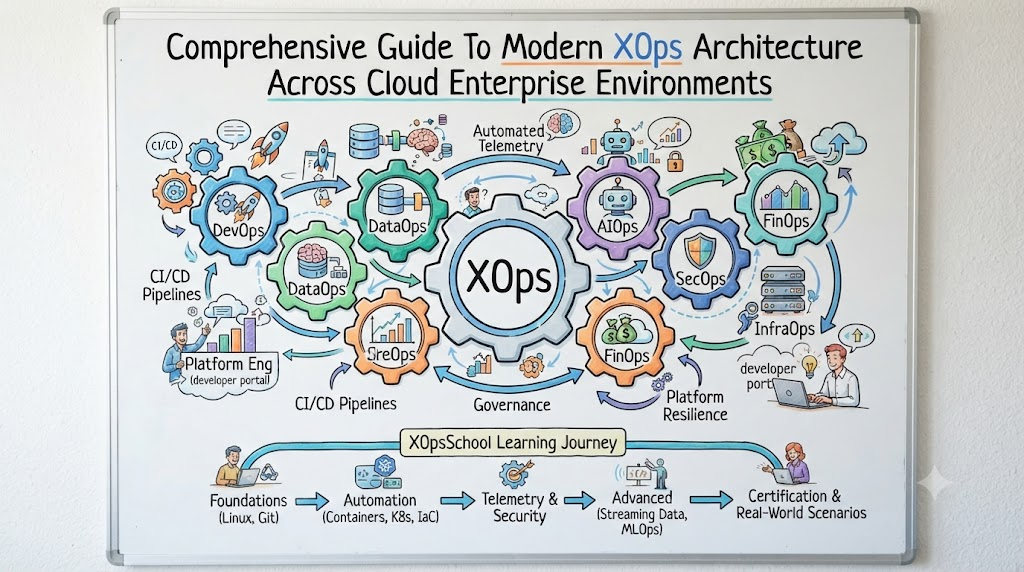
At its architectural core, the term XOps uses the variable “X” to represent any critical operational domain—spanning software development, data pipelines, predictive intelligence, security, and financial governance—and connects it directly with systematic operations. Rather than managing isolated workflows where developers hand off code to operations, data engineers maintain unmonitored extract-transform-load jobs, and machine learning teams manually deploy models, an umbrella XOps model establishes continuous feedback loops across all participating disciplines. Consider a modern cloud-native e-commerce application: DevOps automates the containerized service deployments via declarative pipelines, DataOps ensures clean clickstream event streaming, MLOps governs the recommendation engine’s lifecycle, AIOps correlates anomalous latency spikes across millions of telemetry metrics, SecOps enforces container runtime compliance, FinOps manages dynamic cluster sizing to optimize expenditure, and SRE establishes strict error budgets. By synthesizing these disciplines into an interconnected operational lifecycle, technology organizations achieve predictable service reliability and true end-to-end technical accountability.
What Does XOps Include?
The modern operational ecosystem brings together multiple specialized disciplines, each handling a dedicated phase of the broader application and platform lifecycle while relying on shared automated infrastructure. DevOps delivers core continuous integration and delivery capabilities, DataOps orchestrates dependable data flows, MLOps stabilizes predictive model deployments, and AIOps ingests telemetry data to identify system degradation proactively. Simultaneously, SecOps embeds automated security guardrails into pipelines, FinOps aligns resource utilization with business budgets, SRE balances feature velocity with system availability, InfraOps standardizes declarative bare-metal or cloud platforms, and Platform Engineering builds self-service internal developer platforms that consolidate these complex tools into clean application interfaces.
| XOps Discipline | Primary Focus | Typical Responsibilities |
| DevOps | Software Delivery Lifecycle | Automating CI/CD pipelines, containerizing services, managing Git workflows, and streamlining continuous code delivery. |
| DataOps | Data Quality & Pipeline Velocity | Orchestrating distributed data pipelines, validating data schemas, monitoring pipeline degradation, and tracking data lineage. |
| MLOps | Machine Learning Workflows | Managing model training lifecycles, governing artifact versioning, deploying models via APIs, and tracking data drift. |
| AIOps | Algorithmic System Operations | Applying machine learning models to telemetry metrics, deduplicating alerts, isolating root causes, and automating system self-healing. |
| SecOps | Continuous Security Integration | Scanning dependencies for CVEs, validating container images, auditing compliance configurations, and managing runtime policies. |
| FinOps | Cloud Cost Governance | Monitoring infrastructure expenditure, managing committed resource utilization, rightsizing computing instances, and tracking team cost allocations. |
| SRE | Service Reliability & Availability | Defining SLIs/SLOs, managing error budgets, designing automated failovers, and leading blameless post-incident reviews. |
| InfraOps | Infrastructure Provisioning | Maintaining baseline compute networks, provisioning storage clusters, codifying cloud resources, and orchestrating hypervisors. |
| Platform Engineering | Internal Developer Platforms | Building reusable infrastructure templates, standardizing developer onboarding portals, and abstracting complex underlying toolchains. |
What Is XOpsSchool?
XOpsSchool functions as a specialized knowledge and education platform engineered specifically for professionals navigating modern IT operations, automation architectures, cloud platforms, and machine learning infrastructure. Rather than viewing engineering roles through isolated lenses, the platform structures technical topics to demonstrate how contemporary disciplines—such as GitOps, Kubernetes orchestration, telemetry-driven SRE, automated data validation, and real-time observability—converge into functional production environments. Engineers, architects, and operational leads can review hands-on technical tutorials, reference architectures, and structured curriculum modules that demystify foundational concepts through to production-scale implementations. By highlighting real-world engineering constraints and multi-tool orchestration workflows, the platform provides learners with pragmatic, implementation-focused perspectives on building, operating, and securing resilient cloud systems across hybrid enterprise environments.
Why Is XOps Important?
The industry-wide move toward microservices architectures, ephemeral cloud-native workloads, and dynamic Kubernetes clusters has elevated operational complexity beyond the scope of traditional manual administration. Modern platforms concurrently ingest massive, data-intensive event streams and serve real-time machine learning predictions, creating multi-layered dependencies where an infrastructure network timeout directly degrades machine learning model performance or corrupts analytical data ingestion. When organizations manage these systems inside isolated teams, visibility fragments, security policies fail to apply uniformly, and troubleshooting prolonged outages requires contentious cross-team war rooms. Adopting a unified XOps model addresses these vulnerabilities by mandating unified observability standards, codified compliance guardrails, programmatic infrastructure provisioning, and shared telemetry feeds. This unified baseline breaks down operational silos, enforces shared reliability goals through systematic engineering, and ensures engineering teams maintain holistic oversight over their technical footprint.
Why Choose XOps Training?
Pursuing a structured XOps Training path allows technical practitioners to move beyond isolated domain specializations and cultivate comprehensive, cross-functional architectural capabilities. System administrators, developers, and single-discipline operators gain vital visibility into how infrastructure as code, automated pipelines, real-time telemetry, and container orchestration directly interface with specialized downstream data and machine learning workloads. This horizontal operational perspective significantly improves inter-team collaboration, reduces deployment bottlenecks, and equips engineers to diagnose cascading failures across complex, multi-service production estates. By grounding operational knowledge across automated deployments, cloud-native resilience practices, security validations, and predictive incident analysis, engineers develop the architectural intuition required to design adaptable, highly resilient infrastructure platforms across modern enterprise systems.
How Does XOps Training Work in Practice?
A structured and effective XOps learning path prioritizes progressive, hands-on implementation, guiding learners systematically from fundamental operating system internals to distributed cross-domain automation workflows. Practitioners build confidence through realistic production scenarios, starting with systems configuration, progressing through automated deployments, and culminating in intelligent operational incident response.
- Linux Internals and Shell Scripting: Mastering process scheduling, file permissions, kernel signals, network troubleshooting utilities, and shell automation for routine operational administration.
- Declarative Git Version Control: Implementing branch protection policies, managing release tags, structuring repository patterns, and codifying pull-request review workflows.
- Automated CI/CD Delivery Pipelines: Designing multi-stage continuous integration workflows, running automated unit tests, validating linting standards, and staging deployment artifacts.
- Containerization Engineering: Writing production-grade Dockerfiles, minimizing image footprints, enforcing non-root container runtimes, and managing multi-stage build systems.
- Kubernetes Orchestration: Configuring ingress controllers, persistent volumes, auto-scalers, deployments, and managing high-availability container clusters.
- Infrastructure as Code: Provisioning reproducible cloud environments, managing state locking, modularizing templates, and preventing configuration drift using Terraform.
- Enterprise Cloud Platforms: Architecting multi-tier virtual networks, managing identity access management roles, and securing storage infrastructure across cloud environments.
- Observability and Telemetry: Instrumenting code with distributed tracing collectors, establishing metric aggregation pipelines, and configuring actionable dashboard views.
- Security Automation: Running automated static application security scans, managing container vulnerability registries, and auditing runtime policy violations.
- Reliability Engineering: Formulating Service Level Objectives, managing error budgets, and conducting chaos experiments to validate auto-recovery behavior.
- DataOps Pipelines: Scheduling workflow directed acyclic graphs, validating ingest data schemas, and isolating pipeline bottlenecks programmatically.
- MLOps Model Lifecycles: Registering model artifacts, versioning datasets, deploying real-time inference containers, and setting telemetry monitors for data drift.
- AIOps Event Analysis: Ingesting system log streams, configuring event correlation heuristics, reducing alert noise, and executing automated self-healing scripts.
- Cross-Domain Automation: Unifying infrastructure triggers across multiple operational domains to achieve self-healing, fully automated enterprise operations.
XOps Certification: What Should You Look For?
When evaluating an XOps Certification program, technical professionals must prioritize practical, scenario-driven laboratory assessments over static, multiple-choice theoretical testing. A credible credential evaluates your ability to resolve broken cluster configurations, remediate corrupted deployment pipelines, configure fine-grained IAM policies, isolate performance bottlenecks in telemetry dashboards, and programmatically orchestrate distributed data workflows. Furthermore, reputable assessment frameworks ensure that automation, security compliance, reliability engineering, and multi-cloud architecture are evaluated in context alongside core development and machine learning operations. While obtaining a recognized industry certification systematically validates structured learning, engineers must recognize that credentials complement, rather than substitute for, sustained hands-on implementation experience, active contribution to live engineering initiatives, and demonstrated production troubleshooting expertise.
XOps Tools: Understanding the Technology Stack
Modern cross-functional operations do not rely on a monolithic proprietary software suite; instead, teams compose specialized open-source tools and enterprise platforms into a modular toolchain. Version control systems anchor declarative configurations, CI/CD engines automate build verification, container platforms isolate runtime dependencies, and declarative orchestrators handle dynamic workload placement. Concurrently, GitOps controllers continuously reconcile infrastructure state against version control, secrets engines safeguard credentials across environments, and distributed tracing systems correlate log events with performance metrics. The selected tooling must integrate cleanly via standardized APIs and open telemetry protocols to maintain operational cohesion across systems.
| Operational Area | Example Tools | Practical Purpose |
| Version Control | Git, GitHub, GitLab | Managing declarative source code, tracking operational changes, and enforcing peer-reviewed pull request workflows. |
| CI/CD Automation | Jenkins, GitHub Actions, GitLab CI | Automating code testing, building deployable artifacts, and managing standardized multi-stage promotion pipelines. |
| Containerization | Docker, Podman, containerd | Packaging applications with their dependencies into lightweight, portable images optimized for secure execution. |
| Container Orchestration | Kubernetes, Nomad, OpenShift | Managing automatic workload placement, container scaling, service discovery, self-healing restarts, and rolling updates. |
| Infrastructure as Code | Terraform, OpenTofu, Pulumi | Provisioning, versioning, and managing declarative compute, network, and storage infrastructure programmatically. |
| Configuration Management | Ansible, SaltStack, Chef | Automating configuration enforcement, managing package updates, and bootstrapping target servers idempotently. |
| GitOps Delivery | Argo CD, Flux CD | Continuously reconciling live cluster runtime states with desired declarative configurations stored in Git repositories. |
| Metrics & Monitoring | Prometheus, VictoriaMetrics | Collecting high-cardinality time-series performance metrics from applications, runtime environments, and host hardware. |
| Dashboards & Visualization | Grafana | Rendering interactive metrics dashboards, querying performance data sources, and visualizing system trends. |
| Log Management | Elastic Stack, Splunk, Loki | Ingesting, parsing, indexing, and querying centralized operational log streams to accelerate incident root-cause analysis. |
| Observability Platforms | Dynatrace, Datadog, New Relic | Providing automated application performance monitoring, distributed tracing, dependency mapping, and telemetry correlation. |
| Secrets Management | HashiCorp Vault, AWS Secrets Manager | Securely storing, rotating, leasing, and auditing dynamic API keys, certificates, and operational credentials. |
| Intelligent Automation | RunPod, StackStorm, Temporal | Orchestrating resilient background workflows, executing event-driven remediation scripts, and managing automated recovery processes. |
DevOps Training as the Foundation of XOps
Because all operational disciplines rely fundamentally on rapid delivery cycles, repeatable environments, and programmatic infrastructure management, structured DevOps Training serves as the mandatory bedrock for advanced XOps specializations. Learning to codify infrastructure through declarative templates, build containerized application packages, configure automated continuous integration pipelines, and deploy workloads to Kubernetes provides the core technical competency required for higher-order automation. Without a firm operational grasp of version control workflows, automated rollback mechanisms, and distributed logging foundations, engineers inevitably struggle to manage the nuances of streaming data validation or automated model serving. Consequently, mastering foundational DevOps automation principles ensures that professionals possess the necessary engineering baseline to implement reliability practices, data operations, and intelligent telemetry analysis successfully.
AIOps Training: Adding Intelligence to Operations
As modern cloud estates scale past millions of telemetry data points per minute, traditional human-driven alert monitoring and static threshold triggers inevitably collapse under alert fatigue. Targeted AIOps Training equips engineers to deploy machine learning algorithms directly against operational logs, metrics, and distributed traces to automatically establish dynamic baselines, correlate isolated warnings into coherent incident contexts, and eliminate redundant system notifications. This intelligent filtering enables technical teams to identify impending systemic degradations, pinpoint anomalous latency spikes, and invoke automated runbooks for routine remediation before business-facing services suffer outages. However, engineers must understand that AIOps platforms depend strictly upon high-quality, standardized telemetry feeds; implementing algorithmic operational intelligence without clean data normalization and robust monitoring will merely automate confusion at scale.
MLOps Training: Taking Machine Learning Into Production
Transitioning experimental machine learning algorithms from isolated research notebooks into reliable, highly available production endpoints introduces unique operational challenges that standard software deployment pipelines cannot resolve. Comprehensive MLOps Training guides professionals through managing the entire machine learning lifecycle, including tracking dataset versioning, automating multi-stage training pipelines, maintaining model registry governance, and orchestrating low-latency containerized inference serving. Crucially, MLOps bridges the gap between software engineering and data science by establishing continuous monitoring mechanisms that track real-time model inference degradation, feature drift, and data distribution shifts over time. By incorporating automated model retraining loops and deployment canary patterns, engineers ensure that intelligent systems remain mathematically accurate, performant, and resilient against evolving real-world user interactions.
DataOps Training: Making Data Operations Reliable
Modern business applications rely continuously on analytical data lakes and real-time event streaming architectures, making downstream service availability directly dependent on uninterrupted data delivery. Focused DataOps Training addresses this requirement by applying traditional software development best practices—including automated pipeline testing, versioned data transformations, Git-driven release validation, and continuous schema management—to distributed data environments. Engineers learn to construct resilient, orchestrated pipelines, establish programmatic data quality assertions, track data lineage across complex transformation jobs, and implement real-time data observability to detect missing payloads or corrupted schemas instantly. By treating data workflows with the same engineering rigor applied to production application code, organizations eliminate fragile, unmonitored scripts and deliver dependable data streams to production systems.
Real-Life Scenarios / Experiences
Implementing cross-disciplinary operational practices resolves persistent, complex engineering bottlenecks across enterprise delivery pipelines.
- Resolving Intermittent Recommender Failures: A retail platform experienced recurring microservice timeouts because an updated machine learning model required more GPU memory than traditional staging deployments had provisioned. By integrating MLOps resource validation directly into standard CI/CD deployment pipelines, the team automatically caught the memory misallocation, provisioned the correct node pools via Terraform, and eliminated user-facing checkout delays.
- Preventing Production Outages from Schema Drift: A critical analytics dashboard continually failed on Monday mornings due to upstream engineers pushing database schema updates without notifying analytical teams. Adopting DataOps principles allowed the engineering team to embed automated schema validation tests into pull request checks, instantly catching incompatible payload transformations and alerting developers before unvalidated code reached the central data lake.
- Deduplicating Cascading Cloud Alerts During Network Flaps: When a major cloud provider suffered a localized availability zone degradation, an enterprise operations team received over four thousand alerts within three minutes, paralyzing response efforts. Leveraging AIOps event correlation algorithms allowed the platform to cluster the redundant alerts under a single root-cause incident ticket, isolate the impacted network route, and trigger an automated traffic reroute without manual operator intervention.
- Eliminating Multi-Team Operational Finger-Pointing: An organization struggling with sluggish service responses spent days debating whether delays stemmed from microservice code, slow analytical database queries, or underlying hypervisor limits. By establishing a unified SRE observability baseline that integrated distributed tracing with database query metrics, platform engineers clearly isolated the problem to an unindexed database query, resolving the dispute and returning the service to baseline performance within an hour.
Common Mistakes to Avoid When Choosing Operational Learning Paths
Selecting an operational education path without proper strategic evaluation frequently leads to fragmented knowledge, wasted effort, and disappointing technical progress.
- Focusing Exclusively on Syntax Over Core Architectural Concepts: Memorizing the specific command-line arguments of tools without understanding underlying operating system mechanisms, distributed networking, and container runtimes prevents engineers from adapting when enterprise toolsets change.
- Relying on Passive Video Viewing Without Hands-On Implementation: Watching instructors build cloud platforms creates a misleading sense of competence; practical engineering proficiency requires personally building, breaking, and fixing real-world infrastructure inside dedicated sandbox environments.
- Ignoring Operating System Internals and Distributed Networking: Skipping fundamental Linux administration, process isolation, DNS routing, and subnets leaves engineers completely unprepared to diagnose complex production cluster failures.
- Chasing Overly Advanced Disciplines Before Mastering DevOps Fundamentals: Attempting to implement predictive AIOps or automated MLOps pipelines without a solid foundation in Git, Docker containerization, CI/CD, and Kubernetes will inevitably lead to fragile, unmaintainable systems.
- Choosing Programs That Rely Exclusively on Multiple-Choice Testing: Theoretical multiple-choice quizzes cannot evaluate an engineer’s capability to troubleshoot runtime crashes, diagnose broken pipelines, or recover corrupted configuration states.
- Neglecting Security and Governance Principles: Isolating automation from security leads to vulnerabilities; operational training must inherently integrate identity access management, vulnerability scanning, and compliance policies into delivery workflows.
- Overlooking Practical Telemetry and Observability Practices: Building deployment automation without incorporating continuous metric collection, distributed tracing, and centralized logging leaves platforms vulnerable to silent failures.
- Failing to Understand Data Pipelines and ML Lifecycles: Assuming that traditional web service deployment patterns apply identically to data pipelines and machine learning models leaves engineers blind to data drift, schema mismatches, and training pipeline failures.
How XOpsSchool Can Support the Learning Journey
Engineers seeking a structured path through modern infrastructure complexity can leverage the educational resources hosted on XOpsSchool to bridge theoretical operational concepts with production implementations. The platform curates deep-dive technical tutorials, architectural breakdowns, and hands-on operational guides covering core domains such as Kubernetes cluster management, Infrastructure as Code using Terraform, GitOps deployment methodologies, and end-to-end observability frameworks. By systematically demonstrating how foundational DevOps, SRE reliability practices, DataOps pipelines, MLOps model serving, and AIOps event analysis intersect in real-world systems, the resource helps practitioners build pragmatic, cross-functional capabilities. Rather than viewing operational engineering as fragmented tools, technical learners gain access to contextual, industry-aligned insights that reinforce sound architectural judgment, automated delivery workflows, and resilient cloud-native operations.
How to Get the Most From an XOps Course
To maximize educational outcomes, technical learners must replace passive content consumption with an active, iterative implementation methodology: Learn → Implement → Break → Troubleshoot → Document → Automate → Measure. After exploring a new architecture, immediately build it inside a local or cloud sandbox; for example, deploy a multi-tiered containerized application into a Kubernetes cluster using automated CI/CD pipelines. Next, deliberately introduce realistic system faults—terminate critical service pods, corrupt the network routing tables, introduce schema errors into data streams, or trigger synthetic load spikes to break application health checks. Spend time systematically debugging the resulting failures using raw logs, metrics dashboards, and distributed traces rather than immediately consulting a solution guide. Finally, document the incident post-mortem, codify an automated remediation script to handle future failures, and measure the recovery metrics, cementing genuine production-level engineering instincts.
Frequently Asked Questions
1. What does the term XOps actually mean in modern enterprise computing?
XOps functions as an architectural umbrella paradigm that links development, operational workflows, data management, machine learning models, reliability, and security practices into a cohesive, automated delivery model. Rather than keeping specialized technical teams segregated in distinct operational silos, XOps unifies toolchains, standardizes observability data, and establishes shared continuous feedback loops to ensure high reliability across complex, multi-service modern cloud platforms.
2. How does an XOps strategy fundamentally differ from traditional DevOps?
DevOps primarily focuses on breaking down organizational barriers between software developers and IT operations by automating continuous code testing, containerization, and application deployments. In contrast, XOps expands this foundational philosophy beyond standard application services to encompass complex downstream engineering domains, intentionally integrating data pipelines, machine learning lifecycles, intelligent algorithmic telemetry analysis, cloud financial governance, and systemic reliability engineering into one synchronized operating structure.
3. What technical prerequisites should an engineer complete before enrolling in XOps Training?
Prospective learners should establish a foundational understanding of Linux operating system administration, basic command-line navigation, and shell scripting, alongside core distributed networking concepts such as DNS, TCP/IP, and routing protocols. Additionally, possessing baseline familiarity with modern software development lifecycles, Git version control commands, and basic programming concepts will significantly accelerate an engineer’s ability to master advanced container orchestration and automation modules.
4. Which foundational disciplines are covered within a modern XOps Course curriculum?
A comprehensive curriculum covers foundational DevOps deployment practices, Infrastructure as Code provisioning, Docker containerization, Kubernetes cluster orchestration, and continuous integration pipelines before expanding outward. Advanced phases introduce data pipeline orchestration through DataOps, model lifecycle management via MLOps, telemetry event correlation using AIOps, cloud financial management with FinOps, proactive security automation through SecOps, and systemic availability engineering anchored in SRE principles.
5. Why is earning a practical XOps Certification beneficial for technical career progression?
A hands-on, scenario-driven certification offers external validation of an engineer’s ability to design, implement, and troubleshoot complex operational architectures across multi-disciplinary enterprise environments. By proving competence across automated delivery pipelines, container orchestrators, infrastructure automation, security guardrails, and telemetry platforms, certified engineers distinguish themselves from single-domain practitioners and demonstrate the versatile, cross-functional skill set demanded by modern platform engineering and infrastructure teams.
6. Can an IT professional transition into XOps without prior coding experience?
While advanced software development skills are not strictly mandatory, modern operations mandates fluency in basic scripting and declarative coding practices. Engineers regularly interact with declarative configurations such as YAML and HCL, alongside Python or Bash scripting to automate pipelines, provision cloud infrastructure, and manage automated incident responses. A willing professional can comfortably develop these practical scripting capabilities alongside their foundational operational training.
7. What specific types of XOps Tools are commonly utilized across enterprise systems?
Enterprise teams utilize a diverse, modular suite of specialized open-source and commercial tools rather than a single monolithic platform. Essential technologies include Git for version control, Docker for container packaging, Kubernetes for workload orchestration, and Terraform for infrastructure provisioning. Continuous delivery engines like Argo CD and Jenkins automate deployment, while Prometheus, Grafana, Elasticsearch, HashiCorp Vault, and specialized data orchestrators provide runtime visibility and governance.
8. Why is completing focused DevOps Training considered essential prior to studying MLOps or AIOps?
DevOps provides the core mechanics of modern automation, including source code versioning, automated testing workflows, artifact packaging, containerization, and infrastructure deployment pipelines. Attempting to manage machine learning model lifecycles or configure automated telemetry correlation without these skills results in fragile architectures. Mastering basic DevOps principles ensures engineers understand how to build and maintain the core infrastructure that complex data and AI workloads inherently rely upon.
9. How does participating in dedicated AIOps Training help resolve operational alert fatigue?
Modern distributed environments emit thousands of telemetry signals per second, often overwhelming human administrators with redundant alerts during system outages. Dedicated training teaches engineers to deploy machine learning algorithms that analyze incoming log streams, filter out transient noise, correlate symptoms across diverse infrastructure layers, and highlight isolated root causes. This algorithmic filtering prevents operator burnout and automates standard incident remediation workflows effectively.
10. What unique operational issues does specialized MLOps Training directly solve for engineering teams?
Machine learning models behave fundamentally differently than static application code because their performance depends on shifting real-world data patterns over time. Specialized training educates practitioners on tracking dataset versions, monitoring production endpoints for mathematical feature drift, managing centralized model registries, and triggering automated retraining pipelines. These competencies bridge the gap between experimental data science models and stable, high-availability production cloud services.
11. Why has continuous DataOps Training become a vital requirement for data-intensive organizations?
Modern enterprise decision-making and real-time application features depend continuously on reliable data lakes, complex transformation jobs, and uninterrupted event streaming architectures. This operational training applies proven software development discipline—such as automated testing, schema drift validation, environment isolation, version-controlled transformations, and end-to-end data observability—to data platforms, preventing silent corruption and ensuring consistent data flow across all enterprise applications.
12. How does an active platform like XOpsSchool assist engineers in building practical skills?
XOpsSchool functions as a practical learning and technical reference platform, publishing targeted, implementation-oriented educational resources covering the intersection of cloud infrastructure, automation pipelines, Kubernetes orchestration, and modern operational architectures. Rather than focusing exclusively on abstract theory, the platform provides actionable tutorials, architectural reviews, and operational methodologies that help technical learners understand how to build, maintain, troubleshoot, and scale resilient cross-functional systems in production environments.
Conclusion
The rapid growth of modern distributed systems, data-driven microservices, and hybrid cloud infrastructures has made isolated engineering practices obsolete across forward-thinking technology organizations. Embracing XOps as a unified operational methodology bridges the traditional gaps separating software delivery, data management, machine learning models, reliability engineering, and infrastructure governance. By investing in practical cross-disciplinary education, developing expertise across declarative tooling, and establishing unified observability standards, technical professionals position themselves to design, scale, and maintain highly resilient platforms capable of supporting modern software delivery. Ultimately, mastering these shared operational practices transforms fragmented teams into collaborative engineering organizations that consistently achieve operational excellence.
