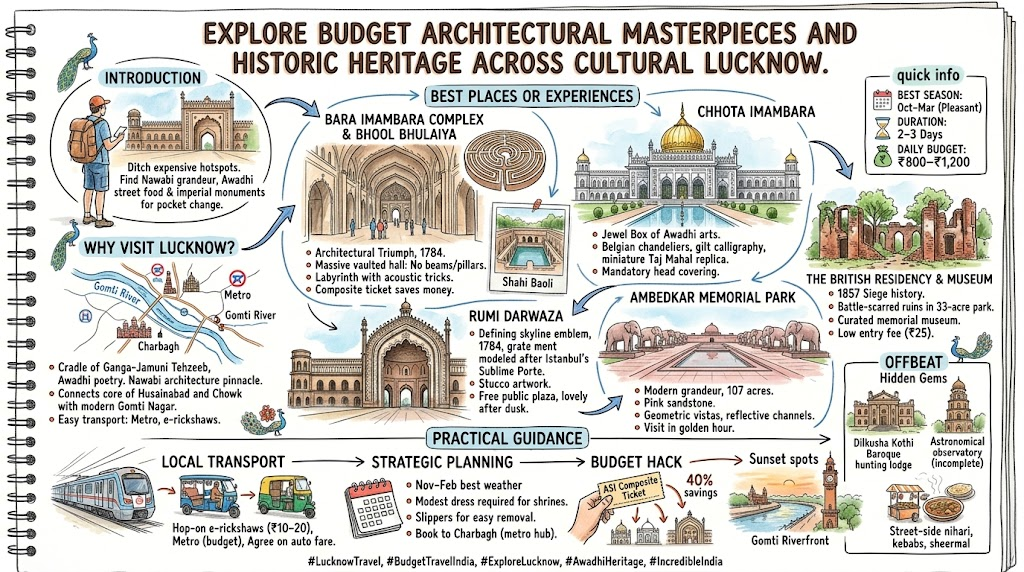
Introduction
Ditch the overpriced tourist circuits and commercialized hotspots where your travel budget disappears on vanity tickets. Lucknow delivers something increasingly rare across the subcontinent: pure aristocratic heritage, transcendent Awadhi street food, and imperial monuments accessible for just pocket change. This city does not demand luxury resort tariffs to reveal its heart. Instead, its winding historic alleys, soaring arched gateways, and fragrant food bazaars invite travelers into living history at almost no cost.
Why Lucknow is a must-visit city
Lucknow holds extraordinary cultural weight as the cradle of refined Ganga-Jamuni Tehzeeb, poetic Awadhi traditions, and revolutionary historical milestones. Nestled along the meandering Gomti River in Uttar Pradesh, it served as the royal court where Nawabi architecture reached its pinnacle through monumental masonry and visionary urban planning. Unlike cities that price out independent travelers, Lucknow remains remarkably accessible via world-class expressways, high-speed rail lines connecting Charbagh, and budget metro corridors.
The budget travel circuit centers around two distinct geographic halves: the historic core of Husainabad and Chowk, and the modern riverside promenades of Gomti Nagar. In the old quarters, entry fees rarely exceed the cost of a cup of tea, and legendary royal culinary recipes remain priced for everyday locals. You can marvel at world-record vaulted halls, wander silent colonial battlegrounds, and savor century-old kebab recipes without financial strain.
| Travel Dimension | Quick Insight |
|---|---|
| Best Travel Season | October to March (crisp mornings, pleasant afternoons) |
| Ideal Budget Duration | 2 to 3 Days |
| Connectivity Hubs | Charbagh Railway Station (LKO), Amausi Airport (LKO) |
| Average Daily Budget | ₹800 – ₹1,200 per day for budget backpackers |
| Key Transport Mode | Lucknow Metro and shared electric rickshaws |
Best Places or Experiences
Bara Imambara Complex & Bhool Bhulaiya
Commissioned in 1784 by Nawab Asaf-ud-Daula as a profound famine-relief employment initiative, the Bara Imambara stands as an architectural triumph of Awadhi engineering. Its central arched hall measures an astonishing 50 meters in length and three stories in height, constructed completely without wooden beams, metal girders, or support pillars. Above this vaulted chamber lies the legendary Bhool Bhulaiya, an intricate labyrinth of over 1,000 interlocking passageways designed to confuse intruders while providing extraordinary acoustic ventilation.
The complex also houses the monumental Asfi Mosque and the historic Shahi Baoli, a stepwell whose unique angle allowed guards to spot approaching attackers through reflections in the water. For an economical entry fee, visitors gain access to world-class architectural innovation, vast open courtyards, and panoramic city vistas from the rooftop arches.
Bara Imambara’s colossal arched facade.
- Location: Machchhi Bhavan, Husainabad; approximately 5 km north of Charbagh Railway Station.
- Why it is worth visiting: Home to one of the largest unsupported vaulted arched halls in the world and an ingenious three-dimensional acoustic maze.
- Best things to do: Test the whisper acoustics across the central hall’s arches, navigate the upper-level corridors of the Bhool Bhulaiya, and explore the multi-tiered galleries of the Shahi Baoli.
- Best time to visit: Arrive at 8:00 AM on weekdays to beat tourist crowds and explore the labyrinth before the midday heat.
- Ideal for whom: History buffs, architecture students, solo backpackers, and budget family groups.
- Travel tip: Purchase the ASI composite ticket at the counter; it bundles Bara Imambara, Chhota Imambara, and the Picture Gallery into a single money-saving pass.
Chhota Imambara (Husainabad Imambara)
Constructed in 1838 by Muhammad Ali Shah, the Chhota Imambara stands as the jewel box of Awadhi decorative arts. Often called the Palace of Lights, the interior of this ornate mausoleum is adorned with hundreds of delicate Belgian crystal chandeliers, gilt-edged mirrors, and arabesque calligraphic inscriptions. Its gilded main dome shines brightly under the midday sun, mirrored in the pristine rectangular pool that stretches before its ornate white facade.
Within the same walled courtyard stands the historic tomb of Princess Zinat Algiya, designed as a miniature architectural homage to the Taj Mahal. The surrounding gardens offer quiet, shaded benches where visitors can soak in the atmosphere away from street traffic.
Chhota Imambara’s ornate chandelier-lit hall
- Location: Husainabad Road, about 1.5 km west of Bara Imambara.
- Why it is worth visiting: Exquisite Indo-Islamic ornamental design featuring rare European glasswork, gilt calligraphy, and regal crown relics.
- Best things to do: Admire the 19th-century Belgian glass lanterns inside the central prayer hall, view the miniature Taj Mahal replica across the courtyard, and inspect the decorative silver pulpit.
- Best time to visit: 4:00 PM to 6:00 PM when the setting sun reflects off the gilded dome and facade pool.
- Ideal for whom: Cultural purists, architectural photographers, and travelers interested in heritage decor.
- Travel tip: Remove footwear at the marble courtyard threshold and carry a small scarf or handkerchief, as head coverings are mandatory within the sanctum.
The British Residency Grounds & Memorial Museum
The British Residency preserves the dramatic siege of 1857 within its expansive 33-acre parkland. Preserved in its battle-scarred state by the Archaeological Survey of India, the roofless brick structures, shattered banquet halls, and bullet-pocked masonry tell the story of the Indian Rebellion. Nature has gracefully reclaimed the site, weaving creeping bougainvillea, banyan trees, and soft lawns across historic red-brick ruins.
At the heart of the complex lies a curated memorial museum inside the reconstructed model room. It houses original lithographs, hand-drawn battle maps, dial weapons, and a diorama of the original estate. The grounds offer an open, contemplative space for quiet walks and historical reflection right in the heart of town.
The historic Residency ruins and memorial grounds.
- Location: Mahatma Gandhi Marg, Deep Manak Nagar, roughly 4 km from Charbagh Railway Station.
- Why it is worth visiting: A rare preserved 19th-century battleground in South Asia offering a deeply moving look at colonial and revolutionary history.
- Best things to do: Inspect the artillery shot indentations on the treasury walls, visit the basement rooms where civilians sheltered during the siege, and explore the museum’s historical maps.
- Best time to visit: November through February from 9:00 AM to 12:00 PM for optimal outdoor light and cool walking temperatures.
- Ideal for whom: Military history enthusiasts, landscape photographers, couples seeking quiet walks, and budget readers.
- Travel tip: Entry costs just ₹25 for Indian nationals when paying via digital QR code at the gate counter.
Rumi Darwaza & Husainabad Heritage Plaza
Standing 60 feet tall between the two imambaras, the Rumi Darwaza is the defining emblem of Lucknow’s skyline. Built in 1784 under Nawab Asaf-ud-Daula, this colossal portal was modeled after the historic Sublime Porte in Istanbul. Its western face displays an arched, winged fan design carved into stucco brickwork, while the eastern side features stepped decorative balconies and ornate turrets.
The surrounding open plaza connects directly to the Husainabad Clock Tower and the nearby Satkhanda watchtower. Spending an evening watching street life unfold beneath this historic arch costs nothing, making it one of the most rewarding free public spaces in northern India.
The majestic facade of Rumi Darwaza.
- Location: Husainabad Heritage Zone, situated directly adjacent to Bara Imambara.
- Why it is worth visiting: An architectural masterwork of grand scale that can be appreciated entirely free of charge from the pedestrian plaza.
- Best things to do: Photograph the gate’s floral stucco carvings from the pedestrian plaza, observe the lantern chamber at the apex, and view the illuminated archway after dusk.
- Best time to visit: 6:30 PM to 8:30 PM when warm floodlights highlight the ornate cornices against the night sky.
- Ideal for whom: Urban explorers, street photographers, backpackers, and casual evening strollers.
- Travel tip: Stand on the northern pathway near the pond for a clear, unobstructed angle of the arch framing the setting sun.
Dr. Babasaheb Ambedkar Memorial Park
Spanning across 107 acres in Gomti Nagar, this monumental contemporary landmark is constructed entirely from pink sandstone quarried in Mirzapur. Designed by modern Indian architects, the complex features sprawling plazas, soaring stupa domes, and an avenue lined with 62 hand-carved stone elephant statues.
The scale of the park is striking, offering geometric corridors, tranquil reflective water channels, and elevated viewing terraces. It provides a fascinating contrast to the historic quarters of Old Lucknow, showing how contemporary civic architecture celebrates social justice and historical empowerment.
The sprawling pink sandstone expanse of Ambedkar Park.
- Location: Vipul Khand, Gomti Nagar, approximately 8 km east of Charbagh Station.
- Why it is worth visiting: One of modern India’s most ambitious public architectural works, offering clean geometric vistas at a minimal entry price.
- Best things to do: Walk along the stone elephant colonnade, visit the central memorial stupa, and watch the sunset cast deep pink tones across the sandstone terraces.
- Best time to visit: 5:00 PM to 7:30 PM when the afternoon heat drops and the stone paths cool down.
- Ideal for whom: Contemporary design lovers, geometry enthusiasts, evening joggers, and budget travelers.
- Travel tip: The vast stone courtyard offers little shade during midday; bring sunglasses and visit during the golden hour to avoid reflective heat.
Offbeat Exploration: Hidden Gems Tourists Miss
The Atmospheric Ruins of Dilkusha Kothi
Tucked inside the quiet boundaries of the Lucknow Cantonment, the crumbling red-brick ruins of Dilkusha Kothi stand in peaceful contrast to the city’s busier landmarks. Built around 1800 by British officer Gore Ouseley as a baroque hunting lodge for the Nawabs, this multi-story country house once featured classical English gables and grand hunting towers.
Today, its weathered brick shell rises above quiet, manicured lawns filled with flowering shrubs and old trees. It is rarely visited by regular tourist buses, making it an ideal, free-to-enter spot for reading, sketching, or enjoying an unhurried morning walk.
Satkhanda (The Incomplete Watchtower)
Just steps from the Chhota Imambara stands Satkhanda, an ambitious watchtower begun in the 1830s by King Muhammad Ali Shah. Modeled after the Leaning Tower of Pisa and the Qutub Minar, it was designed to rise seven stories high as an astronomical observatory and city watchtower. Construction halted permanently at the fourth story following the king’s death, leaving an intriguing, open-air octagonal structure with sweeping triple-arched windows.
Tourists often walk past its iron gates on their way to larger monuments, missing the chance to admire its unique blend of Greek and Mughal arches set against a quiet garden pool.
The Culinary Alleys of Akbari Gate and Chowk
While casual visitors head straight to modern restaurant chains in commercial malls, travelers on a budget find real culinary gold in the narrow, fragrant lanes of Akbari Gate. Steaming copper cauldrons of slow-simmered nihari, tender galawati kebabs, and warm, saffron-scented sheermal flatbreads line the street, cooked with heritage recipes passed down over generations.
Exploring these bustling food alleys gives you a front-row seat to authentic culinary craft, where historic recipes cost a fraction of sit-down restaurant prices.
Detailed Practical Guidance for Travelers
| Destination | Standard Entry Fee | General Timings | Best Local Food Options Nearby | Recommended Nearby Attractions |
|---|---|---|---|---|
| Bara Imambara | ₹50 (Indian) / ₹500 (Foreigner) (Composite) | 6:00 AM – 5:00 PM (Closed Mondays) | Rahim’s Kulcha Nihari (Akbari Gate, ₹120) | Rumi Darwaza, Shahi Baoli |
| Chhota Imambara | Included in Bara Imambara ticket | 6:00 AM – 5:00 PM (Daily) | Tunday Kababi (Chowk Old Branch, ₹110) | Satkhanda, Husainabad Clock Tower |
| The Residency | ₹25 (Digital UPI) / ₹300 (Foreigner) | 7:00 AM – 6:00 PM (Daily) | Netram Sweets Kachori-Jalebi (Aminabad, ₹60) | General Post Office, Begum Hazrat Mahal Park |
| Rumi Darwaza | Free Public Monument | Open 24 Hours (Lit at night) | Idrees Biryani (Patanala Crossing, ₹160) | Picture Gallery, Husainabad Tank |
| Ambedkar Memorial | ₹20 per person | 11:00 AM – 9:00 PM (Daily) | Street chaat stalls at 1090 Chauraha (₹40–80) | Janeshwar Mishra Park, Gomti Riverfront |
Logistics & On-Ground Navigation
Local Transport Options
- Lucknow Metro: Clean, rapid, and air-conditioned; running north-to-south from Munshipulia to Amausi Airport. Fares range between ₹10 and ₹60, making it the most cost-effective option for traveling between major city transit zones.
- Shared Electric Rickshaws (E-Rickshaws): The backbone of budget intra-neighborhood travel. Hop-on fares run between ₹10 and ₹20 per passenger along standard corridors like Charbagh to Chowk or Hazratganj.
- Auto-Rickshaws & App Cabs: Auto-rickshaws require firm price agreement beforehand; always cross-check prices on Uber Auto, Ola, or Rapido to avoid marked-up tourist rates.
- Bicycle & Scooter Rentals: Several local rental outlets near Gomti Nagar provide pedal bicycles for exploring large public parks.
Budget Planning
- Shoestring / Backpacking Tier: ₹800 – ₹1,200 per day. Covers a bed in a heritage guesthouse or backpacker hostel (₹400–600), meals at historic street stalls and sweet shops (₹250–350), shared transport on metro and e-rickshaws (₹60–100), and entry tickets using the composite pass.
- Comfort Budget Tier: ₹2,200 – ₹3,500 per day. Covers a private room in a boutique hotel (₹1,500–2,200), sit-down dining at historic family restaurants (₹600–800), point-to-point app-cab travel (₹300–400), and guide charges at major monuments.
Safety and Inclusivity Tips
- Families: Public parks and monument grounds are safe and stroller-accessible, with plenty of shaded benches and drinking water kiosks.
- Couples: Stick to well-lit main plazas in Hazratganj and public promenades in Gomti Nagar during evening hours.
- General Safety: Keep your wallet and phone secure in crowded market lanes around Aminabad and Chowk, and carry small-denomination bills for street vendors.
Budget Insider Hack: Always ask for the official Archaeological Survey of India (ASI) composite ticket at the Bara Imambara counter. It covers Bara Imambara, Chhota Imambara, and the Picture Gallery for just ₹50, saving you 40% compared to purchasing separate admissions.
Strategic Travel Planning Guardrails
Travel Planning Tips for Lucknow
- Travel between November and February to enjoy cool, walkable weather for exploring open courtyards.
- Keep UPI digital payment apps active on your phone, as most monuments and food stalls prefer fast QR scans.
- Dress modestly with shoulders and knees covered when entering working places of worship, and carry a scarf for hair covering.
- Pack comfortable, easily removable slip-on shoes since several heritage sites require barefoot entry.
- Book intercity trains into Charbagh Station (LKO) rather than outlying junctions to arrive right next to the metro line.
Common Mistakes to Avoid
- Hiring unlicensed guides near the Bara Imambara gate without negotiating and agreeing on the total price beforehand.
- Eating exclusively in hotel restaurants and missing out on authentic street-side kebab, chaat, and kulfi specialties.
- Trying to take large vehicles into the historic lanes of Chowk, where gridlock can trap cars for hours.
- Forgetting to bring cash for small roadside tea stalls, rickshaws, and shoe-holding stands.
- Planning monument visits on Mondays, when state-run museums and several historical sites remain closed.
Suggested Itinerary Blueprints
1. Day Quick Dash (The Classic Nawabi Circuit)
Tailored for travelers on a 24-hour layover who want to experience the city’s iconic landmarks on a tight budget.
- Morning: Arrive at Charbagh, hop on the metro to Durgapuri/City Station, and take a ₹15 e-rickshaw to Bara Imambara. Explore the vaulted halls, Shahi Baoli, and the Bhool Bhulaiya maze.
- Afternoon: Walk through the Rumi Darwaza to Chhota Imambara. Grab an affordable lunch of kulcha-nihari or fresh roomali rolls near Akbari Gate.
- Evening: Take an e-rickshaw to Hazratganj for an evening stroll, try traditional basket chaat, and catch a late train or flight out.
2. Day Deep-Dive (Heritage, Rebellion & Riverside)
Designed for weekend travelers looking for a balanced mix of 1857 history and vibrant local food cultures.
- Day 1: Dedicate the day to Old Lucknow. Tour the Bara Imambara and Chhota Imambara in the morning, browse the historic perfume and chikan embroidery lanes of Chowk in the afternoon, and end with sunset photography at Rumi Darwaza.
- Day 2: Spend a quiet morning exploring the battle-scarred ruins of The British Residency. Head to Aminabad for an affordable lunch, visit the ruins of Dilkusha Kothi in the afternoon, and enjoy sunset across the open stone plazas of Ambedkar Memorial Park.
3. Complete Weekend Travel Plan (The Grand Awadh Trail)
A comprehensive three-day loop covering historic architecture, quiet garden retreats, and the city’s modern expansions.
- Friday: Arrive and settle in. Spend a relaxed afternoon wandering the historic lawns of The British Residency, followed by tea and evening people-watching along the arcades of Hazratganj.
- Saturday: Explore the historic Old City. Tour the Husainabad monuments with the composite ticket, discover the incomplete tower of Satkhanda, and spend the evening enjoying authentic kebabs along the food stalls of Akbari Gate.
- Sunday: Take a morning walk through the quiet grounds of Dilkusha Kothi, browse the embroidery workshops of Chowk, and spend your final evening watching the sunset at Ambedkar Memorial Park.
Common Tourist Mistakes to Avoid
- Geographic Blunders: Don’t try to visit Gomti Nagar and the Old City of Chowk back and forth on the same afternoon. The Gomti River separates these two zones, and crossing through city-center traffic will waste valuable sightseeing hours. Group your visits by zone.
- Commercial Traps: Avoid spending your travel days inside modern shopping centers. Modern retail malls charge inflated food-court prices for average snacks, while the historic bazaars of Aminabad offer authentic hand-embroidered Chikan kurtas and royal recipes at true local prices.
- Neglecting Modern/Alternative Zones: Don’t focus exclusively on older monuments and skip Gomti Nagar’s contemporary public spaces. The riverside parks and monumental stone plazas provide a unique perspective on contemporary urban development.
- Transport Overpayment: Never step into an unmetered auto-rickshaw outside railway exits without agreeing on the price beforehand. Open your smartphone app to check standard fares, or walk out to the main road to catch a shared electric rickshaw.
- Luxury Dining Bias: Skipping roadside food stalls out of general caution deprives you of Lucknow’s authentic culinary heritage. Look for bustling stalls with high local turnover, where piping-hot tandoors and deep copper pots guarantee fresh, delicious dishes made on the spot.
Frequently Asked Questions
1. Is Lucknow an affordable city to visit for budget travelers and backpackers?
Yes, Lucknow is one of India’s most budget-friendly heritage destinations. Most world-class architectural monuments cost under ₹50 for entry, public transit via metro and e-rickshaws costs between ₹10 and ₹30, and world-famous heritage street food meals rarely exceed ₹150. A backpacker can easily travel comfortably here on ₹1,000 per day.
2. How much does the composite ticket cost for the historic monuments in Lucknow?
The Archaeological Survey of India composite ticket costs ₹50 for Indian citizens and ₹500 for foreign nationals. This unified pass grants entry to the Bara Imambara complex, the Bhool Bhulaiya, the Shahi Baoli, Chhota Imambara, and the Picture Gallery, saving you money over individual tickets.
3. What is the cheapest way to travel locally around Lucknow?
The most affordable transport combination is using the Lucknow Metro for long journeys between transit hubs, supplemented by shared electric rickshaws for shorter trips. Shared e-rickshaw fares typically range from ₹10 to ₹20 per ride along main roads, keeping daily travel costs well under ₹100.
4. Are the street food stalls in Old Lucknow safe for visitors to eat at?
Yes, street food across Chowk and Akbari Gate is generally safe if you patronize popular, high-turnover stalls where food is freshly cooked at high heat. Look for vendors with busy local crowds, opt for freshly baked flatbreads and piping-hot curries, and drink bottled or purified water.
5. How much does a licensed guide cost at the Bara Imambara and Bhool Bhulaiya?
Official guides charge standardized rates ranging from ₹200 to ₹400 depending on group size, with approved rate cards posted near the central ticket window. Always verify the guide’s official government ID badge before starting your tour to ensure you receive accurate architectural commentary.
6. Can you visit the Rumi Darwaza without paying an entry fee?
Yes, the Rumi Darwaza stands as an open civic gateway on the public road running through the Husainabad Heritage Corridor. Visitors can walk around, admire its intricate stucco work, and photograph the monument entirely free of charge at any time of day or night.
7. Where can I find authentic, reasonably priced Chikankari clothing in Lucknow?
The wholesale lanes of Chowk and the inner street stalls of Aminabad offer the most authentic and budget-friendly Chikankari clothing. Buying directly from artisan cooperatives and small market stalls cuts out the high markups found in luxury boutiques, with everyday cotton kurtas starting around ₹350.
8. Is the British Residency open every day, and how much is admission?
The British Residency is open daily from sunrise to sunset, generally between 7:00 AM and 6:00 PM. Entry costs ₹25 for Indian visitors using digital payments (UPI or cards) and ₹300 for international travelers, which includes access to the 33-acre park and the on-site memorial museum.
9. Are credit cards and digital UPI payments widely accepted across Lucknow?
Digital UPI payments via QR codes are accepted by almost everyone, including small tea stalls, e-rickshaws, and monument ticket booths. Credit cards are useful in hotels, seated restaurants, and major shops, but it is always wise to keep ₹500 in small cash notes for local transit.
10. What is the best free sunset viewpoint in Lucknow?
The best free sunset viewpoints are along the Gomti Riverfront promenade and from the public plaza near the Husainabad Clock Tower tank. These open spots offer lovely vantage points across the water as the historic domes, minarets, and modern bridge arches catch the evening golden light.
11. Is it necessary to hire a guide to explore the Bhool Bhulaiya maze?
While not mandatory, hiring a guide is helpful for first-time visitors because the maze contains hundreds of nearly identical arched corridors. A local guide can help you navigate the passages, explain the building’s acoustic design, and ensure you find your way safely to the roof terrace.
12. When is the best time of year to visit Lucknow on a budget?
The best window to visit is between October and March, when daytime temperatures stay between 15°C and 25°C. Pleasant weather makes walking between monuments and exploring outdoor markets enjoyable, eliminating the need to hire air-conditioned taxis to escape summer afternoon heat.
Conclusion
Choosing an affordable journey through Lucknow proves that the greatest cultural encounters are rarely found behind expensive velvet ropes. The true spirit of the city lives in the quiet arches of its grand imambaras, the shared conversations over warm morning tea, and the living history carried forward in its timeless neighborhoods. Walking these historic paths connects you directly with the soul of Awadh, rewarding curious travelers with memories that far outshine any ordinary vacation.
