Introduction
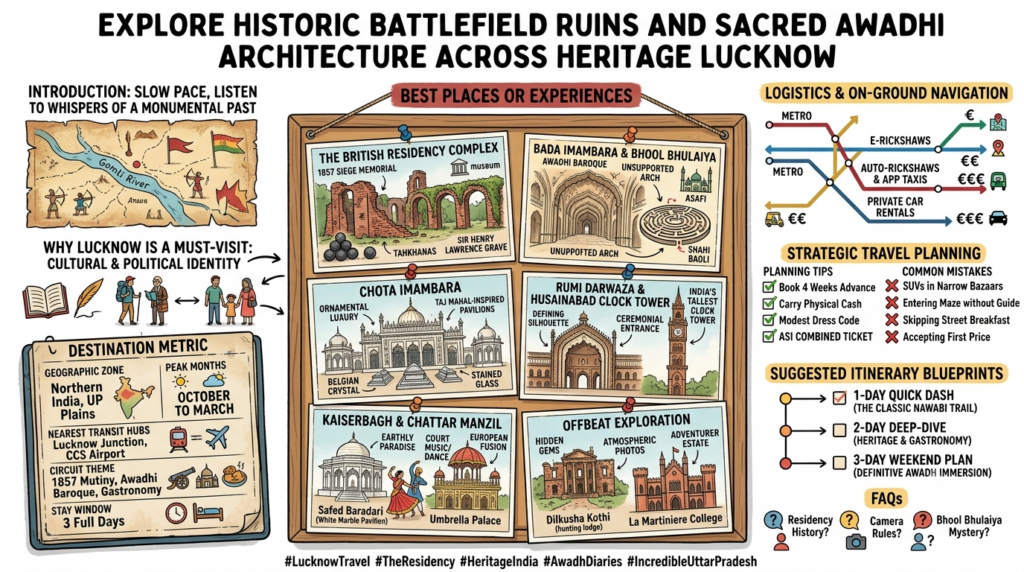
Modern travel often defaults to frantic itineraries through hyper-commercialized tourist hubs where authentic local heritage gets lost behind souvenir stalls and digital selfie queues. Lucknow offers the exact opposite experience: a city that demands you slow your pace and listen to the whispers of a monumental past. Here, history is not preserved in sterile glass cases, but carved into cannon-scarred brick ramparts, towering terracotta gateways, and fragrant alleys echoing with classical Awadhi poetry.
Stepping into The Residency complex immerses you directly in an evocative chapter of the 1857 uprising, untouched by contemporary glitz. Surrounded by centuries of layered cultural traditions, royal culinary arts, and tranquil landscaped gardens, this destination connects you directly with the soul of northern Indian heritage.
Why Lucknow is a must-visit city
Lucknow anchors the cultural and political identity of Uttar Pradesh, having evolved from the seat of the Nawabs of Awadh into a sophisticated center of literature, craft, and rebellion. Geographically positioned along the fertile banks of the Gomti River, the city showcases a rare convergence of Persian, Mughal, and European neoclassical architectural styles. Beyond its dramatic architectural pedigree, the capital provides modern, stress-free hospitality infrastructure that seamlessly welcomes solo backpackers, multigenerational family units, and heritage scholars alike.
The primary travel circuit gracefully weaves the dramatic siege memorials of the colonial era with opulent royal complexes and artisanal craft quarters. Travelers can easily arrive via the Chaudhary Charan Singh International Airport, board high-speed Vande Bharat and express rail connections at the historic Charbagh Railway Station, or arrive via high-grade multi-lane expressways from Delhi, Agra, and Varanasi. The entire destination functions as an accessible, open-air living museum where every corner reveals living traditions of tehzeeb (refined courtly etiquette).
| Destination Metric | Essential Traveler Detail |
|---|---|
| Geographic Zone | Central Gangetic Plains, Uttar Pradesh, Northern India |
| Peak Visiting Months | October to March (Crisp mornings, mild afternoons, cool evenings) |
| Nearest Transit Hubs | Lucknow Junction / Charbagh (LKO), Chaudhary Charan Singh International Airport (LKO) |
| Primary Circuit Theme | 1857 Mutiny Memorials, Awadhi Baroque Monuments, Chikan Embroidery & Royal Gastronomy |
| Suggested Stay Window | 3 Full Days (Enables relaxed heritage tours, culinary walks, and craft discovery) |
Best Places or Experiences
The British Residency Complex
The British Residency stands as one of the most poignant, evocative historical memorial complexes in the entire subcontinent. Constructed between 1780 and 1800 by Nawab Asaf-ud-Daula and later expanded by British Resident engineers, the site served as the administrative headquarters and refuge for the British East India Company during the fierce Siege of Lucknow in 1857. Today, the complex remains preserved in the exact ruined state left by heavy rebel artillery bombardment, featuring exposed Lakhori brickwork, gaping cannonball cavities, and overgrown ivy crawling across arched colonnades.
Wandering through the grounds reveals the grand multi-level Residency building, the remains of the banqueting hall, the subterranean tahkhanas (cool cellars that sheltered women and children), and the cemetery containing the graves of over two thousand defenders, including Sir Henry Lawrence. An outstanding on-site government museum displays detailed three-dimensional siege models, period lithographs, rusted weaponry, and intimate journal entries that bring this dramatic historical clash vividly to life
.
The historic Residency ruins in Lucknow.
- Location: Mahatma Gandhi Marg, Deep Manak Nagar, Qaisar Bagh, approximately 4.5 km north of Charbagh Railway Station.
- Why it is worth visiting: Unfiltered physical evidence of the 1857 uprising with preserved battle scars, peaceful botanical gardens, and an exceptional historical research museum.
- Best things to do: Explore the dark underground vaulted tahkhana chambers, inspect the original 1857 siege model inside the museum gallery, and view the bronze memorial plaque honoring Sir Henry Lawrence.
- Best time to visit: October to February, ideally between 8:30 AM and 11:00 AM for soft morning light across the brick ruins.
- Ideal for whom: History enthusiasts, architectural photographers, heritage walk groups, and military history buffs.
- Travel tip: The sprawling grounds require extensive walking on paved stone and grass pathways; carry drinking water and wear comfortable, flat walking shoes.
Bada Imambara & Bhool Bhulaiya
Commissioned in 1784 by Nawab Asaf-ud-Daula as an ambitious famine-relief employment project, the Bada Imambara is an engineering and architectural triumph of the Awadhi Baroque style. The central arched hall measures an astonishing fifty meters in length and fifteen meters in height, constructed completely without internal pillar supports, wooden beams, or structural iron girders. The mortar consists of a traditional mixture of crushed brick, molasses, river sand, pulses, and lime that has defied gravity for well over two centuries.
Above this colossal arched chamber lies the world-renowned Bhool Bhulaiya, a complex three-dimensional labyrinth of more than one thousand interconnected passageways, identical blind turns, and acoustic balconies. Outside, the complex includes the functioning Asafi Mosque, deep step-wells (shahi baoli), and sweeping paved courtyards that capture the royal confidence of eighteenth-century Awadh.
Magnificent Bada Imambara complex.
- Location: Husainabad, Old Lucknow, approximately 6 km northwest of the city center.
- Why it is worth visiting: One of the world’s largest unsupported vaulted halls paired with an intricate architectural labyrinth that offers panoramic rooftop city views.
- Best things to do: Hire a verified local monument guide to navigate the Bhool Bhulaiya maze, test the whispering gallery wall acoustics, and admire the underground water reservoirs of the Shahi Baoli.
- Best time to visit: 9:00 AM to 12:00 PM on weekdays to avoid large holiday crowds and midday roof heat.
- Ideal for whom: Architectural lovers, curious families, mystery solvers, and international travelers.
- Travel tip: Shoes must be deposited at the outer entrance shoe room before entering the sacred courtyards; bring clean slip-on socks during sunny winter afternoons.
Chota Imambara (Husainabad Imambara)
Built between 1837 and 1842 under the rule of Nawab Muhammad Ali Shah, the Chota Imambara—formally known as the Imambara of Husainabad—radiates delicate, ornamental luxury. In stark contrast to the colossal, somber brick arches of the nearby Bada Imambara, this ornate complex features exquisite calligraphic plasterwork, gold-plated main domes, and intricate European-influenced stained-glass window panes. The interior functions as a luminous royal mausoleum housing the silver-plated tombs of Muhammad Ali Shah and his mother.
The central hall is widely nicknamed the “Palace of Lights” due to its dazzling array of Belgian crystal chandeliers, gilt mirrors, and vintage silver lanterns imported from Venice and London. Within the serene outer garden courtyard, two mirror-image white pavilions stand opposite one another, including a scaled architectural tribute inspired by the Taj Mahal of Agra.
- Location: Husainabad, roughly 1.5 km west of Bada Imambara along the main heritage corridor.
- Why it is worth visiting: Spectacular collections of antique Belgian glass chandeliers, gold-leaf minarets, and refined calligraphic ornamentation.
- Best things to do: Examine the antique ceremonial royal tazias crafted from silver and wax, photograph the reflecting pool gardens, and view the historic treasury pavilion.
- Best time to visit: 3:30 PM to 5:30 PM when the setting sun illuminates the colored stained glass panels.
- Ideal for whom: Decorative art scholars, cultural travelers, and fine-art photographers.
- Travel tip: Dress modestly with covered shoulders and knees to show respect for active religious and commemorative prayer spaces.
Rumi Darwaza & Husainabad Clock Tower
Soaring sixty feet above the bustling streets of old Lucknow, the Rumi Darwaza stands as the defining silhouette of the city. Erected in the 1780s under Nawab Asaf-ud-Daula, this monumental archway served as the grand ceremonial entrance to the historic walled capital. Modeled conceptually after an ancient gate in Constantinople (modern Istanbul), the portal features an arched semi-circular facade crowned with floral petal flourishes and miniature ornamental stone turrets.
Just a short walk down the boulevard stands the magnificent Husainabad Clock Tower, constructed in 1881 to welcome British Viceroy Sir George Couper. Rising 221 feet into the sky as India’s tallest free-standing clock tower, it demonstrates high Victorian-Gothic design merged with delicate Awadhi brickwork, fronting a peaceful rectangular heritage tank known as the Husainabad Talaab.
The historic Rumi Darwaza.
- Location: Connecting road between Bada Imambara and Chota Imambara, Husainabad.
- Why it is worth visiting: The ultimate visual icon of Awadhi urban architecture alongside the country’s grandest colonial clock tower.
- Best things to do: Take twilight street photos from the central plaza island, stroll around the perimeter of the Husainabad Talaab, and admire the intricate leaf stucco carvings beneath the arch.
- Best time to visit: 5:00 PM to 7:00 PM when municipal floodlights illuminate the arch against the evening sky.
- Ideal for whom: Street photographers, urban history enthusiasts, and architectural buffs.
- Travel tip: The road passing under the arch is pedestrian-only; walk along the side pathways to capture clean, unblocked wide-angle perspective shots.
Kaiserbagh Palace Complex & Chattar Manzil
Conceived by Nawab Wajid Ali Shah between 1847 and 1850, the Kaiserbagh Palace was envisioned as an earthly paradise of courtyards, open-air stages, and classical Italianate pavilions. While significant portions were demolished in the aftermath of the 1857 conflict, remaining structures like the Safed Baradari (White Marble Pavilion) showcase the poetic, artistic zenith of the final Awadh dynasty. This grand open hall served as the court where the Nawab staged music performances, classical Kathak dance recitals, and public audience assemblies.
A short distance away along the riverbank stands the Chattar Manzil (Umbrella Palace), distinguished by its distinctive gilded umbrella-shaped dome. Combining European classical facades with subterranean riverfront salons designed to stay cool during northern Indian summers, the complex encapsulates the romantic, experimental architecture of the late Nawabi period.
- Location: Kaiserbagh heritage quarter, approximately 2 km south of the Gomti River.
- Why it is worth visiting: The historical center of classical Awadhi court music, dance, and late eighteenth-century European-Nawabi architectural fusion.
- Best things to do: Admire the white stone arches of the Safed Baradari, take an exterior walking tour around Chattar Manzil, and browse old book shops along the surrounding lanes.
- Best time to visit: 10:00 AM to 1:00 PM on crisp winter weekdays.
- Ideal for whom: Cultural purists, literature enthusiasts, dance historians, and architecture students.
- Travel tip: The Safed Baradari occasionally hosts private heritage exhibits or literary events; check local event boards in Hazratganj before visiting.
Offbeat Exploration: Hidden Gems Tourists Miss
Dilkusha Kothi & Hunting Lodge Ruins
Located quietly in the cantonment woods, the romantic eighteenth-century ruins of Dilkusha Kothi were originally built around 1800 by British officer Gore Ouseley as a hunting lodge and countryside retreat for Nawab Saadat Ali Khan. Modeled loosely on Seaton Delaval Hall in Northumberland, England, its weathered baroque towers, broken pediments, and arched doorways rise dramatically out of manicured green lawns. Because it remains completely off the primary tour bus route, it provides a quiet, crowd-free sanctuary perfect for slow historical contemplation and atmospheric photography.
La Martiniere College & Constantia Estate
Commissioned in the late eighteenth century by Claude Martin, a French soldier of fortune who rose to become a major general in the East India Company, Constantia is one of the most bizarre and spectacular architectural estates in Asia. Blending crenelated Gothic battlements, classical Roman arches, Renaissance urns, and mythological gargoyles, this massive palace now houses one of India’s premier boarding schools. Exploring its grounds, chapel, and the crypt of Claude Martin reveals a fascinating chapter of independent European adventurers embedded deep inside the royal Awadhi court.
Kotwara House in Kaiserbagh
Tucked inside an unassuming residential lane within the historic Kaiserbagh district, Kotwara House is the preserved private urban palace wing of the royal family of Kotwara, spearheaded by filmmaker and designer Muzaffar Ali. Visiting by prior arrangement gives travelers a private glimpse into authentic Nawabi interior aesthetics, featuring vintage velvet divans, antique brassware, classical Awadhi costumes, and delicate Zardozi embroidery workshops that continue royal family traditions away from public sight.
Detailed Practical Guidance for Travelers
| Destination | Standard Entry Fee | General Timings | Best Local Food Options Nearby | Recommended Nearby Attractions |
|---|---|---|---|---|
| The British Residency | ₹25 (Indians), ₹300 (Foreigners) | 7:00 AM – 6:00 PM (Daily) | Netram Golgappa & Jalebi, Aminabad | Kaiserbagh Palace, Shaheed Smarak |
| Bada Imambara | ₹50 (Combined ticket, Indians), ₹500 (Foreigners) | 6:00 AM – 5:00 PM (Tues–Sun) | Tunday Kababi, Phool Wali Gali, Chowk | Rumi Darwaza, Picture Gallery |
| Chota Imambara | Included in Combined Ticket | 6:00 AM – 5:00 PM (Daily) | Rahim’s Kulcha Nihari, Chowk | Husainabad Clock Tower, Satkhanda |
| Rumi Darwaza | Free Public Access | Open 24 Hours (Best at Sunset) | Kashmiri Chai & Makkhan Malai stalls | Bada Imambara, Husainabad Talaab |
| Dilkusha Kothi | Free Entry | 8:00 AM – 5:30 PM (Daily) | Cantonment club cafes, Sadar Bazaar | La Martiniere College grounds |
| Kaiserbagh Baradari | ₹20 (May vary during exhibits) | 9:00 AM – 5:00 PM (Mon–Sat) | Royal Cafe, Hazratganj (Basket Chaat) | Chattar Manzil, General Wali Kothi |
Logistics & On-Ground Navigation
Local Transport Options
- Lucknow Metro: Ultra-modern, punctual, and fully air-conditioned, the North-South corridor runs from the airport straight through Charbagh, Hazratganj, and northern terminals.
- Electric Rickshaws (E-Rickshaws): Highly affordable, zero-emission three-wheelers operating continuously across Chowk, Aminabad, and Husainabad; ideal for navigating congested historic bazaars.
- Auto-Rickshaws & App Taxis: Uber, Ola, and local metered three-wheelers are widely available across all sectors for seamless hotel transfers and multi-stop journeys.
- Private Car Rentals: Recommended when planning comprehensive day circuits that include suburban heritage properties like Dilkusha Kothi, La Martiniere, or regional culinary trail journeys.
Budget Planning
- Backpacker & Budget Tier: Expect to spend ₹1,200 to ₹1,800 per day. This covers public transit (metro and shared e-rickshaws), ticket counter fees, street dining (galawati rolls, bun makhan, and sweet lassi), and budget heritage guesthouses around Charbagh or Aminabad.
- Mid-Range & Comfort Tier: Expect to spend ₹3,500 to ₹6,500 per day. This budget accommodates comfortable app-hailed air-conditioned sedans, licensed private heritage guides, sit-down dining at historic establishments, boutique heritage hotels, and high-quality handloom Chikan shopping.
Safety and Inclusivity Tips
- For Families: Historical complexes offer large open lawns where children can rest comfortably; keep younger children close along unrailed staircases inside the Bhool Bhulaiya maze and Shahi Baoli step-well.
- For Couples: Public monument gardens are safe, well-monitored, and welcoming; maintain understated public decorum to respect conservative local cultural values.
- General Safety: Street crime is minimal, but busy markets like Chowk and Aminabad require standard precautions against pickpockets; always drink sealed bottled water and carry portable hand sanitizers for street snacking.
Local Heritage Secret: Purchase the ASI combined monument ticket at the Bada Imambara counter early in the morning. This single ticket grants access to the Bada Imambara, Chota Imambara, Picture Gallery, and Shahi Baoli, saving significant queue time later in the day.
Strategic Travel Planning Guardrails
Travel Planning Tips for Lucknow
- Secure train and hotel bookings at least four weeks in advance if traveling between November and January, the region’s peak winter festival season.
- Carry a modest amount of physical cash (small ₹20, ₹50, and ₹100 notes) because small street food vendors and monument shoe lockers often cannot process UPI QR codes due to basement network dead zones.
- Respect local dress codes when visiting active worship spaces within the Imambaras by bringing a lightweight scarf or stole to cover heads and shoulders.
- Schedule walking-heavy exploration for morning slots (8:30 AM to 11:30 AM) to avoid afternoon sun exposure, even in winter.
- Download offline navigation maps before heading into the dense, winding pedestrian alleys of Chowk and Aminabad.
Common Mistakes to Avoid
- Trying to drive large SUVs through the narrow inner bazaars of Chowk, which inevitably causes gridlock and delays.
- Entering the Bhool Bhulaiya labyrinth without an officially accredited guide if you are prone to directional disorientation or mild claustrophobia.
- Skipping the local breakfast culture of piping-hot khasta kachori and jalebi in favor of generic hotel breakfast buffets.
- Accepting the first quoted price from antique souvenir or embroidery vendors without courteous, good-natured counter-bargaining.
- Booking accommodations on the far eastern outer ring road, which adds frustrating commute times to old-city heritage sites.
Suggested Itinerary Blueprints
1-Day Quick Dash (The Classic Nawabi Trail)
Designed for travelers on a tight schedule who want to capture the absolute essentials of colonial history and royal Awadhi architecture in twelve high-impact hours.
- Morning: Arrive at The British Residency by 8:30 AM for a two-hour walking loop of the battlefield ruins and museum; proceed to Bada Imambara to explore the hall and Bhool Bhulaiya.
- Afternoon: Stroll beneath the Rumi Darwaza, admire the chandeliers inside Chota Imambara, and break for an authentic Awadhi lunch at Rahim’s in Chowk.
- Evening: Wrap up with evening tea and shami kababs along the bustling heritage colonnades of Hazratganj before departing.
2-Day Deep-Dive (Heritage, Resistance & Gastronomy)
A balanced two-day exploration allowing deep historical absorption, artisanal discovery, and slow architectural photography across Old and New Lucknow.
- Day 1 (The 1857 Crucible & Imperial Monuments): Spend the full morning exploring the gardens, museum, and cemetery grounds of The British Residency. Head to Bada Imambara, Shahi Baoli, and the grand Rumi Darwaza. In the evening, explore the historic perfumery (ittar) and silver leaf (vark) shops of Chowk.
- Day 2 (Nawabi Palaces, Hidden Estates & Craftsmanship): Start early at the romantic ruins of Dilkusha Kothi, followed by an exterior architectural tour of La Martiniere College. In the afternoon, explore the Kaiserbagh Safed Baradari and browse handloom Chikan embroidery workshops, ending with dinner at Tunday Kababi.
3-Day Weekend Travel Plan (The Definitive Awadh Immersion)
The ultimate circuit covering classical landmarks, colonial ruins, forgotten royal lodges, and world-class regional dining.
- Friday: Arrive, settle into your hotel, and spend a gentle afternoon exploring the Safed Baradari and Chattar Manzil. Enjoy sunset views along the Gomti Riverfront Park, followed by dinner in Gomti Nagar.
- Saturday: Dedicate the day to Old Lucknow. Begin at The British Residency at opening time, continue to Bada Imambara and Chota Imambara, and spend the late afternoon enjoying street delicacies along Phool Wali Gali in Chowk.
- Sunday: Take a morning photography excursion to Dilkusha Kothi and Constantia Estate. Conclude with souvenir shopping for brassware, embroidered kurtas, and traditional sweets (rewri and gajak) across Hazratganj and Aminabad.
Common Tourist Mistakes to Avoid
- Geographic Blunders: Grouping suburban sites like Dilkusha Kothi or Gomti Nagar with distant old-city monuments like Bada Imambara on the same morning wastes precious hours in traffic. Always divide your days geographically.
- Commercial Traps: Spending your leisure afternoons inside modern air-conditioned suburban shopping malls instead of exploring the historic arcades of Hazratganj or the traditional craft lanes of Aminabad.
- Neglecting Modern/Alternative Zones: Focusing exclusively on centuries-old monuments while missing out on the beautifully planned riverfront promenades, sprawling public parks, and vibrant contemporary cafe culture of Gomti Nagar.
- Transport Overpayment: Agreeing to unmetered, arbitrary fares quoted by waiting street rickshaws right outside major monument gates; cross-check prices on ride-hailing apps first to establish realistic local rates.
- Luxury Dining Bias: Restricting your culinary dining solely to upscale hotel dining rooms; skipping time-tested street-side establishments like Tunday Kababi, Netram, and Rahim’s deprives you of the authentic flavors of Awadh.
Frequently Asked Questions
1. What makes The British Residency in Lucknow historically unique compared to other colonial monuments in India?
The British Residency is preserved as an untouched, battle-scarred ruin rather than a restored administrative building. It offers visitors raw, visible evidence of the historic 1857 Siege of Lucknow. The surviving structures still retain deep cannonball gouges, shattered brick archways, intact underground defense cellars, and military cemetery grounds that remain frozen in time.
2. How much time should a visitor allocate to explore The Residency complex properly?
Plan to spend at least two to two and a half hours within the compound. This allows adequate time to walk the extensive fifteen-acre landscaped gardens, examine the surviving brick ruins, read the historical markers, and thoroughly explore the on-site government museum galleries housing authentic siege models and period artifacts.
3. Are professional cameras and tripods permitted inside The Residency and other monuments?
Personal smartphone cameras and basic digital cameras are permitted across all monument grounds without hassle. However, setting up heavy professional photography equipment, lighting rigs, or tripods generally requires prior written authorization from the Archaeological Survey of India (ASI) office, and commercial drone photography is strictly prohibited.
4. What is the mystery behind the Bhool Bhulaiya at the Bada Imambara complex?
The Bhool Bhulaiya is an architectural acoustic maze built directly above the colossal unsupported central hall. Constructed with over a thousand interconnected labyrinthine passages and identical blind corridors, it was engineered to confuse intruders while providing natural air circulation, structural weight distribution, and remarkable acoustic eavesdropping channels.
5. Can visitors enter the monuments during religious prayer services or festivals?
While the monument grounds generally remain open year-round, certain sections of active worship spaces, such as the Asafi Mosque inside the Bada Imambara complex, may temporarily restrict tourist entry during Friday congregational prayers or major religious observances such as Muharram. Always verify local timings at the gate.
6. What are the signature culinary dishes that every visitor must try near the heritage circuit?
Visitors should taste melt-in-the-mouth Galawati Kababs paired with flaky Mughlai Parathas at Tunday Kababi, rich Nihari Kulcha at Rahim’s in Chowk, royal Prakash ki Kulfi, crisp Khasta Kachori at Netram, and the signature basket chaat at Royal Cafe in Hazratganj.
7. Where can travelers purchase authentic, verified Lakhnawi Chikankari embroidery work?
Head straight to the government-certified UPICA handloom outlets or the historic family establishments in Chowk and Janpath Market in Hazratganj. Look for pieces featuring genuine hand embroidery (stitching techniques like murri, phanda, and tepchi) rather than modern, flat machine-manufactured imitations sold at inflated prices.
8. Is Lucknow a safe destination for solo female travelers exploring independently?
Yes, Lucknow is generally safe, welcoming, and hospitable for solo women. People are respectful, and public transit like the Lucknow Metro is clean and heavily monitored. When exploring old bazaar lanes after dark, exercise standard urban awareness, dress modestly, and rely on registered app-based cabs for late evening commutes.
9. What is the significance of the Shahi Baoli located beside the Bada Imambara?
The Shahi Baoli is a multi-story step-well built around a central reservoir connected to the Gomti River. Engineered as a summer retreat and secret surveillance post, its unique optical angles allowed palace guards seated inside the cool corridors to observe incoming visitors mirrored on the water’s surface without being seen themselves.
10. What specific footwear etiquette must be followed when visiting Lucknow’s sacred monuments?
Visitors must remove all footwear before stepping onto the inner elevated marble terraces of the Bada Imambara and Chota Imambara. Monument staff maintain monitored shoe counters for a nominal coin tip. Because stone pathways heat up on sunny days, wearing comfortable slip-on socks makes walking enjoyable.
11. Is it necessary to hire a licensed monument guide at the heritage sites?
Hiring an official, government-authorized guide is strongly recommended at the Bada Imambara and The Residency. A knowledgeable guide brings architectural illusions, historical siege strategies, and hidden labyrinth secrets to life with historical context that standard monument signage boards cannot convey.
12. What is the best way to travel between The Residency and the Chowk market area?
The most convenient and atmospheric way is to hop on an electric rickshaw (e-rickshaw) or auto-rickshaw along the river road. The short 3-kilometer journey takes roughly ten to fifteen minutes, dropping you right at the gateway of the vibrant heritage bazaars while avoiding narrow-lane car traffic.
Conclusion
Choosing to explore Lucknow beyond the surface offers an intellectually enriching and emotionally grounding travel experience. Standing among the sun-dappled brick ruins of The Residency, navigating the gravity-defying corridors of the Bhool Bhulaiya, and savoring age-old culinary creations passed down through generations connects you to an authentic royal legacy. The city leaves visitors with an enduring sense of grace, warmth, and timeless cultural beauty.
