Introduction
Step beyond the standardized itineraries of rushed sightseeing circuits and enter a city where knowledge has been revered for centuries. Lucknow presents an extraordinary, layered narrative that contrasts sharply with the sensory overload of commercial holiday hubs. For curious students and thoughtful families, the Uttar Pradesh capital transforms into a living classroom where history, science, artistic craftsmanship, and revolutionary zeal intersect seamlessly. Here, authentic cultural connection replaces artificial tourist spectacles, inviting travelers into tranquil corridors holding ancient antiquities, scientific wonders, and royal Awadhi secrets.
Why Lucknow is a must-visit city
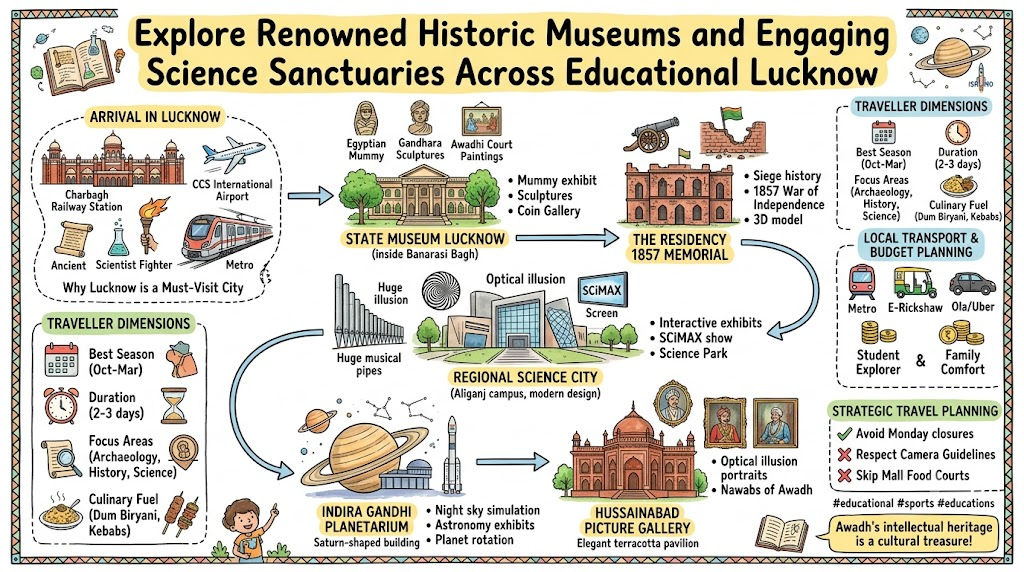
Lucknow anchors the geographic and cultural heart of the Gangetic plain, holding centuries of political transition, artistic patronage, and scientific inquiry. From the high refined aesthetics of the Nawabi era to pivotal chapters of India’s 1857 liberation movement, the city’s built landscape serves as a grand archive of human endeavor. Its strategic setting on the banks of the Gomti River supported generations of scholarship, making it a natural nexus for premier educational institutions, specialized research labs, and expansive archival collections.
For traveling families and student groups, the city offers unmatched accessibility. High-speed expressways link it across North India, the Chaudhary Charan Singh International Airport accommodates widespread domestic and global flights, and the architectural marvel of Charbagh Railway Station welcomes passenger trains from all corners of the country. Within the city, an integrated modern metro corridor and budget-friendly shared transit networks make museum hopping intuitive and economical. The broader museum circuit spans ancient archaeological relics, colonial sieges, space explorations, and tactile science parks—offering an unforgettable intellectual voyage for every curious mind.
| Travel Dimension | City Indicator & Practical Details |
|---|---|
| Best Travel Season | October to March (Crisp mornings, pleasant daytime temperatures) |
| Recommended Exploration Duration | 2 to 3 Full Days for comprehensive museum coverage |
| Primary Transit Nodes | CCS International Airport (Amausi), Charbagh Station (LKO/LJN) |
| Educational Focus Areas | Ancient Archaeology, Awadhi Lineage, 1857 Colonial History, Astrophysics |
| Local Culinary Fuel | Classic Awadhi Dum Biryani, Gilawat Kebabs, Sheermal, Makhan Malai |
Best Places or Experiences
State Museum Lucknow
Established in 1863, the State Museum in Lucknow stands as one of the oldest and most prominent multipurpose repositories in India. Set amid the verdant greens of the historic Banarasi Bagh botanical campus, this multi-level institution houses vast collections of archaeological discoveries, ancient coinage, bronze masterpieces, and rare manuscripts. Its tranquil stone halls provide a rare journey through the artistic evolution of the subcontinent, away from chaotic traffic.
The museum’s crowned treasure is an authentic Egyptian mummy dating to around 1000 BCE, drawing mesmerized schoolchildren and history students from across the country. Surrounding galleries display striking Gandhara and Mathura stone sculptures, exquisite Awadhi court paintings, and an unmatched cache of numismatic treasures spanning two millennia. It delivers an unforgettable educational outing that bridges ancient global civilizations with classical Indian dynastic history
.
State Museum within Banarasi Bagh campus.
- Location: Banarasi Bagh, Narhi, approximately 4.5 km from Charbagh Railway Station.
- Why it is worth visiting: Rare juxtaposition of an authentic Egyptian mummy, ancient Buddhist-Jain sculptural treasures, and regional Awadhi artifacts under one roof.
- Best things to do: Examine the intricate linen wraps of the Egyptian mummy, trace religious iconographic changes across Mathura red sandstone carvings, and explore the ancient minting exhibits in the Coin Gallery.
- Best time to visit: 10:30 AM to 1:30 PM on weekdays for quiet, uncrowded exploration.
- Ideal for whom: History students, archaeological researchers, school excursion batches, and multi-generational families.
- Travel tip: Combine entry with the surrounding Lucknow Zoo grounds for a complete educational day out.
The Residency 1857 Memorial Museum
The Residency grounds stand as a poignant open-air memorial complex bearing the raw scars of the historic Siege of Lucknow during the 1857 War of Independence. Within the battered brick walls of the central banqueting hall and model room, this specialized museum preserves the lived realities of soldiers, royalty, and civilians trapped in the crossfire of freedom struggles. Cannons, shattered pediments, and deeply pocked masonry narrate one of the most fierce anti-colonial uprisings on Indian soil.
Inside the museum chambers, carefully maintained scale models recreate the original sprawling estate prior to its wartime destruction. Detailed oil paintings, personal journals, vintage lithographs, and unearthed regimental badges bring human texture to textbook chapters. Walking these peaceful lawns while studying archival battle diagrams teaches children the profound value of freedom and historical preservation.
Residency 1857 Memorial Museum complex.
- Location: Mahatma Gandhi Marg, Deep Manak Chowk, roughly 5 km from Hazratganj.
- Why it is worth visiting: An unparalleled on-site war museum where real historical architecture directly illustrates the military chronology of the 1857 uprising.
- Best things to do: Study the detailed 3D diorama of the Residency compound during the 1857 siege, trace preserved cannonball marks across the brick walls, and inspect archival field journals in the lower gallery.
- Best time to visit: 3:30 PM to 5:30 PM to catch golden-hour lighting across the manicured grounds.
- Ideal for whom: Military history buffs, older students, photography lovers, and contemplative travelers.
- Travel tip: Download an offline map or purchase the official ASI booklet at the counter, as mobile reception drops near old subterranean stone chambers.
Regional Science City
Spanning several acres in the Aliganj neighborhood, the Regional Science City serves as northern Uttar Pradesh’s premier hands-on interactive learning hub. Operating under the National Council of Science Museums (NCSM), the campus demystifies physical laws, biotechnological advances, and human biology through tactile experimentation. Rather than maintaining static glass enclosures, this dynamic center invites children to pull levers, spin optical illusions, and participate directly in scientific inquiry.
The complex features massive open-air science parks with oversized musical pipes, levers, and momentum demonstrations set among green lawns. Inside, visitors find cutting-edge exhibition galleries like ‘Under the Sea’, human physiology simulations, a 3D digital theatre, and an immersive SCiMAX show. It turns fundamental academic theories into tangible, thrilling adventures for young learners
.
Interactive campus at Regional Science City.
- Location: Sector E, Aliganj, approximately 9 km north of Charbagh Station.
- Why it is worth visiting: Fully hands-on interactive exhibits that transform textbook physics, mechanics, and marine biology into engaging, playful experiments.
- Best things to do: Experience the immersive dome projection in the SCiMAX theatre, test balance and optical perception in the Fun Science gallery, and explore kinetic energy sculptures across the outdoor park.
- Best time to visit: Arrive by 10:30 AM to catch sequential 3D screenings and outdoor demonstrations before afternoon crowds gather.
- Ideal for whom: Primary and secondary school students, science enthusiasts, and families with young children.
- Travel tip: Book combined admission tickets that include the SCiMAX and 3D theatre screenings right at the main counter to secure your preferred showtimes.
Indira Gandhi Planetarium (Taramandal)
Rising beside the Gomti River in Surajkund Park, the Indira Gandhi Planetarium captivates visitors with its striking astronomical architecture shaped like Saturn, complete with rings encircling the dome. This modern facility serves as the focal point for public space education in Uttar Pradesh. It offers young astronomers an inspiring window into celestial mechanics, interplanetary exploration, and cosmic discovery.
The centerpiece is the digitally equipped, air-conditioned projection dome that simulates the night sky with stunning realism. Engaging narration guides visitors through constellation patterns, planetary orbits, lunar landings, and distant black holes. Informational display panels lining the circular lobbies highlight Indian space achievements from ISRO, making it an empowering stop for young dreamers.
Saturn-inspired Indira Gandhi Planetarium.
- Location: Nabiullah Road, Surajkund Park, around 3 km from the historic Chowk area.
- Why it is worth visiting: Unique Saturn-shaped architectural landmark offering immersive planetarium shows and educational astronomy exhibits.
- Best things to do: Attend a full-dome digital sky simulation show, study scaled models of Indian launch vehicles like PSLV and Chandrayaan, and track planetary rotation models in the corridors.
- Best time to visit: Plan your visit around afternoon public show screenings (typically running at 1:00 PM, 2:30 PM, and 4:00 PM).
- Ideal for whom: Space enthusiasts, school children, astronomy lovers, and family day-trippers.
- Travel tip: Confirm show timings at the entrance counter upon arrival, as special school bookings can occasionally alter regular weekend screening schedules.
Hussainabad Picture Gallery
Overlooking a serene ornamental water reservoir in the Old City, the Hussainabad Picture Gallery is housed inside an elegant terracotta-red British-Awadhi heritage pavilion. Built in 1838 by Nawab Mohammad Ali Shah, this historic art gallery preserves life-sized canvas portraits of all the Nawabs of Awadh. It stands as a magnificent testament to 19th-century royal court art and optical ingenuity.
What captivates students and travelers alike is the remarkable optical illusions crafted by historic court painters. As you walk across the wooden gallery floors, the eyes, shoe tips, and royal sword scabbards in the grand oil portraits appear to follow you across the room. Guides demonstrate these artistic perspective techniques, offering visiting children a fascinating look into early perspective painting and royal court portraiture.
Historic Hussainabad Picture Gallery.
- Location: Husainabad, Old City, right between the Chota Imambara and Clock Tower.
- Why it is worth visiting: Remarkable collection of monumental Awadhi royal portraits painted with masterful optical perspective tricks.
- Best things to do: Walk the length of the hall to watch the royal portraits’ eyes and shoes pivot with your perspective, admire the adjacent Hussainabad Clock Tower, and take in the water tank views from the upper terrace.
- Best time to visit: 11:00 AM to 2:00 PM when soft natural sunlight illuminates the lofty portrait halls.
- Ideal for whom: Art lovers, heritage enthusiasts, older students, and cultural photographers.
- Travel tip: Photography of the portrait canvases is strictly prohibited inside the main gallery; preserve battery life to capture the stunning terracotta exterior instead.
Offbeat Exploration: Hidden Gems Tourists Miss
Birbal Sahni Institute of Palaeosciences Museum
Situated along University Road near the northern bank of the Gomti, this premier research institute hosts a world-class paleobotany museum. Named after the legendary Indian scientist Prof. Birbal Sahni, the museum displays fossilized plants, petrified wood trunks millions of years old, and early life-form remnants that leave young earth science students spellbound.
Crafts Museum (Shilpgram, Lucknow)
Located near Awadh Shilpgram, this specialized crafts facility spotlights Uttar Pradesh’s unmatched artisanal heritage. Students can observe live demonstrations of intricate Chikankari needlecraft, Zardozi gold thread embroidery, and traditional bone-carving crafts while learning about the socioeconomic fabric supporting traditional master artisans.
Kala Gaon (Cultural Village Museum)
Tucked away on the eastern outskirts near Faizabad Road, Kala Gaon provides a delightful open-air simulation of rural Awadhi village life. Featuring traditional mud-and-thatch architecture, agricultural apparatus, pottery wheels, and regional folk art performances, it offers urban kids a hands-on window into rural traditions.
Detailed Practical Guidance for Travelers
| Destination | Standard Entry Fee | General Timings | Best Local Food Options Nearby | Recommended Nearby Attractions |
|---|---|---|---|---|
| State Museum Lucknow | ₹15 for Adults, ₹5 for Children | 10:30 AM – 4:30 PM (Closed Mondays) | Saffron restaurant & Hazratganj chaat stalls | Lucknow Zoo, Botanical Gardens |
| The Residency Memorial | ₹25 (Indian Citizens), ₹300 (Foreigners) | 8:00 AM – 5:30 PM (Open Daily) | Royal Cafe Hazratganj (Basket Chaat) | Shaheed Smarak, Gomti Riverbank |
| Regional Science City | ₹30 (General), Shows Extra (₹15–₹50) | 9:30 AM – 5:30 PM (Open Daily) | Classic North Indian thalis in Aliganj | Kapoorthala Market, Sector A Park |
| Indira Gandhi Planetarium | ₹25 per person (Free for differently abled) | 11:00 AM – 5:00 PM (Closed Mondays) | Moti Mahal Hazratganj, Chowk sweets | Surajkund Park, Chota Imambara |
| Hussainabad Picture Gallery | ₹20 (Included in Imambara combo ticket) | 9:00 AM – 5:00 PM (Open Daily) | Tunday Kababi, Rahim’s Kulcha-Nihari | Clock Tower, Chota Imambara |
Logistics & On-Ground Navigation
Local Transport Options
- Lucknow Metro Corridor: A pristine north-south metro connects Chaudhary Charan Singh Airport to Munshipulia. It offers smooth, air-conditioned links to Hazratganj, Sachivalaya, and Charbagh for quick museum transfers.
- Prepaid & Shared E-Rickshaws: These quiet green vehicles run through every residential neighborhood and old-city lane. They provide cheap, zero-emission hops between metro stations and museum entrance gates.
- App-Based Taxis & Auto-Rickshaws: Services like Uber and Ola run reliably across the city. Booking fixed-route auto-rickshaws through the app avoids price haggling during peak afternoon travel hours.
- Full-Day Private Rentals: Ideal for multi-generational families visiting outer attractions like Regional Science City in Aliganj or Kala Gaon along the Lucknow-Ayodhya highway.
Budget Planning
- Budget / Student Explorer Tier: ₹800 – ₹1,200 per day per person. This covers budget guest houses or youth hostels, metro and e-rickshaw travel, museum student concessions, and delicious local street eateries.
- Mid-Range / Family Comfort Tier: ₹2,800 – ₹4,500 per day per person. This includes mid-scale boutique heritage hotels, reserved private air-conditioned cabs, composite family museum tickets with premium shows, and sit-down dining at iconic Awadhi restaurants.
Safety and Inclusivity Tips
- For Families: Major museum complexes like the State Museum, Residency, and Science City feature secure perimeter walls, wheelchair ramps, clean drinking water coolers, and spacious shady lawns perfect for resting energetic children.
- For Couples & Independent Travelers: Stick to well-traveled, designated walking tracks and official gallery paths. The grounds of the Residency are expansive and quiet, but paths remain monitored and safe through afternoon closing.
- General Travel Security: Keep small currency notes handy for ticket windows and museum locker fees. Keep your identification cards accessible to claim student and senior citizen ticket concessions at government ticket booths.
Local Archival Secret: Many government museums in Lucknow offer discounted or near-free admission for students carrying valid educational institution IDs. Keep school and college identity cards handy to access discounted tickets and special show reservations.
Strategic Travel Planning Guardrails
Travel Planning Tips for Lucknow
- Plan your museum visits from Tuesday through Saturday to avoid Monday public museum closures and Sunday family rushes.
- Carry a lightweight water bottle and portable charging bank, as large grounds like the State Museum and Residency involve extensive walking.
- Take advantage of digital ASI QR-code booking gates at monuments like the Residency to skip long queues at on-site cash counters.
- Dress comfortably with walking shoes and breathable cottons to navigate sprawling staircases, garden paths, and uncarpeted museum galleries.
- Respect strict camera guidelines: handheld mobile photography is permitted on most grounds, but tripods and indoor flash setups are banned.
- Dedicate your mornings to indoor exhibits and schedule outdoor open-air ruins for late afternoon to stay comfortable under the sun.
Common Mistakes to Avoid
- Cramming sites on opposite sides of the city—such as Aliganj’s Science City and Old City’s Picture Gallery—into a single morning run.
- Forgetting to carry valid institutional student ID cards, which forfeits substantial educational ticket discounts.
- Relying exclusively on private cars inside the narrow heritage lanes of Husainabad, where parking is scarce and slow-moving.
- Assuming every museum accepts online card payments; keeping spare physical cash helps avoid ticketing delays at local booths.
- Leaving the Hussainabad Picture Gallery without asking on-duty gallery caretakers to demonstrate the optical perspective tricks in the portraits.
- Skipping museum cafeterias and local street stalls to eat at generic shopping mall food courts instead.
Suggested Itinerary Blueprints
1. Day Quick Dash (The Central Heritage & History Trail)
Designed for transit travelers, day-trippers, and time-pressed student groups seeking high-value learning in central corridors.
- Morning: Arrive at the State Museum Lucknow inside Banarasi Bagh. Spend 2.5 hours exploring the Egyptian Mummy exhibit, Mathura sculptures, and regional archaeological finds.
- Midday: Head to Hazratganj for a quick authentic lunch of basket chaat, followed by a stroll along the historic Victorian-style promenade.
- Afternoon: Explore The Residency 1857 Memorial Museum. Study the detailed battle models and preserved ruins until golden hour sets in over the riverside park.
2. Day Deep-Dive (From Ancient Antiquities to Modern Cosmos)
A comprehensive two-day route balancing historical heritage on Day 1 with hands-on science and astrophysics on Day 2.
- Day 1 (Royal Awadh & Revolutionary Battles): Start early at the Hussainabad Picture Gallery to view the optical royal portraits. Stroll past the Clock Tower and explore the central ruins at The Residency Memorial Museum in the afternoon. End your day with dinner in Chowk savoring authentic Awadhi kebabs.
- Day 2 (Science, Space & Antiquity): Spend your morning conducting interactive physics experiments at Regional Science City in Aliganj. Head toward the riverbank for a late afternoon planetary sky show at the Indira Gandhi Planetarium, finishing with an evening walk through the halls of the State Museum.
3. Complete Weekend Travel Plan (The Grand Awadh Educational Loop)
A complete three-day curriculum trail for families seeking a balanced mix of history, science, nature, and cultural crafts.
- Friday: Arrive in Lucknow, check into your hotel, and spend a relaxed afternoon discovering ancient tree specimens and petrified plant fossils at the Birbal Sahni Institute Museum. Enjoy an evening dinner in Hazratganj.
- Saturday: Spend the morning exploring the Regional Science City with the children. Take a midday break, then head to the Old City for the Hussainabad Picture Gallery and an inspiring sunset astronomy show at the Indira Gandhi Planetarium.
- Sunday: Dedicate your morning to the rich galleries of the State Museum Lucknow and adjoining zoo lawns. After a hearty Awadhi lunch, spend the late afternoon reflecting along the quiet trails of The Residency 1857 Memorial Museum before your departure.
Common Tourist Mistakes to Avoid
- Geographic Blunders: Group your destinations by neighborhood. Visiting the Hussainabad Picture Gallery in Old Lucknow in the morning, rushing north to Aliganj for Science City, and returning to the Old City for dinner wastes hours in cross-town traffic.
- Commercial Traps: Spending afternoon hours browsing contemporary glass shopping malls in Gomti Nagar robs families of the city’s rich living culture. Prioritize authentic historical collections, craft workshops, and open public campuses instead.
- Neglecting Modern/Alternative Zones: Focusing entirely on Nawabi heritage causes many travelers to miss the brilliant educational institutions scattered across new sectors, such as the interactive parks at Regional Science City.
- Transport Overpayment: Auto-rickshaws outside railway terminals and tourist spots often quote inflated fares. Always cross-reference prices on ride-hailing apps or use the metro to keep your travel costs sensible.
- Luxury Dining Bias: Sticking solely to upscale multi-cuisine hotel buffets keeps you from experiencing the city’s true culinary soul. Walk into historic neighborhood establishments in Chowk and Aminabad for authentic Awadhi culinary history.
Frequently Asked Questions
1. Are all major museums in Lucknow open on Mondays?
No, most government-run institutions, including the State Museum and the Indira Gandhi Planetarium, remain strictly closed to the public every Monday for regular conservation and administrative maintenance. Always schedule your visits between Tuesday and Sunday. The Residency memorial grounds remain open seven days a week under Archaeological Survey of India protocols.
2. Which museum in Lucknow is the most engaging for primary school students?
The Regional Science City in Aliganj is hands-down the most captivating destination for younger children. Its hands-on models, bubble-making experiments, mirror mazes, and interactive outdoor science park encourage energetic physical play while teaching fundamental physical and biological concepts. The SCiMAX theatre dome projection also keeps young children thoroughly entertained.
3. How much time should a family allocate to fully explore the State Museum?
A proper visit across the multi-floor State Museum typically takes between 2 to 3 hours. This gives families enough time to examine the Egyptian mummy, admire the Mathura stone carvings, and browse the coin and weapons galleries without rushing through the exhibits.
4. Is photography permitted inside the Hussainabad Picture Gallery?
No, visitors are strictly prohibited from taking photographs inside the portrait rooms of the Hussainabad Picture Gallery to protect the delicate antique oil paintings. However, you can freely photograph the terracotta-red architectural exterior, surrounding heritage structures, and the adjacent historic water reservoir without restriction.
5. Can visitors with restricted mobility access The Residency grounds easily?
The main perimeter lawns and primary asphalt avenues surrounding the Residency are flat and accessible for wheelchairs. However, some deep subterranean cellars, split-level banquet halls, and historic red-brick ruins feature ancient masonry thresholds, stone staircases, and gravel that require steady foot navigation.
6. Are combo tickets available for the monuments and galleries in Old Lucknow?
Yes, the Hussainabad Allied Trust offers convenient composite tickets at the entrance gates of Bada Imambara. These combined tickets grant admission to the Bada Imambara, the historic Shahi Baoli stepwell, the Chota Imambara, and the Hussainabad Picture Gallery, saving visitors money compared to individual tickets.
7. How do I reserve tickets for planetarium shows at Indira Gandhi Planetarium?
Show tickets are purchased directly from the on-site ticket window located in the entrance foyer of the planetarium. Because public screenings run at fixed times during the day and school groups frequently reserve blocks of seats, it is smart to arrive 30 minutes before your preferred showtime to secure seats.
8. What makes the mummy at the State Museum of Lucknow historically unique?
The Egyptian mummy preserved inside the State Museum represents an authentic relic from the Ptolemaic or late Pharaonic period, acquired in the early 20th century. It is one of only six genuine Egyptian mummies carefully preserved and displayed across Indian institutions, making it a truly rare educational wonder in the country.
9. Are food and outside picnic snacks permitted inside museum premises?
Outside food packets and hot meals are strictly barred within interior museum galleries and exhibition halls to protect artifacts from pests and litter. However, manicured outdoor spaces like the Residency lawns and the science park at Regional Science City allow families to enjoy light picnic refreshments in designated areas.
10. Is there an entry concession for school groups and university students?
Yes, virtually all major museums in the city—including the Regional Science City, State Museum, and Indira Gandhi Planetarium—provide reduced admission rates for institutional student groups. Students should carry valid school, college, or university photo ID cards to take advantage of these educational discounts at the box office.
11. Which museum provides the most detailed insights into India’s 1857 War of Independence?
The Residency 1857 Memorial Museum provides the most thorough and immersive look at the 1857 uprising. Its collection of artillery relics, original battle maps, personal letters, and scale models of the besieged garrison offers a detailed, ground-level chronicle of the fierce historic battles fought across the city.
12. What public transport route best connects Charbagh Station to the museum cluster?
The Lucknow Metro Red Line offers the fastest, most convenient link from Charbagh Railway Station. Take the train north to the Hazratganj or KD Singh Babu Stadium metro stations to reach central spots like the State Museum and Residency. From there, short e-rickshaw rides bring you directly to the museum gates.
Conclusion
Choosing an educational journey through Lucknow rewards families with far more than an ordinary holiday escape. Walking these preserved historic halls and open-air science spaces deepens your understanding of human resilience, scientific curiosity, and artistic achievement. The city sparks wonderful conversations between generations—bridging ancient civilizations, colonial history, and modern space exploration. Step into these timeless institutions and discover why the intellectual heritage of Awadh remains one of India’s most inspiring cultural treasures.
