Introduction
In an era defined by homogenized tourist experiences and overcrowded, generic travel circuits, Lucknow emerges as a defiant bastion of authenticity. If you are weary of mainstream destinations that feel like carbon copies of each other, this city is your antidote. Lucknow isn’t just a place on a map; it’s a deep cultural pulse that demands you slow down and connect. It offers a rare opportunity to peel back layers of history that possess deep roots, rather than just surface-level monuments. Here, you trade the plastic predictable with an immersive experience, engaging with a living, breathing storytelling legacy.
Why Lucknow is a must-visit city
Lucknow stands as a paramount chapter in the grand narrative of Indian travel, distinguished by its unique historical and cultural weight. Centrally located on the banks of the mighty Gomti River, it has been the crucible of Awadhi culture, a refined blending of Persian, Mughal, and local Indo-Aryan traditions. This wasn’t merely a political center; it was the heart of an era known for its Tehzeeb (refined etiquette), poetry, dance, and a culinary sophisticated sophistication that is unmatched. To miss Lucknow is to ignore a defining cornerstone of modern Indian identity.
Logistically, Lucknow is effortlessly accessible, making it an easy addition to any itinerary. Its primary gateway, the Chaudhary Charan Singh International Airport, is extremely well-connected globally and domestically. The extensive railway network links it to every major Indian metropolis via standard and luxury trains, and seamless highways provide rapid road connectivity for different traveler archetypes, from luxury explorers to backpackers. The travel circuit itself is concentrated and logical, focusing primarily on the old city and the contrasting planned wide avenues of Gomti Nagar.
| Key Fact | Summary |
| Best Travel Season | October to March (Cool, pleasant evenings) |
| Primary Vibe | Tehzeeb, Poetic Heritage, Awadhi Cuisine |
| Must-Try Dish | Tunday Kababi (authentic melt-in-the-mouth galouti) |
| Signature Souvenir | Chikan Embroidery (hand-carved textile work) |
| Accessibility | International Airport, Major Rail Hub, National Highways |
Best Places or Experiences
In a city brimming with landmarks, here are the most crucial heritage sites and cultural experiences you cannot miss.
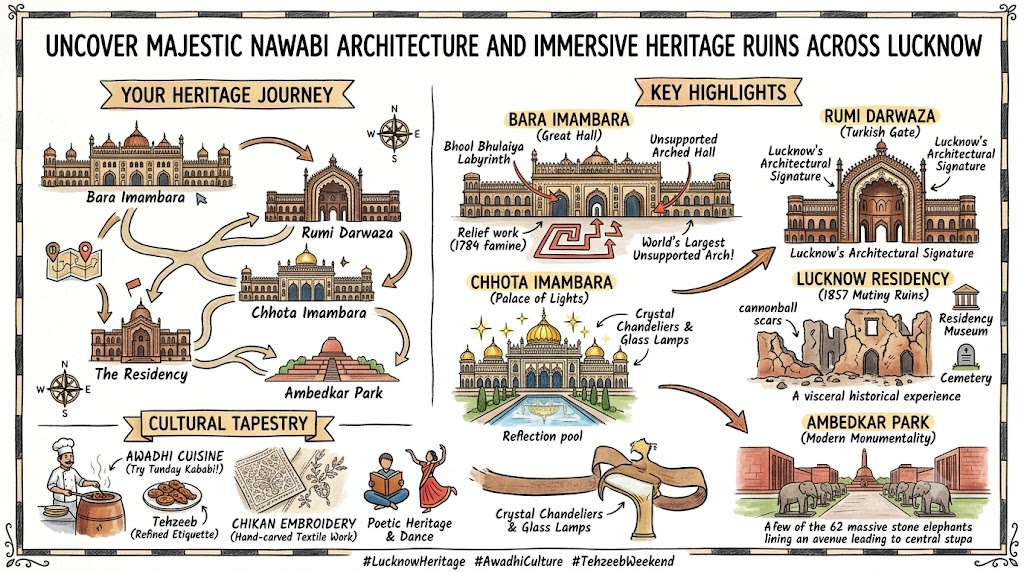
Bara Imambara
This colossal masterpiece of 18th-century architecture is the definitive icon of Lucknow, constructed during the devastating famine of 1784 as a relief project. The Bara (Great) Imambara is a sprawling complex, but its most shocking structural marvel is the massive central arched hall—one of the largest of its kind in the world—built entirely without an inch of external supportive beams or pillars. It is a stunning testament to Awadhi engineering, combining Mughal, Persian, and indigenous structural design.
Beyond the main hall, the complex includes the iconic Asafi Mosque, a tranquil stepwell (baoli), and the utterly mind-bending Bhool Bhulaiya (Labyrinth). This is not just a palace; it is a profound historical statement. The labyrinth is a complex maze of interconnected passages on the upper floor, designed intentionally to disorient and confuse any intruders. Exploring its dark, echoing corridors with a knowledgeable local guide is the only way to genuinely grasp its strategic brilliance.
- Location: Hussainabad zone, Old Lucknow, approx. 5 km from the city center.
- Why it is worth visiting: The world’s largest unsupported arched hall and the unique, disorienting thrill of the Bhool Bhulaiya.
- Best things to do: Explore the echoes in the unsupported Central Hall, hire a guide to navigate the Bhool Bhulaiya, and climb the terrace for views of the Asafi Mosque.
- Best time to visit: Early morning (8:00 AM) to beat the crowds or late afternoon for warm, soft lighting.
- Ideal for whom: History buffs, families, architecture students, and couples.
- Travel tip: The ticket is a combined entry for Bara Imambara, Chhota Imambara, the Picture Gallery, and the Clock Tower. Do not lose your counterfoil!
Chhota Imambara
Often called the ‘Palace of Lights,’ the Chhota Imambara is perhaps the most refined and ornate of all Lucknow’s heritage buildings, located just down the road from its larger counterpart. Built in 1838 by Nawab Muhammad Ali Shah, this complex is not characterized by scale, but by exquisite, detailed sophistication. The main structure is adorned with gold-plated domes, elaborate stucco work, calligraphic inscriptions, and a breathtaking collection of crystal chandeliers and glass lamps, many of which were imported from Belgium.
Entering this courtyard feels like stepping into a tranquil, lost world of imperial luxury. The reflection pools, standard with charbagh landscaping, amplify the visual impact of the building’s intricate facade. During special occasions like Muharram, the entire structure is illuminated by the hundreds of lamps and chandeliers, transforming it into a radiant, glowing beacon that is utterly surreal. It is a profound, atmospheric contrast to the military-like dominance of the Bara Imambara.
- Location: Hussainabad zone, Old Lucknow, approx. 5 km from the city center.
- Why it is worth visiting: Exquisite chandeliers, gold domes, and a rare example of calligraphic architectural decoration.
- Best things to do: See the collection of Belgian Chandeliers, examine the detailed calligraphy, and relax in the quiet reflection pool gardens.
- Best time to visit: Sunset is magical as the lights are turned on, illuminating the glass.
- Ideal for whom: Couples, architecture lovers, art enthusiasts, and photography buffs.
- Travel tip: Strict modesty is required; you must remove your shoes before entering the main hall.
Rumi Darwaza
This stunning gateway is the architectural signature of Lucknow, standing as a triumphant entrance to the historic old city. It was modeled after the Sublime Porte (Bab-i-Huma) in Istanbul, but adapted with a unique, distinctly Indo-Islamic flair, including decorative multi-layered arches and elaborate stucco designs that seem to bloom under the sun. It is a powerful, expressive structure, designed not for defense but to project cultural grandeur.
Standing 60 feet high, the Rumi Darwaza defines the cityscape. It was the ceremonial entrance where the Nawabs and British dignitaries entered the administrative complex. Unlike typical fortified gates, it is hollow, and a staircase leads to the top, which was once a viewing platform for state processions. Today, it remains the defining viewpoint of the Hussainabad area, best observed from a slight distance to fully appreciate its graceful symmetry.
- Location: Hussainabad zone, Old Lucknow, between the two Imambaras.
- Why it is worth visiting: The visual signature of Lucknow; a unique fusion of Ottoman and Indo-Islamic design.
- Best things to do: Capture iconic photos from the street, hire a local tonga for a slow ride through, and observe the detailed stucco patterns.
- Best time to visit: Sunrise for beautiful silhouettes or late night when it is dramatically lit up.
- Ideal for whom: Photography buffs, architecture lovers, and general tourists.
- Travel tip: It is a functioning public road. Traffic does not stop, so be extremely careful when trying to take photos.
Lucknow Residency
No site captures the poignant complexity of Lucknow’s history like the British Residency. Originally a sprawling 33-acre complex built for the British Resident, it became the epicenter of the defining Siege of Lucknow during the First War of Independence in 1857. For months, British troops and civilians were besieged by Indian revolutionaries. Today, the Residency is not a pristine palace but a protected ruin, left exactly as it was after the fierce fighting, its walls still scarred with cannonball holes and musket fire.
It is a somber, deeply atmospheric space. Walking through the skeleton of the main banqueting hall, the treasury, and the subterranean cellars where women and children sheltered is a visceral, emotional experience. The sprawling, quiet gardens, now a peaceful sanctuary, contrast sharply with the residual energy of the past. The on-site museum is excellent, displaying models of the original complex and artifacts found in the debris, providing crucial context to this defining event.
- Location: Central Lucknow, near the Gomti River, approx. 2 km from city center.
- Why it is worth visiting: The key historic site of the 1857 Mutiny/Uprising; a protected ruin frozen in time.
- Best things to do: Visit the Residency Museum, explore the ruined cellars, and see the cannonball scars on the main building.
- Best time to visit: Early evening for a peaceful walk; the museum closes earlier than the gardens.
- Ideal for whom: History buffs, general explorers, and photography enthusiasts.
- Travel tip: The complex is huge. Dedicate at least two hours to explore the grounds, museum, and cemetery.
Ambedkar Memorial Park
Lucknow isn’t just about ancient history; it also possesses powerful modern monuments. The Ambedkar Memorial Park, located in the modern extension of Gomti Nagar, is a staggering statement of contemporary design and social significance. Constructed entirely with red sandstone from Rajasthan, it is a vast, expansive complex dedicated to the life and struggle of Dr. B.R. Ambedkar and other social reformers. The sheer scale is overwhelming, designed with grand ceremonial avenues and a central, colossal memorial stupa.
Entering the park is a sensory experience defined by monumental symmetry. The central pathway is lined with 62 massive stone elephants, leading to the towering monument. The architecture is clean, sharp, and geometric, a stark visual alternative to the ornamental Nawabi buildings. While it has political roots, its scale and clean design are objectively monumental, especially when viewed at sunset when the light catches the red stone.
- Location: Gomti Nagar zone, new Lucknow, approx. 6 km from city center.
- Why it is worth visiting: A masterclass in colossal, contemporary red sandstone architecture on an epic scale.
- Best things to do: Walk the Ceremonial Elephant Avenue, see the central Dr. Ambedkar statue, and admire the geometric water features.
- Best time to visit: Late evening (sunset) is essential, as the lighting on the red sandstone is spectacular.
- Ideal for whom: Modern architecture lovers, families, photography buffs, and general tourists.
- Travel tip: It is a massive, exposed open area. Avoid visiting during the height of a summer afternoon; there is very little shade.
Offbeat Exploration: Hidden Gems Tourists Miss
La Martiniere College
This isn’t a museum; it is a functioning, elite school, and perhaps the only institution in the world designed by a French adventurer and built as a grand palace to himself. Major General Claude Martin, whose tomb is in the crypt, designed this bizarrely beautiful complex in the late 18th century, mixing European Neoclassical, Palladian, and playful Gothic features with Indian motifs. It has been used in countless films and is a surreal blend of a grand, echoing European estate and Indian palace. Exploring its halls and observation tower is an absolute hidden treat.
Dilkusha Kothi
Once the elegant summer palace of the Nawabs, modelled after a specific English estate, Dilkusha Kothi was tragically destroyed during the 1857 Siege. Today, it stands as an atmospheric, stabilized ruin within a quiet, protected park. It is almost never on the main tourist map, meaning you will likely have the peaceful grounds and the evocative, skeletal shell of the once-grand Kothi entirely to yourself.
Detailed Practical Guidance for Travelers
| Destination | Standard Entry Fee | General Timings | Best Local Food Options Nearby | Recommended Nearby Attractions |
| Bara Imambara | ₹50 (Indian), ₹500 (Foreign) | 8:00 AM – 6:00 PM | Dastarkhwan (Galouti Kabab) | Chhota Imambara, Clock Tower |
| Chhota Imambara | (Included in combined ticket) | 8:00 AM – 6:00 PM | Hussainabad Street Food (Pasanda) | Bara Imambara, Picture Gallery |
| Lucknow Residency | ₹25 (Indian), ₹300 (Foreign) | 8:00 AM – 5:30 PM | Mubeen’s (Nihari Kulcha) | Hazratganj, Begum Hazrat Mahal Park |
| Ambedkar Park | ₹10 (Indian), ₹100 (Foreign) | 11:00 AM – 9:00 PM | Gomti Nagar Cafes (The Hazelnut Factory) | Janeshwar Mishra Park |
Logistics & On-Ground Navigation
Local Transport Options
- App-Based Cabs: Uber and Ola are extensively operational and the most comfortable and safest way for families or groups to navigate the busy city.
- Auto-Rickshaws (Tuk-Tuks): Omnipresent and efficient for quick dashes. Crucial: Always clarify if you want a private auto or are willing to share.
- E-Rickshaws: These silent, battery-operated vehicles are the kings of the narrow lanes in the Old City. Use them to zip between Rumi Darwaza and the Imambaras for a minimal shared cost.
- Metro: Clean, modern, and efficient. The single line connects major areas like the Airport, Charbagh Railway Station, and Hazratganj, but does not yet reach the Old City core (Hussainabad).
Budget Planning
- Budget Tier: For solo travelers or backpackers, a reasonable per-day cost would be ₹1,500 – ₹2,500. This covers a bed in a hostel/budget guesthouse, shared transport (e-rickshaws/metro), and relying heavily on the fantastic and cheap street food scene.
- Mid-Range Tier: A per-day budget of ₹4,000 – ₹6,000 provides a comfort experience, including a room in a business-class hotel (e.g., in Gomti Nagar or Hazratganj), app-based private cabs for logistics, and dining at a mix of iconic local eateries and mid-range restaurants.
Safety and Inclusivity Tips
- Families: Public heritage buildings and Ambedkar Park are extremely well-guarded, well-lit, and very family-friendly, though navigating Old Lucknow with small children requires constant vigilance.
- Couples: The expansive gardens of Janeshwar Mishra Park (near Ambedkar Park) are very popular with couples, as is sunset photography at Rumi Darwaza.
- General Safety: Lucknow is generally considered very safe for tourists, but Old City areas are chaotic. Always safeguard your pockets in congested areas and, like any Indian city, it is wise for women to avoid navigating isolated streets alone late at night.
Strategic Travel Planning Guardrails
Travel Planning Tips for Lucknow
- Digital Entry: While physical tickets are available, the ASI sites (Bara Imambara, Residency) offer entry through online ticket booking. Skip the queues and book tickets in advance on the official portal.
- Modesty Matters: Lucknow is a traditional city. Dress modestly, especially when visiting active religious spaces (the Imambaras are not mosques but are deeply revered religious halls), covering shoulders and knees.
- Hazratganj is the “Ganj”: If people say they are going “Ganjing,” they are heading to the main, refined shopping street of Hazratganj. Dedicate an evening to walking this area for Chikan shopping and coffee.
- Cash is King for Small Payments: While UPI is universally accepted for most things, carry small cash notes for e-rickshaws, tonga rides, and small street food stalls.
Common Mistakes to Avoid
- Ferrying Old City to Gomti Nagar in One Go: Avoid trying to explore Ambedkar Park and Bara Imambara in the same morning. Traffic between new and old city can be immense; group your sites by region.
- Missing Street-Level Cuisine: The real soul of Awadhi food isn’t in a five-star hotel. Do not miss street vendors. Places like Mubeen’s for Nihari, Sharma Ji Ki Chai, or any authentic chaat vendor in Hazratganj are essential.
- Skipping a Bhool Bhulaiya Guide: Do not try to navigate the labyrinth alone. You will get lost, miss all the architectural secrets (like the whispering walls), and not understand its purpose.
- Skipping the Old City Vibe: While Hazratganj is lovely, you must spend time in Old Lucknow (Chowk). This is where the true, atmospheric Tehzeeb lives, in the ancient shops and chaotic alleys.
Suggested Itinerary Blueprints
1-Day Quick Dash (Nawabi Core)
Perfect for a transit traveler with only 8-10 hours, focusing exclusively on the Old City’s architectural icons.
- Route: Start early (8:00 AM) at Bara Imambara complex (with Bhool Bhulaiya). Walk through Rumi Darwaza, then visit Chhota Imambara and the Picture Gallery. Lunch in Hussainabad. Spend a quick 90 minutes at The Residency, then finish with an evening walk and dinner in Hazratganj.
2-Day Deep-Dive (Heritage & Contemporary Fusion)
For a comprehensive visit, splitting the city’s dual identities.
- Day 1 (Nawabi Core): Complete exploration of Hussainabad (Bara & Chhota Imambara, Rumi Darwaza, Clock Tower). Explore the ancient Chowk for street food (Nihari) and Chikan shopping.
- Day 2 (Colonial & Modern): Morning at The Residency and museum. Afternoon architecture tour of La Martiniere. Finish with a monumental sunset at Ambedkar Memorial Park and dining in Gomti Nagar.
Complete Weekend Travel Plan (Tehzeeb Weekend)
Friday arrival to Sunday departure, allowing a slow, sensory immersion.
- Friday Evening: Arrival, check-in. Ganjing (walking and dinner) in the colonial-era streets of Hazratganj.
- Saturday: Full day in Old Lucknow. Morning at the Imambaras and Bhool Bhulaiya. Lunch at the authentic Tunday Kababi in Chowk. Spend the afternoon in Chowk market for authentic shopping. Evening Tonga ride through Rumi Darwaza.
- Sunday: Morning visit to La Martiniere College and Dilkusha Kothi ruins. A final Awadhi lunch, then a grand sunset visit to Ambedkar Park before departure.
Frequently Asked Questions
1. Is it necessary to hire a guide for the Bara Imambara labyrinth (Bhool Bhulaiya)?
It is absolutely essential to hire an authorized local guide (available at the ticket counter) for the Bhool Bhulaiya labyrinth. This maze is intentionally disorienting with hundreds of identical interconnected passages. Without a guide, you will not only get lost but you will also miss all the subtle architectural marvels, such as the whispering walls (where a whisper travels across a 100-foot arch) and the strategic viewpoints designed to confuse intruders. The experience is hollow and potentially risky without their narrative.
2. Are the entry tickets for Bara Imambara and Chhota Imambara separate?
No, the entry tickets for the main Nawabi sites are structured as a convenient combined ticket (counterfoil). You buy one single ticket, which is then stamped and validated at Bara Imambara, Chhota Imambara, the Picture Gallery, and the Clock Tower museum. This means you only queue once and must keep the ticket counterfoil safe throughout your exploration of all the main Hussainabad landmarks; do not lose it.
3. What should women wear to visit the Imambaras?
When visiting the Imambaras (which are active Shia religious halls, not mosques, but require the same level of reverence), both men and women must dress modestly. For women, this means covering your shoulders, knees, and hair before entering the main prayer/relic halls. A loose scarf (dupatta) should be carried to drape over your head. Tight-fitting clothing or sleeveless tops should be avoided. Modesty is a non-negotiable prerequisite for entry.
4. Where is the best authentic Galouti Kabab in Lucknow?
The single most iconic and authentic location is the original Tunday Kababi restaurant in the narrow lanes of Old Nazirabad Road in Chowk. While there are newer branches across the city and even in other cities, the Old Chowk branch uses the original 17th-century recipe with over 100 spices, cooked on charcoal griddles. Eating here is a crowded, visceral, street-level experience that captures the true soul of Awadhi cuisine.
5. What is the most convenient transport to navigate the Old City lanes between the Imambaras?
Once you arrive in Hussainabad (near Rumi Darwaza), the best way to move between the closely located landmarks (the two Imambaras, Clock Tower, Picture Gallery) is by using the ubiquitous, shared e-rickshaws. These silent, small, battery-operated vehicles are perfect for weaving through the tight, congested Nawabi-era lanes where private cars are too large and slow. A shared ride will cost just ₹10–₹20 between sites.
6. Is Lucknow safe for solo female travelers?
Yes, Lucknow is generally considered safe for solo female travelers, known for its politeness. However, like any major city, it requires smart vigilance. Stick to well-lit, public streets after dark, always clarify fares before boarding shared autos, and avoid navigating the narrow, confusing lanes of the Old City Chowk area alone at night. Popular tourist areas like Hazratganj and Gomti Nagar are extremely well-patrolled and safe.
7. How much time should I dedicate to exploring the British Residency?
The British Residency is a massive, sprawling complex of 33 acres, including multiple ruined buildings, a dedicated on-site museum, a cemetery, and vast gardens. To genuinely experience the historical magnitude of the 1857 Siege and properly explore the museum artifacts and ruined cellars, you should dedicate at least two full hours. It is not a site for a 30-minute quick visit.
8. Is Ambedkar Memorial Park worth visiting?
Yes, Ambedkar Memorial Park is highly recommended for any visitor interested in colossal modern architecture and contemporary Indian history. While its origins are political, the sheer scale of the red sandstone structures, the symmetry of the central elephant avenue, and the clean geometric lines of the stupa are objectively monumental. It offers a stunning visual alternative to the ornamental Nawabi buildings, especially when dramatically lit up at sunset.
9. Can we go inside La Martiniere College?
Yes, you can visit La Martiniere College, but remember it is a functioning, elite boarding school. During school hours, access is generally restricted to the outer grounds to avoid disturbing students. To explore the interiors, the magnificent main hall, and Major General Claude Martin’s tomb in the crypt, the best time to visit is on Sundays or school holidays. Always respect the environment and seek permission from guards before entering academic blocks.
10. What is unique about the structure of the Rumi Darwaza?
The Rumi Darwaza is unique for its synthesis of Ottoman Turkish and Indian design, modeled after the Sublime Porte in Istanbul but adapted with a distinct Indo-Islamic flair. What makes it structurally remarkable is that, unlike typical fortified Indian gates, it is built with no supporting iron or external steel beams. The massive arch is self-supporting, a feat accomplished entirely through brick and intricate stucco work, standing 60 feet high.
11. Is it better to stay in Hazratganj or Gomti Nagar?
This depends on your travel goals. Hazratganj is the historic heart, excellent for luxury shopping and being within a quick commute of the major heritage sites. Gomti Nagar is a modern, planned extension with wider roads, larger cafes, and close proximity to Ambedkar Park. Stay in Gomti Nagar for modern cafes, parks, and wide avenues; stay in or near Hazratganj to be close to the heritage core.
12. When is the best time to see the Imambaras lit up?
The Chhota Imambara (Palace of Lights) and Rumi Darwaza are spectacularly lit every evening, and the best time to see this transformation is at sunset. The Bara Imambara complex is also illuminated, creating dramatic views from the terrace of the Asafi Mosque. For the absolute most surreal experience, try to time your visit with major Shia festivals like Muharram, when thousands of extra lamps are illuminated.
Conclusion
Choosing Lucknow isn’t merely a logistical travel decision; it is an act of intellectual and cultural rebellion. You trade the predictable, plastic vacation of common circuits for a raw, authentic engagement with a culture that has deep, complex roots. Here, you aren’t just looking at history; you are connecting with Tehzeeb—a living legacy of refined etiquette, authentic flavors, and genuine interaction. This isn’t a passive tourist trap; it is an immersive dialogue with a defining era. To experience Lucknow’s palaces is to let a city possess your senses, offering not just photos for an album, but a profound, enduring understanding of the refined soul of Awadh.
