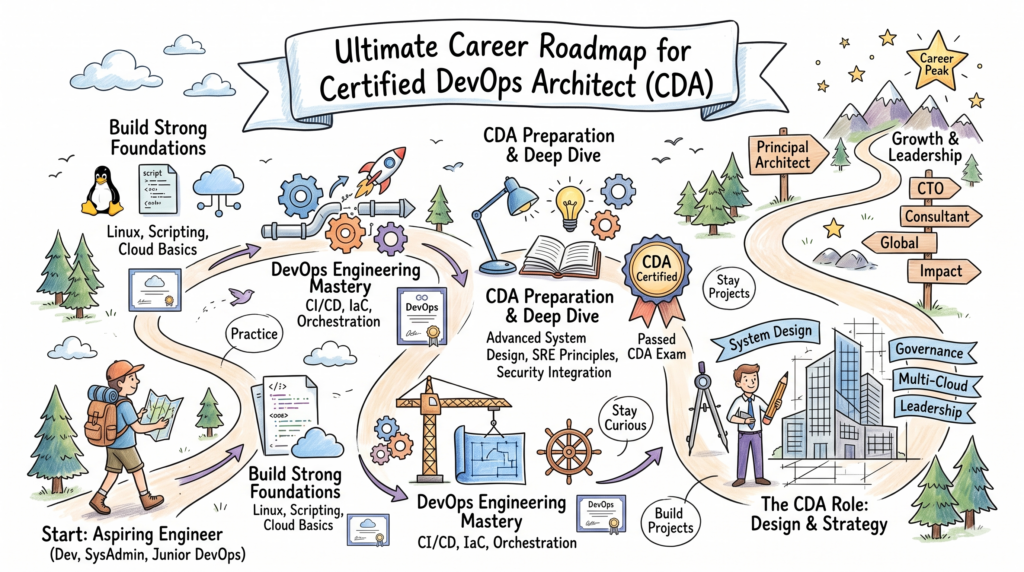
Introduction
The Certified DevOps Architect (CDA) is a high-level program designed for those who want to move beyond basic automation and into the world of system design. This guide is built for engineers and managers who are ready to take the lead in their organizations by building resilient and scalable infrastructures. It matters today because businesses are no longer just looking for people who can use tools; they need professionals who can design the entire ecosystem.
In this guide, we look at how this certification fits into the broader world of DevOps, cloud-native technologies, and platform engineering. Whether you are an experienced engineer or a technical lead, this resource will help you understand the path forward. By the end, you will have the clarity needed to make an informed decision about your professional growth and how to navigate the complex world of modern engineering workflows.
What is the Certified DevOps Architect (CDA)?
The Certified DevOps Architect (CDA) represents a professional milestone that validates your ability to design and manage complex delivery pipelines. It exists to bridge the gap between technical execution and strategic planning. Unlike basic certifications that focus on learning a single tool, this program emphasizes a production-focused approach to learning how different components of a system work together.
It aligns perfectly with modern engineering workflows by focusing on architecture that supports high availability and security. Enterprises today need systems that can handle rapid changes without breaking. The CDA program ensures that you understand these enterprise practices and can apply them to real-world scenarios. It is about moving from a “doing” mindset to a “designing” mindset.
Who Should Pursue Certified DevOps Architect (CDA)?
This certification is highly beneficial for several roles within an IT organization. Senior DevOps engineers, Site Reliability Engineers (SREs), and Cloud Architects will find the content directly applicable to their daily tasks. Additionally, security professionals and data engineers who want to understand the architectural side of automation will gain a significant advantage in their career progression.
While it is aimed at those with some experience, ambitious beginners and engineering managers can also benefit from the structured knowledge it provides. In the Indian tech market and the global industry, there is a massive demand for people who can oversee large-scale transitions to the cloud. Managers can use this knowledge to better lead their teams, while engineers can use it to justify their move into senior leadership or principal roles.
Why Certified DevOps Architect (CDA)
The demand for architectural expertise is growing as more companies adopt multi-cloud and microservices strategies. Tools may change every few months, but the core principles of architecture remain steady. Holding a CDA proves that you have a deep understanding of these principles, ensuring your career remains relevant even as specific technologies evolve or become obsolete.
Investing time in this certification offers a high return on investment because it positions you for high-level roles. Enterprises are looking for stability and efficiency, and an architect is the one who provides the blueprint for both. By focusing on the “big picture,” you become an indispensable asset to any organization looking to scale its technical operations effectively over the long term.
Certified DevOps Architect (CDA) Certification Overview
The program is officially delivered through and is hosted on the devopsschool platform. It is structured to be practical and unbiased, focusing on the skills you actually need in a professional setting. The assessment approach is designed to test your ability to solve real problems rather than just memorizing facts from a textbook.
Ownership of the learning process stays with the professional, as the structure allows for flexible progression through different technical domains. It covers everything from infrastructure as code to advanced monitoring and security. By the end of the program, you will have a comprehensive understanding of how to build a modern, automated enterprise environment that meets the highest industry standards.
Certified DevOps Architect (CDA) Certification Tracks & Levels
The certification is organized into clear tracks to help you progress logically. It starts with foundation levels that cover the basic building blocks of architecture and automation. From there, you move into professional levels where the focus shifts to specific toolchains and integration strategies. Each level is designed to build upon the last, ensuring a solid knowledge base.
Advanced levels and specialization tracks allow you to dive deeper into areas like SRE, FinOps, or DevSecOps. This flexibility means you can tailor your learning path to match your current job or the role you want to move into next. By following these tracks, you can clearly demonstrate your growth to employers and show that you are ready for more responsibility.
Complete Certified DevOps Architect (CDA) Certification Table
| Track | Level | Who it’s for | Prerequisites | Skills Covered | Recommended Order |
| Core Architecture | Expert | Senior Engineers | 5+ years IT | System Design, CI/CD | 1st |
| SRE Track | Advanced | SREs & Leads | Core CDA | Reliability, Monitoring | 2nd |
| Security Track | Advanced | Security Leads | Core CDA | DevSecOps, Compliance | 2nd |
| Cloud Track | Expert | Cloud Architects | Basic Cloud Knowledge | Multi-cloud, Scaling | 1st |
| Platform Track | Advanced | Platform Leads | Core CDA | Internal Platforms | 2nd |
Detailed Guide for Each Certified DevOps Architect (CDA) Certification
Certified DevOps Architect (CDA) – Professional Level
What it is
This certification validates your ability to design and implement end-to-end automation strategies for enterprise-grade applications. It proves you can handle the complexities of modern infrastructure and delivery.
Who should take it
It is ideal for Senior DevOps Engineers, Technical Leads, and Aspiring Architects who want to formalize their design skills and move into leadership roles within engineering teams.
Skills you’ll gain
- Designing scalable CI/CD pipelines for microservices.
- Implementing Infrastructure as Code (IaC) at an enterprise scale.
- Managing multi-cloud environments and hybrid cloud strategies.
- Optimizing system performance and observability.
Real-world projects you should be able to do
- Build a fully automated disaster recovery plan for a global application.
- Design a zero-downtime deployment strategy for a high-traffic fintech platform.
- Automate the compliance and security auditing process within a delivery pipeline.
Preparation plan
- 7-Day Strategy: Focus on refreshing your knowledge of core tools like Kubernetes, Terraform, and Jenkins. Review architectural patterns and best practices.
- 30-Day Strategy: Spend time building small-scale architectural prototypes. Read through case studies of successful DevOps transitions and practice designing system diagrams.
- 60-Day Strategy: Engage in deep-dive labs. Work on end-to-end projects that require integrating multiple tools. Participate in community forums to solve complex architectural problems.
Common mistakes
- Focusing too much on a single tool rather than the overall design strategy.
- Ignoring the cultural aspects of DevOps which are vital for an architect to understand.
- Over-complicating the architecture when a simpler solution would be more effective.
Best next certification after this
- Same-track option: Certified SRE Master.
- Cross-track option: DevSecOps Professional.
- Leadership option: Engineering Management Foundation.
Choose Your Learning Path
DevOps Path
The DevOps path focuses on the core principles of continuous integration and delivery. It is about breaking down silos between development and operations teams. You will learn how to automate every step of the software lifecycle, from code commit to production. This path is perfect for those who enjoy building the engines that power modern software companies.
DevSecOps Path
In this path, security is integrated into every stage of the DevOps pipeline. You will learn how to automate security testing and ensure compliance without slowing down the development process. This is a critical path for industries like finance and healthcare. It allows you to build trust by ensuring that every release is as secure as it is functional.
SRE Path
The Site Reliability Engineering (SRE) path focuses on the operational health and reliability of systems. You will learn how to manage service level objectives (SLOs) and handle incident responses effectively. This path uses software engineering principles to solve operations problems. It is ideal for those who want to ensure that high-scale systems stay up and running smoothly.
AIOps / MLOps Path
This path explores the intersection of artificial intelligence and operations. You will learn how to use AI to improve system monitoring and automate the deployment of machine learning models. As companies use more data, this path becomes essential for managing the complexity of AI-driven systems. It focuses on making operations smarter and more predictive.
DataOps Path
DataOps focuses on improving the quality and cycle time of data analytics. You will learn how to build automated pipelines for data processing and ensure that data is available to those who need it. This path is vital for organizations that rely on data-driven decision-making. It ensures that data flows through the organization as efficiently as code does.
FinOps Path
The FinOps path is about bringing financial accountability to the variable spend of the cloud. You will learn how to optimize cloud costs and ensure that every dollar spent on infrastructure provides value. This path allows you to work closely with finance teams to align technical spending with business goals. It is a key role for managing large-scale cloud budgets.
Role → Recommended Certified DevOps Architect (CDA) Certifications
| Role | Recommended Certifications |
| DevOps Engineer | CDA Core + Jenkins Specialist |
| SRE | CDA Core + SRE Professional |
| Platform Engineer | CDA Core + Kubernetes Architect |
| Cloud Engineer | CDA Core + Multi-Cloud Specialist |
| Security Engineer | CDA Core + DevSecOps Expert |
| Data Engineer | CDA Core + DataOps Professional |
| FinOps Practitioner | CDA Core + Cloud Cost Expert |
| Engineering Manager | CDA Core + Leadership Foundation |
Next Certifications to Take After Certified DevOps Architect (CDA)
Same Track Progression
After completing the CDA, you can move into deep specialization within the architecture domain. This might involve looking at specific industry standards or highly advanced scaling techniques. Staying within the same track allows you to become one of the top experts in your field, often leading to principal engineer or CTO-level roles.
Cross-Track Expansion
If you want to broaden your skills, consider moving into a different but related track like DevSecOps or AI. This makes you a more versatile professional who can handle multiple aspects of a technical project. Broadening your skills is a great way to ensure long-term career stability and opens up more opportunities in different sectors.
Leadership & Management Track
For those who want to move away from daily coding and into management, focusing on leadership certifications is the way to go. You will learn how to manage teams, handle budgets, and align technical strategy with business goals. This transition is perfect for experienced architects who want to influence the direction of an entire company.
Training & Certification Support Providers for Certified DevOps Architect (CDA)
DevOpsSchool
DevOpsSchool is a leading platform that provides comprehensive training for various technical certifications. They focus on practical, hands-on learning that helps professionals gain the skills they need for the real world. Their courses are designed by industry experts who understand the challenges of modern software delivery. By offering a mix of live sessions and self-paced learning, they cater to a wide range of needs. Their support system is robust, ensuring that students have the resources they need to succeed in their exams and their careers. They are a primary choice for anyone looking to master the DevOps landscape.
Cotocus
Cotocus specializes in providing high-quality training and consulting services for IT professionals. They offer a range of programs that focus on emerging technologies and industry best practices. Their approach is very much centered on the student, ensuring that each person gets the attention they need to grasp complex concepts. They have a strong reputation for helping engineers transition into more senior roles through targeted skill-building. Their trainers are experienced professionals who bring real-world insights into the classroom. Cotocus is known for its commitment to excellence and its ability to stay ahead of industry trends.
Scmgalaxy
Scmgalaxy is a well-known community and training hub for software configuration management and DevOps professionals. They provide a wealth of resources, including tutorials, blogs, and specialized training programs. Their focus is on sharing knowledge and helping the community grow together. They offer practical advice on toolchains and architectural patterns that are easy to understand. Many professionals turn to Scmgalaxy for their clear explanations and extensive library of content. It is a great place for those who want to keep their skills sharp and stay updated on the latest developments in the field.
BestDevOps
BestDevOps focuses on delivering top-tier educational content for those looking to excel in the DevOps domain. They provide structured courses that cover everything from basic automation to advanced architecture. Their curriculum is updated regularly to reflect the changing tech environment. They emphasize the importance of hands-on labs and real-world projects, ensuring that students can apply what they learn immediately. BestDevOps is a reliable partner for companies looking to upskill their teams or individuals seeking to boost their career prospects. They take pride in their high success rates and the quality of their instruction.
devsecopsschool
devsecopsschool is a specialized platform that focuses on the integration of security into the DevOps process. They offer unique programs that teach engineers how to build secure pipelines from the ground up. In a world where security threats are constantly evolving, their training is more important than ever. They provide a clear roadmap for becoming a security professional within a DevOps environment. Their courses are designed to be practical, focusing on the tools and techniques that work in production. Many security-focused engineers find their content to be the most comprehensive and relevant in the industry.
sreschool
sreschool is dedicated to the discipline of Site Reliability Engineering. They offer training that helps professionals understand how to maintain high-scale systems and ensure they remain reliable. Their curriculum covers monitoring, incident response, and performance tuning in great detail. They bridge the gap between software development and traditional operations, teaching students how to use code to solve infrastructure problems. Sreschool is a go-to resource for anyone looking to build a career in SRE. Their instructors are veterans in the field who have managed some of the largest systems in the world.
aiopsschool
aiopsschool focuses on the future of operations, where artificial intelligence and machine learning play a central role. They provide training on how to use AI to automate complex operational tasks and improve decision-making. Their courses cover data analysis, predictive modeling, and AI-driven monitoring. As environments become more complex, the skills taught at aiopsschool become vital for maintaining efficiency. They help professionals understand how to leverage data to make their operations smarter and more proactive. It is an excellent choice for those looking to enter the cutting-edge world of AIOps.
dataopsschool
dataopsschool provides specialized training for managing data pipelines and ensuring data quality. They focus on the principles of DataOps, which aim to bring the speed and reliability of DevOps to the world of data. Their courses are ideal for data engineers and analysts who want to improve their workflows. They teach how to automate data testing and deployment, making data processes more efficient. Dataopsschool is a leader in this niche, providing the tools and knowledge needed to handle modern data challenges. Their training is highly practical and focused on delivering value to the business.
finopsschool
finopsschool addresses the growing need for financial management in the cloud. They offer programs that teach professionals how to monitor and optimize cloud spending. This is a critical skill for any organization looking to control its IT costs. They provide a clear framework for collaborating between technical and finance teams. Their training covers cost allocation, forecasting, and optimization strategies. Finopsschool is essential for anyone who wants to take a lead role in managing a company’s cloud budget. They help bridge the gap between technical infrastructure and business profitability.
Frequently Asked Questions (General)
How difficult is the Certified DevOps Architect (CDA) exam?
The exam is designed to be challenging but fair. It tests your practical understanding of architectural principles rather than just theory. If you have solid experience in the field and have prepared well, you should find it manageable.
How much time should I spend preparing?
Most professionals find that 30 to 60 days of consistent study is enough. This allows you to go through the materials and practice with the tools in a lab environment.
What are the prerequisites for this certification?
While there are no strict barriers, having a few years of experience in systems administration or software development is highly recommended. Understanding basic DevOps tools will also help you progress faster.
Is the investment in this certification worth the ROI?
Yes, because it positions you for senior and lead roles that come with higher salaries. It also gives you a set of skills that are in high demand across the globe.
Can I take the exam online?
Yes, the certification is designed to be accessible to a global audience, allowing you to take the assessment from the comfort of your home or office.
What is the passing score for the CDA?
The passing score varies depending on the specific track, but generally, you need to demonstrate a high level of proficiency in all core areas.
Do I need to renew the certification?
Most advanced certifications require some form of renewal or continuing education every few years to ensure you stay current with industry changes.
Does this certification focus on a specific cloud provider?
No, the CDA is designed to be cloud-agnostic, meaning the principles you learn can be applied to AWS, Azure, Google Cloud, or on-premise environments.
How does this help my career in India?
India has a massive tech sector with many global companies looking for architects. This certification makes you a stand-out candidate for high-level positions in these firms.
Is there a community for CDA students?
Yes, platforms like devopsschool offer forums and groups where you can interact with other students and experts.
What kind of support is available if I get stuck?
Training providers like those mentioned above offer extensive support, including expert guidance and peer discussion groups.
Can I switch tracks after I start?
Yes, the modular nature of the program allows you to adjust your learning path as your career goals evolve.
FAQs on Certified DevOps Architect (CDA)
What exactly does a DevOps Architect do daily?
An architect designs the systems that developers use to ship code. This includes choosing tools, setting security standards, and ensuring the infrastructure can scale to meet user demand.
Does the CDA cover Kubernetes and Docker?
Yes, containerization and orchestration are core parts of the CDA curriculum because they are essential for modern architecture.
Is coding required for the CDA certification?
While you don’t need to be a full-stack developer, having a good grasp of scripting and automation languages is very important for success.
How does CDA differ from a standard Cloud Architect cert?
While a Cloud Architect focuses on provider-specific services, a CDA focuses on the entire delivery pipeline and the automation culture of the organization.
Can I move into a management role with this?
Absolutely. Many people use the CDA as a stepping stone to becoming a Team Lead or an Engineering Manager.
Are there lab environments provided during training?
Yes, most reputable training providers include access to cloud labs so you can practice designing and building systems in a safe environment.
How long is the certification valid for?
Typically, the certification is valid for two to three years, after which you can renew it to show you are still up to date.
Is this certification recognized globally?
Yes, devopsschool certifications are recognized by major enterprises around the world, making it easier to work in different countries.
Final Thoughts: Is Certified DevOps Architect (CDA) Worth It?
When you reach a certain point in your career, you have to decide if you want to keep doing the same tasks or if you want to start leading the way. The Certified DevOps Architect (CDA) is for those who choose leadership. It is an honest, practical way to validate that you have the vision and the technical skill to design the systems of tomorrow. It is not just about a certificate on your wall; it is about the knowledge you gain and the confidence you build. If you are ready to stop just reacting to problems and start building systems that prevent them, then this is the right path for you. It requires work and dedication, but the career impact is well worth the effort.
