Introduction
Modern software delivery demands speed, agility, and continuous deployment, yet fast delivery cannot come at the expense of systems protection. Historically, security teams evaluated applications right before production release, which frequently resulted in critical deployment bottlenecks, expensive last-minute architectural fixes, or unaddressed vulnerabilities going live. As organizations scale up their use of cloud computing, microservices, containerization, Kubernetes, Infrastructure as Code, and automated deployment pipelines, traditional perimeter-based security controls can no longer keep pace with rapid change. DevSecOps addresses this tension by weaving security practices directly into every stage of development, testing, infrastructure provisioning, and continuous deployment operations. Security evolves from being an isolated final audit into a shared operational priority across engineering teams. Mastering these automated security automation skills, cloud-native protections, and proactive threat modeling allows technical professionals to build resilient applications while maintaining high delivery velocity. For individuals seeking structured learning paths and professional credentials, exploring specialized DevSecOpsSchool programs can provide comprehensive training options and industry-recognized certification pathways tailored to modern enterprise requirements.
Understanding DevSecOps
DevSecOps stands for Development, Security, and Operations, serving as an evolution of traditional DevOps that treats security as an integrated, shared responsibility across the entire software delivery lifecycle. Rather than treating security as an isolated final gatekeeper, this model embeds security controls, automated scanners, and policy validation continuously from initial source code design to live production monitoring. The foundational principle of DevSecOps is “shifting left,” which means identifying, triaging, and remediating security weaknesses as early as possible in the development workflow when fixes are simple and inexpensive. Automated security controls integrate directly into native developer workflows, performing static code analysis, third-party dependency checks, secrets scanning, container image audits, infrastructure verification, policy-as-code enforcement, and runtime security monitoring. Transitioning from periodic manual penetration tests to continuous, automated security checking ensures that rapid software delivery does not compromise application integrity or enterprise compliance standards.
Importance of DevSecOps Skills
The demand for DevSecOps expertise has accelerated due to widespread adoption of cloud infrastructure, microservice architectures, container ecosystems, Infrastructure as Code, and automated CI/CD pipelines. Modern applications heavily rely on public APIs, third-party open-source libraries, and dynamic infrastructure services, which significantly expands the potential attack surface and heightens software supply chain risks. Because infrastructure configurations are now defined in code and deployments occur multiple times daily, security can no longer be managed solely by a centralized, separate security department. Modern engineering practices distribute operational security responsibilities directly to developers, DevOps engineers, platform teams, and site reliability engineers who manage infrastructure automation. Possessing practical DevSecOps skills enables technical professionals to write secure code, automate compliance validation, secure cloud topologies, manage containerized workloads, and mitigate vulnerabilities proactively before attackers can exploit enterprise systems.
Core Areas Covered in DevSecOps Training
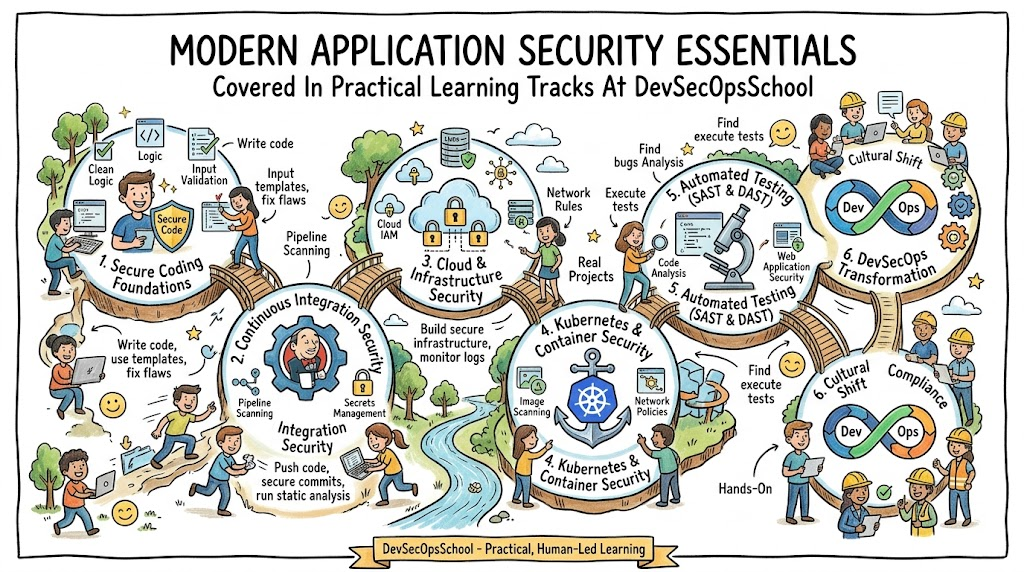
Comprehensive DevSecOps education provides technical professionals with practical, hands-on knowledge required to automate security across modern application development and cloud infrastructure environments. Core learning paths cover the entire software development lifecycle, teaching practitioners how to select, configure, and integrate automated security tools directly into modern deployment pipelines. Key training domains focus on secure coding practices, static and dynamic application testing, open-source dependency analysis, secrets management, infrastructure scanning, container security, cloud policy enforcement, and Kubernetes runtime protection. Mastering these interconnected security domains equips technical teams to protect complex applications, prevent data breaches, lower remediation costs, and satisfy continuous regulatory compliance requirements across diverse multi-cloud environments.
Secure Software Development Lifecycle
The Secure Software Development Lifecycle embeds security controls, threat awareness, and automated testing across every phase of software creation rather than treating security as a post-development audit. During initial planning, teams conduct threat modeling and establish security requirements, which inform system design choices, access control strategies, and data protection mechanisms long before code is written. Throughout the development and build phases, developers utilize automated scanning engines, secure coding patterns, and peer code reviews to intercept logic errors, input validation flaws, and bad practices immediately. Before deployment, automated gates validate compliance, verify infrastructure configurations, and execute runtime vulnerability tests, while post-deployment production monitoring provides continuous operational visibility, anomaly detection, and rapid incident response.
Static Application Security Testing
Static Application Security Testing involves analyzing application source code, binaries, or bytecode for security vulnerabilities, logic flaws, and coding errors without executing the program itself. Integrating SAST scanners directly into integrated development environments and automated CI/CD workflows allows developers to receive instant feedback on security flaws like SQL injections, cross-site scripting, and buffer overflows as code is committed. Professional training programs emphasize proper scanner integration, false-positive tuning, and rule customization using platforms like SonarQube, Semgrep, and Snyk, ensuring scanners provide clear, actionable feedback rather than overwhelming development teams with noise. Learning how to configure SAST engines properly allows teams to fix security bugs within their normal coding routines long before applications reach staging or production environments.
Dynamic Application Security Testing
Dynamic Application Security Testing evaluates a running application from the outside in, simulating real-world external attacks to identify exploitable security vulnerabilities in live environments. Unlike static analysis, DAST analyzes dynamic behavior, authentication mechanisms, session management problems, input validation errors, request handling, and server configuration issues while the application processes actual requests. Integrating automated DAST tools like OWASP ZAP into staging or testing environments enables automated pipelines to launch targeted security scans against functional deployments prior to production releases. Understanding how to configure automated DAST scans within continuous deployment workflows allows security engineers to detect runtime vulnerabilities that static analysis engines cannot spot, validating overall application resilience under simulated attack conditions.
Software Composition Analysis
Software Composition Analysis focuses on identifying, cataloging, and managing security risks associated with third-party open-source libraries, frameworks, and transitive dependencies embedded within modern applications. Since open-source code frequently constitutes the vast majority of modern enterprise software stacks, unmonitored libraries introduce severe software supply chain vulnerabilities, legal licensing compliance issues, and known common vulnerabilities and exposures. Structured training programs teach practitioners how to automate dependency scanning within CI/CD pipelines, generate Software Bills of Materials, evaluate license risks, track transitive dependency trees, and automate version updates. Mastering SCA techniques ensures that engineering teams maintain complete visibility over external software components, allowing rapid remediation when new vulnerabilities are disclosed in popular open-source packages.
Secrets Management
Hardcoding sensitive credentials, API keys, database passwords, encryption keys, or cloud access tokens directly into source code, Git repositories, pipeline scripts, or container configurations introduces catastrophic enterprise security risks. Centralized secrets management solves this exposure by removing credentials from source code repositories and replacing static parameters with dynamic, short-lived tokens retrieved securely at runtime. Utilizing dedicated secrets platforms like HashiCorp Vault allows organizations to enforce fine-grained access control policies, automate dynamic credential generation, manage automatic key rotation, log access requests, and encrypt sensitive configuration variables. DevSecOps engineers implement automated scanning tools to catch accidentally committed secrets instantly while establishing secure injection mechanics that deliver credentials directly into running containers without exposing sensitive data in cleartext formats.
Infrastructure as Code Security
Infrastructure as Code allows engineering teams to provision, manage, and scale cloud networks, virtual machines, storage buckets, and load balancers using declarative configuration files such as Terraform, CloudFormation, or Ansible. However, misconfigured IaC files can automatically deploy dangerously exposed resources, unencrypted storage systems, overly permissive Identity and Access Management policies, and open network security groups across cloud environments. Integrating specialized static analysis scanners like Checkov into pull requests and deployment pipelines allows teams to detect infrastructure misconfigurations before cloud resources are created. Practitioners learn to define policy guardrails, validate encryption defaults, enforce strict networking boundaries, restrict administrative permissions, and automate infrastructure compliance checks, ensuring cloud deployments adhere strictly to enterprise security baselines.
Container Security
Containerization provides lightweight, portable application packaging, but securing containerized environments requires protection across the base operating system, container image build processes, image registries, and container runtime execution. Developers must select minimal, trusted base images, run container processes with non-root privileges, remove unnecessary system packages, strip out unnecessary utilities, and sign images to guarantee integrity. Utilizing automated image scanners like Trivy during CI/CD image builds enables teams to identify vulnerable libraries, unpatched system packages, embedded credentials, and insecure configurations before pushing images to private registries. Securing containers demands distinguishing between static image scanning during build time and active runtime monitoring, ensuring containers operate within strict isolation boundaries and resource limits once deployed.
Kubernetes Security Training
Kubernetes has become the standard platform for orchestrating containerized applications, making specialized Kubernetes Security Training essential for securing cloud-native production environments against complex attack vectors. Managing cluster security requires configuring robust Role-Based Access Control policies to restrict service account and user permissions to strict least-privilege standards. Implementing fine-grained Network Policies ensures network isolation by restricting traffic flows between specific pod namespaces, applications, and external endpoints. Image security policies guarantee that clusters execute only verified, scanned, and digitally signed container images from trusted enterprise registries, while Kubernetes Secrets are stored securely using external secrets operators or envelope encryption mechanisms. Admission Controllers like Validating and Mutating Webhooks inspect deployment requests, blocking non-compliant, privileged, or insecure configurations before they enter the cluster. Continuous runtime security tools monitor running workloads, detecting anomalous system calls, unexpected file modifications, network intrusions, and unauthorized privilege escalations in real time.
Policy as Code
Policy as Code allows engineering teams to define, manage, and enforce compliance, operational, and security guardrails using automated code declarations rather than manual, error-prone auditing procedures. Platforms like Open Policy Agent enable security teams to write clear, version-controlled policy logic that evaluates resource configurations, Kubernetes manifests, IaC templates, and deployment requests automatically. Common policy examples include prohibiting containers from running with root privileges, requiring specific cost-allocation labels on cloud resources, restricting public storage bucket creation, blocking unencrypted database deployments, and enforcing mandatory security scanning checks. Automating policy enforcement across delivery pipelines ensures consistent organizational compliance, prevents security drift, reduces manual governance overhead, and provides clear, immediate feedback to developers when policy checks fail.
DevSecOps and CI/CD Pipeline Security
Integrating automated security controls directly into continuous integration and continuous delivery pipelines ensures every code modification undergoes rigorous validation before reaching production environments. Platforms like Jenkins, GitHub Actions, and GitLab CI act as central orchestration engines, running automated security tests sequentially or in parallel alongside standard software compilation and unit testing workflows. A robust DevSecOps pipeline moves code through structured stages: checking out source code, scanning repositories for secrets, executing static code analysis, auditing open-source dependencies, building container images, scanning container vulnerabilities, verifying infrastructure code, deploying to staging environments, conducting dynamic application security testing, evaluating policy compliance, and deploying to production. Designing clear pipeline stages ensures security testing runs automatically without introducing friction or unnecessary delays into release cycles.
Security Gates and Vulnerability Prioritization
Blindly failing build pipelines for every identified low-severity vulnerability creates friction between security and engineering teams, causing pipeline blockages, developer fatigue, and ignored alerts. Implementing risk-based security gates allows organizations to categorize findings dynamically according to vulnerability severity, exploitability, asset critical nature, enterprise business impact, and exposure levels. Security policies should enforce strict, automated rules that block deployments when critical or high-risk vulnerabilities are detected while generating actionable remediation tracking tickets for medium and low-severity findings.
| Severity | Suggested Response |
| Critical | Stop deployment immediately, block the release pipeline, and assign urgent remediation. |
| High | Block production deployment or require mandatory security lead approval with a temporary exception. |
| Medium | Allow deployment to proceed but generate a tracked remediation task for the next sprint. |
| Low | Track finding in backlog and schedule remediation during routine maintenance cycles. |
| Informational | Log finding for compliance auditing, review periodically, and update baseline rules. |
Configuring flexible, risk-aware security gates maintains developer productivity, focuses engineering effort on urgent threats, and establishes clear operational SLAs for vulnerability remediation.
Cloud Security in DevSecOps
Applying DevSecOps principles across cloud service providers like Amazon Web Services, Microsoft Azure, and Google Cloud Platform requires embedding security automation directly into cloud architecture provisioning and operations. Engineers manage strict Identity and Access Management policies, enforcing least-privilege access, multi-factor authentication, temporary session credentials, and automated permission boundaries across all human and service accounts. Network infrastructure must be segmented using private subnets, security groups, web application firewalls, and restricted ingress policies, while all data at rest and in transit undergoes strong encryption managed by centralized key management services. Comprehensive audit logging, centralized security telemetry, configuration monitoring, and automated threat detection tools track cloud posture continuously, alerting teams to misconfigurations, unauthorized access attempts, or compliance drift across multi-cloud enterprise environments.
DevSecOps Toolchain Overview
A modern DevSecOps toolchain integrates specialized technologies across every layer of the application development lifecycle, cloud infrastructure ecosystem, and continuous deployment pipeline.
| Security Area | Common Technologies |
| CI/CD Orchestration | Jenkins, GitHub Actions, GitLab CI |
| Static Analysis (SAST) | SonarQube, Semgrep |
| Dependency Security (SCA) | Snyk, OWASP Dependency-Check |
| Dynamic Analysis (DAST) | OWASP ZAP |
| Container Scanning | Trivy |
| Infrastructure as Code | Terraform |
| IaC Security | Checkov |
| Secrets Management | HashiCorp Vault |
| Policy as Code | Open Policy Agent (OPA) |
| Container Engine | Docker |
| Orchestration Platform | Kubernetes |
| Cloud Platforms | AWS, Azure, GCP |
Engineers must prioritize underlying security concepts, threat modeling strategies, and architectural principles rather than simply memorizing specific tool commands, ensuring skills remain adaptable as enterprise technologies evolve.
Skills Developed Through DevSecOps Certification Training
Enrolling in comprehensive training programs equips professionals with practical skills required to design, implement, and manage enterprise-grade security automation systems across modern cloud platforms. Practitioners gain hands-on experience building secure CI/CD pipelines, integrating automated SAST, DAST, and SCA scanning engines, and managing centralized vulnerability management platforms. Core technical competencies include container image hardening, Kubernetes RBAC and network policy configuration, secrets management with HashiCorp Vault, and automated Infrastructure as Code scanning using Checkov. Furthermore, professionals master policy-as-code enforcement with Open Policy Agent, cloud security posture management, dynamic credential management, automated compliance validation, and software supply chain protection techniques essential for defending enterprise systems against modern cyber threats.
DevSecOps Engineer Certification and Career Development
Earning a formal certification complements practical engineering experience, proving to prospective employers that a candidate possesses verified skills across security automation, cloud security, and software architecture. Achieving professional certifications, such as becoming a credentialed specialist, demonstrates a comprehensive understanding of integrated engineering security practices rather than isolated tool usage. A well-rounded DevSecOps professional must build core competencies across four key domains:
- Development Skills: Version control mastery with Git, REST API security, microservices architecture, build automation, source control branch strategies, and managing software dependency lifecycles.
- Operations Skills: System administration with Linux, CI/CD pipeline orchestration, container management, Kubernetes cluster administration, infrastructure monitoring, and system metrics logging.
- Cloud Skills: Cloud architecture across AWS, Azure, or GCP, Identity and Access Management, cloud networking, serverless infrastructure, and cloud storage encryption protocols.
- Security Skills: Vulnerability assessment, SAST, DAST, SCA scanning, secrets management, threat modeling, container runtime protection, and automated compliance enforcement.
Combining these four technical domains prepares engineers to architect resilient pipelines, protect enterprise infrastructure, and accelerate career advancement in high-demand technology sectors.
Professionals Who Can Benefit from DevSecOps
Transitioning to integrated security models benefits professionals across diverse technology functions, allowing each role to enhance software quality, system reliability, and overall security posture:
- Developers: Learn secure coding practices, catch code vulnerabilities early in local environments, reduce rework, and fix security flaws within daily development routines.
- DevOps Engineers: Automate security controls within deployment pipelines, implement infrastructure scanning, manage secrets securely, and ensure rapid delivery without compromising compliance.
- Security Engineers: Shift from manual gatekeeping to writing security policy as code, building automated security tooling, and scaling protection mechanisms across engineering teams.
- Cloud Engineers: Provision secure cloud architectures, automate IAM governance, enforce network isolation, and validate infrastructure configurations against industry compliance benchmarks.
- SRE Professionals: Maintain platform reliability by integrating runtime security monitoring, mitigating automated exploit attempts, and ensuring system availability during security incidents.
- Platform Engineers: Build internal developer platforms with embedded security templates, automated pipeline gates, secure base container images, and seamless compliance tooling.
- Kubernetes Professionals: Enforce fine-grained RBAC, manage cluster network isolation, configure admission controllers, manage secrets, and protect container runtimes.
- Architects: Design resilient, defense-in-depth system architectures, integrate security controls across microservices, and manage software supply chain security risks.
- Engineering Managers: Accelerate release frequency, reduce emergency patch overhead, satisfy compliance mandates, and bridge operational silos between development and security teams.
Cross-skilling across these technical disciplines creates collaborative engineering environments where security becomes an automated, continuous component of software delivery excellence.
Individual Training vs Corporate DevSecOps Training
Individual learning paths focus primarily on personal career development, acquiring hands-on tool skills, preparing for professional certifications, and completing practical portfolio projects to demonstrate technical competence to potential employers. Conversely, corporate training initiatives customize educational curricula to address an enterprise’s specific technology stack, internal security policies, existing CI/CD pipelines, multi-cloud architectures, and unique regulatory compliance requirements. Corporate programs emphasize cross-team collaboration, aligning development, DevOps, SRE, and cybersecurity teams around unified security automation workflows, shared metrics, and standardized governance policies. Organizations investing in corporate learning accelerate enterprise-wide security transformations, minimize policy misalignments, reduce software vulnerability remediation times, and foster a mature, security-first engineering culture across all business units.
DevSecOps Online Training
Flexible online training programs offer accessible, high-impact learning experiences tailored for busy professionals and geographically distributed enterprise teams worldwide. Effective online courses feature live, instructor-led lectures combined with hands-on cloud sandbox labs, real-world scenario demonstrations, practical assignments, and end-to-end pipeline security projects. Learners gain direct experience configuring automated tools, troubleshooting broken build pipelines, resolving simulated security incidents, and implementing complex policy-as-code guardrails in live cloud environments. Emphasizing practical, exercise-based learning over passive lecture content ensures participants develop real-world problem-solving skills, operational confidence, and job-ready technical expertise capable of securing modern enterprise application stacks.
DevSecOps Training in India
As global technology firms expand cloud engineering, software development, cybersecurity, and platform engineering operations, specialized security automation education has become increasingly important. Professionals across major IT hubs seek practical training programs covering modern CI/CD security, container security, cloud posture management, and Kubernetes security controls. When evaluating educational options, prospective learners should evaluate programs based on curriculum depth, hands-on lab availability, real-world project scenarios, instructor experience, and alignment with industry certification standards. Choosing rigorous, hands-on learning options equips software professionals to meet growing global enterprise demands for robust software supply chain security and cloud-native protections.
Selecting a DevSecOps Course
Selecting an effective training program requires carefully evaluating course curricula to ensure comprehensive coverage of core security domains, hands-on tools, and modern software delivery principles. An ideal learning path must balance foundational theory with extensive lab exercises, guiding students through practical scenarios rather than superficial tool demonstrations.
- Foundational Security: Fundamentals, threat modeling, secure SDLC principles, and Git repository security.
- Application Security: SAST, DAST, Software Composition Analysis, dependency license checks, and secret scanning.
- Pipeline Integration: Securing Jenkins, GitHub Actions, GitLab CI, and managing risk-based security gates.
- Cloud & Infrastructure: Docker container security, Kubernetes security, Terraform IaC scanning, and cloud IAM governance.
- Automation & Governance: Policy as code with OPA, automated compliance, and software supply chain protection.
Programs emphasizing real-world pipeline design, hands-on lab environments, and practical project execution provide the highest long-term educational value for technical professionals.
Practical Learning vs Tool Memorization
Effective engineering security education prioritizes understanding underlying security concepts, risk evaluation, and control strategies over memorizing specific command-line syntax or tool configurations. Practitioners should approach security through a structured framework: identifying the business or technical risk, defining the appropriate security control, selecting the automation mechanism, implementing the tool, and measuring effective outcomes. For instance, rather than merely memorizing container scanning commands, an engineer must understand why base image vulnerabilities occur, how layers inherit vulnerabilities, how to set policy thresholds, and how to automate container remediation within CI/CD pipelines. Mastering transferable architecture concepts ensures engineers can adapt quickly when enterprise organizations migrate across different cloud providers, scanning platforms, or deployment pipelines.
Important DevSecOps Metrics
Tracking clear performance metrics allows organizations to measure the effectiveness of security automation, identify process bottlenecks, and foster healthy engineering collaboration without creating friction. Useful operational metrics include tracking open critical vulnerability counts, mean time to remediation, vulnerability recurrence rates, the percentage of active repositories covered by automated scanning, and total container images verified. Teams also monitor software dependency vulnerability ratios, policy violations caught pre-deployment, secrets discovered in source control, automated pipeline security build failures, and SLA compliance for patching production issues. Analyzing these metrics objectively helps leadership refine security guardrails, optimize developer workflows, allocate remediation resources effectively, and demonstrate continuous improvement in enterprise security posture over time.
DevSecOps Learning Roadmap
Structured career progression requires mastering software delivery concepts sequentially, building technical expertise across application development, infrastructure management, security controls, and pipeline automation mechanics.
Stage 1 – DevOps Foundations
Master source control management with Git, Linux administration, basic shell scripting, cloud computing fundamentals, container basics with Docker, and continuous integration concepts using Jenkins or GitHub Actions.
Stage 2 – Application Security
Understand common application security risks including OWASP Top 10 vulnerabilities, static code analysis with SonarQube, dynamic application scanning using OWASP ZAP, open-source dependency auditing, and automated secrets scanning.
Stage 3 – Infrastructure Security
Learn container hardening techniques, Kubernetes cluster administration, Network Policy enforcement, RBAC access controls, Infrastructure as Code provisioning with Terraform, IaC scanning using Checkov, and cloud IAM policy design.
Stage 4 – Security Automation
Integrate security scanners into CI/CD pipelines, configure risk-based security build gates, manage dynamic secrets injection with HashiCorp Vault, and build automated end-to-end security delivery pipelines.
Stage 5 – Advanced DevSecOps
Implement Policy as Code using Open Policy Agent, generate Software Bills of Materials, secure software supply chains, automate cloud compliance checks, and implement Kubernetes runtime security monitoring.
Stage 6 – Certification and Projects
Consolidate acquired technical skills by designing end-to-end enterprise portfolio projects, securing multi-service applications, and earning recognized professional certifications to validate career readiness.
DevSecOpsSchool Ecosystem and Learning Pathways
For professionals and enterprise teams seeking structured educational resources, platforms like DevSecOpsSchool.com offer comprehensive training programs covering modern security automation, secure SDLC methodologies, cloud infrastructure protection, and container security. Their educational pathways provide instructor-led courses, hands-on lab environments, interactive troubleshooting scenarios, and project-based learning modules designed around enterprise technology stacks. Offerings include individual career development paths, online instructor-led cohorts, specialized corporate training packages, and certification preparation tracks covering tools like Jenkins, Kubernetes, Terraform, Vault, OPA, and major cloud platforms. Prospective learners should evaluate course curricula, lab infrastructure, trainer expertise, and practical project alignment carefully to ensure selected programs match their specific professional development objectives.
Frequently Asked Questions
1. What is the main difference between DevOps and DevSecOps?
DevOps focuses on automating software delivery and improving collaboration between development and operations teams to accelerate deployment speed. DevSecOps builds directly upon this foundation by integrating automated security checks, policy guardrails, and compliance testing into every stage of the software delivery lifecycle. This shift ensures rapid deployment does not compromise system integrity or cloud infrastructure security.
2. Do I need deep programming experience to learn DevSecOps?
While deep software development expertise is not strictly required, having a solid understanding of basic programming logic, scripting with Python or Bash, and familiarity with Git workflows is highly beneficial. DevSecOps engineers frequently write automation scripts, configure YAML deployment files, analyze static code scanning results, and define security policies as code across continuous integration and delivery pipelines.
3. Which tools should beginners learn first in DevSecOps?
Beginners should start by mastering version control with Git, containerization basics using Docker, and continuous integration pipelines using GitHub Actions or Jenkins. Once foundational pipeline flow is understood, learners can introduce basic security tools such as SonarQube for static application security testing, Trivy for container image scanning, Checkov for infrastructure configuration scanning, and HashiCorp Vault for basic secrets management.
4. How does DevSecOps handle false positives in automated security scans?
Handling false positives requires tuning security scanner rules, defining custom exclusion policies, and configuring risk-aware thresholds based on application context. Security engineers review flagged findings alongside developers, whitelist validated non-issues, update baseline rules, and refine scanner configurations. This ongoing maintenance ensures continuous deployment pipelines provide clear, actionable feedback without stalling delivery or creating developer fatigue.
5. Why is secrets management critical in automated deployment pipelines?
Hardcoding credentials, passwords, or API tokens into source code or pipeline files creates major security risks because exposed secrets can be leaked through version control systems. Centralized secrets management platforms store sensitive credentials securely, dynamic credential generation limits exposure, and automated scanning engines intercept cleartext secrets before code is committed to remote repositories.
6. What is Policy as Code and why is it useful?
Policy as Code involves defining compliance requirements, cloud guardrails, and security rules as declarative code files using tools like Open Policy Agent. This approach enables automated, consistent, and fast policy evaluation across deployment pipelines, Infrastructure as Code scripts, and Kubernetes clusters, ensuring non-compliant resources are blocked automatically before deployment.
7. How long does it take to complete a DevSecOps course?
The duration of a comprehensive training program typically ranges from 6 to 12 weeks, depending on course depth, lab intensity, and weekly commitment hours. Programs structured around live instructor-led sessions, hands-on cloud labs, and practical portfolio projects require consistent study to master interconnected application, container, and cloud security domains thoroughly.
8. Is Kubernetes security training necessary for modern DevSecOps roles?
Yes, because Kubernetes has become the standard platform for orchestrating containerized applications in production cloud environments. Understanding Kubernetes security—including Role-Based Access Control, network segmentation policies, admission controller policies, secrets protection, and container runtime monitoring—is essential for protecting cloud-native application infrastructure against modern attack vectors.
9. What is the role of Software Composition Analysis in supply chain security?
Software Composition Analysis scans applications to identify third-party open-source libraries, track transitive dependencies, detect known vulnerabilities, and flag open-source license risks. SCA helps organizations maintain a complete Software Bill of Materials, mitigating software supply chain risks by ensuring third-party packages are audited and updated promptly when vulnerabilities are discovered.
10. Can non-security professionals transition into a DevSecOps career?
Yes, developers, DevOps engineers, Linux system administrators, cloud engineers, and QA specialists can successfully transition into DevSecOps roles. By building upon existing software delivery or infrastructure experience and acquiring specialized skills in security automation, vulnerability scanning, cloud protection, and policy enforcement, professionals can step into high-demand engineering positions.
11. What is the difference between static and dynamic application security testing?
Static Application Security Testing (SAST) analyzes source code or binaries for vulnerabilities offline without executing the application, identifying issues early in development. Dynamic Application Security Testing (DAST) tests a running application from the outside, simulating external attacks to detect runtime vulnerabilities, authentication issues, and server misconfigurations in live environments.
12. How do enterprise teams benefit from corporate training programs?
Corporate training programs tailor educational content to an organization’s specific technology stack, existing CI/CD pipelines, cloud architectures, and internal security compliance policies. Customized team training aligns developers, DevOps specialists, platform engineers, and cybersecurity staff around standardized automation workflows, improving cross-departmental collaboration and reducing vulnerability remediation times across enterprise projects.
Conclusion
Integrating security directly into modern software delivery pipelines has evolved from an optional operational best practice into a mandatory requirement for managing cloud-native infrastructure, containerized workloads, and rapid continuous deployment workflows. By embedding automated static analysis, dependency scanning, dynamic security testing, secrets management, container protection, and policy-as-code guardrails across development lifecycles, organizations protect applications without sacrificing delivery velocity. Mastering these technical skills enables developers, DevOps specialists, platform engineers, and security professionals to collaborate effectively while reducing enterprise attack surfaces and satisfying complex regulatory mandates. Pursuing structured education, completing hands-on cloud labs, and earning industry credentials provides technical professionals with the practical expertise needed to architect secure, resilient software delivery pipelines across modern multi-cloud environments.
