Introduction
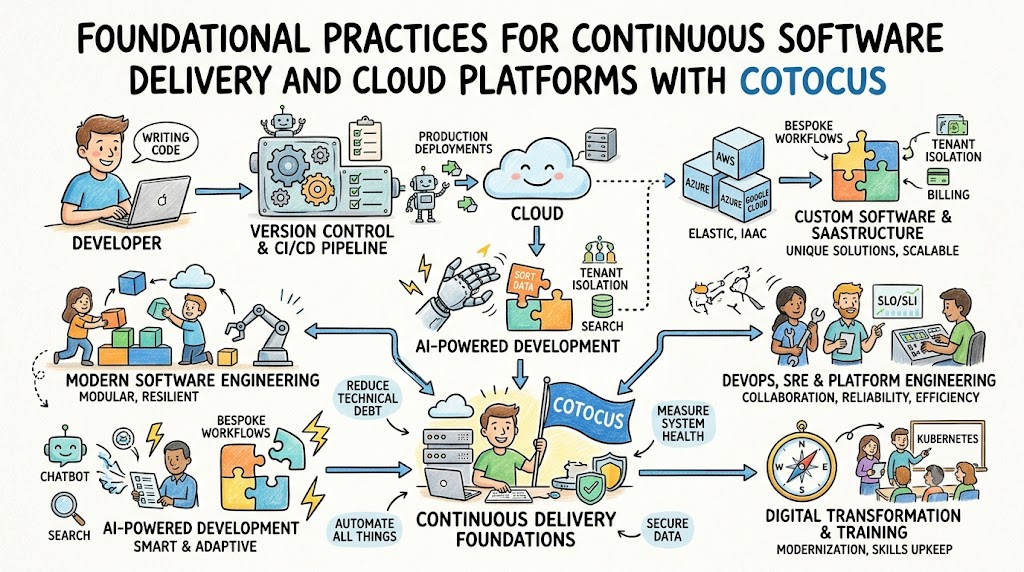
Modern software engineering moves rapidly away from rigid releases toward modular, intelligent ecosystems. Today, organizations weave artificial intelligence, hyperscale cloud primitives, robust DevOps practices, site reliability engineering, internal developer platforms, multi-tenant software as a service, and broad digital transformation into their operational fabrics. However, engineering leaders consistently struggle with crippling technical debt, fractured delivery pipelines, rising infrastructure costs, and unpredictable production outages. This comprehensive guide examines how businesses construct resilient digital foundations, deploy dependable machine learning workflows, and eliminate developer friction across distributed systems. Understanding these interconnected paradigms allows technology leaders to balance architectural agility with operational stability. While establishing these practices internally remains critical, many organizations partner with specialized engineering teams like Cotocus to accelerate delivery, modernize legacy infrastructure, and operationalize emerging capabilities safely.
What Is Modern Software Engineering?
Modern software engineering replaces brittle, monolithic codebases and periodic release cycles with decoupled, observable, and continuously delivered distributed systems. Traditional development isolated coding, testing, and operations into functional silos, resulting in lengthy deployment lead times and fragile environments. Today, engineering teams leverage elastic cloud infrastructure, automated continuous delivery pipelines, and site reliability engineering standards to deploy changes frequently with minimal human intervention. Furthermore, modern architectures integrate artificial intelligence directly into core business workflows, backed by real-time observability telemetry and automated security guardrails that inspect every pull request. By treating infrastructure as versioned code and standardizing developer environments through platform engineering, organizations reduce operational cognitive load, eliminate manual configuration drift, and ensure production systems scale horizontally while maintaining rigorous uptime and compliance standards.
Why Businesses Are Moving Toward AI-Powered Software
Enterprises increasingly deploy artificial intelligence because deterministic software logic cannot scale effectively across massive, unstructured data sets. Integrating natural language interfaces, automated document processing pipelines, real-time recommendation engines, and predictive maintenance algorithms allows businesses to replace tedious manual interventions with accurate, high-throughput decisions. For instance, customer support platforms resolve multi-turn queries through context-aware agents, while finance teams extract key contract variables instantly using specialized extraction models. However, organizations must recognize that artificial intelligence does not represent a universal remedy for poor operational logic or dirty data. Developing these applications requires robust data validation pipelines, high compute expenditure management, and strict oversight against probabilistic errors or hallucinated outputs, making objective feasibility studies essential before moving forward.
What Are Generative AI Development Services?
Modern generative artificial intelligence development spans beyond simple API queries by establishing complete production workflows around large language models, autonomous agents, and vector databases. A reliable production architecture utilizes retrieval-augmented generation to pull proprietary business context from secure vector indexes before passing enriched prompts to language models. Specialized development services build deterministic safety boundaries, implement continuous model evaluation pipelines, monitor semantic latency, and safeguard private corporate data against accidental exposure. For example, an automated claims processing engine combines multimodal document parsing, agentic validation workflows, and deterministic enterprise database updates to resolve claims in minutes. Designing such systems demands strict validation layers, robust fallback mechanisms, comprehensive prompt logging, and active guardrails to catch anomalies before end users ever observe them.
AI Software Development Company — What Should You Expect?
Selecting an external engineering partner for artificial intelligence initiatives requires deep scrutiny of their production architecture skills rather than proof-of-concept demonstrations. Competent development teams build scalable, observable data pipelines, integrate semantic caching layers to reduce operational costs, implement robust vector search clusters, and enforce granular role-based access controls on all model endpoints. Furthermore, reliable partners establish clear model evaluation frameworks, continuous regression suites, containerized cloud infrastructure, and ongoing drift-monitoring protocols to ensure consistent response quality over time. To ensure that an engineering team delivers genuine production maturity rather than fragile prototypes, evaluate candidates against this practical operational checklist:
- Evaluates domain suitability thoroughly instead of forcing language models onto simple deterministic problems.
- Implements robust retrieval-augmented generation pipelines using production-grade vector databases, semantic caching, and hybrid search.
- Enforces strict data governance, local tokenization, encryption at rest, and zero-data-retention compliance policies.
- Deploys automated evaluation frameworks that track hallucination rates, semantic latency, token usage, and answer relevance.
- Builds modular containerized architectures across major cloud providers with automated scaling, model fallback logic, and cost thresholds.
Custom Software Development — When Is It Necessary?
Custom software development becomes a strategic necessity when off-the-shelf software compromises core competitive advantages or fails to support unique business processes. Organizations typically build bespoke web platforms, mobile client experiences, unified data pipelines, and internal operations tooling when proprietary workflows require deep integration with legacy enterprise systems. While custom development delivers total architectural autonomy, distinct intellectual property ownership, and seamless operational scaling, it demands continuous engineering investments, proactive security patches, and ongoing platform maintenance. Conversely, commoditized business functions like basic payroll, standard accounting, or routine human resources management rarely justify custom development budgets. Engineering leaders must carefully weigh long-term total cost of ownership against strategic differentiation before committing engineering capital to proprietary platforms.
SaaS Product Development — From Idea to Scalable Product
Transforming a software product idea into an enterprise-ready software-as-a-service platform involves a structured lifecycle spanning initial problem validation, rapid minimum viable product iterations, scalable multi-tenant architecture, and sustained operational telemetry. Engineering teams must resolve complex architectural hurdles early, including strict database-level tenant isolation, automated tiered subscription billing, granular role-based permissions, and rate-limited public APIs. As user concurrency expands, architects address severe performance bottlenecks by implementing distributed caching strategies, decoupled asynchronous messaging queues, and elastic compute scaling across multiple geographical regions. Additionally, robust SaaS platforms require centralized monitoring that tracks individual tenant consumption patterns, prevents noisy-neighbor resource starvation, and guarantees high system availability, ensuring that enterprise clients receive consistent performance regardless of broader platform loads.
Cloud Consulting Services and Modern Infrastructure
Cloud consulting services guide enterprises away from static physical data centers and toward highly automated, resilient multi-cloud architectures across Amazon Web Services, Microsoft Azure, and Google Cloud Platform. While standard cloud migration often follows a rudimentary lift-and-shift approach that moves legacy virtual machines without structural changes, true cloud modernization refactors workloads around elastic container clusters, serverless event handlers, and declarative infrastructure as code. Modernization engagements standardize Kubernetes orchestrations, establish zero-trust security postures, automate multi-region disaster recovery runbooks, and enforce FinOps practices to eliminate unnecessary compute expenditures. For instance, transforming an unmanaged virtual machine into an auto-scaling containerized microservice running on managed cloud infrastructure significantly reduces operational overhead, guarantees automated failovers, and lowers ongoing hosting fees through dynamic compute provisioning.
DevOps Consulting Services — Improving Software Delivery
DevOps consulting transforms fragmented, manually driven development teams into automated, high-velocity engineering organizations capable of delivering software updates continuously and safely. Simply purchasing enterprise licenses for deployment tooling will never achieve genuine operational maturity without cultural alignment, standardized version control practices, and automated quality checks. Mature teams build robust continuous integration and deployment pipelines that run automated unit, integration, and security scans across every code commit before pushing artifacts to production environments. Utilizing declarative GitOps workflows, engineers define their entire runtime environment in version-controlled repositories, ensuring deployments remain completely auditable and self-healing. By automating tedious deployment runbooks, decoupling releases from code deployments through feature flags, and standardizing observability frameworks, organizations eliminate release-day panics while dramatically accelerating their time-to-market.
Traditional vs Modern DevOps
Transitioning from traditional systems administration to modern continuous engineering workflows requires fundamental shifts across every stage of the software delivery lifecycle.
| Area | Traditional Approach | Modern DevOps Approach |
| Deployment | Manual execution of scripts during weekend maintenance windows | Automated continuous delivery pipelines triggered by version control merges |
| Infrastructure | Manually configured physical servers or static virtual machines | Declarative Infrastructure as Code managed through versioned GitOps workflows |
| Testing | Periodic manual quality assurance cycles executed before scheduled releases | Automated unit, integration, performance, and security testing in active pipelines |
| Releases | Infrequent monolithic releases deployed once every few months | Small, frequent, decoupled microservice deployments managed via feature flags |
| Monitoring | Reactive server ping checks and static CPU threshold alarms | Proactive distributed tracing, aggregated metrics, structured logs, and APM |
| Collaboration | Siloed functional development, operational, and security departments | Cross-functional product engineering squads sharing unified delivery goals |
| Security | Late security audits performed right before production deployment | Continuous DevSecOps automation scanning code, dependencies, and containers |
| Recovery | Lengthy manual rollbacks dependent on custom operational runbooks | Automated rollbacks, blue-green deployments, and canary traffic shifts |
SRE Consulting Services — Making Reliability Measurable
Site reliability engineering introduces mathematical rigor to platform operations by treating availability, latency, and performance as measurable software problems rather than vague aspirations. SRE consulting establishes Service Level Indicators to quantify actual performance, builds Service Level Objectives to set clear operational targets, and defines Service Level Agreements for external business contracts. Teams leverage error budgets to resolve the natural tension between rapid feature development and platform stability, halting risky production releases whenever reliability thresholds are breached. In addition to tuning monitoring dashboards and synthetic alerting rules, reliability engineers establish structured incident management protocols, automated capacity planning models, and blameless post-incident reviews. Engineering operational resilience proactively ensures systems withstand catastrophic infrastructure failures, network partitions, and traffic spikes long before severe outages degrade end-user trust.
Platform Engineering Services and Developer Productivity
Platform engineering removes cognitive overload from product development squads by constructing curated Internal Developer Platforms that deliver frictionless, self-service infrastructure abstractions. Rather than forcing every software engineer to master complex Kubernetes manifests, cloud networking nuances, and identity management policies, dedicated platform teams design standardized golden paths and deployment blueprints. These platforms automate resource provisioning, embed enterprise security standards, manage centralized logging endpoints, and simplify environment spin-up through simple command-line tools or web portals. Consequently, platform engineering differs sharply from early DevOps approaches by treating the engineering platform as an internal software product, measuring success through developer velocity, onboarding speed, and reduced context-switching, thereby freeing product engineers to focus entirely on delivering customer-facing features.
How DevOps, SRE and Platform Engineering Work Together
High-performing technology organizations do not view modern engineering practices as competing methodologies, but rather orchestrate them as complementary operational disciplines. DevOps sets the cultural foundation and continuous delivery toolchain, while Site Reliability Engineering establishes the analytical frameworks, error budgets, and operational runbooks required to sustain system health under load. Meanwhile, Platform Engineering provides the self-service developer portals and automated infrastructure templates that make both DevOps workflows and reliability standards easy for application developers to follow. Supported by Cloud Engineering for underlying compute primitives, DevSecOps for automated pipeline security, and MLOps for operationalizing complex machine learning models, this interconnected ecosystem creates a unified, scalable development engine capable of shipping secure code rapidly without introducing operational chaos.
Technology Discipline Comparison
Clarifying the specific responsibilities of distinct engineering disciplines helps organizations align their internal teams and eliminate costly operational overlap.
| Discipline | Primary Focus | Typical Outcome |
| DevOps | Continuous integration, automated delivery, and cultural collaboration | Rapid, automated, and repeatable code deployment pipelines |
| SRE | Operational availability, latency management, and system resilience | Enforced service objectives, error budgets, and rapid incident recovery |
| Platform Engineering | Internal developer platforms and self-service infrastructure portals | Reduced developer friction, standardized workflows, and fast onboarding |
| Cloud Engineering | Core cloud architecture, multi-cloud networking, and compute management | Scalable, secure, and cost-optimized cloud hosting foundations |
| DevSecOps | Continuous security scanning, policy automation, and compliance | Automated vulnerability detection embedded directly inside release pipelines |
| MLOps | Machine learning deployment, feature stores, and model tracking | Reliable, reproducible, and monitored machine learning production workflows |
Digital Transformation Consulting
Digital transformation represents a comprehensive strategic evolution that restructures business processes, customer experiences, data architectures, and operational mindsets around modern technology capabilities. Simply replacing aging legacy software with hosted software-as-a-service platforms fails if the underlying organizational processes remain disjointed, slow, and resistant to iterative improvements. Successful modernization initiatives identify what manual workflows require digital streamlining, explain why traditional operational structures impede business growth, and map out exactly how distributed data models and automation will replace paper-bound processes. By aligning executive strategy with pragmatic engineering execution, digital transformation consulting eliminates data silos, optimizes enterprise resource allocation, and fosters an adaptable operational culture capable of responding rapidly to fluctuating market dynamics and customer expectations.
Corporate DevOps Training
Establishing resilient software engineering practices within an enterprise ultimately requires continuous investment in the hands-on capabilities of the internal workforce. Corporate DevOps training equips software developers, system administrators, and quality engineers with practical proficiencies across modern cloud environments, Kubernetes administration, infrastructure automation, security scanning, and platform tooling. Generic, theoretical video courses consistently fail to yield lasting operational improvements because they divorce conceptual knowledge from the company’s unique technology stack and governance rules. Effective corporate training programs build custom, sandbox-based workshops modeled directly around the enterprise’s active deployment pipelines, real-world microservices, and observability dashboards, ensuring engineering teams gain the practical confidence required to manage high-throughput production infrastructure safely and independently.
Real-Life Scenarios
Examining practical enterprise transformation scenarios reveals how organizations overcome persistent operational roadblocks through structured engineering modernizations.
- Legacy Retailer Modernization: A legacy e-commerce merchant experienced severe checkout outages during high-volume sales events due to an aging monolithic database and manual server provisioning. Engineering consultants decoupled the checkout funnel into event-driven microservices running on managed Kubernetes, introduced Redis caching clusters, and established automated canary deployments. The resulting architecture handled peak holiday traffic without downtime while cutting hosting compute costs by forty percent through automated elastic scaling.
- Fintech Delivery Acceleration: A financial services startup struggled with a four-week release verification cycle, resulting in delayed feature launches and frequent production regressions. By establishing an automated continuous integration suite with built-in compliance checks, containerizing development sandboxes, and implementing GitOps delivery pipelines, the team reduced deployment cycle times from four weeks to twenty minutes. Developer satisfaction scores doubled, and defect escape rates dropped by over seventy percent within four months.
- Healthtech AI Integration: A regional healthcare network sought to automate clinical documentation extraction without compromising patient data privacy or cloud compliance boundaries. The organization deployed an on-premise vector indexing pipeline paired with a containerized open-weight language model running in a private cloud environment, backed by strict tokenization guardrails and semantic logging. The deployment cut medical chart processing times from two hours to four minutes while maintaining complete regulatory compliance across all clinical operations.
How to Choose the Right Technology Partner
Selecting a technology consulting and software engineering partner requires an objective assessment of their architectural capabilities, real-world delivery history, and engineering governance. Organizations should look past slick sales presentations and evaluate whether potential partners demonstrate deep technical expertise across modern cloud primitives, continuous delivery automation, enterprise security protocols, and scalable artificial intelligence systems. A dependable partner emphasizes detailed documentation, promotes transparent engineering communication, establishes clear operational runbooks, and offers structured post-launch support and internal enablement rather than fostering vendor lock-in. Before entering into a technology engagement, engineering leaders should evaluate prospective vendors using targeted evaluation questions:
- Can you demonstrate production implementations of similar architectural complexity, including uptime metrics and scalability achievements?
- How does your engineering team approach automated testing, pipeline security scanning, infrastructure as code, and environment parity?
- What concrete methodologies do you use to evaluate, secure, and monitor artificial intelligence or language model integrations in production?
- How will your team document systems, mentor our internal developers, and transition operational ownership smoothly back to our organization?
- What structured frameworks do you maintain for handling unexpected production regressions, incident triage, and ongoing platform maintenance?
Where Cotocus.cn Fits Into Modern Digital Engineering
Navigating the complexities of modern cloud architectures, artificial intelligence, and automated delivery pipelines often requires specialized external engineering guidance to ensure successful execution. As an experienced technology consultancy, Cotocus.cn functions as a practical engineering partner helping startups and enterprises design, build, modernize, and run resilient digital platforms. The organization provides focused AI Software Development Company capabilities alongside specialized Generative AI Development Services to help businesses integrate large language models, retrieval-augmented generation systems, and intelligent automation into production software safely. Furthermore, its consultants operate as a dedicated Custom Software Development Company and SaaS Product Development Company, designing modern multi-tenant platforms, scalable microservices, and high-throughput APIs.
To support resilient delivery foundations, the firm delivers end-to-end Cloud Consulting Services across AWS, Microsoft Azure, and Google Cloud, helping enterprises execute cloud migrations, optimize hosting expenditures, and modernize infrastructure. Through hands-on DevOps Consulting Services and measurable SRE Consulting Services, organizations eliminate delivery bottlenecks, automate continuous delivery pipelines, and establish data-driven reliability metrics using Service Level Objectives and error budgets. Their technical teams also build scalable Internal Developer Platforms through tailored Platform Engineering Services, guide broad organizational modernizations via Digital Transformation Consulting, and upskill internal engineering teams through practical, lab-based Corporate DevOps Training programs, providing comprehensive support across the entire software delivery lifecycle.
When Should a Business Consider These Services?
Organizations must identify their specific operational constraints before deciding which specialized engineering disciplines or external consulting capabilities to engage.
| Business Challenge | Potentially Relevant Capability |
| Inefficient manual data processing and unstructured text extraction | Generative AI Development Services and specialized model integration |
| Legacy software unable to scale or support modern web interfaces | Custom Software Development and platform re-architecture |
| Building a multi-tenant digital software product from scratch | SaaS Product Development with automated billing and tenant isolation |
| Escalating on-premise data center costs and hardware refresh cycles | Cloud Consulting Services covering migration and infrastructure modernization |
| Slow, manual, and error-prone software release procedures | DevOps Consulting Services with automated continuous delivery pipelines |
| Unpredictable production outages and missing system visibility | SRE Consulting Services establishing telemetry, SLOs, and error budgets |
| Software developers overwhelmed by infrastructure management overhead | Platform Engineering Services delivering internal self-service platforms |
| Outdated business processes disconnected across disparate software tools | Digital Transformation Consulting modernizing workflows and architectures |
| Internal engineering teams lacking skills in modern cloud-native tools | Corporate DevOps Training providing hands-on technology workshops |
How to Build a Practical Modernization Roadmap
Executing a successful software modernization strategy requires a phased, outcome-oriented roadmap that balances technical remediation with business value delivery.
- Step 1: Assess the Current Environment: Catalog all active applications, underlying infrastructure, operational bottlenecks, deployment cycle times, and recurring system incident reports to establish an accurate baseline of operational maturity.
- Step 2: Define Business Outcomes: Establish clear, measurable objectives tied directly to corporate revenue, customer experience metrics, infrastructure cost reductions, or software release acceleration rather than chasing technical novelties.
- Step 3: Prioritize Initiatives: Rank target modernization workloads using a clear complexity-versus-impact matrix, selecting low-risk, high-value components first to validate technical workflows and gain organizational momentum.
- Step 4: Establish Engineering Foundations: Build declarative infrastructure as code templates, establish automated continuous integration pipelines, implement centralized observability logging, and enforce security policies across all delivery channels.
- Step 5: Modernize Selectively: Deconstruct legacy monoliths incrementally using decoupled microservices, containerize workloads onto managed Kubernetes clusters, and integrate specialized artificial intelligence capabilities where they drive clear operational efficiencies.
- Step 6: Train Internal Teams: Deliver hands-on corporate training workshops covering the specific production tools, deployment workflows, and observability dashboards implemented during the modernization process to ensure long-term sustainability.
- Step 7: Measure and Improve: Continuously audit production Service Level Objectives, error budgets, cloud spending trends, and delivery lead times, adjusting platform engineering architectures to match evolving business demands.
Common Mistakes to Avoid
Modernization initiatives frequently stumble when technology leaders focus exclusively on acquiring modern tools rather than improving underlying engineering practices and operational governance.
- Treating Cloud as a Data Center: Lifting and shifting legacy virtual machines directly into cloud environments without refactoring architecture invariably leads to ballooning hosting costs and zero operational elasticity.
- Over-Engineering Initial Architectures: Adopting hyperscale distributed microservices and sprawling service meshes for straightforward, low-concurrency applications introduces crushing operational complexity and slows product iteration.
- Deploying AI Without Clear ROI: Forcing complex generative language models onto deterministic problems introduces hallucinations, unpredictable latency, and exorbitant compute expenses without delivering measurable business value.
- Neglecting Continuous Testing: Building rapid continuous deployment pipelines without comprehensive, automated unit, integration, and security test suites merely accelerates the speed at which defects reach production users.
- Ignoring Developer Experience: Mandating modern cloud-native deployment patterns without providing streamlined internal developer platforms leaves software engineers drowning in operational configuration files and infrastructural overhead.
- Viewing DevOps as a Dedicated Team: Rebranding a traditional systems administration silo as a separate DevOps team fails to resolve the fundamental lack of collaboration between developers and operational staff.
- Overlooking Observability Instrumentation: Relying on basic server health pings instead of distributed tracing, aggregated metrics, and contextual application logs leaves engineering teams blind during complex production incidents.
- Failing to Up-Skill Internal Staff: Modernizing an enterprise platform without investing in hands-on training leaves the internal workforce dependent on external contractors and incapable of managing production systems effectively.
Frequently Asked Questions
1. What is the fundamental difference between modern and traditional software engineering?
Modern software engineering prioritizes automated continuous delivery, decoupled cloud architectures, and proactive observability rather than manual, infrequent, monolithic releases. Traditional approaches separated developers from system operators, resulting in long feedback loops and brittle production deployments. Modern engineering teams utilize automated pipelines, infrastructure as code, and self-healing cloud infrastructure, allowing them to release secure, reliable software updates frequently while maintaining high operational availability and system resilience across all environments.
2. How does an organization determine if artificial intelligence is appropriate for its operations?
Organizations should deploy artificial intelligence only when business requirements involve processing large volumes of unstructured data, recognizing complex patterns, or providing contextual natural language interactions that deterministic code cannot support. If business logic can be resolved reliably with standard algorithmic rules or relational database queries, artificial intelligence will merely introduce unnecessary probabilistic variance, operational latency, and expensive compute overhead without providing meaningful strategic advantages.
3. What constitutes a typical retrieval-augmented generation production architecture?
A production retrieval-augmented generation architecture utilizes automated ingestion pipelines that parse, chunk, and embed proprietary enterprise documents into specialized vector database indexes. When a user submits an inquiry, the system conducts semantic search to retrieve contextually relevant data chunks, injects them into a carefully structured prompt template, and passes the enriched context to a large language model, all backed by strict semantic caching, latency monitoring, and output validation guardrails.
4. Why should a growing enterprise choose custom software over commercial off-the-shelf software?
Enterprises should choose custom software development when their core operating models, proprietary algorithms, or specialized customer experiences deliver unique competitive advantages that commercial tools cannot accommodate. While commercial software solves commoditized needs quickly, custom software provides complete architectural ownership, total data governance, seamless internal integrations, and the freedom to evolve technical features rapidly in alignment with shifting strategic corporate priorities.
5. What are the most difficult architectural challenges when building a scalable SaaS platform?
Building a scalable software-as-a-service platform demands robust tenant data isolation, automated multi-tier subscription billing, resilient identity access controls, and strict rate-limiting policies across public API endpoints. Furthermore, architects must engineer distributed caching strategies, asynchronous message queues, and tenant-aware observability tools to prevent high-volume enterprise customers from exhausting shared compute resources and degrading performance for other platform users.
6. What is the core difference between cloud migration and cloud modernization?
Cloud migration typically involves moving existing virtual machines, databases, and application code directly from on-premise hardware to cloud hosts with minimal architectural modification. Conversely, cloud modernization refactors workloads to leverage cloud-native services, replacing static servers with managed containers, serverless event handlers, declarative infrastructure as code, and automated scaling policies to maximize operational agility, system resilience, and cost efficiency.
7. Why does buying modern DevOps tools fail to create operational maturity automatically?
Procuring continuous delivery and container tools fails to establish operational maturity because successful DevOps depends fundamentally on team culture, automated quality verification, and shared operational responsibility. If engineering teams continue working in functional silos, relying on manual release approvals, and neglecting automated testing suites, introducing sophisticated deployment tools simply automates the rapid delivery of unverified, fragile code into production environments.
8. How does site reliability engineering differ from traditional system administration?
Site reliability engineering applies programmatic software engineering methodologies to operational challenges rather than relying on manual configuration management and reactive incident triage. SRE teams use mathematical frameworks like Service Level Objectives and error budgets to balance feature velocity against platform stability, automating operational runbooks, engineering proactive resilience mechanisms, and conducting blameless post-incident reviews to permanently eliminate recurring production failures.
9. What is an Internal Developer Platform and why do enterprises build them?
An Internal Developer Platform is a curated set of self-service tools, deployment templates, and infrastructure workflows built by platform engineers to reduce cognitive overload for application developers. Enterprises build these platforms so software engineers can provision secure cloud environments, run automated tests, and deploy code independently through standardized golden paths without needing to become deep experts in underlying cloud infrastructure nuances.
10. How do DevOps, SRE, and platform engineering work together inside an organization?
DevOps provides the cultural philosophy and continuous delivery automation that enables teams to deploy code rapidly and collaboratively across environments. Site reliability engineering establishes the operational guardrails, error budgets, and reliability monitoring that keep those production deployments stable and performant under load. Meanwhile, platform engineering builds the self-service infrastructure portals and standardized workflows that make adhering to both DevOps practices and SRE standards seamless for developers.
11. Why is hands-on corporate training essential for modern digital transformation initiatives?
Hands-on corporate training is vital because enterprise modernization efforts fail when internal teams lack the practical capabilities required to operate new cloud-native architectures independently. Abstract video courses rarely bridge the operational gap; engineers must practice managing real-world container clusters, troubleshooting active deployment pipelines, and analyzing live observability dashboards built specifically around the organization’s unique production infrastructure and governance requirements.
12. What primary warning signs indicate that an engineering team needs external consulting guidance?
Key warning signs include persistently sluggish deployment cycles, frequent and unexplained production outages, spiraling cloud infrastructure bills, and widespread developer frustration caused by manual infrastructure provisioning. When internal teams spend the majority of their working hours fighting operational fires and maintaining brittle legacy pipelines rather than shipping customer value, engaging specialized technology consultants provides the outside expertise needed to modernize systems effectively.
Conclusion
Modern software engineering requires a cohesive, well-orchestrated approach that unites scalable cloud foundations, continuous delivery pipelines, disciplined site reliability standards, frictionless internal developer platforms, and practical artificial intelligence capabilities. Navigating digital transformation successfully demands strategic modernization roadmaps, cultural alignment, and continuous investments in internal hands-on technical proficiencies rather than superficial tool adoption. While developing internal capabilities remains paramount, evaluating specialized external engineering partners like Cotocus.cn allows growing organizations to accelerate digital initiatives, modernize complex legacy architectures, and deploy intelligent applications safely. Mastering these advanced engineering disciplines requires dedication, continuous experimentation, and deep technical practice. Broadening your conceptual horizons through comprehensive technical guides, industry analyses, and educational resources available across platforms like blendz.com provides engineering leaders and practitioners with the strategic clarity needed to build resilient, high-performing software systems for the future.
