Introduction
Modern software delivery continues to grow increasingly complex as businesses transition away from monolithic architectures toward distributed, multi-cloud platforms. Consequently, engineering teams frequently encounter friction from manual infrastructure provisioning, fragmented deployment pipelines, unaddressed security vulnerabilities, and unpredictable production outages. Addressing these systemic obstacles requires holistic DevOps Consulting Services rather than piecemeal tool adoptions or isolated automation scripts. Effective organizational transformation aligns cross-functional engineering teams, modernizes workflows, embeds governance, and measures throughput alongside system reliability. Through balanced, end-to-end guidance across infrastructure, container orchestration, and continuous compliance, organizations partner with specialized practitioners like Cotocus to systematically transform fragile release mechanisms into resilient, high-velocity software delivery engines that support sustainable business growth.
What Are DevOps Consulting Services?
Professional DevOps consulting evaluates your entire value stream rather than simply installing popular open-source utilities or pushing scripts into repositories. Experienced consultants analyze your organization’s delivery pipelines, cloud footprints, release schedules, and system observability to identify the true root causes of organizational friction. For example, an engineering group might request automated testing to solve slow delivery cycles, yet an objective assessment reveals that manual approval gates and non-standard staging environments are actually delaying deployments by weeks. Typical consulting outcomes involve establishing declarative Infrastructure as Code, modernizing cloud and container runtimes, embedding automated security controls, refining release processes, and elevating developer experience. Ultimately, these targeted improvements allow your teams to release code with confidence while maintaining robust platform reliability.
Why Do Businesses Need DevOps Consulting?
Enterprises routinely face delivery roadblocks that stifle developer productivity, strain internal budgets, and introduce operational instability across production systems. When organizations lack standardized workflows, these common enterprise delivery challenges inevitably emerge:
- Manual deployments that introduce human error and trigger costly production rollbacks.
- Slow release cycles that prevent features from reaching users in a timely manner.
- Infrastructure drift between staging and production due to manual server configurations.
- Fragmented observability that delays incident response and obscures application bottlenecks.
- Security checks treated as late-stage gates, causing significant pre-release redesigns.
- Runaway cloud costs resulting from untracked resource provisioning and architectural sprawl.
- Kubernetes architectural complexity overwhelming internal operations and engineering squads.
- Critical internal skills shortages across cloud engineering, reliability, and containerization.
- Unstable application uptime caused by reactive operations lacking automated failover.
- Tool sprawl with redundant utilities complicating workflows and inflating enterprise licensing.
Specialized advisory engagements eliminate these operational silos, establishing uniform delivery baselines that align daily engineering efforts directly with core business objectives.
How Does a DevOps Consulting Engagement Work?
Structured advisory engagements adhere to an iterative lifecycle designed to replace operational guesswork with measurable platform outcomes.
Assess the Current Environment
Consultants initiate the engagement by thoroughly analyzing your existing source repositories, deployment pipelines, cloud environments, and team workflows. This comprehensive review highlights operational waste, architectural risks, and tooling disconnects across your entire engineering delivery chain.
Identify Delivery Bottlenecks
After mapping the end-to-end value stream, specialists pinpoint specific structural bottlenecks that artificially slow code flow from developer workstations to production. Identifying whether release delays stem from manual QA handoffs, fragile build configurations, or inconsistent target environments allows teams to target solutions accurately.
Create a DevOps Roadmap
Consultants construct an actionable, phased blueprint outlining prioritized architectural interventions, tooling standardizations, and workflow refactoring milestones. This practical roadmap correlates target outcomes directly with key delivery indicators, including deployment frequency, lead time for changes, change failure rate, and mean time to recovery.
Implement Improvements
Engineers and consultants work side-by-side to construct declarative infrastructure pipelines, automate verification gates, containerize services, and configure native cloud architectures. This hands-on implementation phase standardizes development environments, reduces build durations, and enforces consistent deployment behaviors across every tier.
Measure Results
The final phase evaluates platform performance against initial delivery metrics to ensure automation efforts produce tangible, sustainable organizational value. Teams track reductions in provisioning times, observe drop-offs in production incident rates, and establish continuous feedback loops that sustain technical excellence over the long term.
Managed DevOps Services: What Do They Cover?
While strategic consulting engagements identify and implement foundational platform upgrades, ongoing operations often demand round-the-clock administration that internal squads cannot sustain alone. Managed DevOps Services provide dedicated, 24/7 technical oversight across cloud infrastructures, deployment mechanisms, and runtime platforms to prevent regressions and maintain optimum platform health. By offloading routine pipeline maintenance, configuration patches, vulnerability tracking, and real-time incident resolution to external platform operations teams, internal software engineers remain entirely focused on developing customer-facing product features.
| Area | Typical Responsibility |
| CI/CD | Pipeline maintenance, automated runner patching, build optimization, and failed pipeline remediation. |
| Infrastructure | Declarative IaC management, capacity provisioning, drift detection, and baseline configuration enforcement. |
| Monitoring | Telemetry stack administration, synthetic probe execution, alert rule tuning, and dashboard maintenance. |
| Deployment | Canary rollout supervision, automated rollback orchestration, and zero-downtime release coordination. |
| Cloud | Multi-cloud resource optimization, IAM role management, security group updates, and networking checks. |
| Incident Response | 24/7 production triage, on-call support, root cause investigation, and blameless post-mortem execution. |
| Automation | Routine operational scripting, automated backup verification, node rotation, and environment provisioning. |
| Security | Automated vulnerability patching, continuous dependency updates, and secret rotation management. |
Cloud Consulting Services: Building the Right Foundation
Strategic cloud consulting ensures enterprise architectures deployed across AWS, Microsoft Azure, or Google Cloud actively advance operational efficiency rather than merely shifting infrastructure costs. Decoupled microservices, zero-trust Identity and Access Management, unified network topologies, and Infrastructure as Code require thorough architectural design before migrating substantial workloads. What business outcome should the cloud architecture improve? A resilient cloud footprint must tangibly improve operational resilience, lower mean time to recovery during zone disruptions, and maintain strict governance while reducing unallocated computing expenses. Through comprehensive Cloud Consulting Services, enterprises align their compute, storage, and networking layers with predictable scaling models that maintain governance, enforce compliance, and protect business continuity.
Cloud Migration Services: Moving Without Creating New Problems
Executing an infrastructure migration requires a rigorous, phased strategy that prevents unexpected downtime and avoids transferring legacy technical debt into the cloud. Organizations must execute comprehensive application discovery, map intricate service dependencies, classify enterprise workloads, and establish a secure target landing zone before migrating data assets. Teams traditionally select from three core migration strategies based on technical dependencies and time-to-market constraints:
- Rehosting: Moving virtualized workloads directly to cloud instances with minimal changes, suited for rapid data center evacuations.
- Replatforming: Modernizing specific runtime components, such as adopting managed cloud databases, without modifying underlying application logic.
- Refactoring: Redesigning application code into cloud-native microservices to maximize cloud scalability, resilience, and operational efficiency.
By pairing meticulous data replication with automated validation testing and structured cutover windows, professional Cloud Migration Services safeguard business-critical operations throughout the modernization journey.
Real-Life Cloud Migration Scenario
An enterprise financial services company operated a monolithic transaction processing platform inside a private data center facing impending hardware lease expirations. The core application suffered from unpredictable batch execution delays, while manual server patching regularly forced extended operational maintenance windows outside business hours. An engineering audit revealed tight database coupling, untracked network dependencies, and unmanaged file stores spread haphazardly across disparate local drives. Consultants opted for a replatforming strategy, migrating legacy databases to managed cloud instances and refactoring static file stores to encrypted cloud object storage while keeping application logic intact. The resulting cutover completed during a planned weekend maintenance window, immediately lowering computing overhead by 32% and eliminating operational panics during end-of-month financial processing.
Kubernetes Consulting Services: Managing Containers at Scale
Adopting container orchestration platforms such as Amazon EKS, Azure AKS, or Google Cloud GKE provides significant architectural agility, yet running Kubernetes in enterprise production environments introduces substantial operational complexity. Enterprises should adopt Kubernetes when managing distributed microservices that demand automated bin-packing, fine-grained horizontal autoscaling, dynamic service discovery, and declarative rollouts; simple monolithic workloads often operate more reliably on serverless or managed container runtimes. Through targeted Kubernetes Consulting Services, organizations establish scalable cluster architectures, robust ingress networking, persistent storage integrations, and hardened RBAC policies. Emphasizing operational simplicity over tool popularity guarantees that your Kubernetes deployment provides genuine operational efficiency, streamlined cluster monitoring, and controlled compute expenditure without overwhelming administrative teams.
DevSecOps Consulting Services: Making Security Part of Delivery
Traditional security models that evaluate software exclusively at the conclusion of development cycles consistently delay releases and force expensive architectural remediations right before launch. Implementing DevSecOps Consulting Services introduces shift-left principles, integrating security validation directly into source repositories and automated deployment pipelines. Security automation scans software dependencies for known vulnerabilities, verifies container image layers, flags hardcoded credentials, and validates cloud infrastructure against declarative compliance baselines before provisioning. By implementing automated policy enforcement within CI/CD workflows, developers receive contextual security feedback directly within their existing development environments, securing production environments while maintaining rapid delivery velocity.
SRE Consulting Services: Improving Reliability
Site Reliability Engineering applies software engineering principles directly to operational challenges, replacing subjective availability debates with data-driven service metrics. By defining precise Service Level Indicators and manageable Service Level Objectives, cross-functional teams establish shared error budgets that balance rapid feature releases against baseline system stability. Consider an e-commerce platform that repeatedly suffers cascading microservice outages during high-volume sales campaigns. Rather than simply provisioning larger virtual machines, SRE specialists implement automated circuit breakers, distributed tracing, and real-time bottleneck detection to prevent resource exhaustion across downstream dependencies. Through specialized SRE Consulting Services, enterprises build automated failover routines, maintain actionable telemetry dashboards, streamline incident response management, and prevent recurring operational failures.
Platform Engineering Consulting Services
Platform engineering reduces developer cognitive load by providing standardized internal developer platforms and reusable self-service workflows that abstract underlying cloud infrastructure. Rather than forcing individual application developers to configure intricate cloud networking rules, Kubernetes manifests, and IAM permissions, platform teams build structured “golden paths” that encapsulate enterprise architectural best practices. For example, a software engineer can provision a fully compliant, containerized development environment—complete with database connectivity, pipeline automation, and telemetry endpoints—using a simple declarative configuration file. Investing in Platform Engineering Consulting Services establishes uniform delivery standards, reinforces infrastructure security guardrails, and substantially accelerates software onboarding across enterprise engineering teams.
Corporate DevOps Training
Building resilient cloud-native platforms requires developing internal technical capabilities to operate, maintain, and evolve newly implemented automation over time. Comprehensive Corporate DevOps Training bridges operational skills gaps by combining hands-on laboratory exercises, architectural design workshops, and practical troubleshooting drills centered on your organization’s specific technical ecosystem. Training modules cover end-to-end continuous delivery, cloud infrastructure automation, Kubernetes administration, DevSecOps compliance, and Site Reliability Engineering practices. Grounding curricula in actual business scenarios and enterprise toolchains ensures internal engineering teams acquire the practical competencies necessary to sustain continuous modernization independently.
Comparison of DevOps Services
Selecting the appropriate engagement model depends entirely on your current operational maturity, organizational bottlenecks, and technical goals.
| Service | Primary Goal | Best Suited For |
| DevOps Consulting Services | Value stream optimization, pipeline automation, and delivery strategy. | Organizations facing slow releases and unstandardized delivery pipelines. |
| Managed DevOps Services | 24/7 infrastructure oversight, pipeline support, and incident mitigation. | Teams seeking dedicated platform maintenance to focus on product code. |
| Cloud Consulting Services | Secure, scalable, and cost-effective multi-cloud architecture design. | Businesses adopting AWS, Azure, or GCP requiring foundational governance. |
| Cloud Migration Services | Seamless workload migration from on-premise setups to the cloud. | Enterprises decommissioning data centers and migrating legacy monoliths. |
| Kubernetes Consulting Services | Cluster deployment, workload orchestration, and runtime optimization. | Organizations running distributed microservices needing container scale. |
| DevSecOps Consulting Services | Embedding automated security, policy, and compliance into pipelines. | Regulated companies aiming to remediate vulnerabilities early in delivery. |
| SRE Consulting Services | Availability engineering, observability, SLOs, and incident workflows. | Systems experiencing production instability, outages, or scaling friction. |
| Platform Engineering Consulting Services | Internal developer platforms and standardized self-service golden paths. | Growing engineering organizations struggling with developer cognitive load. |
| DevOps Outsourcing Services | Scaling technical delivery with dedicated engineering capacity. | Companies requiring immediate access to senior DevOps and cloud talent. |
| Corporate DevOps Training | Upskilling internal staff through hands-on technical labs and scenarios. | Enterprises modernizing legacy development and operations workforces. |
How to Choose the Right DevOps Approach
Organizations rarely require every modernization service simultaneously, meaning leadership must prioritize initiatives based on immediate operational vulnerabilities, team capabilities, and strategic timelines. Start by auditing your primary operational bottlenecks to guide your technical roadmap:
- Address manual deployments and inconsistent builds by prioritizing CI/CD pipeline automation and foundational DevOps consulting.
- Guide greenfield deployments or cloud expansions by engaging cloud architecture consulting to establish compliant landing zones.
- Decommission physical data centers or aging private clouds through structured cloud migration frameworks.
- Resolve container scaling issues and configuration sprawl by engaging targeted Kubernetes consulting.
- Eliminate late-stage compliance hold-ups by shifting security left through DevSecOps automation.
- Combat frequent production outages and inconsistent alerting through targeted Site Reliability Engineering practices.
- Remove developer onboarding friction and environmental delays by building internal platform self-service capabilities.
- Solve critical internal staffing shortages by leveraging specialized DevOps Outsourcing Services or targeted workforce training.
Balancing engineering complexity, existing risk profiles, and internal budget parameters ensures that platform modernizations consistently deliver tangible, long-term business value.
About Cotocus
Cotocus delivers vendor-neutral advisory, modernization, and operational engineering support designed to help organizations build resilient, automated delivery platforms across complex cloud ecosystems. The firm assists businesses across varied maturity stages by delivering high-impact DevOps advisory, enterprise cloud architecture design, production Kubernetes orchestration, DevSecOps pipeline automation, and Site Reliability Engineering. Organizations requiring day-to-day platform oversight benefit from proactive managed operations, while companies scaling internal engineering throughput leverage specialized outsourcing and role-based enterprise training programs. Rather than promoting rigid tooling paradigms, the team focuses on practical value-stream optimization, helping technical leaders lower operational risk and accelerate digital transformation.
What Should a Business Expect From a DevOps Roadmap?
A comprehensive modernization roadmap connects low-level technical interventions with transparent, high-level business indicators to justify platform investments and maintain engineering alignment.
| Business Challenge | Technical Response | Potential Measurement |
| Slow releases | Standardize automated CI/CD pipelines and deployment runners. | Lead time for changes reduced from weeks to hours. |
| Frequent outages | Implement SRE observability, synthetic testing, and SLO thresholds. | Production availability improved to 99.95% uptime. |
| Manual infrastructure | Introduce declarative Infrastructure as Code using Terraform or OpenTofu. | Environment provisioning duration cut by over 80%. |
| Security delays | Embed automated SAST, DAST, and container vulnerability scanning. | Pre-release security review backlogs eliminated. |
| Cloud complexity | Rationalize cloud resource utilization and re-architect landing zones. | Monthly cloud infrastructure spend reduced by 25%. |
| Developer bottlenecks | Establish an Internal Developer Platform with automated self-service. | New engineer environment onboarding reduced to one day. |
| Skills shortages | Augment delivery capacity through specialized technical training. | Internal velocity and ticket resolution rates doubled. |
| Container complexity | Deploy managed Kubernetes clusters with GitOps delivery patterns. | Failed deployment rollbacks automated to zero downtime. |
Tracking these key metrics guarantees that software delivery improvements deliver clear, measurable financial and operational advantages.
Real-Life Scenarios / Experiences
A mid-sized healthcare organization suffered multi-hour delays releasing critical patient portal features because testing procedures required manual deployment across shared staging virtual machines. Engineers frequently overwritten each other’s configurations, producing phantom bugs that derailed release schedules. Consulting engineers introduced containerization alongside automated ephemeral environments, allowing the CI/CD pipeline to provision isolated staging environments for every pull request automatically. This single intervention eradicated configuration conflicts, lowered testing wait times by 65%, and enabled developers to release incremental application enhancements multiple times per week.
A digital retail platform experienced severe database timeouts and cascading API failures during recurring promotional flash sales, directly impacting platform revenue and user trust. The operations team had historically reacted by manually resizing backend cloud instances, which ballooned infrastructure spending without solving the underlying performance issues. SRE consultants conducted traffic analysis, uncovering an unthrottled search microservice that overwhelmed downstream cache layers during traffic spikes. By introducing distributed caching tiers, establishing strict rate-limiting policies, and configuring horizontal pod autoscaling, the platform handled holiday shopping traffic surges seamlessly without service degradation.
An enterprise software company managing dozens of customer-facing applications struggled with severe tool fragmentation, running four distinct CI engines and disparate monitoring dashboards across business units. This excessive sprawl made cross-team engineer transfers exceptionally difficult, inflated enterprise software licensing expenses, and left critical security patches unapplied across neglected repositories. The leadership team sponsored a unified platform engineering initiative that consolidated CI/CD operations onto a standardized platform featuring pre-approved deployment pipelines. This consolidation reduced tooling license overhead by 40% while establishing consistent security and compliance baselines across the organization’s entire software portfolio.
Common Mistakes to Avoid
Enterprise digital transformation initiatives frequently stumble when organizations treat methodology changes as simple tool purchases without adjusting broader engineering practices:
- Adopting complex tools like Kubernetes or service meshes because of industry hype rather than actual architectural necessity.
- Automating fundamentally broken, unstandardized deployment processes, which merely accelerates the delivery of configuration errors.
- Treating cultural transformation as a secondary concern, allowing traditional departmental walls between development and operations to persist.
- Neglecting continuous security integration until late in the delivery cycle, recreating pre-release validation bottlenecks.
- Focusing exclusively on deployment velocity while ignoring critical production observability, system reliability, and error budgets.
- Building internal developer platforms without gathering direct feedback from software development teams, leading to poor internal adoption.
- Overlooking routine cloud cost governance, which results in unmanaged cloud resource sprawl and inflated operating expenses.
- Failing to invest in continuous internal workforce training, leaving teams unable to operate newly implemented platforms independently.
Avoiding these common implementation pitfalls ensures that your modernization investments deliver resilient, scalable, and sustainable infrastructure operations.
How Do DevOps, Cloud, Kubernetes, and SRE Work Together?
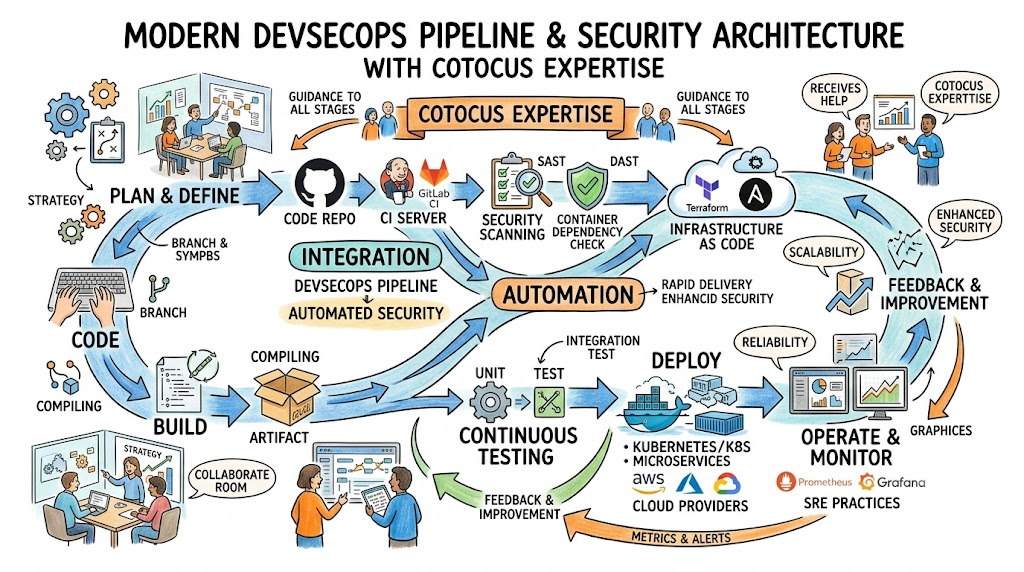
Modern software engineering achieves maximum operational velocity when DevOps, cloud platforms, Kubernetes, and Site Reliability Engineering operate as an integrated platform ecosystem rather than isolated practices. Cloud providers deliver the scalable infrastructure backbone, while Infrastructure as Code frameworks codify and provision these environments predictably. Kubernetes provides the declarative container orchestration layer that runs on this elastic cloud foundation, standardizing application lifecycles and workload placement. Simultaneously, DevOps practices automate the continuous testing and delivery of containerized software into these orchestration clusters. Finally, SRE practices oversee this entire operating environment, applying objective telemetry, error budgets, and automated incident recovery mechanisms to safeguard production availability while engineering teams release updates at pace.
How Can Cotocus Support Your Modern Engineering Journey?
Navigating enterprise modernization requires seasoned architectural leadership capable of translating technical investments into sustainable business performance. Whether your organization requires end-to-end consulting to overcome delivery bottlenecks, specialized cloud migration execution, Kubernetes cluster hardening, or comprehensive DevSecOps pipeline automation, experienced consultants provide the objective technical expertise necessary to deliver results. Leveraging external expertise provides your team with battle-tested architectures, accelerates platform maturity, and avoids expensive architectural missteps. By uniting strategic consulting with continuous operational support and targeted workforce upskilling, your engineering teams build the modern operational foundations needed to compete effectively in today’s digital landscape.
Frequently Asked Questions
1. What is the difference between DevOps consulting and managed services?
DevOps consulting assesses workflows, designs architectures, and implements modern tooling to improve delivery pipelines, whereas managed services provide continuous, 24/7 technical oversight across cloud platforms, infrastructure operations, and production incident response.
2. How long does a typical consulting engagement take to deliver results?
Initial discovery assessments and strategic roadmap creation usually require two to four weeks, while core architectural improvements and automated pipeline implementations typically deliver measurable operational milestones within three to six months.
3. When should an enterprise migrate to Kubernetes?
Organizations should adopt Kubernetes when managing distributed microservices that require automated scaling, self-healing capabilities, and dynamic service discovery; simpler monolithic applications often run more cost-effectively on serverless or managed container runtimes.
4. How does DevSecOps avoid slowing down development velocity?
DevSecOps embeds automated vulnerability scanning, container inspection, and configuration checks directly into existing CI/CD pipelines, providing developers with immediate remediation feedback without forcing manual security approvals before every production release.
5. Why are Service Level Objectives important in SRE?
Service Level Objectives define clear reliability thresholds that align business priorities with engineering efforts, using error budgets to balance rapid feature releases against the system availability required to maintain customer satisfaction.
6. What core benefit does platform engineering provide developers?
Platform engineering reduces developer cognitive load by providing standardized internal developer portals and automated self-service golden paths, allowing engineers to provision compliant development environments without manually configuring complex underlying cloud infrastructure.
7. How does Infrastructure as Code prevent environment drift?
Infrastructure as Code defines operational environments within version-controlled configuration files, ensuring every staging and production environment is provisioned identically and preventing manual configuration modifications from destabilizing systems.
8. What metrics best track modern software delivery improvement?
Engineering teams evaluate delivery performance using core metrics: deployment frequency, lead time for changes, change failure rate, and mean time to recovery, combined with application availability and infrastructure provisioning duration.
9. When does outsourcing technical operations make business sense?
Outsourcing operations is ideal when internal teams face critical cloud engineering skills shortages, need immediate operational scaling, or want dedicated external platform support so developers can focus entirely on customer-facing features.
10. Can legacy applications migrate directly to the cloud?
Legacy systems can migrate directly to the cloud via rehosting, though achieving optimal scalability and operational cost efficiency typically requires replatforming databases or refactoring monolithic architectures into containerized services.
11. How does practical workforce training accelerate digital transformation?
Hands-on training grounded in an organization’s specific technical ecosystem equips internal engineering teams with the practical skills required to manage, optimize, and evolve newly implemented cloud-native automation independently.
12. How does automated continuous delivery reduce release risk?
Automated continuous delivery validates application code through comprehensive testing gates and deploys small, incremental changes using canary or blue-green strategies, significantly reducing blast radiuses and simplifying automated rollbacks.
Conclusion
Modernizing enterprise software delivery requires a balanced, continuous commitment across culture, process automation, cloud architecture, container management, and system reliability engineering. Navigating this operational evolution successfully demands that engineering teams pair modern architectural foundations with disciplined execution and regular operational practice across all tiers. Leveraging technical ebooks, architectural reference designs, and structured learning resources supports engineering organizations as they master emerging cloud-native delivery paradigms. Sustaining a competitive technical advantage ultimately depends on an organization’s dedication to continuous learning, iterative platform optimization, and the relentless elimination of operational friction.
