Introduction
Most mainstream vacation destinations greet travelers with commercial frenzy, rushed queues, and standardized hotel corridors that dilute regional character. Lucknow welcomes you with an entirely different rhythm—an unhurried, graceful cadence born from centuries of Awadhi courtliness, architectural wonder, and artisanal devotion. Walking through its historic lanes feels less like sightseeing and more like entering an intimate cultural dialogue where every sensory detail matters.
Preparing for this city demands thoughtful preparation. Packing for Lucknow is not merely about stuffing clothes into a suitcase; it requires balancing modest cultural etiquette, extreme seasonal weather shifts, and substantial footwork across historic cobblestones and sprawling heritage grounds. When your luggage matches the city’s unique landscape, you move seamlessly from sacred sanctums and bustling spice markets to tranquil riverside parks.
Why Lucknow is a must-visit city
Lucknow anchors the heart of Uttar Pradesh as an intellectual, architectural, and culinary powerhouse that bridges medieval finesse with dynamic modern expansion. As the historic seat of the Nawabs of Awadh, the city cultivated an extraordinary synthesis of Persian, Mughal, and regional Indian aesthetics. Geographically situated along the Gomti River, it represents an essential chapter of northern Indian heritage that provides authentic encounters far removed from commercialized tourist circuits.
The city offers exceptional connectivity for all traveler profiles, featuring the modern Chaudhary Charan Singh International Airport, the Charbagh Railway hub, and rapid expressways linking it to Delhi, Agra, and Varanasi. Inside the city, an ultra-clean metro network connects older quarters with the contemporary business districts.
The core travel circuit transitions smoothly from the storied grandeur of Old Lucknow (Hussainabad and Chowk) through the colonial arcades of Hazratganj, reaching the green expanses of Gomti Nagar.
| Key Fact | Travel Metric Details |
|---|---|
| Ideal Visiting Window | Late October to March (Crisp mornings, mild afternoons) |
| Recommended Trip Length | 3 Days to 4 Days for a comprehensive heritage circuit |
| Primary Transit Gateways | CCS International Airport (LKO), Lucknow Charbagh Railway Junction |
| Top Travel Hallmarks | Awadhi court architecture, Chikankari textiles, Ittar perfumery, Galawati kebabs |
Best Places or Experiences
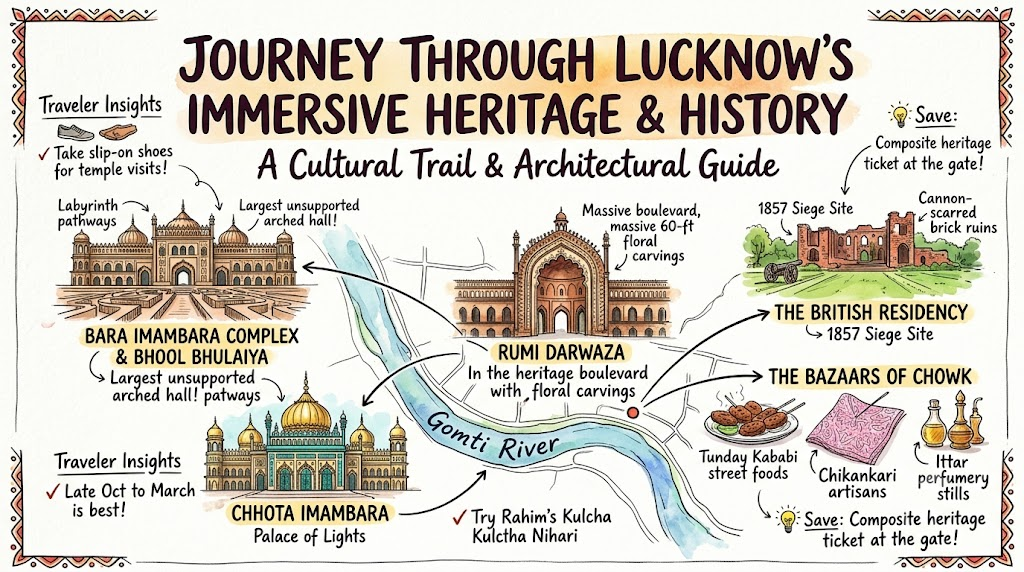
Bara Imambara Complex & Bhool Bhulaiya
Commissioned in 1784 by Nawab Asaf-ud-Daula as an expansive famine-relief project, the Bara Imambara stands as an extraordinary triumph of medieval engineering. Built without a single iron beam or girder, its central vaulted hall is among the largest unsupported arched structures in the world. The monument complex served both as a solemn gathering hall for Shia mourning rituals and as an enduring sanctuary of Awadhi resilience.
Above this massive hall sits the world-famous Bhool Bhulaiya, an intricate three-dimensional labyrinth featuring 1,024 interconnected passageways, rooftop terrace views, and whispering balconies that amplify acoustics with mathematical precision. Exploring its shaded brick passages offers a vivid glimpse into strategic military architecture and defensive acoustic engineering.
Architectural grandeur of Bara Imambara.
- Location: Machchhi Bhavan, Hussainabad, approximately 6 km from Lucknow Charbagh Railway Station.
- Why it is worth visiting: Witness the world’s largest beam-free vaulted chamber and navigate the legendary labyrinthine Bhool Bhulaiya. MakeMyTrip
- Best things to do: Hire an authorized guide to navigate the rooftop maze, test the whispering wall acoustics in the upper gallery, and explore the multi-tiered Shahi Baoli stepwell. MakeMyTrip
- Best time to visit: Early morning between 7:00 AM and 9:30 AM to beat midday tour crowds and high outdoor heat.
- Ideal for whom: Architecture purists, families, history researchers, and optical illusion enthusiasts.
- Travel tip: Shoes must be removed before entering the central hall; carry slip-on walking footwear and breathable cotton socks to navigate sun-warmed stone terraces comfortably. MakeMyTrip+ 1
Chhota Imambara (Hussainabad Imambara)
Erected in 1838 by Muhammad Ali Shah, the Chhota Imambara presents a magnificent counterpoint to the rugged scale of the Bara Imambara. Frequently referred to as the Palace of Lights, the monument’s exterior features a blend of Indo-Islamic calligraphy, golden domes, and turquoise tile motifs set against manicured reflecting pools.
Inside, the Azakhana and Shehnasheen chambers house one of the world’s most lavish collections of Belgian crystal chandeliers, gilt-edged mirrors, and ceremonial silver tazias that are illuminated during Muharram. The complex also houses the unfinished Satkhanda watchtower and the delicate tomb of Princess Zinat Asiya, modeled after the Taj Mahal.
Chhota Imambara Palace of Lights.
- Location: Husanabad Road, Daulatganj, 1.5 km west of Bara Imambara along the heritage corridor.
- Why it is worth visiting: Unmatched collection of historic Belgian chandeliers, crystal lanterns, and Quranic calligraphic reliefs. Lucknow Tourism
- Best things to do: Admire the 19th-century royal silver throne, inspect the water canals in the charbagh garden, and photograph the ornate gilded dome.
- Best time to visit: Late afternoon between 3:30 PM and 5:30 PM as golden hour illuminates the reflective courtyard pools.
- Ideal for whom: Heritage photographers, decorative art lovers, and cultural explorers.
- Travel tip: Dress modestly with shoulders and knees covered; women must carry a lightweight scarf (dupatta) to enter sacred prayer chambers.
The British Residency Grounds
Built between 1780 and 1800 for the British Resident General, this extensive 33-acre complex became the epicenter of the prolonged Siege of Lucknow during the 1857 First War of Independence. Cannonball marks, shattered brick porticos, and collapsed roofs remain preserved exactly as they fell, surrounded by lush manicured flowerbeds.
The grounds offer a tranquil atmosphere where nature has softened the scars of dramatic colonial warfare. The central museum housed in the restored Model Room showcases detailed battle dioramas, historic lithographs, personal journals, and weapons recovered from the siege trenches.
Historic ruins of the British Residency.
- Location: Mahatma Gandhi Marg, Deep Manak Nagar, roughly 4.5 km from Hazratganj.
- Why it is worth visiting: One of the most evocative, unaltered 1857 battleground sites on the Indian subcontinent. Lucknow Tourism
- Best things to do: Inspect cannonball craters on the Banquet Hall walls, visit the museum’s basement diorama, and walk the quiet cemetery grounds around St. Mary’s Church.
- Best time to visit: 8:30 AM to 11:30 AM during winter when morning light filters through ancient banyan canopies.
- Ideal for whom: Military history researchers, solo travelers, and landscape sketchers.
- Travel tip: The sprawling outdoor lawns require extensive walking; pack cushioned sneakers, polarized sunglasses, and a wide-brim sun hat. Goroomgo
Rumi Darwaza & Husainabad Clock Tower
Soaring 60 feet into the sky, the Rumi Darwaza was constructed in 1784 under the patronage of Nawab Asaf-ud-Daula to serve as the imperial entrance to the old walled city. Modeled loosely after the ancient Sublime Porte in Istanbul, this majestic gateway features an arch decorated with floral carvings, stepped battlements, and an eight-sided chhatri at its apex.
Lucknow Tourism+ 1
Directly adjacent stands the Husainabad Clock Tower, constructed in 1881 as India’s tallest clock tower, showcasing Victorian Gothic design executed in brick and limestone. Together, they anchor the visual identity of Old Lucknow, framing horse-drawn tongas and evening street markets
.
The historic Rumi Darwaza portal.
- Location: Hussainabad heritage boulevard, connecting Bara Imambara to Chhota Imambara.
- Why it is worth visiting: The definitive architectural symbol of Awadh, combining Turkish ornamental motifs with Mughal brickwork.
- Best things to do: Photograph the monumental facade from the heritage park promenade, admire the Victorian clock mechanism from below, and sip pink Kashmiri chai at nearby roadside kiosks.
- Best time to visit: 5:30 PM to 8:00 PM when floodlights accentuate the ornamental plaster carvings.
- Ideal for whom: Street photographers, urban explorers, and casual strollers.
- Travel tip: Traffic along the heritage corridor can be dense; access the best photography angles from the designated pedestrian garden medians.
The Culinary & Perfume Bazaars of Chowk
Chowk is the beating cultural heart of Old Lucknow, an ancient maze of narrow cobblestone alleyways where master artisans, perfumers, and traditional cooks have practiced their crafts for centuries. The air is filled with aromas of pure sandalwood oil, roasted cumin, simmering saffron broths, and rosewater.
Beyond its world-famous food stalls, Chowk houses traditional deg-makers hammering copper vessels, zardozi embroidery ateliers, and hereditary perfumers distilling natural floral essences (ittars) using traditional deg-bhapka copper stills. It represents living history that has resisted modern commercialization.
- Location: Old Lucknow district, approximately 5 km northwest of Charbagh Station.
- Why it is worth visiting: The authentic epicenter of hereditary Awadhi gastronomy, handmade Chikankari workshops, and genuine seasonal ittars.
- Best things to do: Sample melt-in-mouth Galawati kebabs at Tunday Kababi, test traditional Mitti (baked earth) and Ruh Gulab ittars at historic perfumeries, and watch master chikan karigars work their needlecraft.
- Best time to visit: 5:00 PM to 9:30 PM when the bazaar stalls, grills, and sweet shops operate at full vibrancy.
- Ideal for whom: Food lovers, culinary journalists, textile collectors, and culture seekers.
- Travel tip: Leave bulky backpacks at your accommodation; navigate these crowded alleyways with a cross-body anti-theft bag and carry small cash denominations.
Offbeat Exploration: Hidden Gems Tourists Miss
La Martiniere College (Constantia)
Commissioned by French Major General Claude Martin in the late 18th century, Constantia is one of the most eccentric architectural landmarks in Asia. Blending Italian Renaissance statues, Gothic gargoyles, Corinthian pillars, and Mughal terrace bastions, this massive palace also served as an active defense post during 1857. Travelers can stroll the expansive lakeside grounds and visit Martin’s underground crypt upon securing entry permission at the gate.
Qadam-e-Rasool & Shahi Baoli Subterranean Channels
While thousands visit the main Imambaras, very few explore the underground plumbing and hidden cooling chambers connected to the Shahi Baoli. This multi-tiered stepwell was built around an active water spring, designed with mirror-reflection angles that allowed royal guards to monitor intruders in the water’s reflection without being seen. Visiting with a knowledgeable local historian reveals ingenious hydraulic engineering.
Traditional Deg-Bhapka Ittar Ateliers of Nakhas
Wander off the main thoroughfare into the historic Nakhas and Phool Wali Gali quarters to witness the slow distillation of seasonal perfumes. Here, flowers such as Damask rose, jasmine, and vetiver roots are heated over wood fires into pure sandalwood oil bases. Interacting with fourth-generation perfumers offers an olfactory masterclass far removed from synthetic commercial fragrances.
Detailed Practical Guidance for Travelers
| Destination | Standard Entry Fee | General Timings | Best Local Food Options Nearby | Recommended Nearby Attractions |
|---|---|---|---|---|
| Bara Imambara & Maze | ₹50 (Indians) / ₹500 (Foreigners) | 6:00 AM – 5:00 PM (Closed Mondays) | Rahim’s Kulcha Nihari in Chowk | Rumi Darwaza, Shahi Baoli |
| Chhota Imambara | ₹50 (Indians) / ₹500 (Foreigners) | 7:00 AM – 6:00 PM Daily | Idrees Biryani on Victoria Street | Husainabad Picture Gallery, Satkhanda |
| The British Residency | ₹25 (Indians) / ₹300 (Foreigners) | 7:00 AM – 6:00 PM Daily | Royal Cafe (Hazratganj Basket Chaat) | General Neill’s Cenotaph, Begum Kothi |
| Rumi Darwaza Zone | Free Public Access | 24 Hours Open (Lighting 6 PM – 11 PM) | Roadside Kashmiri Chai & Bun Makkhan | Clock Tower, Husainabad Tank |
| Chowk Artisan Alleys | Free Public Access | 11:00 AM – 10:00 PM Daily | Tunday Kababi, Ram Asrey Makhan Malai | Phool Wali Gali, Akbari Gate |
Logistics & On-Ground Navigation
Local Transport Options
- Lucknow Metro: Exceptionally clean, punctual, and safe; ideal for traveling between the airport, Charbagh railway terminal, and Hazratganj without traffic delays.
- Electric Auto-Rickshaws (E-Rickshaws): The best option for negotiating the tight turns and pedestrian-heavy alleys of Chowk, Aminabad, and Hussainabad. Always agree on the fare before boarding.
- App-Based Cabs (Uber & Ola): Readily available for cross-town transit between central heritage hotels, Gomti Nagar parks, and fine-dining restaurants.
- Pre-Booked Private Taxis: Best hired for full-day excursions encompassing outlying sites like Nawabganj Bird Sanctuary or Kakori.
Budget Planning
- Budget / Backpacking Tier: ₹1,200 – ₹1,800 per day. Includes clean heritage dorms or guesthouses, public metro and e-rickshaw transit, street-side kebab dinners, and combined monument tickets. Lucknow Tourism
- Mid-Range / Comfort Tier: ₹4,000 – ₹7,000 per day. Covers upscale boutique hotels in Hazratganj, private app cabs, guided heritage walks, fine Awadhi dining, and artisanal textile shopping budgets.
Safety and Inclusivity Tips
- For Families: Paved walkways at the Residency and Gomti Riverfront make stroller navigation easy; keep children close in the Bhool Bhulaiya maze and crowded bazaars.
- For Couples: Public monuments and evening river promenades are safe and welcoming; maintain understated public displays of affection in conservative old-city zones.
- General Safety: Petty pickpocketing can occur in dense bazaars like Aminabad; use zip-secured cross-body pouches and drink only bottled or filtered water.
Local Secret: Do not buy individual entrance passes at each gate. Purchase the composite ASI heritage ticket at the Bara Imambara entrance, which covers Bara Imambara, Chhota Imambara, the Picture Gallery, and the Shahi Hamam in a single transaction.
Strategic Travel Planning Guardrails
Travel Planning Tips for Lucknow
- Packing Strategy: Pack lightweight cotton apparel for spring/summer, but include warm woolen jackets, shawls, and thermal innerwear if traveling between December and January. Goroomgo
- Footwear Essentials: Pack broken-in walking shoes that slip off easily, as you will remove footwear at multiple mosques, shrines, and mausoleums. Goroomgo
- Luggage Allocation: Reserve at least 25% empty space in your baggage for delicate Chikankari garments, brassware, and glass ittar bottles.
- Payment Methods: While UPI digital payments are accepted in 90% of stores, carry ₹1,500 in physical cash for shoe-handlers, rickshaws, and heritage guides.
- Cultural Etiquette: Pack a lightweight shawl or scarf; covering one’s head and dressing modestly is mandatory inside active places of worship. Lucknow Tourism
- Medicine Kit: Include digestive enzymes, oral rehydration salts, and antacids to comfortably enjoy Lucknow’s spice-rich culinary journey.
Common Mistakes to Avoid
- Cramming Old Lucknow and modern Gomti Nagar into the same half-day window, leading to long traffic delays.
- Purchasing factory machine-embroidered garments masquerading as authentic hand-stitched Chikankari in street stalls.
- Wearing complex laced boots that cause frustrating delays at sacred monument checkpoints.
- Skipping winter morning walks along the Residency ruins to sleep in, missing atmospheric morning mist and birdsong. Goroomgo
- Relying exclusively on hotel breakfasts and missing traditional morning breakfasts of warm Khasta Kachori and Malai Makhan.
Suggested Itinerary Blueprints
1. Day Quick Dash (The Nawabi Highlights Express)
Designed for transit visitors and business travelers with limited daylight hours.
- Morning: Arrive at Bara Imambara by 8:00 AM; explore the Great Hall, Shahi Baoli, and the Bhool Bhulaiya maze.
- Midday: Walk through the Rumi Darwaza to Chhota Imambara; admire the royal chandeliers and reflecting pools. Lucknow Tourism
- Afternoon: Head to Hazratganj for a late lunch featuring Basket Chaat at Royal Cafe, followed by quick textile shopping at Janpath Market.
- Evening: Wrap up with Galawati kebabs at Tunday Kababi and an evening walk through the heritage-lit boulevard of Hazratganj.
2. Day Deep-Dive (Heritage, Craft & Culinary Immersion)
A two-day journey balancing monumental architecture with neighborhood crafts.
- Day 1: Dedicate the entire morning to the Hussainabad circuit (Bara Imambara, Chhota Imambara, and Clock Tower). Spend the afternoon on an authentic food tour through Akbari Gate and Chowk, sampling Nihari Kulcha, Mutton Stew, and hand-churned Kulfi. Lucknow Tourism
- Day 2: Spend a quiet morning wandering through the 1857 ruins of The British Residency. After lunch, tour the eccentric architecture of La Martiniere College, and finish with sunset coffee along the Gomti Riverfront promenade. Lucknow Tourism
3. Complete Weekend Travel Plan (The Grand Awadhi Panorama)
A comprehensive three-day loop covering heritage, artisan encounters, and contemporary culture.
- Friday: Check into your hotel; spend the late afternoon exploring the British Residency gardens. Enjoy an evening heritage walk down Victorian-style Hazratganj, indulging in traditional retail browsing and dinner at an Awadhi restaurant. Lucknow Tourism
- Saturday: Explore the Old City’s major monuments early (Bara and Chhota Imambara). Spend the afternoon in Chowk visiting master Chikankari artisans and hereditary ittar distillers, finishing with a dinner tour around Aminabad. Lucknow Tourism
- Sunday: Take a morning architectural tour of La Martiniere College and Sikander Bagh. Spend the afternoon in Gomti Nagar relaxing at Janeshwar Mishra Park, and close your journey with sunset drinks overlooking the Gomti River.
Common Tourist Mistakes to Avoid
- Geographic Blunders: Attempting to combine Old Lucknow (Chowk) with the distant modern developments of Gomti Nagar Phase 2 during peak traffic hours. Always divide the city into geographic zones by day.
- Commercial Traps: Spending afternoon hours in modern shopping malls rather than exploring authentic artisanal lanes like Janpath, Chowk, and Nazirabad where true craftsmanship thrives.
- Neglecting Modern/Alternative Zones: Focusing exclusively on medieval ruins while overlooking the contemporary cultural scene, public parks, and art cafes in Gomti Nagar and Cantt.
- Transport Overpayment: Agreeing to arbitrary roadside auto-rickshaw quotes outside major railway stations; always verify standard rates on ride-hailing apps first.
- Luxury Dining Bias: Restricting meals to upscale hotel dining rooms; doing so misses out on legendary culinary traditions preserved by centuries-old street food stalls in the older quarters.
Frequently Asked Questions
1. What clothing items are absolutely essential to pack for a trip to Lucknow?
Pack loose-fitting, breathable cotton kurtas or linen shirts that provide comfort and modesty for historic quarters and sacred shrines. Include easy slip-on shoes for temple and mosque visits, a lightweight scarf for head covering, sunglasses, and warm layers like jackets and shawls if traveling between December and January.
2. How cold does Lucknow get during the peak winter travel season?
Winter temperatures in December and January frequently drop between 5°C and 8°C during late nights and early mornings. Packing thermal base layers, a dependable wool coat or fleece jacket, warm socks, and a light woolen cap ensures complete comfort during outdoor morning heritage tours.
3. What is the dress code when visiting the Imambaras and active religious monuments?
Visitors must wear modest attire that covers both shoulders and knees; avoid sleeveless tops and shorts. Women are required to cover their heads with a scarf or shawl inside sacred halls, and all guests must remove footwear before stepping onto interior carpets and sanctum terraces.
4. Can I pack and transport authentic Awadhi kebabs and food on return flights?
Yes, popular culinary spots like Tunday Kababi provide secure, specialized travel packing for cooked kebabs. Ensure they are placed in your checked luggage if sauces exceed airport cabin liquid thresholds, and refrigerate or consume them within 24 hours of purchase.
5. How much empty luggage space should I reserve for shopping in Lucknow?
Keep at least 20% to 30% of your luggage space empty. Lucknow is famous for Chikankari clothing, handmade leather footwear, brass artifacts, and delicate ittar bottles, which require secure padding and ample room to avoid crushing during transit.
6. What type of footwear is most practical for walking across Lucknow’s historic monuments?
Pack cushioned walking shoes or loafers that slip on and off effortlessly without intricate buckles or laces. You will repeatedly take off your shoes at religious sites, and traversing sprawling stone courtyards requires sturdy arch support.
7. Are digital payments universally accepted by local vendors across traditional markets?
UPI-based digital payments are widely used across shops, restaurants, and autorickshaws. However, packing ₹1,500 to ₹2,000 in small cash notes is essential for paying shoe caretakers at monuments, tipping heritage guides, and purchasing treats from street carts.
8. Is a guided tour mandatory when exploring the Bhool Bhulaiya inside Bara Imambara?
While not legally mandatory, hiring an authorized ASI-licensed guide is strongly recommended. The labyrinth contains over a thousand identical passageways and dead ends; a professional guide ensures your safety while sharing the acoustic and defensive secrets of the structure.
9. What medical essentials should I carry for enjoying Lucknow’s famous street food?
Carry personal digestive medications, including antacids, motion-sickness tablets, oral rehydration electrolyte packets, and mild laxatives or anti-diarrheal pills. The city’s cuisine features rich spices and clarified butter that may take unaccustomed stomachs some time to process.
10. What is the best way to safeguard and pack delicate glass bottles of Ittar?
Purchase authentic non-alcoholic perfumes sealed in traditional cut-glass or aluminum bottles. Wrap each vial securely in bubble wrap or thick cotton socks inside your luggage, placing them inside sealed zip-lock bags to prevent any leaks onto your clothes during air pressure changes.
11. Is Lucknow considered safe for solo female travelers exploring old markets?
Lucknow is generally hospitable and safe for solo women travelers. Staying aware of your surroundings, utilizing app-based transport after dark, dressing modestly in historic districts, and avoiding poorly lit alleyways late at night ensures a trouble-free travel experience.
12. Can I use photography equipment like tripods and drones at heritage monuments?
Handheld smartphones and regular digital cameras are permitted for a small nominal fee at ticket counters. However, commercial tripods, heavy studio lighting, and drone flights are strictly prohibited across all ASI-protected monuments without prior written governmental clearance.
Conclusion
Traveling through Lucknow leaves an indelible impression on the spirit that sterile vacation destinations simply cannot duplicate. Its real treasure lies not just in its weathered brick arches and intricate monuments, but in its legendary tehzeeb—the gentle, aristocratic courtesy that greets you in every cup of spiced tea and every conversation with a local artisan. Packing thoughtfully ensures you move effortlessly through this storied capital, turning an ordinary getaway into an authentic, deeply fulfilling passage through northern India’s cultural soul.
