Introduction
Skip the relentless rush of commercialized tourist circuits and discover the gracious, measured tempo of northern India’s cultural heartland. While travelers often find themselves overwhelmed by the frantic queues of generic tourist hotspots, Lucknow offers an encounter grounded in unhurried elegance, refined courtesy, and living heritage.
Here, ancient lanes breathe with the cadence of Urdu poetry, historic kitchens simmer centuries-old recipes over glowing charcoal, and towering brick archways tell tales of royal resilience. Visiting Lucknow is not simply a sightseeing vacation, but an immersive plunge into living art, peerless gastronomic mastery, and enduring architectural genius.
Why Lucknow is a must-visit city
Lucknow stands as a vital crossroads in Indian civilizational history, bridging Mughal majesty with the unique refined synthesis of the Awadhi Nawabs and British colonial drama. Geographically anchored along the serene Gomti River in Uttar Pradesh, the city transformed during the eighteenth century into an unmatched center for arts, literature, classical dance, and architectural experimentation.
Reaching the city is remarkably straightforward for every style of traveler. Chaudhary Charan Singh International Airport connects smoothly with major domestic and Gulf aviation hubs, while the historic Charbagh Railway Station serves as a central junction for high-speed expresses like the Vande Bharat and Shatabdi. High-speed expressways—including the Agra-Lucknow Expressway and Purvanchal Expressway—make road journeys smooth, paired with a welcoming hotel ecosystem spanning heritage properties to contemporary boutique hotels.
The classic exploration circuit divides naturally into distinct historical zones. The imperial core sits in Old Lucknow around Husainabad and Chowk, the colonial remnants rest along the central cantonment and riverbanks, and the modern leisure pulse flourishes across Gomti Nagar.
| Key Fact | Practical Specification |
|---|---|
| Ideal Visiting Window | October to March (Crisp mornings, pleasant afternoons, cool evenings) |
| Recommended Duration | 2 to 3 Full Days |
| Primary Transit Gateways | CCS International Airport (LKO), Lucknow Charbagh Station (LJN/LKO) |
| Signature Local Specialities | Galawati Kebabs, Awadhi Biryani, Malai Makhan, Hand-embroidered Chikan |
| Cultural Ethos | Tehzeeb (Refined Courtesy) and Nafasat (Sophistication) |
Best Places or Experiences
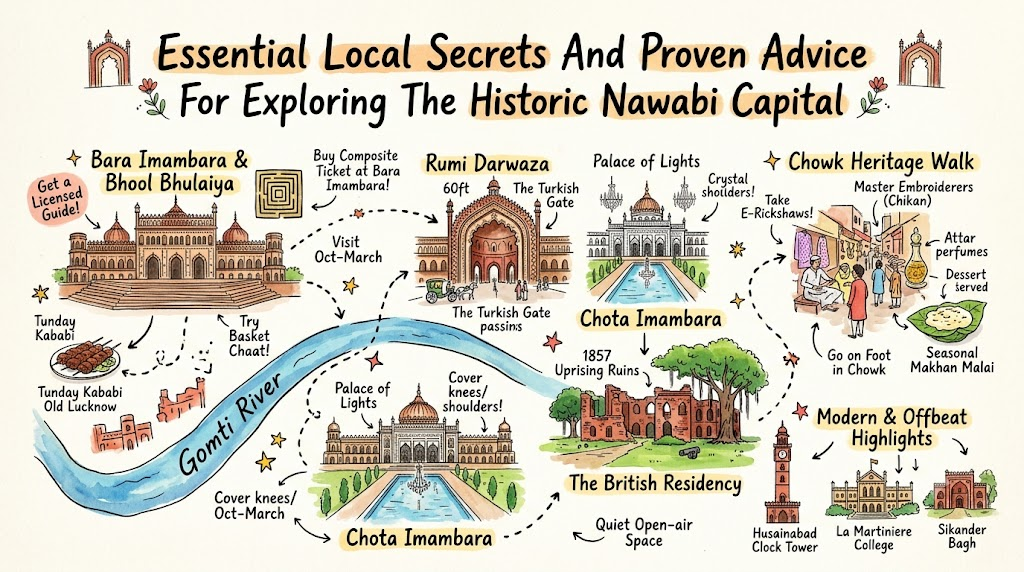
Bara Imambara & Bhool Bhulaiya
Commissioned in 1784 by Nawab Asaf-ud-Daula as a grand famine-relief project, the monumental Bara Imambara represents one of the world’s most astonishing feats of unsupported masonry. The central vaulted hall stretches over 50 meters long and nearly 15 meters high without a single exterior pillar, iron beam, or stone column supporting its tremendous weight. Built using interlocking brickwork bonded with a traditional mortar of lentils, molasses, and lime plaster, the monument reflects pure engineering brilliance.
Above this cavernous hall lies the legendary Bhool Bhulaiya, an intricate three-dimensional labyrinth of hundreds of identical interconnecting passages, narrow staircases, and blind balconies. Designed originally to reduce structural load while disorienting potential invaders, moving through this maze provides both an exhilarating puzzle and breathtaking panoramic vantage points overlooking the entire historical city.
Bara Imambara monument and gardens.
- Location: Machchhi Bhavan, Old Lucknow, approximately 6 km from Lucknow Charbagh Railway Station.
- Why it is worth visiting: Witness the world’s largest unsupported arched hall and explore the famous Bhool Bhulaiya labyrinth.
- Best things to do: Navigate the inner corridors of the Bhool Bhulaiya with an authorized guide, test the acoustic whispers along the main arched hall walls, and descend the steps of the Shahi Baoli stepwell.
- Best time to visit: 8:30 AM to 10:30 AM before midday tour groups arrive.
- Ideal for whom: History buffs, architectural enthusiasts, and curious families.
- Travel tip: Entering the labyrinth requires barefoot walking or socks; hiring an official government-licensed guide at the entrance gate is essential to avoid getting turned around.
Chota Imambara (Palace of Lights)
Erected in 1838 by Muhammad Ali Shah as a mausoleum and congregation hall, the Chota Imambara stands out for its delicate Indo-Islamic ornamental finesse. Crowned by a gilded brass dome and flanked by ornate minarets, the building’s exterior is adorned with intricate Arabic calligraphy and refined floral motifs that contrast vividly with the starker red-brick scale of older Nawabi structures.
Inside, the hall transforms into an opulent spectacle known widely as the Palace of Lights. Hundreds of crystal chandeliers imported from Belgium, gilded mirrors, glass lanterns, and silver-plated decorative pulpits reflect soft illumination across ornate mosaic flooring, creating an intimate and regal atmosphere.
Chota Imambara reflecting pool.
- Location: Daulatganj, roughly 1.5 km west of the Bara Imambara complex.
- Why it is worth visiting: Unmatched collection of historic European crystal chandeliers and shimmering decorative interiors.
- Best things to do: Admire the delicate glass chandeliers inside the prayer chamber, photograph the symmetrical gardens and reflecting pool, and inspect the miniature replica of the Taj Mahal housing the Nawab’s daughter.
- Best time to visit: 3:30 PM to 5:30 PM when warm afternoon sunlight filters through colored window glass.
- Ideal for whom: Cultural photographers, couples, and connoisseurs of vintage interior decorative arts.
- Travel tip: Dress modestly covering shoulders and knees; footwear must be deposited at the outer marble terrace.
The British Residency
Set amidst 33 acres of peaceful rolling lawns, the British Residency remains preserved exactly as it stood at the conclusion of the Siege of Lucknow during the 1857 Uprising. Built between 1780 and 1800 for the British Resident General, the sprawling compound once contained banquet halls, barracks, private villas, and an English Gothic church.
Today, the weathered red-brick ruins, scarred by cannonball fire and musket rounds, evoke deep contemplation. Creeping vines soften the historic brick facades, while mature banyan and tamarind trees provide shade for visitors wandering through this quiet open-air historical sanctuary
The British Residency memorial grounds.
- Location: River Bank Colony, near Qaiserbagh, about 4 km north of Hazratganj.
- Why it is worth visiting: The most poignant, visually striking historical battleground monument documenting the transformative events of 1857.
- Best things to do: Examine the original cannonball impacts preserved in the brick masonry, visit the 1857 Memorial Museum in the reconstructed main building, and walk through the historic cemetery.
- Best time to visit: 7:00 AM to 10:00 AM for soft morning light and peaceful birdlife.
- Ideal for whom: Military history researchers, solo travelers, and heritage enthusiasts.
- Travel tip: Purchase tickets digitally via the official ASI portal QR codes posted at the gate to bypass ticketing counters.
Rumi Darwaza
Rising 60 feet above the historical street corridor between the two great Imambaras, the Rumi Darwaza is the undisputed visual emblem of Lucknow. Commissioned by Nawab Asaf-ud-Daula in the 1780s, this colossal gateway was modeled loosely on the Bab-i-Humayun gate in Constantinople, earning it the moniker of the Turkish Gate.
The gateway features a massive, semi-circular arch adorned with intricately carved floral petals and topped by an ornamental octagonal pavilion. Rather than relying on stone, the master builders used lightweight Lakhori bricks faced with fine crushed mother-of-pearl plaster, achieving breathtaking durability and sculptural nuance that has withstood over two centuries.
Iconic arch of Rumi Darwaza.
- Location: Husainabad Heritage Corridor, connecting Bara Imambara and Chota Imambara.
- Why it is worth visiting: Witness the crowning architectural masterpiece of Nawabi public infrastructure.
- Best things to do: Marvel at the ornamental carvings on both the eastern and western facades, capture dynamic photographs from the landscaped plaza median, and watch the structure glow under evening spotlights.
- Best time to visit: Dusk (5:30 PM to 7:00 PM) as the sunset sky highlights the ornamental archway.
- Ideal for whom: Urban explorers, architectural enthusiasts, and photographers.
- Travel tip: The road passing beneath the gate is pedestrian-focused; take care when walking around nearby carriage lanes during peak traffic hours.
Chowk Heritage & Culinary Walk
The ancient neighborhood of Chowk is the throbbing cultural core where old Lucknow’s living heritage continues uninterrupted. Narrow lanes flanked by wooden balconies, carved wooden doorways, and aromatic attar perfume shops preserve a way of life little changed since the eighteenth century.
Wandering through Chowk introduces visitors to multi-generational artisans hammering pure silver into fine foil, master embroiderers crafting fine Chikan garments, and culinary masters tending large brass cooking vessels. From melt-in-the-mouth kebabs to rich winter desserts, the area offers an unmatched sensory immersion into Awadhi life.
- Location: Chowk District, Western Lucknow, around 5 km from Hazratganj.
- Why it is worth visiting: Experience the living heart of traditional craftsmanship, perfume blending, and legendary street gastronomy.
- Best things to do: Sample legendary Galawati kebabs at heritage stalls, watch master tailors perform intricate Chikan stitches, and sample seasonal Makhan Malai served on sal leaves.
- Best time to visit: 5:00 PM to 9:30 PM when bazaar shops and culinary stalls operate at full energy.
- Ideal for whom: Food lovers, textile collectors, and cultural travelers.
- Travel tip: Avoid bringing cars into these tight lanes; take a battery-operated e-rickshaw to Akbari Gate and explore purely on foot.
Offbeat Exploration: Hidden Gems Tourists Miss
Husainabad Clock Tower & Picture Gallery
Standing 221 feet tall, the red-brick Husainabad Clock Tower represents one of the finest Gothic-Victorian clock towers in South Asia, featuring a colossal 12-petalled flower clockface. Adjacent lies the Picture Gallery, a tranquil red-brick pavilion overlooking an ancient tank, housing rare full-length portraits of the Nawabs of Awadh painted with fascinating optical illusion techniques.
La Martiniere College
Commissioned by French adventurer Major General Claude Martin in the late 1700s, this sprawling palace-school combines Gothic, Baroque, and classical European architecture. Its grand exterior, ornate stucco ceilings, and rich historical library offer a fascinating look at European influence in eighteenth-century Awadh.
Sikander Bagh
Enclosed within high fortified walls in central Lucknow, Sikander Bagh was an ornate royal villa garden that witnessed fierce fighting during the November 1857 relief operations. Today, it offers a peaceful botanical haven with massive historical trees, quiet walkways, and weathered entrance gateways.
Detailed Practical Guidance for Travelers
| Destination | Standard Entry Fee | General Timings | Best Local Food Options Nearby | Recommended Nearby Attractions |
|---|---|---|---|---|
| Bara Imambara | ₹50 (Indians), ₹500 (Foreigners) | 6:00 AM – 5:00 PM (Closed Mondays) | Tunday Kababi (Chowk), Rahim’s Kulcha Nihari | Rumi Darwaza, Shahi Baoli |
| Chota Imambara | Covered under composite ticket | 6:00 AM – 5:00 PM | Husainabad local sweet vendors, Kashmiri Chai | Picture Gallery, Clock Tower |
| The British Residency | ₹25 (Indians), ₹300 (Foreigners) | 7:00 AM – 6:00 PM (Daily) | Marksmen Hazratganj, Royal Cafe Basket Chaat | Qaiserbagh Palace Complex |
| Rumi Darwaza | Free Public Monument | Accessible 24 Hours | Street vendors along Husainabad Boulevard | Asafi Mosque, Bara Imambara |
| Chowk Bazaars | Free Public Area | 11:00 AM – 11:00 PM | Mubeen’s Pasanda, Ram Asrey Malai Gilori | Akbari Gate, Gol Darwaza |
Logistics & On-Ground Navigation
Local Transport Options
- Metro Network: The modern North-South corridor connects the airport to Charbagh, Hazratganj, and northern residential zones with clean, efficient trains.
- E-Rickshaws: Abundant and inexpensive, battery-operated e-rickshaws provide the best way to navigate narrow old-city alleys and short hops.
- Auto-Rickshaws & App Taxis: Uber and Ola operate reliably across the city; auto-rickshaw drivers rarely use meters, so agree on a fare before boarding.
- Chauffeured Car Rentals: Recommended for full-day family excursions that combine outlying parks with city heritage sights.
Budget Planning
- Backpacker / Budget Tier: ₹1,200 – ₹1,800 per day covering clean hostel or guesthouse stays, metro travel, e-rickshaw hops, and legendary street-side meals.
- Mid-Range / Comfort Tier: ₹3,500 – ₹6,000 per day covering boutique heritage accommodations, app-cab transport, museum guides, and sit-down dining.
Safety and Inclusivity Tips
- Families: Major heritage sites feature wide walkways and landscaped gardens suitable for children and seniors.
- Couples: Stick to well-trafficked tourist areas and illuminated promenades after dark, particularly around Hazratganj and the riverfront.
- General Safety: Keep small currency notes handy for e-rickshaws and street vendors, and keep bags secure when navigating busy bazaar lanes.
Local Secret: Buy the composite ticket at the Bara Imambara gate. It covers Bara Imambara, Chota Imambara, and the Picture Gallery, saving money and queue time.
Strategic Travel Planning Guardrails
Travel Planning Tips for Lucknow
- Schedule outdoor monuments for morning and late afternoon hours to avoid midday heat.
- Carry both digital UPI options and small cash bills, as many older street vendors do not take cards.
- Pack breathable cotton clothing along with a scarf for covering your head inside active religious complexes.
- Wear comfortable walking shoes that slip off easily for frequent monument visits.
- Plan heritage monument visits between Tuesday and Sunday, as some government sites observe Monday closures.
- Always verify guide credentials by checking for official state tourism badges before hiring.
Common Mistakes to Avoid
- Cramming Old Lucknow and Gomti Nagar into the same half-day window, resulting in unnecessary time lost to city traffic.
- Using large private SUVs to explore narrow bazaar lanes around Chowk and Aminabad.
- Skipping traditional morning breakfasts of crispy khasta kachori and jalebi in favor of standard hotel buffets.
- Purchasing industrial factory-made garments marketed as hand-embroidered Chikan without inspecting reverse stitches.
- Forgetting to confirm auto-rickshaw prices before starting your trip.
Suggested Itinerary Blueprints
1-Day Quick Dash (The Nawabi Highlights Express)
Designed for transit travelers or weekend visitors looking to experience Lucknow’s essential highlights in a single day.
- Morning: Begin at 8:30 AM at Bara Imambara to navigate the Bhool Bhulaiya before crowds arrive, then admire the nearby Rumi Darwaza.
- Afternoon: Head to Hazratganj for a relaxed lunch, sample famous basket chaat, and take an hour to explore the ruins of The British Residency.
- Evening: Travel to Chowk around 5:30 PM for a guided culinary walk, tasting legendary kebabs and exploring local craft markets.
2-Day Deep-Dive (Heritage, Craft & Culture Loop)
A comprehensive two-day circuit pairing iconic monuments with authentic cultural experiences.
- Day 1 (Imperial Awadh): Spend the morning across the Husainabad heritage zone covering Bara Imambara, Chota Imambara, and the Clock Tower. Dedicate the afternoon to Chowk’s Chikan workshops and evening street food at Akbari Gate.
- Day 2 (Colonial & Modern Lucknow): Explore The British Residency and La Martiniere College in the morning. Shift to Gomti Nagar in the afternoon for a stroll through Janeshwar Mishra Park, concluding with dinner at a modern Awadhi restaurant.
Complete Weekend Travel Plan (The Grand Awadh Trail)
A relaxed three-day weekend journey embracing history, crafts, and riverfront leisure.
- Friday: Arrive by midday, settle into your accommodation, and spend a relaxed evening strolling the illuminated boulevards of Hazratganj.
- Saturday: Spend a full day exploring Old Lucknow, starting with the Imambara complex, followed by shopping for authentic attar perfumes and Chikan textiles in Chowk.
- Sunday: Visit the peaceful grounds of The British Residency and Sikander Bagh in the morning, followed by a sunset boat ride along the Gomti Riverfront before your departure.
Common Tourist Mistakes to Avoid
- Geographic Blunders: Attempting to combine the old western quarter of Chowk with the eastern parks of Gomti Nagar in a single afternoon causes frustrating delays. Organize your travel strictly by geographic districts.
- Commercial Traps: Spending your shopping budget in modern air-conditioned retail malls instead of supporting family-run craft cooperatives in Chowk and Janpath Bazaar.
- Neglecting Modern/Alternative Zones: Focusing solely on eighteenth-century monuments while overlooking newer green spaces, riverfront paths, and contemporary art galleries in Gomti Nagar.
- Transport Overpayment: Accepting the first price quoted by manual or auto rickshaws outside railway terminals; cross-check prices on ride-hailing apps first.
- Luxury Dining Bias: Restricting your meals to upscale hotel dining rooms, which deprives you of the authentic flavors found at historic street-side culinary institutions.
Frequently Asked Questions
1. What is the single best time of year to plan a trip to Lucknow?
The ideal window runs from late October through early March. Winter brings comfortable daytime temperatures averaging 20°C, perfect for exploring sprawling open monuments and enjoying outdoor street food. Avoid peak summer months from April through June, when daytime temperatures frequently surpass 42°C.
2. Is a licensed guide truly necessary when exploring the Bhool Bhulaiya labyrinth?
Hiring an authorized state-licensed guide is strongly recommended. The maze contains over 400 identical corridor openings and three-dimensional pathways designed deliberately to disorient intruders. Beyond navigation, a qualified guide explains the intricate acoustic engineering and hidden airflow shafts that make the structure unique.
3. What should travelers look for when purchasing genuine handcrafted Chikankari garments?
Look closely at the reverse side of the embroidery fabric. Authentic hand-done Chikan features tiny irregularities, knots, and individual thread tensions that machine work cannot replicate. Authentic pieces generally use delicate cotton, muslin, or silk fabrics, whereas synthetic, identical patterns typically indicate mass factory production.
4. Can visitors take personal cameras and tripods inside the main historical monuments?
Standard smartphones and handheld digital cameras are permitted across all Archaeological Survey of India (ASI) and Hussainabad Trust monuments for a small fee. However, large tripods, commercial setups, and drones are strictly prohibited without written permits from local administrative authorities.
5. How accessible are Lucknow’s heritage monuments for senior citizens or travelers with mobility needs?
Accessibility varies by monument. The British Residency features flat, paved garden paths that work well with wheelchairs. However, older monuments like the Bara Imambara and Bhool Bhulaiya require climbing narrow, steep stone steps that are unsuitable for visitors with mobility impairments.
6. What is the best strategy for getting around the city comfortably?
Use the Lucknow Metro for quick, air-conditioned journeys between the airport, railway terminals, and Hazratganj. For short neighborhood hops within congested heritage districts like Chowk, hail electric e-rickshaws. Use ride-hailing applications like Uber or Ola for longer transfers to modern dining and suburban hotel districts.
7. Is street food in Lucknow generally safe for visitors with sensitive stomachs?
Yes, provided you choose high-turnover stalls where food is prepared fresh over high heat. Drink bottled or thoroughly filtered water, and avoid uncooked salads or crushed ice from street carts. Historic family-run vendors in Chowk and Hazratganj maintain high standards due to their loyal local followings.
8. Are credit cards and mobile digital payments widely accepted across markets?
Digital UPI payments are accepted almost everywhere, from neighborhood tea stalls to luxury boutiques. However, international travelers without domestic UPI access should carry modest cash reserves in smaller denominations, as international credit cards are typically accepted only by larger retail stores and hotels.
9. How many days are recommended for a first-time trip to Lucknow?
A 2 to 3 day itinerary provides the ideal timeframe to explore the major Nawabi monuments, tour colonial landmarks, browse traditional textile bazaars, and enjoy the city’s legendary dining culture at an unhurried, comfortable pace.
10. What dress etiquette should travelers observe when entering active religious sites?
Modest clothing covering shoulders, arms, and knees is expected at active places of worship, including the Asafi Mosque and Imambaras. Visitors must remove their footwear before entering inner sanctums, and women are often asked to cover their heads with a lightweight scarf or dupatta.
11. Where can visitors sample the most authentic Galawati Kebabs in the city?
Head to the original Tunday Kababi branch tucked behind the historic Akbari Gate in Chowk. Established in the late nineteenth century, this humble outpost continues to prepare minced buffalo and mutton kebabs infused with traditional aromatic spice blends.
12. What unique seasonal dessert should winter visitors look for in the bazaars?
Look for Makhan Malai, a delicate, airy winter dessert made from milk froth exposed to overnight dew and gently flavored with saffron, cardamom, and silver leaf. It is sold by street vendors across Chowk and Aminabad exclusively from November through February.
Conclusion
A journey to Lucknow leaves a lasting impression that fast-paced vacations rarely match. Walking past weathered brick arches, listening to soft evening call-to-prayer melodies over the Gomti, and sharing hearty meals in bustling alleyways connects you to a timeless tradition of warmth and hospitality. Embracing the measured rhythm of this Nawabi capital rewards you with an authentic, soul-stirring cultural escape.
