Introduction
Modern cloud architectures demand seamless automation, robust delivery loops, and reliable infrastructure management. The Azure DevOps Engineer Expert (AZ-400) certification serves as a benchmark for professionals aiming to validate their expertise in designing and implementing enterprise-grade automation strategies. This comprehensive guide is designed for systems administrators, cloud architects, and software engineers who want to make data-driven career choices and understand the technical requirements of this expert-level credential. Navigating the complex ecosystem of continuous deployment requires a structured approach to learning, and this review breaks down exactly how to approach the milestone.
Aspiring professionals can leverage structured programs delivered via devopsschool to gain hands-on proficiency with Microsoft cloud automation frameworks. Understanding how to handle configuration management, version control, and infrastructure compliance is critical for modern engineering teams working globally. Beyond standard deployment, understanding the intersection of automation with intelligent observation frameworks, such as those discussed at aiopsschool, can help senior engineers build long-term systems resilience. This guide removes the marketing clutter and provides a direct, experience-driven breakdown of the exam path to help you optimize your training investments.
What is the Azure DevOps Engineer Expert (AZ-400)?
The Azure DevOps Engineer Expert (AZ-400) is an advanced certification that validates an engineer’s capability to design and implement collaborative workflows, code management solutions, and continuous integration pipelines. It focuses on the practical application of agile practices, security compliance, and infrastructure as code within the Microsoft cloud ecosystem. Rather than testing abstract theory, the validation process focuses heavily on real-world scenarios that systems face in production environments.
This certification proves that an engineer can successfully combine people, processes, and technologies to deliver continuous value to an enterprise. It covers the end-to-end lifecycle of software delivery, including instrumentation strategies, site reliability mechanisms, and secure compliance gates. Passing the exam shows that you can manage complex infrastructure environments and minimize deployment failures for global projects.
Who Should Pursue Azure DevOps Engineer Expert (AZ-400)?
This expert-level certification is tailored for mid-to-senior level professionals who already manage cloud infrastructure or software development lifecycles. Systems administrators, build engineers, site reliability professionals, and cloud architects will find direct value in this validation path. It is also highly beneficial for technical team leads and engineering managers who need to oversee infrastructure transformation projects.
For professionals based in India and other expanding global tech markets, this certification provides an essential competitive advantage for enterprise roles. Beginners should note that this is not an entry-level credential, as it requires a solid foundational knowledge of cloud administration or development. Experienced engineers use this milestone to prove their capacity to handle multi-tier delivery systems and cloud-native applications.
Why Azure DevOps Engineer Expert (AZ-400)
Enterprise adoption of managed cloud services continues to grow, and organizations require validated professionals to keep their deployment systems highly efficient. Holding this certification shows that you can manage automated workflows independently, making you an asset to any enterprise engineering team. The skills acquired during preparation do not expire when specific tool versions change, as the underlying architecture principles remain constant.
Investing time in this validation path offers a high return on effort by opening access to specialized roles in platform engineering and cloud architecture. It demonstrates to stakeholders that you can optimize infrastructure costs, enforce strict security controls, and reduce time-to-market for software products. This technical baseline keeps your skills highly relevant as delivery methodologies continue to evolve across the industry.
Azure DevOps Engineer Expert (AZ-400) Certification Overview
The certification process verifies your ability to handle complex infrastructure automation and is officially hosted on devopsschool. The evaluation tests your practical knowledge through technical scenarios, case studies, and performance-based multiple-choice questions. It requires deep familiarity with both development processes and operational infrastructure management.
To achieve the expert status, candidates must successfully pass the AZ-400 exam and fulfill the necessary prerequisite certifications. The assessment strictly covers areas such as source control management, continuous integration, telemetry logging, and security auditing. It functions as an authoritative validation of an engineer’s capacity to architect complete enterprise delivery pipelines.
Azure DevOps Engineer Expert (AZ-400) Certification Tracks & Levels
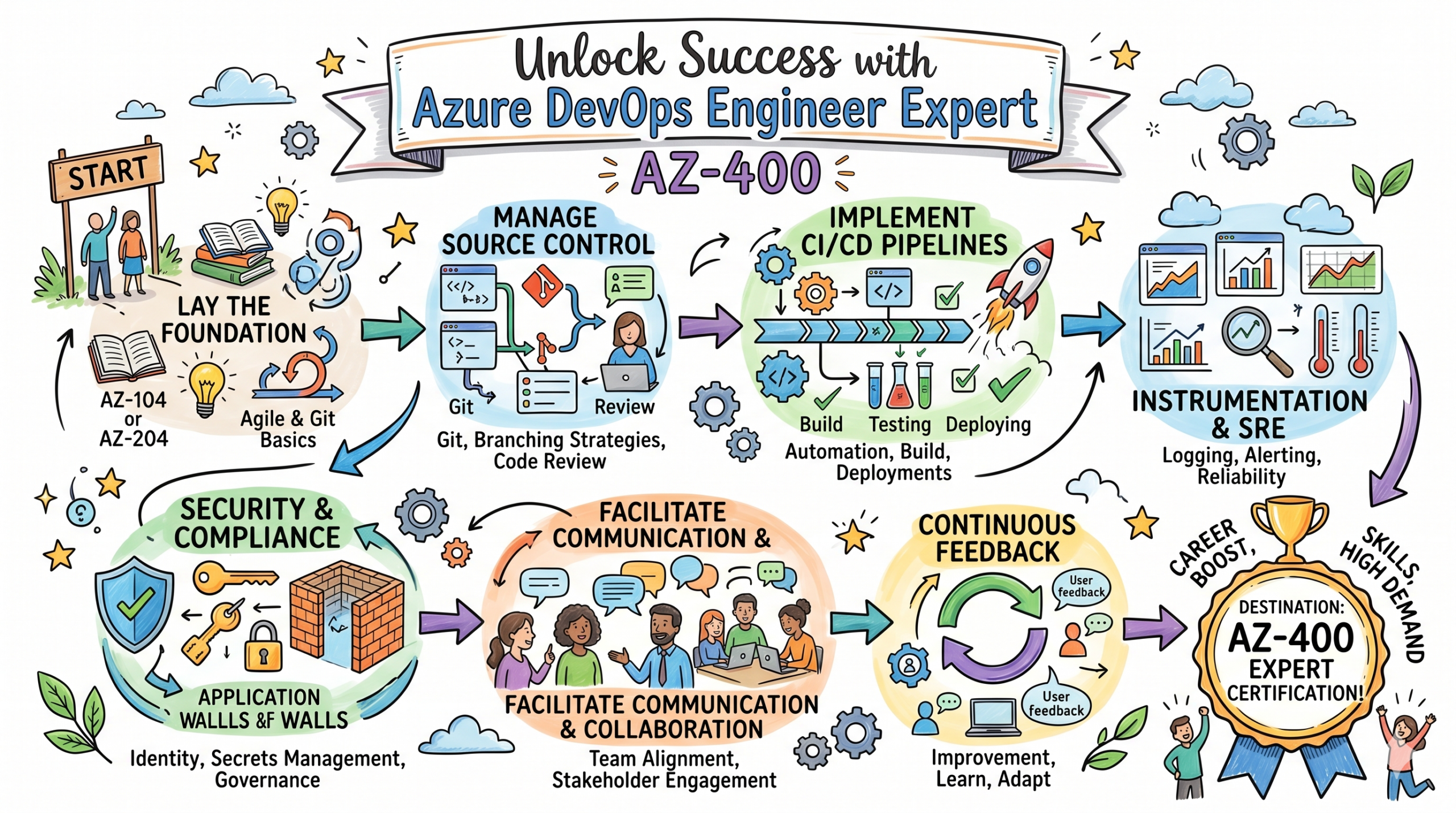
The certification structure transitions from foundational cloud engineering up to the expert tier. Candidates must establish a baseline by earning either the Azure Administrator Associate or the Azure Developer Associate credential before attempting the expert exam. This structure ensures that all certified expert engineers possess a strong understanding of core cloud components before moving to advanced automation.
The advanced track deals directly with specialized areas like site reliability engineering, policy-as-code deployment, and multi-stage release gates. This clear progression helps professionals map their learning curve systematically over time. It allows engineers to build core competencies before validating their skills at the highest architectural tier.
Complete Azure DevOps Engineer Expert (AZ-400) Certification Table
| Track | Level | Who it’s for | Prerequisites | Skills Covered | Recommended Order |
| Infrastructure Automation | Expert | Cloud Administrators & Systems Engineers | Azure Administrator Associate | Git Strategies, CI/CD, IaC, Compliance | First baseline then AZ-400 |
| Application Delivery | Expert | Software Developers & Build Engineers | Azure Developer Associate | Release Management, Security, Packaging | First baseline then AZ-400 |
| Enterprise Platform | Expert | SREs & Platform Architects | Associate Tier Core Cert | Instrumentation, Telemetry, Dependency Mgmt | Complete core then expert exam |
Detailed Guide for Each Azure DevOps Engineer Expert (AZ-400) Certification
Azure DevOps Engineer Expert (AZ-400) – Expert Level Certification
What it is
This certification validates an engineer’s ability to design, implement, and manage secure deployment pipelines, automated infrastructure, and collaborative workflows inside the enterprise cloud environment.
Who should take it
Systems administrators, cloud engineers, and software developers who possess production experience and want to validate their skills as principal automation architects.
Skills you’ll gain
- Design of comprehensive continuous integration and continuous delivery workflows.
- Implementation of infrastructure as code using templates and declarative configurations.
- Integration of security scanning tools and continuous compliance checking mechanisms.
- Setup of telemetry systems, centralized logging, and production monitoring frameworks.
Real-world projects you should be able to do
- Configure a multi-stage deployment pipeline with automated rollback and canary releases.
- Build an automated compliance pipeline that audits infrastructure code before deployment.
- Deploy a containerized microservice environment with centralized configuration management.
Preparation plan
- 7–14 days strategy: Review the official exam sub-topics, take practice assessments, and focus on identifying gaps in source control mechanics and build definitions.
- 30 days strategy: Set up a sandbox environment, write custom pipeline configurations, implement version control workflows, and review documentation on release management.
- 60 days strategy: Build end-to-end production mockups, master infrastructure as code tools, practice exam timing using full-length practice tests, and review containerization strategies.
Common mistakes
- Relying purely on theoretical study material without completing hands-on configuration labs inside a live tenant environment.
- Overlooking the developer-focused portions of the exam, such as package management and branching strategies, if coming from an operations background.
- Neglecting dependency management and technical debt metrics within the instrumentation portion of the test objectives.
Best next certification after this
- Same-track option: Advanced Azure Solutions Architect Certification
- Cross-track option: Azure Security Engineer Associate
- Leadership option: Certified Cloud Enterprise Product Manager
Choose Your Learning Path
DevOps Path
This path focuses on mastering continuous integration, release management, and automated validation systems. Engineers learn how to optimize code repositories, configure branch security, and maintain clean build outputs. It provides the core skills required to reduce deployment friction and maintain stable software delivery loops across enterprise infrastructure.
DevSecOps Path
This track prioritizes the injection of security practices directly into automated deployment pipelines. Professionals learn how to configure automated static code analysis, manage secrets securely, and implement continuous compliance checks. It ensures that infrastructure and software applications remain protected against vulnerabilities without slowing down engineering velocity.
SRE Path
This framework highlights system resilience, high availability, and proactive production monitoring strategies. Engineers focus heavily on configuring advanced logging architectures, tracking error budgets, and automating post-incident recovery tasks. It bridges the gap between fast deployment cadences and absolute production system stability over long periods.
AIOps Path
This specialty teaches engineers to leverage data analytics, machine learning telemetry, and automated log patterns to identify system anomalies. Professionals learn how to optimize large-scale infrastructure environments by reacting to automated operational insights. It is structured for senior teams looking to build self-healing infrastructure systems.
MLOps Path
This path delivers specialized workflows tailored for deploying and managing machine learning models within enterprise cloud pipelines. Candidates learn to orchestrate data validation, manage training compute infrastructure, and automate model tracking cycles. It provides a standard, reliable methodology for scaling intelligent software products safely.
DataOps Path
This discipline applies automation principles directly to complex data integration and analytical data storage pipelines. Professionals focus on orchestrating data delivery, validating data quality automatically, and managing version control for database schemas. It ensures that enterprise data assets remain consistently accessible, accurate, and secure.
FinOps Path
This operational path combines financial accountability with cloud engineering practices to maximize business value. Engineers learn to track resource utilization, analyze enterprise cloud billing data, and implement automated cost controls. It assists organizations in keeping infrastructure overhead predictable while maintaining high performance.
Role → Recommended Azure DevOps Engineer Expert (AZ-400) Certifications
| Role | Recommended Certifications |
| DevOps Engineer | Azure Administrator Associate + AZ-400 Expert |
| SRE | Azure Administrator Associate + AZ-400 + Advanced Monitoring Metrics |
| Platform Engineer | Azure Administrator Associate + AZ-400 + Infrastructure Specialist |
| Cloud Engineer | Azure Administrator Associate + AZ-400 Architecture |
| Security Engineer | Azure Security Engineer + AZ-400 DevSecOps Core |
| Data Engineer | Azure Data Engineer Associate + AZ-400 Pipeline Track |
| FinOps Practitioner | Cloud Finance Foundations + AZ-400 Resource Optimization |
| Engineering Manager | Cloud Fundamentals + AZ-400 Overview Track |
Next Certifications to Take After Azure DevOps Engineer Expert (AZ-400)
Same Track Progression
After mastering advanced automation, engineers should look toward the Azure Solutions Architect Expert certification. This progression expands your focus from deployment pipelines to overarching system topology, high availability patterns, and enterprise migration strategies. It solidifies your position as a principal design leader who can translate business requirements into complete cloud systems.
Cross-Track Expansion
Broadening your technical scope into specialized security or data platforms adds significant value to your professional portfolio. Earning the Azure Security Engineer Associate or an advanced data engineering credential ensures you understand the deep operational realities of modern systems. This combination makes you a highly versatile engineer capable of leading cross-functional platform engineering teams.
Leadership & Management Track
For professionals transitioning away from daily systems configuration toward technical leadership, focusing on enterprise governance and architecture frameworks is ideal. This includes cloud economics credentials and enterprise architecture certifications. These validations demonstrate that you can manage large engineering teams, control infrastructure budgets, and align technological execution with long-term corporate strategies.
Training & Certification Support Providers for Azure DevOps Engineer Expert (AZ-400)
DevOpsSchool Focuses on delivery of top-tier cloud and automated infrastructure learning programs globally. It provides direct, exhaustive practical knowledge for the AZ-400 track. The platform delivers live labs, production-ready scenario setups, and real-time guidance from working software experts. It ensures that candidates fully grasp release management, continuous integration, and automated infrastructure provisioning. The curriculum remains strictly updated according to enterprise demands and industry changes. Students get access to massive resources, mock test banks, and interactive review sessions that minimize candidate failure rates. It serves as an authoritative platform for anyone seeking elite engineering excellence within the cloud market.
Cotocus Specializes in high-end IT consulting and technical skill development across diverse operational landscapes. The organization builds strong competence in cloud computing, infrastructure automation, and enterprise pipeline management. Their programs are crafted by industry consultants who solve real-world system issues every single day. This training ensures that engineers move past basic theoretical concepts into deep, practical execution. They provide tailored environments for master-level certifications, helping professionals scale their careers efficiently. Through intensive hands-on drills and direct technical guidance, candidates learn how to manage large enterprise systems successfully. It remains a prime choice for corporate teams seeking complete infrastructure transformations.
Scmgalaxy Serves as a premier community platform and knowledge base dedicated to configuration management and modern engineering. It offers extensive learning pathways, detailed tutorials, and production-ready code examples for automated workflows. The platform helps engineers bridge the gap between traditional systems administration and advanced software delivery mechanics. It provides structured courses focusing heavily on continuous feedback loops, source control strategies, and automated testing setups. The material is highly technical, focusing on real-world system stability and optimization strategies. Professionals rely on this network to clear challenging enterprise assessments and stay updated with evolving architectural standards across global teams.
BestDevOps Focuses entirely on delivering top-tier educational frameworks for automation engineering and cloud deployment models. The platform offers deeply detailed, project-focused training modules that match current enterprise engineering requirements. Candidates learn how to orchestrate complex build systems, secure pipelines, and manage containerized environments at scale. The instructional methodology prioritizes direct implementation over passive viewing, pushing students to build actual production infrastructure. It acts as an elite preparatory center for advanced professional examinations, ensuring comprehensive knowledge verification. Engineers gain the specific confidence needed to handle enterprise-level cloud infrastructure challenges seamlessly.
devsecopsschool Addresses the critical modern requirement of integrating comprehensive security mechanics into automated deployment pipelines. The platform guides engineers through shifted-left security practices, compliance automation, and continuous vulnerability scanning methodologies. It provides highly specialized training that ensures automation systems are fundamentally secure by design rather than as an afterthought. Professionals learn to build immutable infrastructure while maintaining fast, secure deployment cycles across enterprise cloud frameworks. The courses offer deep insight into policy-as-code and automated threat modeling practices. It is an indispensable destination for teams looking to protect their automated delivery pipelines from modern security risks.
sreschool Dedicated entirely to the principles of site reliability engineering, system availability, and production performance tuning. The training focuses heavily on monitoring architectures, advanced logging setups, incident management frameworks, and error budget implementation. It helps engineers move from basic automated deployment into long-term system stability and resilience management. The lessons translate complex architectural patterns into simple, actionable strategies for maintaining massive enterprise cloud systems. Candidates learn how to minimize downtime, handle production incidents efficiently, and automate post-mortem analysis. It stands out as an essential training provider for scaling reliable cloud native systems globally.
aiopsschool Focuses on the modern shift toward data-driven automation by integrating intelligent algorithms into standard enterprise workflows. The platform teaches professionals how to use automated logs, metrics, and patterns to predict system anomalies before failures happen. It provides highly analytical courses that merge operational workflows with advanced observational metrics. Engineers discover how to optimize large scale infrastructure environments using data patterns and automated remediation workflows. The curriculum is perfectly structured for senior professionals wanting to lead intelligent system scaling initiatives within enterprise domains. It delivers a futuristic approach to infrastructure management and system operations.
dataopsschool Addresses the growing need for automated, high-quality data pipelines across complex business and enterprise environments. The courses provide deep learning paths for data orchestration, continuous data testing, and automated lifecycle management. It helps professionals apply standard automated deployment principles directly to complex data flows and warehouse systems. The platform ensures that data engineers and administrators can deliver clean, reliable data assets with minimal manual intervention. Through structured projects and enterprise scenarios, students master the art of scaling data infrastructure with high efficiency and compliance. It is a vital educational hub for modern data-driven organizations.
finopsschool Specializes in the critical discipline of cloud financial management, cost optimization, and shared operational accountability. The platform trains engineers and technology leaders to analyze cloud bills, reduce waste, and build sustainable cloud budgets. It combines engineering practices with financial intelligence to ensure organizations maximize their cloud returns. Students learn to implement automated cost alerts, track resource utilization metrics, and optimize multi-cloud spending structures. The training bridges the traditional gap between finance departments and engineering teams for better efficiency. It is the premier choice for organizations looking to scale cloud systems without facing unexpected financial overhead.
Frequently Asked Questions (General)
- What is the typical passing score required for cloud automation exams?Most professional-tier cloud examinations require a minimum scaled score of 700 out of 1000 to pass successfully.
- How long does it take an experienced professional to prepare for an expert-level certification?With consistent effort, an experienced engineer usually requires between 30 to 60 days of targeted practical preparation.
- Are intermediate associate credentials strictly mandatory before moving to expert tiers?Yes, core associate validations must be completed first to satisfy the formal prerequisite rules for the expert credential.
- What is the standard validity period for expert cloud certifications?Most major enterprise cloud providers set a standard certification validity period of one to two years before renewal is required.
- Can practicing inside trial cloud accounts provide sufficient experience for passing the exam?Trial accounts are excellent for sandbox testing, but candidates must practice real enterprise-scale multi-tier configurations to pass easily.
- How heavily does the assessment focus on programming skills compared to infrastructure configuration?The focus is balanced, meaning you must understand pipeline syntax, scripting languages, and declarative configuration models equally well.
- Is it better to pursue multi-cloud credentials or focus deeply on a single vendor track?Deeply mastering a single enterprise track first establishes strong foundational principles that make cross-cloud transitions much simpler later.
- What happens if a candidate fails the professional examination on their first attempt?Providers enforce a brief waiting period, usually 24 hours for the first retry, before allowing a second attempt.
- Do these professional engineering credentials help in obtaining remote global roles?Yes, they serve as globally recognized proofs of competency that help hiring managers verify your skill level quickly.
- How critical is the knowledge of containerization for advanced delivery path assessments?Container orchestration and microservices deployment strategies form a significant portion of modern cloud infrastructure examination patterns.
- Are exam questions purely multiple choice or do they include performance tasks?The exam includes traditional multiple-choice questions along with complex architectural case studies and interactive drag-and-drop scenarios.
- Does obtaining this credential automatically guarantee a transition into platform engineering?The certification validates your technical knowledge base, but practical execution and real-world system delivery experience remain critical factors.
FAQs on Azure DevOps Engineer Expert (AZ-400)
- What are the specific prerequisite options required to achieve the AZ-400 expert designation?Candidates must possess either the Azure Administrator Associate or the Azure Developer Associate certification before the expert credential can be issued.
- How deeply does the AZ-400 exam test third-party open-source automation tools?
While focused on Microsoft technologies, it heavily tests integration scenarios with industry-standard build, configuration management, and containerization platforms. - Is coding experience mandatory to clear the instrumentation and telemetry sections of the AZ-400?
You do not need to be a full-stack developer, but you must be able to read scripts, configure log queries, and understand application metrics. - What percentage of the AZ-400 exam blueprint is dedicated to security and compliance?Security validation accounts for approximately 15 to 20 percent of the total exam material, focusing on secure pipelines and credential isolation.
- How does the AZ-400 certification impact a professional working primarily as an on-premises administrator?
It helps bridge the gap into hybrid cloud strategies, showing you can manage delivery pipelines connecting local hardware with cloud resources. - What is the most effective way to practice for the Git and branching strategy questions?
Build local repositories, simulate merge conflicts, configure pull request validation gates, and study multi-stage branch policies in a live environment. - Does the AZ-400 exam cover agile project management frameworks and tracking tools?
Yes, it evaluates your knowledge of project configuration, work item tracking, team dashboards, and continuous feedback integration loops. - Which training format yields the best results for clearing the AZ-400 exam efficiently?
Combining structured lab exercises, active testing simulators, and peer review groups offers the highest probability of passing on your first attempt.
Final Thoughts: Is Azure DevOps Engineer Expert (AZ-400) Worth It?
Earning the Azure DevOps Engineer Expert (AZ-400) credential requires a disciplined commitment to learning and hands-on laboratory practice. From a practical engineering standpoint, this certification is highly worth the investment for professionals looking to anchor their careers in cloud automation. It serves as a clear signal to enterprises that you can design secure, scalable, and resilient systems using modern deployment frameworks.
Rather than chasing every new tool on the market, mastering the core domains outlined in the AZ-400 blueprint gives you a sustainable technical baseline. The credential moves your professional profile past entry-level support tasks into high-impact infrastructure architecture decisions. Plan your path, complete the necessary prerequisite associate milestones, and approach the preparation with a focus on real-world system stability.
