Introduction
Skip the commercialized, overpriced tourist traps that leave your wallet empty and your travel spirit drained. Lucknow offers a rare, refreshing sanctuary where centuries of Nawabi refinement meet incredible affordability. In an era where mainstream holiday spots hike prices for synthetic experiences, this majestic capital remains grounded in soulful living.
Traveling on a budget in Lucknow does not require sacrificing quality or authentic comfort. The city opens its palace gates, aromatic culinary lanes, and vibrant heritage trails to travelers of every financial tier. Here, you connect deeply with lived history and poetry without spending fortune.
Why Lucknow is a must-visit city
Lucknow stands as a monumental cultural capital in Northern India, carrying unmatched weight in political history, Islamic architecture, literature, and culinary craftsmanship. Historically the seat of the Nawabs of Awadh, it fostered a civilization renowned for Ganga-Jamuni Tehzeeb (communal harmony and refined courtly etiquette). Geographically anchored along the tranquil Gomti River, it bridges the fertile agricultural heartland of Uttar Pradesh with world-class connectivity.
The city is connected by the Agra-Lucknow and Purvanchal Expressways, Chaudhary Charan Singh International Airport, and the historic Charbagh Railway Station. A swift, low-cost metro rail line makes public navigation effortless for solo backpackers, couples, and family groups alike.
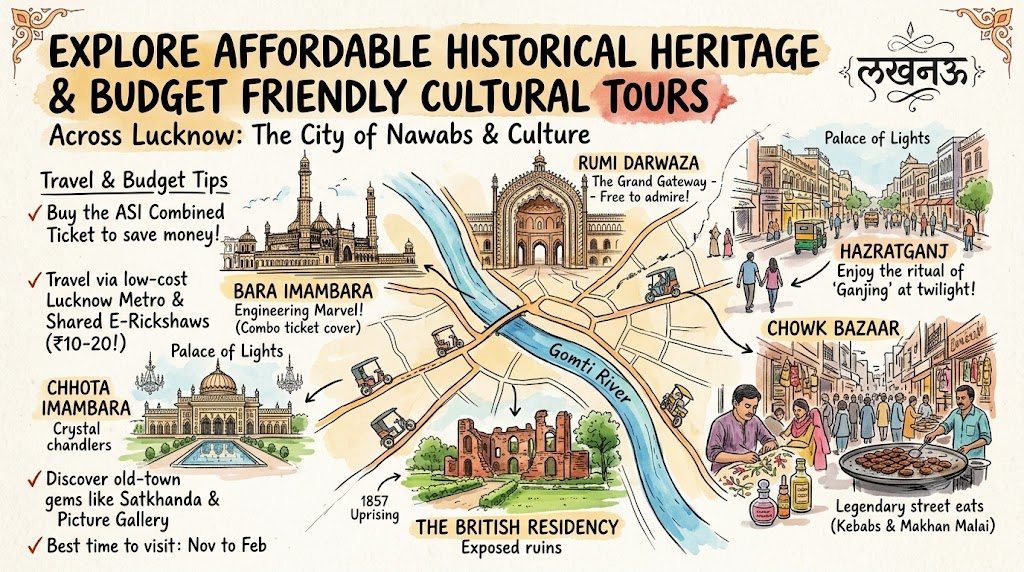
The high-level travel circuit is divided into two distinct historical chapters. The atmospheric western sector encompasses the Old City (Husainabad, Chowk, and Aminabad), packed with monumental gates, arched bazaars, and legendary street eateries. The eastern and central sectors showcase the colonial and modern evolution, spanning Hazratganj’s Victorian promenades and the manicured, expansive eco-parks of Gomti Nagar.
| Key Fact | Practical Overview |
|---|---|
| Ideal Trip Duration | 2 to 3 Days (Complete Heritage & Culinary Immersion) |
| Best Travel Season | October to March (Crisp mornings, pleasant afternoons) |
| Average Daily Budget | ₹1,000 – ₹1,600 (Backpacker/Budget Tier) |
| Primary Transit Mode | Lucknow Metro & Shared Electric Rickshaws (E-Rickshaws) |
| Signature Local Fare | Galouti Kebabs, Nihari Kulcha, Basket Chaat, Makhan Malai |
| Top Cultural Souvenir | Handcrafted Chikan Embroidery from Chowk artisan lanes |
Best Places or Experiences
Bara Imambara & Bhool Bhulaiya
Commissioned in 1784 by Nawab Asaf-ud-Daula as a profound famine-relief project, the Bara Imambara stands as an engineering miracle of the medieval Islamic world. Built without a single iron girder or beam, its cavernous central hall spans 50 meters in length and hangs unsupported by pillars, bound purely by interlocking brickwork and indigenous mortar crafted from lentils, molasses, and limestone.
Above this monumental vault lies the legendary Bhool Bhulaiya, an intricate three-dimensional labyrinth of identical corridors, whispering balconies, and panoramic rooftop overlooks designed to confound invading forces. The monument also houses the stepwell Shahi Baoli, which features an aquatic surveillance system engineered through angled water reflections.
Bara Imambara monumental complex.
- Location: Machchhi Bhavan, Husainabad, approximately 5.5 km from Lucknow Charbagh Railway Station.
- Why it is worth visiting: Global architectural marvel housing an unsupported arched hall and India’s only authentic palace labyrinth.
- Best things to do: Navigate the corridors of Bhool Bhulaiya without losing orientation, test the acoustic whispering gallery across the vaulted chambers, and view the city skyline from the outer ramparts.
- Best time to visit: 8:30 AM to 10:30 AM before tour bus crowds arrive and afternoon sun heats up the stone rooftop.
- Ideal for whom: Architectural purists, history buffs, budget backpackers, and curious family travelers.
- Travel tip: Purchase the ASI composite ticket right at the main counter; it grants entry to Bara Imambara, Chhota Imambara, and the Picture Gallery under one discounted fare.
Rumi Darwaza
Rising sixty feet above the bustling Husainabad boulevard, the Rumi Darwaza is the celebrated visual symbol of Lucknow. Constructed under Nawab Asaf-ud-Daula in the 1780s, it draws stylistic inspiration from the Bab-i Hümayun gate of Constantinople, acting as an opulent ceremonial entrance to the old royal sanctuary.
Its intricate stucco craftsmanship showcases carved floral filigree, defensive arched battlements, and a central octagonal lantern chamber that once radiated light during royal nocturnal processions. Standing beneath this monumental portal at twilight allows you to absorb the raw pulse of the Old City as cycle rickshaws, horse carriages, and evening breezes flow beneath its grand arch.
Rumi Darwaza ceremonial gateway.
- Location: Husainabad Heritage Corridor, approximately 6 km from Charbagh Railway Station.
- Why it is worth visiting: The grandest surviving example of Awadhi civil architecture, requiring no admission ticket to admire.
- Best things to do: Photograph the intricate carved motifs during the golden hour, walk through the pedestrianized heritage precinct, and watch the street lanterns illuminate the facade at dusk.
- Best time to visit: 5:00 PM to 7:00 PM for gentle photographic lighting and cooling street temperatures.
- Ideal for whom: Solo photographers, architectural wanderers, budget tourists, and evening strollers.
- Travel tip: Take wide-angle street shots from the pedestrian pavement opposite the clock tower lawn to capture the complete monument frame without street traffic interference.
Chhota Imambara (Husainabad Imambara)
Erected in 1838 by Nawab Muhammad Ali Shah as his personal mausoleum, the Chhota Imambara is an ornate jewel of Indo-Islamic decorative arts. Known affectionately as the Palace of Lights, its gilded exterior walls showcase Arabic calligraphy, five arched entries, and a pristine central reflection pool flanked by landscaped parterres.
Step inside the main sanctuary to discover an astonishing collection of Belgian crystal chandeliers, stained-glass lanterns, silver mimbars, and royal palanquins preserved across two centuries. The complex also features an architectural homage to the Taj Mahal, housing the tomb of the Nawab’s daughter, Princess Zinat Asiya.
Chhota Imambara, the Palace of Lights.
- Location: Daulatganj, Husainabad, roughly 1.5 km west of Bara Imambara.
- Why it is worth visiting: Exceptional collection of 19th-century European chandeliers and delicate mosaic Islamic tile craft.
- Best things to do: Admire the crystal chandeliers within the prayer hall, photograph the reflection of the golden dome in the exterior reservoir, and examine the miniature white marble mausoleum.
- Best time to visit: 11:00 AM to 1:30 PM when natural sunlight passes through the vibrant interior stained glass.
- Ideal for whom: Art lovers, heritage scholars, couples, and cultural explorers.
- Travel tip: Headwear is mandatory within the sacred hall; carry a lightweight scarf or handkerchief to avoid renting unhygienic head covers at the gate.
The British Residency
The British Residency stands as a preserved open-air memorial of the Siege of Lucknow during the 1857 Uprising. Constructed between 1780 and 1800 for the British Resident General, the sprawling compound once housed multi-storied residential quarters, banqueting halls, doctor’s houses, and a Gothic church.
Today, its exposed brick ruins remain pockmarked by cannonballs and musket fire, framed by ancient banyan trees and sweeping green lawns maintained by the Archaeological Survey of India. The underground chambers (Tahkhana), where hundreds of women and children sought refuge during the five-month siege, now house a fascinating museum containing original lithographs, scale models, and battle diaries.
The British Residency historical grounds.
- Location: Mahatma Gandhi Marg, Deep Manak Nagar, roughly 4 km from Hazratganj.
- Why it is worth visiting: The premier site for understanding the pivotal conflict of the 1857 war amidst tranquil parkland.
- Best things to do: Explore the subterranean museum in the ruined banquet hall, read original siege journals, and examine the cannonball scars on the central tower.
- Best time to visit: 9:00 AM to 12:00 PM for calm walks through the gardens.
- Ideal for whom: War history enthusiasts, quiet readers, budget travelers, and family walkers.
- Travel tip: Book your entry through the ASI online portal using the QR code on the board outside to save ₹5 on the ticket price.
Hazratganj Evening Ganjing Walk
Hazratganj, conceived in 1827 under Nawab Nasir-ud-Din Haider, serves as the commercial and social heart of Lucknow. Revamped with a uniform Victorian aesthetic featuring cream-and-black facades, wrought-iron street lamps, and broad stone walkways, this shopping boulevard is celebrated for the ritual of Ganjing—the local tradition of leisurely evening window-shopping and street snacking.
Beyond modern showrooms, the arcade hides historic bookshops, art deco cinemas, and century-old sweet shops. It represents the living transition point between Lucknow’s regal courtly memories and its contemporary cosmopolitan ambitions.
- Location: Central Lucknow, 3.5 km north of Charbagh Railway Station.
- Why it is worth visiting: The cultural ritual of social strolling without the demand of mandatory tourist purchases.
- Best things to do: Pick up regional literature at Ram Advani Booksellers, enjoy a savory Basket Chaat at Royal Cafe, and browse Chikan embroidery studios along Janpath Market.
- Best time to visit: 5:30 PM to 9:00 PM when the retro street lamps turn on and the street bustles with locals.
- Ideal for whom: Solo backpackers, budget foodies, street photographers, and social observers.
- Travel tip: Avoid taking cars or auto-rickshaws into Hazratganj’s core; get dropped off at the Hazratganj Metro Station and explore on foot.
Chowk Heritage Culinary & Artisan Bazaar
Chowk is the oldest continuously inhabited neighborhood of Lucknow, retaining the medieval layout of shaded alleys, carved wooden balconies, and aromatic culinary lanes. This is the birthplace of Awadhi soul food, where family-run stalls have tended charcoal braziers and tandoors across five generations.
Here, artisans craft authentic handmade Chikankari embroidery, beat silver into edible sheets (vark), and distill delicate natural floral fragrances (ittar) in brass stills. Wandering through Chowk costs nothing, yet reveals the finest living cultural tapestry in Northern India.
- Location: Western Old Lucknow, 2 km southwest of the Clock Tower.
- Why it is worth visiting: The purest epicenter of local street food and authentic artisan workshops.
- Best things to do: Watch master embroiderers work intricate needlecraft inside residential mohallas, sample fresh makkhan malai during winter mornings, and discover century-old perfume makers.
- Best time to visit: 8:00 AM to 10:30 AM for breakfast treats, or 6:30 PM to 10:00 PM for dynamic evening street dining.
- Ideal for whom: Culinary explorers, cultural documentarians, textile shoppers, and backpackers.
- Travel tip: Enter through the Gol Darwaza on foot; vehicular entry into Chowk’s narrow lanes causes severe pedestrian gridlock.
Offbeat Exploration: Hidden Gems Tourists Miss
Picture Gallery (Hussainabad Picture Gallery)
Perched above a stepped heritage reservoir, this red-brick baradari was built in 1838 by Nawab Mohammad Ali Shah. It houses life-sized oil paintings of the Nawabs of Awadh, painted by European artists using perspective techniques where the shoes, eyes, and canes of the portraits appear to track your movement across the hall. It remains completely free of standard tourist crowds.
Satkhanda (The Incomplete Watchtower)
Located directly opposite the Hussainabad Tank, this unfinished red-brick tower was envisioned as a nine-story Greek-Islamic astronomical observatory before construction stopped at the fourth tier in 1842 upon the Nawab’s death. It provides a striking architectural backdrop for exterior photography without any entry queues or ticketing requirements.
Dilkusha Kothi & Surrounding Deer Park
Constructed around 1800 by British officer Gore Ouseley as a baroque-style hunting lodge and country retreat for the Nawabs, this roofless ruined palace features intact neoclassical corner towers. Hidden in the quiet Lucknow Cantonment district, its peaceful lawns make it the ultimate zero-cost heritage escape away from city sirens.
Detailed Practical Guidance for Travelers
| Destination | Standard Entry Fee | General Timings | Best Local Food Options Nearby | Recommended Nearby Attractions |
|---|---|---|---|---|
| Bara Imambara Complex | ₹50 (Combined Ticket) | 6:00 AM – 5:00 PM | Rahim’s Kulcha Nihari (Akbari Gate) | Rumi Darwaza, Shahi Baoli |
| Rumi Darwaza | Free Public Monument | Open 24 Hours | Street Tunday Kebabs (Chowk Lane) | Husainabad Clock Tower |
| Chhota Imambara | Included in ASI Combo | 6:00 AM – 5:00 PM | Local Sheermal and Chai carts | Satkhanda, Husainabad Tank |
| The British Residency | ₹25 (Online ASI) | 7:00 AM – 6:00 PM | Sharma Tea Corner (Hazratganj) | Begum Hazrat Mahal Park |
| Hazratganj Boulevard | Free Public Promenade | 10:00 AM – 10:00 PM | Royal Cafe Basket Chaat | Janpath Market, General Post Office |
| Chowk Artisan Alley | Free Public Bazaar | 11:00 AM – 10:30 PM | Makkhan Malai stalls, Idris Biryani | Gol Darwaza, Phool Wali Gali |
Logistics & On-Ground Navigation
Local Transport Options
- Lucknow Metro Rail: The most cost-effective and air-conditioned north-south spine running from the Airport to Munshipulia; fares range from just ₹10 to ₹60.
- Shared E-Rickshaws: Abundant in Husainabad, Chowk, and Charbagh. A fixed rate of ₹10 to ₹20 per passenger covers major 2-3 km hops.
- Auto-Rickshaws: Practical for late nights, but demand metered billing or negotiate strictly before boarding (typically ₹60–₹100 for cross-zone rides).
- City Bus Network (UPSRTC): Low-cost electric city buses connect Charbagh, Alambagh, and Gomti Nagar for under ₹30.
Budget Planning
- Shoestring / Backpacker Tier: ₹1,000 to ₹1,500 per day. Covers budget hostel beds or guest lodges near Charbagh (₹600–₹800), street food meals (₹300), and metro/shared e-rickshaw transit (₹100).
- Mid-Range / Comfort Tier: ₹2,800 to ₹4,200 per day. Includes clean boutique hotel stays in Gomti Nagar or Hazratganj (₹2,000–₹2,800), sit-down dining at heritage restaurants (₹800), and app-cab rides (₹500).
Safety and Inclusivity Tips
- For Families: The heritage parks and metro platforms are clean, well-lit, and monitored by security personnel, with priority seating across public transport.
- For Couples: Stick to open historical promenades like the Residency, Lohia Park, and Hazratganj; avoid isolated corners of monument ruins at night.
- General Safety: Guard your belongings carefully inside crowded wholesale markets like Aminabad and Chowk, where pickpocketing can occasionally occur in tight aisles.
Local Secret: Do not buy individual entry tickets at each monument. Request the ASI Combined Ticket at the Bara Imambara counter; it covers Bara Imambara, Chhota Imambara, Shahi Baoli, and the Picture Gallery, saving you considerable money and queue time.
Strategic Travel Planning Guardrails
Travel Planning Tips for Lucknow
- Plan your trip between November and February to comfortably explore open heritage grounds without the intense summer heat.
- Keep ₹10 and ₹20 currency notes handy, as small street vendors and shared rickshaws often face UPI server lags.
- Dress modestly when visiting functioning religious sites like the Imambaras; carry a light cotton scarf to cover your head.
- Download the Lucknow Metro app for digital QR ticketing to skip station token queues during peak hours.
- Set aside early mornings for monument photography to take advantage of soft light before tour groups arrive.
Common Mistakes to Avoid
- Packing your daily schedule with distant sites across the city, resulting in wasted hours stuck in traffic.
- Buying mass-produced machine embroidery in flashy tourist gift shops instead of visiting authentic artisan workshops in Chowk.
- Over-relying on app-hailed private cabs within the old city where narrow alleys cause severe bottlenecks.
- Skipping street-side food stalls out of misplaced cleanliness fears; high-turnover legacy vendors offer some of the freshest fare.
- Forgetting to confirm closing times for monument ticket counters, which consistently shut down 45 minutes prior to sunset.
Suggested Itinerary Blueprints
1-Day Quick Dash (The Royal Awadh Capsule)
Designed for transit travelers or backpackers with exactly 24 hours to soak up the highlights on a shoestring budget.
- Morning: Arrive at Charbagh, take the metro to Durgapuri/Husainabad, and tour the Bara Imambara and Bhool Bhulaiya.
- Afternoon: Walk through Rumi Darwaza to Chhota Imambara, then catch a ₹10 e-rickshaw to Chowk for a street lunch of kebabs and roomali roti.
- Evening: Travel to Hazratganj for the iconic Ganjing promenade walk, taste street chaat, and finish your night catching the metro back to your transit hub.
2-Day Deep-Dive (Heritage, Textiles & Culinary Loop)
A comprehensive weekend breakdown balancing monument architecture with culinary discoveries.
- Day 1: Explore the British Residency ruins and museum in the morning. Head to Aminabad for lunch at an authentic legacy diner, browse local Chikan fabric stores, and spend your evening around Hazratganj and the illuminated Gomti Riverfront.
- Day 2: Dedicate the morning to the Bara Imambara complex and Shahi Baoli. Walk to the Hussainabad Picture Gallery and Satkhanda. In the evening, explore the hidden artisan alleys of Chowk, watching masters beat silver leaf and tailor intricate garments.
Complete Weekend Travel Plan (The Ultimate Budget Loop)
A relaxed three-day itinerary for slow travelers wanting total regional immersion.
- Friday: Arrive, settle into budget accommodations near Charbagh, and spend a relaxing afternoon visiting the neoclassical ruins of Dilkusha Kothi. Enjoy an evening tea break with bun makkhan at Hazratganj.
- Saturday: Spend the morning exploring the complete Husainabad heritage belt. Enjoy an authentic Awadhi biryani lunch, rest during the afternoon heat, and head to the street markets of Aminabad by dusk for bargains.
- Sunday: Wake early for winter makkhan malai in Chowk. Tour the British Residency grounds before visiting the botanical greenery of Sikander Bagh, concluding your trip with sunset vistas over the Gomti River.
Common Tourist Mistakes to Avoid
- Geographic Blunders: Attempting to combine the historic Old City (Husainabad) and the modern business sector (Gomti Nagar) in a single morning. These districts lie on opposite sides of the city; crossing back and forth burns precious budget and time.
- Commercial Traps: Spending afternoon hours in modern glass shopping malls. Lucknow’s living cultural soul resides on its historic street pavements, not in franchised stores found across every major city.
- Neglecting Modern/Alternative Zones: Focusing entirely on medieval monuments while skipping the remarkable modern public parks, riverside trails, and creative cafes of Gomti Nagar.
- Transport Overpayment: Agreeing to flat-rate auto-rickshaw fares without checking app prices on Uber or Ola first. Always confirm the rate upfront or choose shared electric rickshaws for short hops.
- Luxury Dining Bias: Eating exclusively at five-star hotel buffets. Fine dining establishments rarely match the authentic aromatic flavors perfected over decades by small culinary masters in the Old City.
Frequently Asked Questions
1. What is the most cost-effective way to get around Lucknow on a budget?
The most affordable transport is the combination of the Lucknow Metro and shared e-rickshaws. The metro line provides swift, air-conditioned transit across the city center for ₹10 to ₹60. For reaching narrow streets within the Old City, hop onto shared electric rickshaws, which run short routes for just ₹10 to ₹20 per passenger.
2. How much does an authentic plate of street food cost in the Old City?
An authentic meal at legacy street stalls in Chowk or Aminabad remains remarkably affordable. A serving of genuine soft kebabs paired with freshly baked roomali rotis typically costs between ₹50 and ₹120. A plate of rich slow-cooked Nihari with tandoori kulcha runs around ₹80 to ₹150, offering rich flavor without hefty prices.
3. Are entry tickets for the historical monuments expensive?
Not at all. The Archaeological Survey of India provides an integrated composite ticket costing approximately ₹50 for Indian nationals. This single pass covers your admission to Bara Imambara, the Bhool Bhulaiya labyrinth, Shahi Baoli, Chhota Imambara, and the Hussainabad Picture Gallery, making sightseeing exceptionally wallet-friendly for budget travelers.
4. Where should budget travelers look for safe, affordable accommodation?
The area surrounding Charbagh Railway Station offers dozens of clean, budget-friendly guest houses and hotels priced between ₹600 and ₹1,200 per night. If you prefer a quieter, modern neighborhood, look for budget homestays and backpacker hostels in Gomti Nagar or around the edges of Hazratganj close to metro lines.
5. How can I purchase authentic Chikankari garments without being overcharged?
Avoid air-conditioned tourist showrooms near the main monument gates where driver commissions inflate garment prices. Instead, head into the narrow wholesale lanes of Chowk behind Gol Darwaza or explore the Janpath market arcade. You can buy authentic, hand-stitched cotton kurtas directly from family workshops starting at ₹350 to ₹600.
6. Can I visit the famous Bhool Bhulaiya without hiring an expensive guide?
While you can technically enter the labyrinth on your own, its dark, interlocking passages were specifically designed to confuse intruders. Freelance guides at the gate frequently demand ₹300 or more. You can negotiate their fee down to ₹100 or simply join a small group of fellow travelers to split the cost evenly.
7. Is Lucknow safe for solo budget travelers and women using public transit?
Lucknow is generally safe and welcoming, with local culture placing strong emphasis on politeness and respectful address. Public spaces, parks, and metro trains are actively monitored by police and transport staff. Standard urban precautions apply: avoid deserted alleyways late at night and rely on app-tracked cabs after 10:00 PM.
8. What are the best free sights to visit across the city?
Several of Lucknow’s most impressive sights cost nothing to enjoy. You can admire the towering Rumi Darwaza from street level, explore the incomplete architectural wonder of Satkhanda, experience the evening social stroll along Hazratganj, and wander through the historic ruins of Dilkusha Kothi without buying an admission ticket.
9. When can visitors experience the famous winter sweet Makkhan Malai?
Makkhan Malai, also known as Daulat ki Chaat, is an airy, saffron-infused milk foam confection prepared exclusively during cool winter mornings. It is sold by street vendors across Chowk and Gol Darwaza between November and February from 7:00 AM until noon, costing just ₹30 to ₹60 per earthen bowl.
10. What hidden charges should travelers watch out for at historical monuments?
The main unexpected costs are shoe-storage fees and mobile camera charges at religious shrines and monuments. While shoe attendants often ask for tips, the standard deposit fee is only ₹5 to ₹10. Always clarify guide rates before moving past monument entry gates to avoid surprise fees at the end of tours.
11. Is digital UPI accepted by local street vendors and transport drivers?
Digital UPI payments via QR codes are widely accepted across Lucknow by food vendors, fruit stalls, and market shops. However, shared e-rickshaw drivers and entrance shoe counters often face network connectivity drops or lack change, making it essential to keep a small supply of ₹10, ₹20, and ₹50 cash notes in your pocket.
12. How many days are needed to explore Lucknow properly on a tight budget?
A two-day, three-night itinerary provides ample time to experience the city’s key attractions without overspending. Two days allow you to explore the historic Husainabad monument corridor, walk the British Residency grounds, shop in traditional bazaars, and enjoy legendary street meals while keeping total trip expenses under ₹3,500 per person.
Conclusion
Choosing to explore Lucknow on a modest budget is not an exercise in compromise; it is the most rewarding way to experience its true spirit. By leaving luxury vehicles behind for quiet strolls through centuries-old alleyways and dining shoulder-to-shoulder with locals at corner stalls, you uncover an authentic warmth untouched by modern commercialism. The true nobility of this royal city is found in its everyday interactions, poetic courtesies, and timeless charm, proving that the most enriching journeys are often the simplest.
