Introduction
Modern organizations rely on vast flows of telemetry, operational records, and business transactions to drive automated decisions, yet brittle pipelines frequently break and stall reporting. Because fragmented teams struggle to balance delivery speed with platform stability, embracing DataOps bridges operational gaps by combining agile methodologies, continuous integration, and rock-solid reliability across the entire data lifecycle. Readers often search for clear foundational concepts while seeking sustainable ways to eliminate manual data firefighting across distributed cloud environments. This comprehensive guide examines core engineering principles, robust tooling ecosystems, structured courses, certification pathways, implementation roadmaps, enterprise consulting, and specialized services. Platforms like DataOpsSchool serve as a practical educational resource for professionals and enterprise teams seeking structured learning paths, architectural guidance, and production-tested operational practices.
What Is DataOps?
DataOps is an automated, process-oriented methodology that unifies data engineering, DevOps automation, continuous integration, and quality assurance to deliver dependable analytical products rapidly. Instead of treating data pipelines as passive scripts, this operational discipline applies software engineering rigor—including strict version control, automated schema validation, and continuous testing—directly to data workflows across development, operations, and business analytics units. In a traditional workflow, an engineer manually edits SQL scripts directly in staging, runs brittle batch tasks overnight, and scrambles when downstream dashboards fail due to unannounced source schema changes. Conversely, a modern automated pipeline automatically routes source updates through isolated containerized staging tests, verifies row-level anomalies, executes integration checks, and alerts engineers instantly before flawed records contaminate production warehouses.
Why DataOps Matters for Modern Data Teams
Exponential increases in distributed data volumes and multi-cloud architectural patterns make manual maintenance untenable for fast-moving analytics teams facing strict governance and compliance mandates. When production pipelines break silently without granular observability, analytics platforms suffer from corrupted reporting, missed service level agreements, and severe degradation of stakeholder trust across executive tiers. Implementing proactive operational practices directly eliminates these friction points by replacing slow, manual deployments with continuous integration routines that catch edge-case bugs early. Consequently, technical teams minimize time spent on repetitive firefighting, streamline platform maintenance, accelerate delivery velocity, and empower business stakeholders with fresh, verified analytics that drive mission-critical enterprise decisions without friction.
How Does DataOps Work?
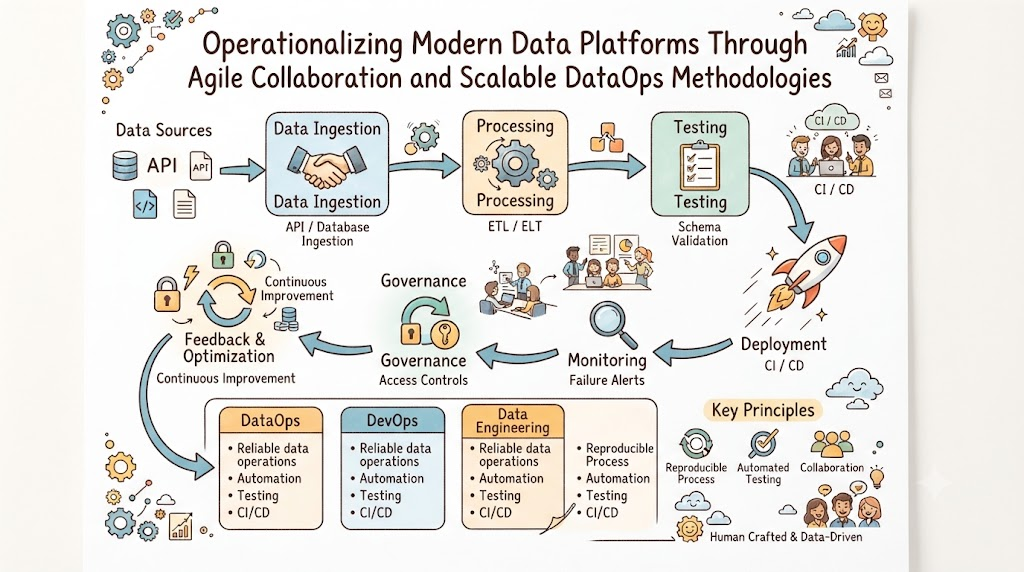
An operational data workflow functions as a synchronized, end-to-end assembly line that continuously ingests, validates, transforms, packages, deploys, monitors, and optimizes raw data streams into high-value operational products. The sequence begins at the data sources, passes through containerized ingestion workers, runs automated schema tests, executes transformations, and verifies referential integrity before deploying changes via automated delivery pipelines. Throughout this progression, workflow orchestration engines schedule dependent tasks while integrated observability tools constantly evaluate pipeline execution durations, resource consumption patterns, and row-level statistical anomalies. If upstream anomalies occur, automated circuit breakers immediately quarantine defective records, update incident alerting systems, and trigger rapid feedback loops that allow engineering teams to remediate edge cases without corrupting production environments.
DataOps Lifecycle
Understanding this continuous operational cycle helps platform teams recognize that operational success requires shared workflows, disciplined delivery practices, and reliable architectural coordination rather than purchasing isolated software licenses.
| Stage | What Happens | Example |
| Data Ingestion | Data enters the platform | API/database ingestion |
| Processing | Data is transformed | ETL/ELT |
| Testing | Data and pipelines are tested | Schema validation |
| Deployment | Changes are released | CI/CD |
| Monitoring | Pipeline health is tracked | Failure alerts |
| Governance | Data access and policies are managed | Access controls |
| Feedback | Issues and improvements are identified | Pipeline optimization |
Because data environments change constantly as upstream systems evolve, managing this lifecycle through versioned code, automated policy enforcement, and continuous verification ensures your ecosystem remains flexible, secure, and completely repeatable across every operational stage.
Key Principles of DataOps
Operational excellence depends on treating data transformations as version-controlled code, automating integration steps, maintaining absolute reproducibility across isolated environments, and practicing continuous quality verification across all ingestion boundaries. Teams establish automated unit tests for every transformation algorithm, enforce peer code reviews, isolate development branches within transient staging sandboxes, and monitor lineage to ensure complete auditability across pipelines. Additionally, fostering active collaboration between analytical developers and platform infrastructure engineers breaks down historic organizational silos, preventing disjointed handoffs and communication gaps. Emphasizing continuous validation and granular system observability enables teams to catch silent data drift early, maintain regulatory compliance, and consistently deliver high-integrity analytical outputs to downstream consumers.
DataOps Tools
Rather than relying on an all-in-one software package, enterprise data teams combine modular, specialized tools that handle distinct pipeline, delivery, infrastructure, and observability requirements across modern enterprise environments.
| DataOps Function | Example Tools/Technologies | Purpose |
| Version Control | Git | Track changes |
| CI/CD | Jenkins, GitHub Actions, GitLab CI | Automate delivery |
| Orchestration | Apache Airflow | Manage workflows |
| Transformation | dbt | Transform data |
| Containers | Docker, Kubernetes | Standardize environments |
| Data Quality | Great Expectations | Validate data |
| Observability | Data observability platforms | Monitor data health |
| Cloud Data | AWS, Azure, Google Cloud | Data infrastructure |
| Monitoring | Prometheus, Grafana | Monitor systems |
| Databases | PostgreSQL, MySQL, cloud databases | Store data |
Selecting the ideal tool combination requires evaluating existing architectural footprints, overall workload volume, internal engineering proficiencies, cloud vendor constraints, governance mandates, and organizational scalability targets to ensure seamless interoperability.
DataOps vs DevOps vs Data Engineering
Although these three disciplines share underlying philosophies surrounding system reliability, automation, and continuous delivery, they address distinctly different operational challenges within modern technological environments.
| Area | DataOps | DevOps | Data Engineering |
| Main Focus | Reliable data operations | Reliable software delivery | Building data systems |
| Automation | Data workflows | Software infrastructure | Data pipelines |
| Testing | Data + pipeline quality | Application/infrastructure testing | Data transformation testing |
| Monitoring | Data and pipeline health | Applications/infrastructure | Pipeline/system health |
| CI/CD | Data workflows | Software deployments | Pipeline deployments |
These disciplines work synergistically when DevOps teams manage fundamental infrastructure abstractions, data engineers craft core extraction routines, and operational specialists implement continuous testing, deployment automation, and comprehensive data monitoring across enterprise production environments.
Benefits of Implementing DataOps
Adopting disciplined operational workflows significantly enhances technical productivity, reduces manual deployment errors, minimizes pipeline downtime, and ensures analytical deliverables reflect accurate, validated source information. By replacing manual hotfixes with automated integration runs, engineering units identify breaking schema changes before bad records reach downstream reporting layers or executive interfaces. Furthermore, standardized delivery pipelines empower developers to test and release complex transformation logic safely, accelerating overall release cadences without endangering platform uptime. Consequently, engineering organizations achieve seamless operational predictability, enforce enterprise-grade data governance, reduce operational troubleshooting expenses, and foster reliable collaboration between analytical builders, infrastructure specialists, and operational decision-makers.
Real-Life DataOps Scenarios and Industry Experience
A multi-region enterprise encountered continuous dashboard failures because third-party transactional APIs modified their payload structures overnight, breaking ingestion scripts and causing widespread reporting outages across executive divisions. The engineering team resolved this challenge by introducing automated pull-request validation pipelines using schema assertion tools, instantly halting flawed transformations before bad payloads entered the production warehouse. In another scenario, a financial platform struggling with twelve-hour batch delays reorganized its pipelines into decoupled, containerized transformations managed by declarative orchestration workflows, cutting overall runtimes by half while automatically capturing runtime telemetry. Applying isolated test environments, continuous integration, and automated alert routing fundamentally transformed both organizations from reactive troubleshooting units into reliable, high-velocity operational delivery engines.
How to Implement DataOps in an Organization
Organizations begin their operational evolution by assessing existing architectural workflows, cataloging manual pipeline interventions, identifying recurring data quality failures, and pinpointing infrastructural bottlenecks across every ingestion boundary. Next, teams establish measurable quality metrics covering completeness, freshness, validity, and referential consistency, while placing all transformation scripts, configurations, and infrastructure-as-code definitions under centralized version control. Subsequently, engineers introduce automated unit, schema, and integration tests directly into continuous integration workflows, ensuring incoming revisions deploy safely through staging sandboxes into production without manual interventions. Finally, teams configure end-to-end lineage tracing, system observability metrics, granular access governance, and continuous retrospectives to refine operational efficiency as analytical workloads scale over time.
DataOps Training and DataOps Course
Professionals seeking structured career progression benefit immensely from comprehensive DataOps Training programs and interactive courses designed to bridge software engineering disciplines with modern data management practices. An effective, industry-focused DataOps Course must emphasize practical cloud labs, automated pipeline assembly, automated schema assertion testing, declarative orchestration, and real-world deployment workflows over theoretical concepts. Engaging with dedicated educational platforms like DataOpsSchool allows software developers, operations specialists, and analytics engineers to acquire production-grade operational competencies through structured tutorials and realistic scenario-based exercises. Mastering these operational methodologies equips engineers with the collaborative problem-solving skills, automation fundamentals, and infrastructure knowledge required to manage resilient, modern cloud data architectures successfully.
DataOps Certification
Pursuing an industry-aligned DataOps Certification allows technology practitioners to systematically validate their expertise across automated pipeline design, workflow orchestration, observability, governance, and reliable production deployment methodologies. While theoretical knowledge forms a vital foundation, reputable certification tracks assess an engineer’s ability to diagnose silent pipeline degradation, construct automated delivery pipelines, and enforce data quality gates. Preparing for these rigorous exams encourages engineers to deepen their hands-on troubleshooting skills, master automated testing architectures, and eliminate architectural blind spots across complex enterprise stacks. Ultimately, combining proven enterprise production experience with industry credentials provides hiring managers with tangible proof of an engineer’s ability to build reliable operational platforms.
Certified DataOps Engineer
A Certified DataOps Engineer specializes in constructing, automating, testing, and maintaining dependable, end-to-end data pipelines that deliver clean, validated information across complex cloud environments. These technical professionals demonstrate deep proficiency in containerization, declarative workflow orchestration, continuous integration automation, automated data validation frameworks, and granular telemetry monitoring across distributed analytical warehouses. System engineers, analytics developers, and data infrastructure builders aiming to transition into high-impact operational roles gain clear technical clarity by following this specialized engineering pathway. Dedicated learning ecosystems like DataOpsSchool provide comprehensive instructional roadmaps, hands-on engineering tutorials, and realistic lab exercises designed to prepare ambitious technical specialists for demanding engineering certification benchmarks.
Certified DataOps Architect
Operating at an enterprise strategic tier, a Certified DataOps Architect designs scalable, highly available data platform foundations, defines overarching automation strategies, and establishes rigorous governance, security, and compliance frameworks. While execution engineers concentrate on constructing and troubleshooting specific pipeline workflows, architects evaluate platform scalability limits, select modular technologies, establish cross-cloud disaster recovery protocols, and orchestrate enterprise-wide operational standards. Professionals in this role bridge the divide between business stakeholders, analytical teams, and infrastructure engineers to ensure that data platforms scale securely without accumulating technical debt. Achieving this level of architectural expertise requires years of hands-on platform design experience, proven mastery of distributed cloud ecosystems, and a deep understanding of organizational operational dynamics.
DataOps Tutorial: Where Should Beginners Start?
Aspiring practitioners should initiate their operational journey by solidifying fundamentals in distributed file systems, relational databases, cloud storage concepts, Git version control, and shell scripting environments. Once comfortable with basic system navigation, learners should build rudimentary data extraction and transformation routines, gradually integrating declarative workflow orchestrators to schedule tasks and manage pipeline dependencies reliably. After establishing basic transformations, students must integrate automated schema assertion libraries into continuous integration pipelines, ensuring every code change is validated before merging into primary branches. As confidence builds, beginners can incorporate monitoring dashboards, capture runtime telemetry, configure alerts, build portfolio-ready production simulations, and eventually pursue structured certifications to validate their expanding capabilities.
DataOps Consulting and DataOps Services
Enterprises facing brittle data pipelines, frequent analytical outages, compliance risks, and fragmented engineering workflows frequently engage external DataOps Consulting teams to modernize their underlying operational architectures. Professional DataOps Services assess existing pipeline bottlenecks, design resilient CI/CD deployment workflows, implement automated data quality gates, and construct unified observability frameworks tailored to organizational requirements. Furthermore, external consultants provide specialized guidance during complex cloud migrations, helping organizations establish standardized governance policies, fine-tune resource allocation, and eliminate dangerous single points of failure across analytical platforms. Organizations like DataOpsSchool combine extensive operational instructional material with professional advisory services, helping enterprise teams implement resilient, highly scalable data operations that drive sustained business growth.
Common Mistakes to Avoid in DataOps
A frequent operational mistake involves purchasing modern software tools while ignoring underlying organizational silos, manual handoffs, cultural collaboration barriers, and undefined pipeline ownership across engineering teams. Another critical error entails treating data pipelines like static application code, neglecting to implement real-time schema validation and anomaly detection for variable, dynamically evolving upstream inputs. Teams also stumble by failing to place pipeline configurations, infrastructure definitions, and transformation queries under strict version control, leading to unpredictable, unrepeatable manual deployments across production environments. Finally, organizations often fall victim to the following critical operational pitfalls:
- Overlooking end-to-end lineage tracking, which complicates root-cause analysis during unexpected pipeline interruptions.
- Delaying testing routines until data reaches production warehouses, causing downstream analytical dashboards to display corrupted metrics.
- Relying exclusively on manual deployment approvals, which creates severe operational bottlenecks and slows down delivery velocity.
- Ignoring comprehensive access governance and audit logging, exposing sensitive enterprise assets to regulatory non-compliance penalties.
- Disregarding operational feedback loops, which prevents teams from iteratively refining pipelines based on consumer incident reports.
How to Choose the Right DataOps Approach
Selecting an effective operational strategy requires assessing workload volumes, internal engineering capabilities, regulatory compliance mandates, pipeline complexity, and the current cloud platform architecture across your organization. Lightweight organizations handling straightforward analytical workloads benefit from managed, low-maintenance cloud orchestrators paired with declarative transformation tools that require minimal infrastructure overhead. In contrast, large enterprises managing strict security requirements, hybrid clouds, and multi-petabyte real-time streams require containerized microservices, distributed query engines, and sophisticated observability platforms. Rather than chasing transient industry trends, engineering leadership must choose modular, open-standard technologies that solve immediate reliability bottlenecks while providing the architectural flexibility needed to scale sustainably.
Who Should Learn DataOps?
Because operational maturity impacts every aspect of modern analytical ecosystems, mastering these methodologies yields immense career advantages across several technical disciplines and engineering backgrounds:
- Data Engineers: Professionals seeking to eliminate manual firefighting, automate pipeline validation tests, and streamline repetitive migration deployments.
- DevOps Engineers and SREs: Infrastructure specialists looking to apply their deployment automation, monitoring, and platform reliability expertise to specialized data architectures.
- Analytics Engineers and Data Scientists: Practitioners needing dependable, verified source inputs and reproducible development environments to build accurate analytical models.
- Cloud and Platform Engineers: Technical architects focused on provisioning scalable, cost-optimized, and resilient storage, compute, and networking layers.
- Technical Managers and Architects: Leaders aiming to establish robust cross-functional collaboration, enforce data governance, and accelerate product delivery cadences.
Transitioning into these specialized operational roles allows professionals to leverage existing technical backgrounds while mastering high-demand skills that fundamentally enhance modern enterprise analytical capabilities.
Why DataOpsSchool Can Be a Useful Resource
Navigating the expansive landscape of modern data platform operations requires access to structured, production-tested educational content and seasoned technical guidance. DataOpsSchool provides a dedicated learning and advisory ecosystem designed to help professionals master modern data engineering practices, pipeline reliability, cloud architectures, and delivery automation. Through its structured DataOps Tutorial collections, comprehensive DataOps Training programs, and hands-on DataOps Course modules, learners gain actionable skills required to earn credentials like Certified DataOps Engineer and Certified DataOps Architect. Furthermore, the platform extends its industry expertise to organizations seeking specialized DataOps Consulting and DataOps Services, assisting engineering teams in building automated, observable, and enterprise-grade data platforms that scale efficiently.
Frequently Asked Questions
1. What is the fundamental difference between DataOps and DevOps?
DevOps focuses on automating software application development, testing, and continuous infrastructure deployments to ensure application uptime. DataOps adapts these principles specifically for data environments, managing both operational pipeline code and dynamic, unpredictable data inputs to guarantee analytical accuracy.
2. Can an organization practice DataOps using only open-source tools?
Yes, organizations can construct a robust operational ecosystem using open-source tools like Git for version control, Apache Airflow for orchestration, dbt for transformations, and Great Expectations for quality testing, provided internal teams possess the expertise to manage the underlying infrastructure.
3. How does implementing automated testing improve data reliability?
Automated testing checks incoming datasets against predefined schema rules, null constraints, and value distributions before processing begins. Catching anomalies early prevents corrupted records from entering production warehouses, saving engineers hours of manual troubleshooting and preserving downstream reporting accuracy.
4. Is DataOps relevant only for large enterprise organizations?
No, small and mid-sized teams benefit significantly from these practices because automated testing, version control, and continuous deployment eliminate tedious manual maintenance, allowing lean engineering teams to deliver dependable analytical products without expanding headcount.
5. Which programming languages are most important for DataOps practitioners?
Python and SQL are the most critical languages for managing modern data operations. Python enables engineers to build custom integrations, orchestrate pipelines, and configure testing frameworks, while SQL remains the universal standard for querying, transforming, and validating relational data.
6. How does DataOps accelerate regulatory and governance compliance?
By tracking data lineage, automating access controls, and logging every transformation through version-controlled pipelines, organizations maintain an auditable operational trail. This automated visibility ensures teams can verify compliance with privacy regulations without conducting stressful, manual forensic audits.
7. Does adopting DataOps require rebuilding all existing pipelines from scratch?
No, teams can adopt operational methodologies incrementally by first placing existing transformation scripts under version control. Next, engineers introduce automated testing and pipeline monitoring to the most brittle workflows, gradually modernizing infrastructure components without disrupting live business operations.
8. What role does data observability play in daily platform operations?
Data observability monitors the health of data systems by tracking freshness, volume changes, schema drift, lineage, and execution anomalies. It alerts engineers to unexpected data behavior in real time, enabling rapid incident remediation before business stakeholders notice discrepancies.
9. Can DataOps help reduce overall cloud infrastructure expenses?
Yes, operational monitoring highlights idle compute resources, failed pipeline retries, and inefficient query patterns across cloud data warehouses. By optimizing job scheduling, cleaning unneeded staging tables, and right-sizing compute clusters, platform teams can eliminate significant cloud waste.
10. How do workflow orchestration tools fit into this framework?
Orchestration engines manage task dependencies, schedule execution sequences, and monitor pipeline jobs across distributed environments. They ensure transformations run only after prerequisite ingestion tasks complete successfully, providing automated retries and failure alerts whenever underlying platform issues arise.
11. What is the best way to introduce automated deployments safely?
Engineers should establish continuous integration pipelines that run automated unit, schema, and integration tests in temporary, isolated staging environments. Code merges into production branches only after all validation checks pass, preventing unverified modifications from impacting live workflows.
12. Why are practical labs critical when preparing for engineering certifications?
Certifications test your ability to troubleshoot dynamic system failures, configure deployment automation, and orchestrate complex tasks. Theoretical study cannot replicate real-world nuances, making hands-on labs essential for building the muscle memory required to solve complex production challenges.
Conclusion
Mastering modern data operations requires shifting focus from individual tools to unified engineering cultures that emphasize automation, continuous testing, granular observability, and cross-functional team collaboration. As enterprise ecosystems expand across distributed cloud environments, adopting disciplined operational practices ensures that data platforms scale securely without degrading pipeline reliability or analytical accuracy. Organizations establish this foundation through structured implementation journeys—auditing legacy bottlenecks, enforcing automated quality gates, establishing continuous integration pipelines, and monitoring system telemetry across every ingestion boundary. For technical professionals, investing in hands-on courses, comprehensive tutorials, and recognized certifications unlocks significant career opportunities within modern cloud engineering. Platforms like DataOpsSchool support this continuous evolution by delivering industry-aligned learning pathways, specialized certification preparation, and experienced consulting services designed to transform enterprise data operations. Ultimately, true operational excellence comes from maintaining production-tested deployment rigor, enforcing high data quality standards, and continually optimizing pipelines to deliver dependable enterprise intelligence.
