Introduction
As digital transformation accelerates across global enterprises, cloud adoption has transitioned from a competitive advantage to an operational baseline. However, the shift from traditional fixed-capacity IT budgeting to a dynamic, utility-based cloud consumption model frequently leads to severe budget overruns and financial unpredictability. Traditional procurement processes relying on static annual capital expenditures fail to handle variable operational costs generated by decentralized engineering teams provisioning infrastructure in real time. Organizations urgently require FinOps—a modern operational framework that unifies engineering, finance, and business leadership to drive financial accountability and maximize the business value of cloud investments. By fostering cross-functional transparency, establishing granular cost allocation, and transforming how technical decisions impact the bottom line, professionals are rapidly pursuing structured learning through platforms like FinOpsSchool to master this critical discipline.
What Is FinOps?
FinOps, short for Cloud Financial Operations, is a cultural practice and management discipline that enables organizations to get maximum business value from their cloud investments by driving financial accountability across cross-functional teams. Rather than serving as a static cost-cutting program, FinOps balances speed, quality, and cost by aligning cloud usage directly with organizational revenue and performance targets. Engineering teams gain real-time visibility into the financial impact of their architectural choices, empowering them to design efficient systems without slowing down delivery velocity. Finance teams transition from receiving surprise monthly cloud invoices to predicting operational expenditures with high accuracy using data-driven forecasting models. Simultaneously, procurement specialists leverage usage trends to negotiate favorable enterprise agreements, while executive leadership uses unit economics to ensure every cloud dollar spent advances broader business strategies.
The FinOps Lifecycle
Inform
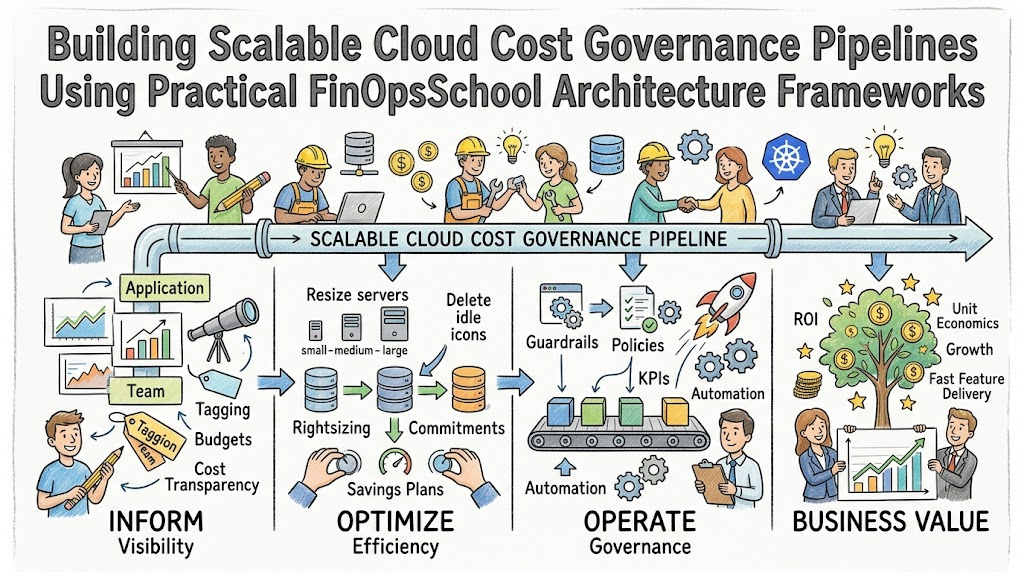
The Inform phase forms the foundation of the FinOps operational framework by providing complete cost visibility, granular reporting, and transparent cost allocation across the enterprise. During this stage, organizations establish tagging standards, map cloud infrastructure to specific accounts or applications, and build real-time dashboards to track spending trends against established budgets. Advanced forecasting models analyze historical usage patterns and seasonal variations to project future cloud expenditure while automated anomaly detection systems alert teams to unexpected spending spikes. By assigning clear financial ownership to specific engineering squads and product managers, this phase eliminates mystery cloud spend and creates the operational baseline necessary for informed decision-making.
Optimize
Once organizations achieve end-to-end expenditure visibility, the Optimize phase focuses on identifying actionable efficiency improvements to maximize business value and eliminate cloud waste. Technical teams analyze utilization telemetry to rightsize overprovisioned virtual machines, remove orphaned block storage volumes, purge outdated snapshots, and transition idle databases to lower-cost tiers. Beyond infrastructure hygiene, teams optimize workloads running on container platforms like Kubernetes and evaluate commitment-based discount instruments such as Reserved Instances and Savings Plans. This phase ensures that infrastructure adjustments are driven by real-world performance metrics rather than arbitrary budget caps, balancing raw financial savings with system availability and performance requirements.
Operate
The Operate phase converts financial insights and optimization techniques into continuous operational habits embedded directly into daily engineering workflows and enterprise governance. Cross-functional teams establish automated policy enforcement, continuous budget monitoring, and automated shutdown routines for non-production environments using Infrastructure as Code pipelines. Executive leaders and department heads hold regular forecast reviews to track key performance indicators, evaluate allocation coverage, and measure unit economics across different business lines. By creating feedback loops between engineering, finance, and business operations, the Operate phase establishes an agile organizational culture where continuous cost governance occurs automatically alongside software development and feature deployment.
Key FinOps Capabilities
Cost Visibility
Cost visibility is the cornerstone of effective cloud financial management, allowing organizations to dissect complex, multi-million-dollar billing files into understandable operational metrics across accounts, applications, environments, and business units. Without granular visibility, enterprise leadership cannot determine whether rising cloud expenses stem from healthy business growth or widespread operational inefficiency. By leveraging specialized cost management platforms, telemetry tags, and custom analytics dashboards, teams track spending patterns in real time across multi-cloud environments. This immediate transparency empowers decentralized engineering squads to visualize the direct cost of their deployed microservices, fostering an environment of financial awareness where teams proactively manage their resource consumption.
Cost Allocation
Cost allocation maps unallocated cloud charges back to the specific departments, business units, products, or engineering teams responsible for generating the infrastructure load. Establishing comprehensive allocation strategies requires consistent metadata tagging, cloud account isolation, resource grouping by subscriptions or projects, and clear mechanisms to split shared infrastructure costs. Unallocated cloud spend creates shared-cost friction, making it impossible to evaluate individual product profitability or hold team leads accountable for their operational budgets. By assigning 100% of cloud expenditure—including shared databases, network transit, and central logging infrastructure—organizations establish complete fiscal transparency, ensuring every expenditure aligns directly with a designated owner and budget.
Showback and Chargeback
Showback and chargeback represent two distinct operational methodologies used to enforce accountability for cloud consumption across enterprise business units and engineering teams. Showback provides teams with regular, detailed reporting on their cloud usage and associated costs without actually transferring funds or deducting money from departmental budgets. Chargeback takes accountability a step further by directly billing business units and deducting cloud expenses from their operational budgets based on actual consumption metrics. While showback builds cultural awareness and allows teams to refine their allocation tracking without immediate financial consequences, chargeback establishes strict fiscal responsibility that encourages proactive resource optimization across mature organizations.
Budgeting and Forecasting
Effective cloud budgeting and forecasting requires moving beyond rigid, annual capital expenditure projections toward dynamic models capable of adapting to variable cloud consumption. Modern cloud financial planning combines historical usage telemetry, product roadmap projections, seasonal demand spikes, anticipated pricing adjustments, and planned commitment purchases to project future spending accurately. Engineering and finance teams must collaborate closely when evaluating new workload deployments, microservice migrations, or global expansion plans to prevent unexpected financial surprises on monthly invoices. By continually refining forecasting algorithms against real-time billing data, enterprise leaders identify potential budget variances weeks before billing periods close, enabling proactive architecture adjustments instead of reactive executive intervention.
What Does FinOps Training Teach?
A comprehensive FinOps curriculum equips technical professionals, finance experts, and operational leaders with the practical skills required to build and maintain mature cloud financial management practices. Participants master cloud cost visibility by breaking down raw billing datasets, constructing operational dashboards, and implementing rigorous metadata tagging strategies for granular allocation. Learning programs cover advanced budgeting and dynamic forecasting techniques alongside practical infrastructure optimization strategies, including rightsizing, idle resource cleanup, and commitment optimization across major cloud providers. Furthermore, trainees learn to implement automated cost governance, configure real-time budget alerts, monitor cost anomalies, and measure key performance metrics that bridge the traditional gap between engineering decisions and enterprise finance goals.
Cloud Cost Optimization Strategies
Rightsizing
Rightsizing involves analyzing compute, memory, disk, and network telemetry to match cloud infrastructure capacity with actual workload performance requirements safely. Engineering teams often provision virtual machines based on peak traffic assumptions or static hardware templates, leading to sustained low utilization across non-production and production environments alike. By analyzing historical utilization trends over extended operational periods, technical teams downsize overprovisioned instances, switch to modern CPU architectures, or implement dynamic autoscaling policies that expand capacity only during high-demand windows. This continuous alignment between provisioned resources and real-world demand slashes monthly compute costs without degrading user experience, application performance, or service level agreements.
Eliminating Idle Resources
Eliminating idle resources is the most immediate method for cutting cloud waste without impacting system performance, application availability, or engineering velocity. Unattached elastic block storage volumes, obsolete database snapshots, orphaned load balancers, unused static IP addresses, and forgotten staging environments silently accumulate thousands of dollars in monthly charges. Engineering teams should establish automated discovery scripts and scheduled cleanup routines to identify non-responsive resources and safely terminate orphaned assets across all provider accounts. Additionally, implementing automated start-stop schedules for non-production development environments ensures that non-essential infrastructure runs exclusively during standard enterprise working hours, instantly eliminating nights and weekend resource spend.
Storage Optimization
Storage optimization focuses on managing data lifecycle strategies to balance access latency, durability requirements, and data storage costs across enterprise repositories. Organizations frequently retain petabytes of unstructured application logs, database backups, and media files in high-performance block or object storage indefinitely without establishing automated lifecycle policies. By configuring automated lifecycle rules, teams seamlessly transition aging, infrequently accessed data from standard tiers to colder object storage tiers or deep archive repositories. Furthermore, compressing log files, implementing storage deduplication, enforcing backup retention limits, and consolidating database snapshots drastically reduce recurring storage expenditures while maintaining strict legal compliance and enterprise data governance standards.
Commitment Optimization
Commitment optimization leverages volume discount models offered by major cloud providers, such as Reserved Instances and Savings Plans, in exchange for multi-year usage commitments. Securing these financial discounts requires rigorous data-driven analysis of baseline workload usage to prevent over-committing to rigid instance types or under-committing and paying high on-demand rates. Finance and cloud operations teams must continuously review utilization rates, portfolio flexibility, and organizational growth trajectories to balance long-term financial savings against potential technology lock-in risks. By managing commitment portfolios dynamically across enterprise accounts, organizations maximize discount coverage on stable infrastructure workloads while retaining the operational flexibility required to adopt emerging cloud native technologies.
FinOps Across AWS, Azure and Google Cloud
Applying cloud financial operations across multi-cloud environments requires understanding how native billing constructs, cost allocation mechanisms, and commitment discount models map across AWS, Microsoft Azure, and Google Cloud. While every major provider delivers native tools to monitor expenditure, each platform uses unique terminology, API frameworks, and discount structures that FinOps teams must unify. The following comparison highlights key functional areas across the three leading cloud platforms:
| FinOps Area | AWS | Microsoft Azure | Google Cloud |
|---|---|---|---|
| Cost Analysis | AWS Cost Explorer & CUR | Azure Cost Management | GCP Cloud Billing Reports |
| Budgeting | AWS Budgets | Azure Budgets | GCP Budgets & Alerts |
| Cost Allocation | AWS Cost Allocation Tags | Azure Tags & Resource Groups | GCP Labels & Projects |
| Commitment Options | Reserved Instances & Savings Plans | Azure Reservations & Savings Plans | Committed Use Discounts (CUDs) |
| Optimization | AWS Compute Optimizer | Azure Advisor | GCP Recommender |
FinOps and Kubernetes
Managing cloud expenditures within containerized environments presents unique financial challenges due to the abstraction layer Kubernetes introduces between application workloads and underlying virtual infrastructure. Traditional cloud billing files itemize virtual machines and block storage volumes but offer zero visibility into how individual pods, namespaces, microservices, or tenant teams consume shared cluster resources. Without specialized container cost allocation tools, engineering teams face significant blind spots regarding CPU requests, memory limits, and node utilization across large multi-tenant clusters. Mastering Kubernetes FinOps requires optimizing cluster autoscaling, aligning container resource requests with actual usage, tracking namespace allocation, and distributing shared cluster infrastructure costs equitably across engineering squads.
FinOps and Cloud Cost Optimization Are Not the Same Thing
While cloud cost optimization focuses on specific tactical actions to reduce infrastructure expenditure—such as deleting idle volumes or rightsizing virtual machines—FinOps is a comprehensive cultural and operational management discipline. Cost optimization represents a reactive, point-in-time technical activity often triggered by executive panic over bloated monthly invoices or sudden budget constraints. Conversely, FinOps establishes an ongoing organizational ecosystem where cross-functional teams continuously balance speed, quality, and financial performance to maximize total business value. For instance, simply cutting cloud compute spend might lower monthly invoices, whereas a mature FinOps practice might intentionally increase cloud expenditure if doing so directly drives higher application velocity, customer acquisition, and overall business profitability.
FinOps Training for Different Professional Roles
Cloud and DevOps Engineers
Cloud and DevOps engineers gain the ability to embed financial considerations directly into Infrastructure as Code scripts, automated CI/CD deployment pipelines, and architectural design patterns. Instead of treating infrastructure costs as an afterthought handled by corporate finance, technical professionals learn to evaluate the ongoing operational expenses of different cloud services before deployment. Understanding cost allocation tagging, auto-scaling efficiencies, and resource rightsizing enables engineers to build highly resilient systems that optimize performance while remaining within departmental budget allocations.
Finance Professionals
Finance professionals transition from analyzing static, backward-looking cloud invoices to building dynamic forecasting models and precise unit economics tracking. FinOps training equips finance teams with the technical literacy required to understand variable cloud billing mechanisms, usage metrics, commitment discount structures, and engineering terminology. By bridging the traditional communication gap with cloud architects, finance specialists accurately project cloud operational expenditures, establish realistic departmental budgets, and ensure that every cloud expenditure maps directly to measurable business growth.
Architects
Cloud architects learn to balance technological capabilities, system resiliency, security requirements, and operational costs when designing enterprise cloud solutions. Understanding cloud financial operations allows architects to evaluate serverless vs containerized architectures, select optimal database deployment models, and integrate cost governance into core framework reviews. By designing systems with automated lifecycle policies, multi-tier storage, and scalable compute components, architects create flexible solutions that naturally optimize resource utilization as application traffic fluctuates.
Procurement Teams
Procurement teams leverage detailed cloud usage metrics, historical growth trends, and cross-provider spend analytics to negotiate favorable enterprise agreement terms with cloud providers. FinOps knowledge enables procurement specialists to optimize commitment-based discount portfolios, avoid vendor lock-in traps, and negotiate customized enterprise support packages. By working closely with engineering and finance leads, procurement professionals ensure that enterprise contracts match actual workload trajectories, maximizing baseline discounts while preserving flexibility for future technological shifts.
Managers and Technology Leaders
Engineering managers, IT directors, and technology executives gain the operational oversight required to align cloud investments directly with high-level corporate goals and revenue metrics. FinOps training provides leadership with executive-level reporting tools, forecast variance alerts, and unit cost KPIs to evaluate product line profitability accurately. Technology leaders use these insights to foster an organizational culture of financial accountability, break down operational silos between departments, and justify technology investments to board members using clear business value metrics.
FinOps Certification vs. Practical Training
Pursuing a formal FinOps certification validates a professional’s theoretical understanding of core cloud financial management frameworks, functional capabilities, and cross-functional operational terminology. However, certification alone is insufficient without hands-on practical experience gained from analyzing raw cloud billing files, designing automated tagging policies, and building custom operational dashboards. Comprehensive learning programs combine rigorous exam preparation with real-world technical lab exercises that simulate enterprise cloud scenarios across AWS, Microsoft Azure, and Google Cloud environments. By pairing theoretical certification knowledge with practical execution skills, technical professionals and finance specialists position themselves as highly effective leaders capable of managing real-world cloud environments.
FinOps Practitioner Training
FinOps Practitioner Training provides a foundational roadmap for professionals seeking to understand the core principles, operational phases, and key capabilities of cloud financial management. This training targets introductory learners, finance specialists, cloud engineers, product managers, and technology leaders who require a clear overview of how cross-functional cloud governance operates within modern enterprises. Coursework covers core concepts including cost allocation mechanisms, budgeting frameworks, basic rightsizing techniques, commitment models, and cross-departmental collaboration strategies. Completing practitioner-level training opens clear career advancement pathways, helping professionals speak fluent cloud financial language and contribute effectively to organizational cost accountability initiatives.
FinOps Engineer Training
FinOps Engineer Training delves deeply into the technical, automated, and algorithmic strategies required to implement cloud financial governance directly within modern software engineering ecosystems. Designed specifically for DevOps engineers, SREs, platform engineers, and cloud architects, this advanced curriculum covers technical topics such as querying cloud billing APIs, processing massive billing datasets, and writing custom automation scripts. Participants learn to enforce metadata tagging through Infrastructure as Code pipelines, configure automated budget alerts, integrate container cost allocation tools, and build real-time monitoring dashboards using custom telemetry. This technical mastery enables engineers to automate governance routines, eliminate infrastructure waste systematically, and design cost-aware cloud platforms.
FinOps in Kubernetes and Modern Cloud Environments
Modern enterprise architectures rely heavily on Kubernetes, serverless platforms, managed database services, artificial intelligence workloads, and massive data analytics pipelines, all of which introduce complex financial tracking requirements. Container orchestration platforms abstract physical and virtual machine infrastructure into shared pools, making traditional cloud cost tracking tools completely blind to pod-level resource consumption. Similarly, serverless functions, multi-region database clusters, AI training pipelines, and high-speed data transit generate micro-billing transactions that scale rapidly with user activity. Applying FinOps across these modern environments requires leveraging specialized telemetry tools to track namespace utilization, monitor data egress charges, optimize AI compute clusters, and map serverless executions back to specific business operations.
FinOps in Multi-Cloud Environments
Operating across AWS, Microsoft Azure, and Google Cloud introduces significant financial management complexity due to contrasting billing file structures, disparate tagging rules, and unique commitment discount models. Organizations utilizing multi-cloud environments struggle with fragmented spend visibility, making it difficult to analyze overall enterprise cloud expenditure or establish consistent organizational governance policies. Establishing a successful multi-cloud FinOps practice requires deploying centralized visibility platforms that normalize billing data across all providers into unified operational reporting dashboards. By standardizing cost allocation schemas, cross-cloud budget policies, and operational metrics, enterprise teams manage multi-cloud expenditures consistently without getting bogged down by provider-specific administrative overhead.
Choosing the Right FinOps Course
Selecting an effective educational program requires evaluating the course curriculum against strict operational criteria to ensure it provides practical, career-defining value. Professionals and enterprise leadership should evaluate potential training programs using the following criteria:
- Curriculum Depth: Covers all three operational phases—Inform, Optimize, and Operate—across multi-cloud environments.
- Practical Exercises: Offers hands-on lab environments involving raw billing data analysis, tagging enforcement, and dashboard building.
- Cloud Platform Coverage: Evaluates cost management mechanics across AWS, Microsoft Azure, and Google Cloud.
- Technical & Financial Balance: Teaches both engineering optimization automation and advanced finance budgeting techniques.
- Kubernetes Integration: Explores container cost allocation, pod-level resource optimization, and shared cluster cost management.
- Certification Alignment: Prepares learners effectively for industry-recognized professional credentialing exams.
- Instructor Expertise: Led by seasoned cloud financial architects with verifiable enterprise implementation experience.
- Flexible Delivery Formats: Provides self-paced online modules alongside interactive, instructor-led corporate workshops.
FinOps Skills Comparison by Career Path
Different professional roles require distinct skill sets and learning focus areas to apply cloud financial operational principles effectively within their specific job functions:
| Career Path | Core FinOps Skills | Useful Learning Focus |
|---|---|---|
| FinOps Practitioner | Cost visibility, allocation, budgeting, basic forecasting, stakeholder collaboration | Framework lifecycle, governance policies, core metrics |
| FinOps Engineer | Billing APIs, IaC tag enforcement, Kubernetes cost allocation, automated cleanup | Automation scripts, telemetry analysis, platform tools |
| Finance Professional | Dynamic forecasting, unit economics, invoice reconciliation, discount modeling | Cloud bill structures, RI/Savings Plan math, amortization |
| Cloud Engineer | Rightsizing, storage tiering, idle resource cleanup, auto-scaling policies | Compute utilization metrics, instance family selection |
| DevOps Professional | CI/CD cost checks, automated environment shutdown, tagging pipelines | Policy-as-code, deployment automation, alerting |
| Technology Manager | Budget variance tracking, KPI monitoring, team accountability, resource planning | Team cost dashboards, forecast variance analysis |
| Procurement Specialist | Enterprise contract negotiation, commitment portfolio management, vendor evaluation | Enterprise agreement terms, provider discount models |
| Technology Leader | Executive reporting, unit cost economics, business value alignment, cultural change | Cloud ROI modeling, cross-functional organizational design |
FinOpsSchool: Practical Learning for FinOps Skills
Developing real-world cloud financial management expertise requires structured, practical instruction that connects theoretical concepts directly to enterprise cloud environments. Learners seeking comprehensive, career-focused skill development can explore structured educational pathways delivered through platforms like FinOpsSchool. The site offers specialized educational tracks, including FinOps Training, FinOps Certification Training, FinOps Online Training, FinOps Practitioner Training, FinOps Engineer Training, Corporate FinOps Training, and targeted Cloud Cost Optimization Training.
Course curriculums cover essential operational areas across AWS, Microsoft Azure, and Google Cloud platforms. Learners acquire practical skills in processing complex cloud billing data, establishing consistent tagging strategies, building showback and chargeback frameworks, and optimizing cost allocations. Furthermore, training modules explore advanced forecasting algorithms, compute rightsizing techniques, commitment management portfolios, custom dashboard creation, automated anomaly detection, and hands-on Kubernetes cost management exercises.
Benefits of FinOps Certification Training
Enrolling in a structured certification learning path helps professionals organize their study efforts, systematically fill technical knowledge gaps, and master complex cloud financial management frameworks. Beyond personal skill acquisition, formal certification validates an individual’s expertise to prospective employers, demonstrating a clear commitment to modern cloud governance standards. Organizations benefit significantly when team members complete standardized training, as certified professionals bring structured frameworks, common operational language, and proven efficiency methodologies to corporate infrastructure management. When paired with real-world lab exercises, certification training equips individuals with the confidence and technical credibility required to drive meaningful financial transformation within their engineering organizations.
Corporate FinOps Training
Enterprise organizations facing ballooning cloud expenditures can accelerate their cloud financial maturity by enrolling cross-functional teams in customized corporate learning workshops. Corporate programs feature tailored engineering labs, finance planning sessions, procurement negotiation seminars, and executive alignment modules designed specifically around an organization’s existing cloud architecture. These collaborative learning sessions guide teams through real-world billing datasets, internal cost allocation policies, tagging compliance exercises, automated governance pipeline setups, and commitment optimization modeling. By training engineering, finance, platform, and leadership teams together, corporate learning breaks down operational silos, aligns enterprise priorities, and establishes an enduring company culture focused on cloud cost accountability.
FinOps Training in India
India’s rapidly expanding technology sector hosts millions of software engineers, DevOps specialists, platform architects, SREs, and IT service delivery managers who oversee massive global cloud deployments. As enterprise client organizations worldwide demand greater financial transparency and efficiency across their AWS, Azure, and Google Cloud environments, Indian technology professionals with specialized financial management capabilities are in high demand. Enrolling in targeted skill development programs enables cloud engineers, finance teams, procurement specialists, and technology leaders across major Indian tech hubs to master global cloud financial operations standards. Developing these specialized governance skills allows regional IT professionals and service provider teams to deliver high-value cost management services to international enterprise clients.
Individual Training vs Corporate DevSecOps Training
Understanding the distinction between individual skill development and organizational workforce upskilling helps professionals and enterprise leaders select the right educational format. Individual learning programs focus primarily on personal career growth, industry certification acquisition, tool mastery, and hands-on technical labs using generic cloud sandbox environments. Conversely, organizational training programs, such as specialized Corporate DevSecOps Training or enterprise FinOps initiatives, align directly with an organization’s specific technology stack, internal security policies, governance requirements, and custom CI/CD pipelines. While individual training builds well-rounded personal expertise, corporate workshops foster seamless cross-functional collaboration, update internal deployment workflows, and establish uniform operational practices across entire enterprise engineering divisions.
Real-Life FinOps Scenario: Reducing Cloud Waste in a Growing Enterprise
Step 1: Establish Cost Visibility
To illustrate practical implementation, consider CloudRetail, a rapidly expanding e-commerce enterprise spending over $250,000 monthly across AWS and Azure without clear cost allocation or financial oversight. The organization suffered from frequent monthly billing surprises, unallocated shared database costs, and zero financial accountability among its decentralized software engineering squads. To resolve this chaos, CloudRetail launched a targeted financial visibility initiative by establishing unified metadata tagging standards, segregating staging and production environments into dedicated accounts, and building real-time expenditure dashboards. Within four weeks, CloudRetail mapped 92% of its total monthly cloud spend directly to specific product teams, business units, and customer-facing microservices.
Step 2: Identify Idle Resources
With baseline cost visibility established, CloudRetail’s engineering leads executed automated scanning scripts across all cloud regions to locate unattached assets and forgotten development infrastructure. The analysis uncovered dozens of orphaned block storage volumes from terminated test instances, obsolete database snapshots, unattached load balancers, and dozens of non-production virtual machines running continuously through nights and weekends. Technical teams implemented automated cleanup policies to purge orphaned storage and configured scheduled start-stop scripts that automatically powered down development environments outside standard business hours. This initial technical cleanup effort immediately reduced CloudRetail’s total monthly cloud expenditure by 14% without affecting production applications or development timelines.
Step 3: Analyze Rightsizing Opportunities
Next, CloudRetail deployed resource monitoring agents across its production compute fleet to evaluate historical CPU, memory, disk I/O, and network bandwidth utilization trends over a thirty-day operational window. The performance telemetry revealed that over 60% of their production virtual machines operated at less than 12% average CPU utilization due to overly conservative initial provisioning choices. Engineering teams conducted controlled rightsizing tests, systematically migrating overprovisioned instance families down to smaller, modern instance sizes equipped with modern processor architectures. Furthermore, teams configured auto-scaling groups to expand compute capacity dynamically during flash sales and shrink infrastructure during low-traffic periods, achieving an additional 18% savings in monthly compute expenditures.
Step 4: Review Commitments
CloudRetail’s cross-functional team then evaluated baseline compute requirements across its AWS and Azure accounts to identify opportunities for commitment-based financial discounts. Finance specialists analyzed historical usage data to separate stable, round-the-clock database and core microservice workloads from highly variable front-end traffic patterns. By purchasing a balanced portfolio of flexible compute Savings Plans and Committed Use Discounts covering their stable baseline infrastructure, CloudRetail secured average provider discounts of 35% on those workloads. The cross-functional team established quarterly commitment reviews to adjust discount coverage continuously as application traffic grew, ensuring maximum financial savings while preserving necessary architectural flexibility.
Step 5: Improve Kubernetes Efficiency
Because CloudRetail ran its core e-commerce microservices within large Kubernetes clusters, the technical team implemented specialized container cost allocation tools to dissect shared cluster spending. The analysis revealed that development teams consistently specified excessive CPU and memory resource requests within pod deployment manifests, forcing the cluster autoscaler to provision unnecessary worker nodes. Platform engineers collaborated with application developers to adjust container resource requests based on actual telemetry data and implemented horizontal pod autoscalers to handle dynamic traffic spikes. Optimizing container resource allocations and cluster bin-packing allowed CloudRetail to decommission 25% of its underlying worker node virtual machines while maintaining application responsiveness.
Step 6: Introduce Ongoing Governance
To prevent cloud waste from re-emerging over time, CloudRetail embedded financial governance directly into its ongoing software development lifecycle and corporate operational cadences. Technical managers introduced automated budget alerts that notified squad leads via messaging channels whenever project spending trends exceeded monthly forecasts by more than 5%. Cross-functional teams instituted bi-weekly FinOps operational reviews where engineering squad leads, finance analysts, and product managers reviewed forecast accuracy, allocation metrics, and unit cost performance. By transforming cloud cost management from a one-time emergency cleanup effort into a continuous operational discipline, CloudRetail sustained long-term financial efficiency while continuing to scale its global e-commerce platform rapidly.
How FinOpsSchool Supports FinOps Learning
Developing enterprise-grade cloud financial capabilities requires structured educational frameworks that combine deep technical instruction with real-world operational strategy. Platforms like FinOpsSchool deliver comprehensive learning programs designed specifically for technical professionals, finance experts, platform teams, and technology leaders. Through structured offerings—including FinOps Training, FinOps Certification, FinOps Course, FinOps Certification Training, Corporate FinOps Training, FinOps Online Training, FinOps Training in India, FinOps Practitioner Training, FinOps Engineer Training, and Cloud Cost Optimization Training—learners master practical cloud financial operations across modern enterprise environments.
Educational modules deliver practical, hands-on exposure to cloud financial operations across AWS, Microsoft Azure, and Google Cloud infrastructure platforms. Participants gain actionable experience in querying complex cloud billing files, establishing enterprise metadata tagging enforcement, and deploying custom showback and chargeback cost allocation mechanisms. Furthermore, practical coursework guides trainees through dynamic financial forecasting, compute rightsizing, commitment portfolio management, container cost tracking, automated anomaly detection, and building custom operational dashboards that foster cross-functional organizational accountability.
Building a FinOps Career
Transitioning into a specialized cloud financial management role offers technical professionals, finance analysts, and operations managers an exciting career advancement path at the intersection of technology and business strategy. Professionals coming from DevOps, cloud engineering, platform architecture, SRE, IT procurement, or corporate finance can leverage their existing domain expertise while developing complementary cloud financial governance capabilities. The ideal career progression moves sequentially from mastering cloud infrastructure fundamentals to acquiring core FinOps knowledge, establishing cost visibility, mastering allocation schemas, executing technical optimization strategies, automating governance, and ultimately driving enterprise business value.
Cloud Fundamentals -> FinOps Fundamentals -> Cost Visibility -> Cost Allocation -> Optimization -> Automation -> Governance -> Business Value
Achieving long-term career success in this growing field requires balancing technical cloud literacy with exceptional cross-functional communication and change management skills. Technical FinOps leaders must explain complex cloud architectural tradeoffs clearly to corporate finance executives, while simultaneously translating high-level business goals into actionable engineering guidance for software developers. Professionals who master both sides of this equation position themselves as invaluable strategic advisors capable of driving organizational efficiency, optimizing multi-million-dollar technology budgets, and advancing into high-level technology leadership positions within modern, cloud-first enterprise organizations.
Measuring FinOps Success
Evaluating the maturity and effectiveness of an enterprise cloud financial management practice requires looking far beyond simple monthly cost savings numbers. While raw financial reductions provide immediate executive satisfaction, focusing exclusively on cost cutting can inadvertently discourage necessary technology innovation, slow product delivery, or degrade system performance. Instead, mature organizations track a balanced dashboard of key performance indicators that measure financial forecasting accuracy, operational governance coverage, and overall alignment between technology spend and business revenue. The most vital metrics for measuring cloud financial operational success include:
- Forecast Accuracy: The variance percentage between projected cloud expenditures and actual final monthly invoices.
- Budget Variance: Tracking spending drift across specific departmental or project budgets to detect cost overrun risks early.
- Allocation Coverage: The percentage of total cloud expenditure assigned directly to specific tags, accounts, or business units.
- Cost Ownership: The proportion of cloud resources actively monitored and managed by designated engineering squad leads.
- Optimization Realization: The ratio of identified cost-saving recommendations that technical teams successfully implement.
- Commitment Utilization: The percentage of active Reserved Instances, Savings Plans, or Committed Use Discounts actively applied to running workloads.
- Resource Utilization Efficiency: Average CPU, memory, disk, and network throughput utilization metrics across deployed compute fleets.
- Unit Economics (Cost Per Business Metric): Measuring cloud spend against operational business outputs, such as cost per active subscriber, cost per transaction processed, or cost per application deployment.
To illustrate unit economics, consider a SaaS company that increases its total monthly cloud compute spend from $50,000 to $80,000. Viewed strictly through a traditional cost-reduction lens, this 60% spending increase might trigger executive panic over uncontrolled infrastructure bloat. However, if the business simultaneously scales its paying customer base from 10,000 to 30,000 users during that exact operational window, its unit cost drops from $5.00 per customer to $2.67 per customer. By measuring cloud investments using unit economics rather than raw spending totals, technology leaders demonstrate that their cloud infrastructure is operating with high financial efficiency while actively scaling the core business.
Common FinOps Mistakes
Organizations establishing cloud financial management practices frequently encounter predictable operational pitfalls that hinder progress, disrupt engineering velocity, or cause cultural friction between departments. Recognizing these common execution errors allows technical leaders and finance teams to design proactive safeguards and build sustainable governance frameworks:
- Treating FinOps as a One-Time Cost-Cutting Exercise: Approaching financial management as a temporary emergency project rather than embedding ongoing accountability into daily engineering deployment routines.
- Focusing Exclusively on Savings Instead of Business Value: Arbitrarily slashing cloud infrastructure spend without considering the potential negative impacts on system availability, performance, or product innovation speed.
- Failing to Include Engineering Teams Early: Attempting to force top-down finance mandates onto software developers without providing technical visibility, training, or context behind cost optimization targets.
- Over-Complicating Tagging Strategies From Day One: Designing overly complex, rigid metadata tagging structures that confuse engineering teams, leading to poor compliance and low allocation coverage.
- Over-Committing to Long-Term Discount Instruments: Purchasing excessive multi-year Reserved Instances or Savings Plans without analyzing future architectural shifts, risking costly financial lock-in.
- Ignoring Kubernetes and Shared Infrastructure Spend: Leaving shared container clusters, central logging systems, and network transit costs unallocated, creating massive financial blind spots in departmental budgets.
- Delaying Anomaly Detection and Real-Time Alerting: Relying exclusively on end-of-month provider billing statements to catch expenditure spikes rather than configuring automated real-time alerts.
The Future of FinOps
As enterprise technology stacks expand in complexity, cloud financial management is rapidly evolving beyond basic public cloud infrastructure tracking to encompass multi-cloud environments, hybrid setups, SaaS platforms, edge computing, private cloud deployments, and software licensing. The explosive growth of resource-intensive artificial intelligence platforms, complex machine learning training pipelines, and massive data analytics warehouses introduces unprecedented cost management challenges that require dynamic financial visibility. Uncontrolled GPU compute usage, high-speed data transfer fees, and complex AI API consumption models can rapidly generate unexpected, multi-million-dollar invoices if left unmonitored. Fostering a mature culture of cloud financial accountability supported by automated governance tools ensures that modern enterprises can rapidly adopt emerging artificial intelligence technologies while maintaining strict fiscal discipline and driving sustainable business growth.
Frequently Asked Questions
1. What is the main objective of FinOps in a modern cloud environment?
The primary goal of FinOps is to maximize the business value derived from cloud investments by driving financial accountability across cross-functional engineering, finance, procurement, and leadership teams. Rather than serving strictly as a cost-cutting measure, it balances system performance, speed, and cost to ensure every cloud dollar spent directly supports enterprise growth, operational efficiency, and broader organizational strategic objectives.
2. How does FinOps differ from traditional IT financial budgeting?
Traditional IT budgeting relies on rigid, static capital expenditures negotiated during annual planning cycles for fixed physical hardware assets. Conversely, cloud financial operations manages variable, usage-based operational expenditures generated dynamically by decentralized engineering teams provisioning cloud infrastructure in real time. This requires dynamic forecasting models, real-time expenditure visibility, granular cost allocation, and continuous cross-departmental collaboration between technical squads and corporate finance teams.
3. Why is engineering involvement critical for successful cloud cost management?
Engineers control the provisioned cloud architecture, resource instance sizing, auto-scaling configurations, database choices, and code deployment pipelines that directly generate monthly cloud expenses. Without technical involvement, finance teams can only analyze historical billing files reactively without understanding architectural context. Involving engineers empowers technical teams to make cost-aware architectural decisions, write efficient code, and automate governance policies directly within continuous integration and deployment pipelines.
4. What is the difference between showback and chargeback mechanisms?
Showback provides business units, engineering squads, and product teams with detailed visibility into their monthly cloud expenditure without actually deducting funds from their operational budgets. Chargeback takes accountability a step further by directly billing internal departments and deducting cloud expenses from their assigned operational budgets based on actual resource consumption. Showback builds initial financial awareness, whereas chargeback enforces strict departmental fiscal responsibility.
5. How do Reserved Instances and Savings Plans reduce overall cloud costs?
Reserved Instances and Savings Plans offer significant hourly usage discounts compared to standard on-demand pricing in exchange for committing to a consistent volume of cloud compute usage over a one-year or three-year period. By analyzing baseline workload traffic patterns, finance and cloud operations teams secure substantial financial savings on stable infrastructure workloads while retaining operational flexibility for variable traffic spikes using on-demand instances.
6. Why does Kubernetes create unique cost allocation challenges for organizations?
Kubernetes abstracts physical or virtual infrastructure into shared compute clusters where multiple application pods, microservices, and tenant teams share underlying worker node resources simultaneously. Standard cloud provider billing statements list total virtual machine costs but offer zero visibility into how individual pods or namespaces consume resources. Specialized container cost management tools are necessary to allocate shared cluster CPU, memory, and storage costs equitably back to specific engineering squads.
7. What role does metadata tagging play in cloud financial visibility?
Metadata tagging assigns descriptive key-value pairs to cloud infrastructure resources, allowing organizations to categorize, slice, and analyze billing data across multiple operational dimensions. Consistent tagging policies enable teams to filter cloud spend by application, owner, environment, business unit, project, or cost center. Without standardized tagging enforcement, organizations cannot assign cloud spend accurately, resulting in unallocated shared costs and zero accountability among engineering teams.
8. What are the key phases of the FinOps lifecycle?
The FinOps lifecycle consists of three continuous, iterative phases: Inform, Optimize, and Operate. The Inform phase focuses on building cost visibility, allocation, reporting, dynamic forecasting, and benchmarking. The Optimize phase identifies actionable efficiency improvements such as rightsizing, eliminating idle assets, and commitment modeling. The Operate phase converts insights into daily operational habits through continuous automated governance, budget alerts, and key performance indicator tracking.
9. How do unit economics help measure the true value of cloud investments?
Unit economics evaluates cloud expenditure by measuring infrastructure costs against specific operational business metrics, such as cost per active subscriber, cost per transaction, or cost per application deployment. This approach prevents misinterpreting healthy cloud spending growth as inefficiency. If overall cloud expenditure increases while the cost per transaction drops significantly, the enterprise is operating with higher financial efficiency despite the larger monthly cloud bill.
10. Can an organization practice FinOps without purchasing expensive commercial software tools?
Yes, organizations can establish a mature cloud financial management practice by leveraging native billing tools provided by AWS, Microsoft Azure, and Google Cloud alongside open-source software analytics platforms. While commercial third-party tools streamline multi-cloud data aggregation and advanced reporting, the core success of the discipline relies on organizational culture, cross-functional collaboration, clear cost allocation policies, standardized tagging compliance, and disciplined engineering operational habits rather than specific software tools alone.
11. How does FinOps help procurement teams negotiate better cloud enterprise agreements?
FinOps equips procurement teams with accurate historical usage trends, multi-cloud spend analytics, growth forecasts, and resource utilization metrics across all enterprise accounts. Instead of negotiating contracts using vague assumptions, procurement specialists leverage granular consumption data to negotiate custom volume discounts, optimized commitment tiers, and favorable enterprise agreement terms with cloud providers. This data-driven approach ensures enterprise contracts match actual workload trajectories, maximizing baseline savings.
12. What skills are required to build a successful career in FinOps?
A successful career in cloud financial management requires a balanced combination of technical cloud literacy, financial acumen, data analytics capabilities, and strong cross-functional communication skills. Technical professionals need to understand cloud architectures, billing APIs, automation scripts, and container platforms, while finance specialists must master variable expenditure modeling, commitment discount math, and unit cost calculations. The ability to translate complex technical decisions into clear business value metrics is paramount.
Conclusion
Mastering cloud financial operations is essential for modern enterprise organizations striving to balance rapid cloud innovation with sustainable fiscal responsibility and predictability. By uniting software engineering, finance, procurement, and technology leadership within a continuous collaborative framework, organizations transform variable cloud expenses from an unpredictable operational risk into a measurable driver of business growth. Through granular cost visibility, rigorous allocation tagging, technical optimization, dynamic commitment modeling, and automated governance pipelines, enterprise teams build a lasting culture of financial accountability across multi-cloud and containerized environments. As cloud architectures continue to grow in complexity with the expansion of artificial intelligence, serverless platforms, and multi-tenant systems, pursuing structured educational pathways through platforms like FinOpsSchool equips professionals and organizational teams with the practical skills needed to maximize the business value of every cloud dollar invested.
